St. Paul Chong Hasang
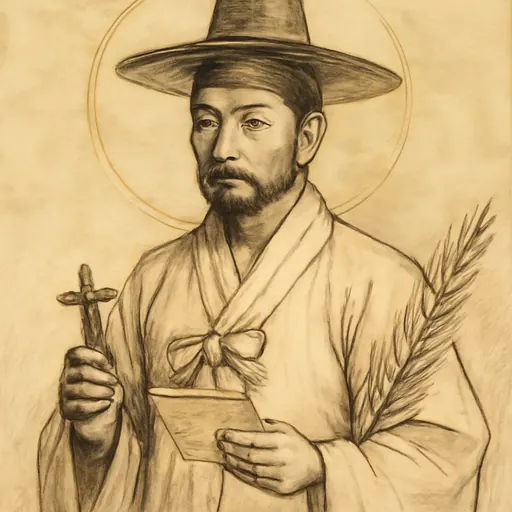
St. Paul Chong Hasang (1795–1839) was a Korean layman, son of a martyr, who traveled to Beijing nine times to beg for priests for Korea's hidden Church and wrote the first Korean defense of the faith. He was beheaded in Seoul in 1839. We keep his feast with St. Andrew Kim Taegon and the Korean martyrs on September 20.
Who was St. Paul Chong Hasang?
St. Paul Chong Hasang was a Korean layman who spent his whole adult life trying to bring priests to a Church that had almost none. Korea's Catholics first came to the faith by reading Christian books from China, and Pope John Paul II, canonizing their martyrs in Seoul in 1984, called theirs "a community unique in the history of the Church by reason of the fact that it was founded entirely by lay people." Paul belongs to its second generation. His father died for Christ when Paul was six; Paul grew up to become the Church's courier, guide and spokesman, and died for Christ at forty-five.
We honor him with St. Andrew Kim Taegon, Korea's first priest, and 101 companions on September 20. His name in Korean is Jeong Ha-sang (정하상); older French books spell it Paul Tieng.
The life of St. Paul Chong Hasang
A family of martyrs
Paul was born in 1795 at Majae, near Seoul, into a noble family of the Namin faction. His father, Augustine Chong Yak-jong, was one of the first Korean Catholics and wrote a catechism in Korean, the Jugyo Yoji (Essentials of the Lord's Teaching). Augustine was beheaded in the persecution of 1801 together with Paul's older brother, Charles. Paul's uncle, Chong Yak-yong, known by his pen name Dasan, became one of the most famous scholars in Korean history. Augustine was beatified by Pope Francis in Seoul in 2014, with 123 other early martyrs.
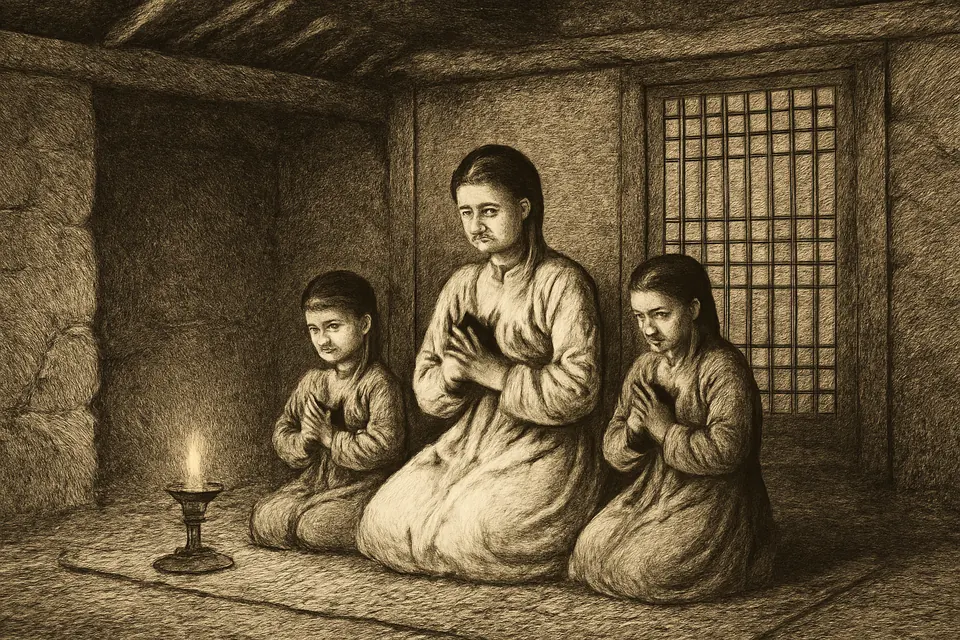
The family lost everything in 1801. Charles Dallet's History of the Church in Korea (1874), built on the martyrs' records gathered in Korea, says the widow and her children were sent back to the countryside with no food and no money, and that relatives who still feared the name of Christian did all they could to stop them from praying. There were no Christian books left in the house. Paul learned the faith from his mother, Cecilia Yu So-sa, by word of mouth.
The courier of the Korean Church
At about twenty, Paul left his mother and sister and went to Seoul to help rebuild a Church that had been without a priest since Father James Zhou Wenmo, the Chinese priest who served Korea secretly, was executed in 1801. He made up his mind not to marry. (Some popular lives call him a married man, but Bishop Imbert, who lived in his house, wrote that he had always kept celibacy.) Dallet writes that his only ambition was to bring priests in, and through them to save his brothers and sisters in the faith.
A nobleman could not simply travel to China. So Paul humbled himself and became the servant of a government interpreter who traveled with Korea's yearly embassy to Beijing. Late in 1816 he made his first journey, carrying the Korean Christians' appeal to the Bishop of Beijing. According to the Korean bishops' biography, he went to Beijing nine times in all and three more times to the Manchurian border, on foot, over the years that followed.
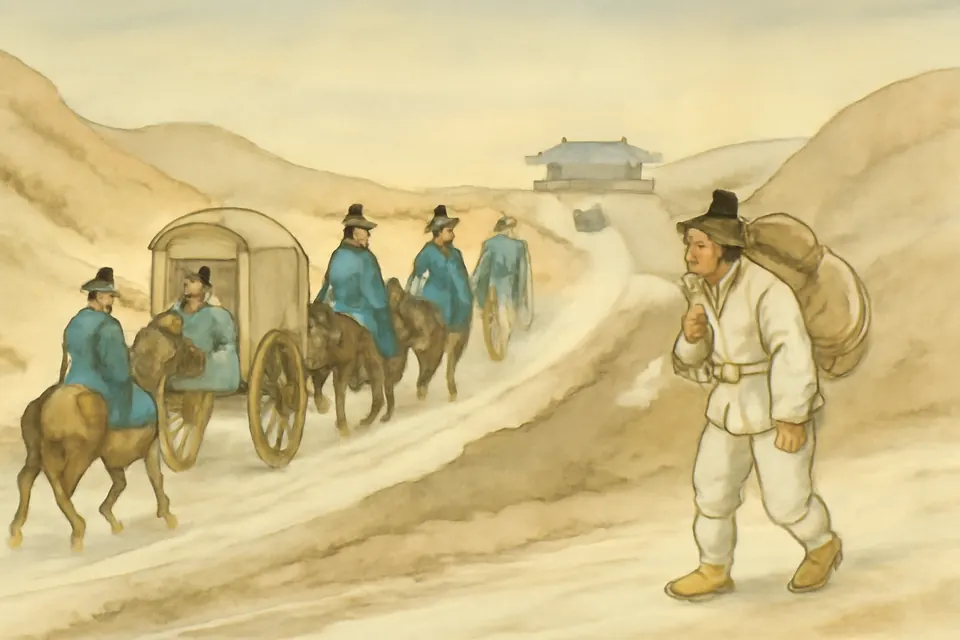
The answer was a long time coming. Once the bishop promised a priest, and Paul's party waited at the border town for him, but no one came: the Church in China was itself under persecution. Paul and his friend Augustine Yu Chin-gil, an official interpreter who had become a Christian, kept writing. Around 1825 Augustine wrote a letter to the Pope on behalf of "Ambrose and the others," a cover name for the Korean faithful, begging for shepherds. Dallet says it reached Rome in 1827.
Rome acted. On September 9, 1831, Pope Gregory XVI made Korea a vicariate apostolic of its own, separate from Beijing, and entrusted it to the Paris Foreign Missions Society. Over forty years after the first Korean Catholics had been baptized, they were going to have a bishop.
Guide and student of Bishop Imbert
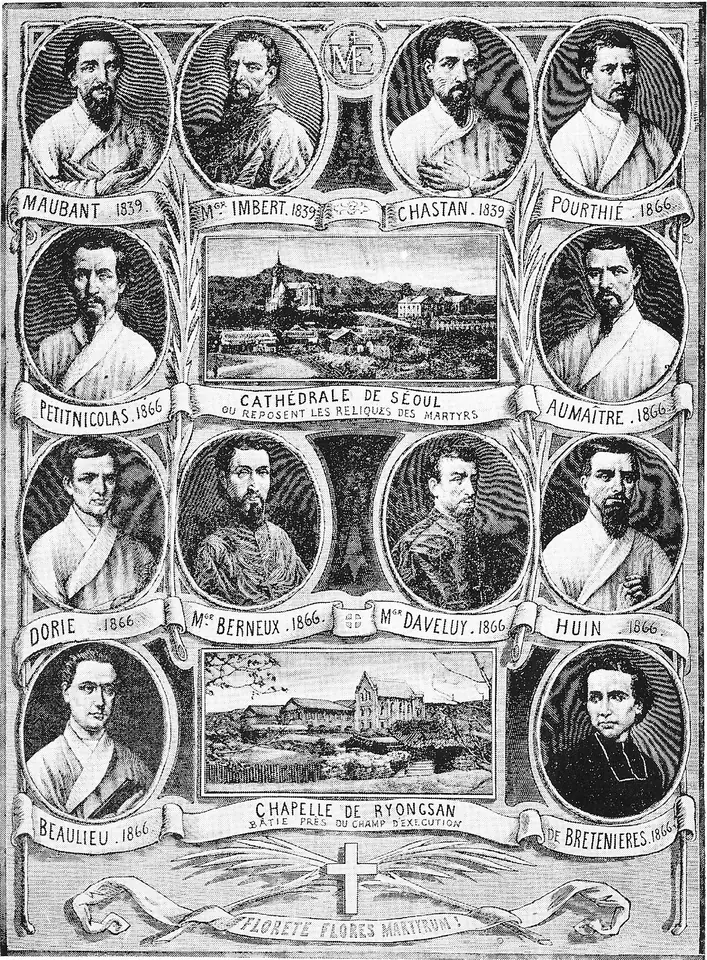
Paul met the French missionaries at the border at Uiju and brought them secretly into the country. Father Pierre Maubant came first, then Father Jacques Chastan, and late in 1837 Bishop Laurent Imbert. When Imbert entered Seoul, Dallet's account names "Paul Tieng" as one of his two chief guides. The bishop lived in Paul's house and Paul served him through his ministry in the capital.
Imbert saw what kind of man he had. In a letter Dallet quotes in French, the bishop wrote that he had found suitable mature men for the priesthood, first of all "our courier to Beijing, forty-two years old, who has always kept celibacy and introduced all of us into Korea," the son of the martyr Augustine. He taught Paul Latin and theology twice a day and hoped to ordain him within three years.

The Letter to the Prime Minister
In 1839 the persecution known as the Gihae persecution broke out. Imbert fled to the countryside and Paul stayed to guard the house. Knowing he would be arrested, he wrote the Sang-je-sang-seo, a "Letter to the Prime Minister" addressed to the minister directing the persecution, explaining the Catholic faith and asking that it be tolerated. The Korean bishops call it the first book of apologetics in Korea and say that even enemies of the Church admired it.
He was arrested with his mother and his sister Elizabeth, and he presented the letter the day after he arrived in prison. At his first interrogation, Dallet records, the chief criminal judge asked why he followed a foreign religion. Paul answered that every day Koreans gladly use precious things that come from foreign countries, so why reject the true religion only because it comes from another kingdom? When the judge asked whether he blamed the king for forbidding it, Paul would only say, "I have nothing to answer to that; I have only to die."
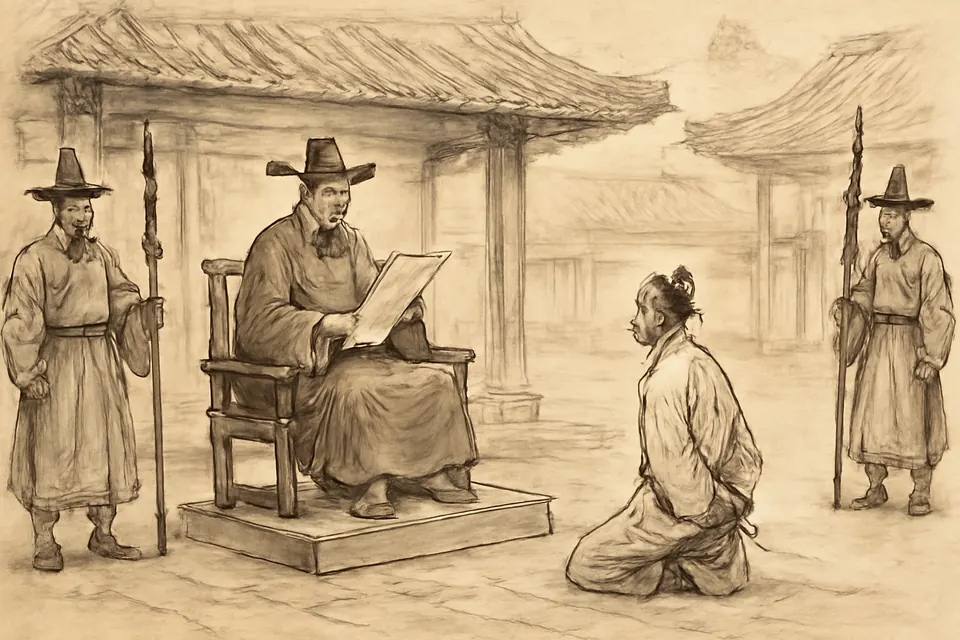
Martyrdom outside the Little West Gate
He was tortured in six separate interrogations, the last of them meant to force him to reveal where the priests were hiding. He was confronted with the bishop, who had given himself up to spare his flock. Imbert, Maubant and Chastan were beheaded at Saenamteo by the Han River on September 21, 1839.
The next day, Dallet says, Paul and Augustine Yu were led out together, and Paul went to his execution with a smiling face. They were beheaded outside the Little West Gate of Seoul, Seosomun, on the 15th day of the 8th lunar month, which was September 22, 1839. Paul was forty-five. His mother Cecilia died for the faith that November, and his sister Elizabeth was beheaded at the end of the year. Both are saints with him.
The miracles of St. Paul Chong Hasang
Paul is honored as a martyr, and the Church does not require a miracle to beatify a martyr. No miracle is attached to his name in the sources used here.
- His beatification in 1925 and canonization in 1984: approved as acts of the Church. Pope Pius XI beatified him in 1925 with other martyrs of the persecutions of 1839 and 1846, and Pope John Paul II canonized him with the 102 other Korean martyrs at Yeouido Plaza in Seoul on May 6, 1984.
- Favors received through his prayers: reported by the faithful in Korea and abroad, not formally examined.
The greatest sign connected with him is the one the Pope pointed to in 1984: a Church that kept the faith for half a century with almost no priests and then grew from the blood of some ten thousand martyrs.
Why St. Paul Chong Hasang is a patron of Korea
With St. Andrew Kim Taegon and their companions, Paul is honored as a patron of the Church in Korea. He is a natural patron for lay people who carry the Church when clergy are few: catechists, parish leaders, and Christians who must explain their faith to officials or employers who don't share it. See our patron saints page, and the other martyrs of Asia, St. Paul Miki of Japan, St. Lorenzo Ruiz of the Philippines and the Vietnamese Martyrs.
Symbols of St. Paul Chong Hasang in art
No portrait of Paul was made in his lifetime, so every image of him is an artist's idea. Korean Catholic art usually shows him this way:
- White hanbok and the black horsehair gat: the dress of a Korean gentleman of the Joseon era, marking him as a layman of noble family.
- A scroll or folded letter: his Sang-je-sang-seo, or his letters to Beijing and Rome.
- The palm and the crucifix: the martyr's palm and the cross he refused to deny.
- Standing beside St. Andrew Kim Taegon: in group paintings of the 103 saints, Andrew wears a priest's stole and Paul, at his side, wears lay clothes.
To find him in a Korean church, look in the large paintings of the 103 martyrs for the bearded man in white at the front, next to the young priest.
Feast day and Seosomun Shrine
The Church keeps the memorial of Sts. Andrew Kim Taegon, Paul Chong Hasang and Companions on September 20, and Korea gives the whole month of September to the martyrs. Find the date on our feast days calendar.
The place of his death is now the Seosomun Martyrs' Shrine and Seosomun Shrine History Museum in central Seoul. The Korea Times notes that 44 of the 103 canonized martyrs died at this one execution ground, more than at any other site. Pope Francis prayed at Seosomun on the morning of August 16, 2014, before beatifying Paul's father and 123 other martyrs at Gwanghwamun Gate. In that homily he said their names "now stand alongside those of the holy martyrs Andrew Kim Taegon, Paul Chong Hasang and companions."
Prayer to St. Paul Chong Hasang
The prayer of the Church on his feast is the collect of the memorial of Sts. Andrew Kim Taegon, Paul Chong Hasang and Companions in the Roman Missal (English translation, 2011):
O God, who have been pleased to increase your adopted children in all the world, and who made the blood of the Martyrs Saint Andrew Kim Tae-gon and his companions a most fruitful seed of Christians, grant that we may be defended by their help and profit always from their example. Through our Lord Jesus Christ, your Son, who lives and reigns with you in the unity of the Holy Spirit, God, for ever and ever.
No separate traditional prayer to Paul alone is widely used. Let us ask St. Paul Chong Hasang, with St. Andrew and all the Korean martyrs, to pray for the Church in Korea, North and South, for lay people who keep the faith alive where priests are few, and for the courage to give a gentle, clear account of our hope when we are asked.
Frequently asked questions
Who was St. Paul Chong Hasang?
He was a Korean nobleman's son who became the lay leader of Korea's persecuted Catholics in the early 1800s. Disguised as an interpreter's servant, he went to Beijing again and again to ask for priests, guided the first French bishop into Korea, and wrote a defense of the faith addressed to the government. He was martyred in 1839 and canonized in 1984.
When is the feast day of St. Paul Chong Hasang?
September 20, the memorial of Sts. Andrew Kim Taegon, Priest, Paul Chong Hasang and Companions, Martyrs, in the General Roman Calendar. He died on September 22, 1839.
What is the Sang-je-sang-seo?
It is the "Letter to the Prime Minister" that Paul Chong Hasang wrote in 1839, expecting arrest, to explain and defend the Catholic faith before the officials leading the persecution. He handed it to the court the day after he was imprisoned. The Korean bishops call it the first book of apologetics in Korea.
How did St. Paul Chong Hasang die?
After six rounds of interrogation and torture he was beheaded outside the Little West Gate (Seosomun) of Seoul on September 22, 1839, the day after Bishop Imbert and two French priests were executed. The French historian Charles Dallet says he went to his death with a smiling face.
Was Paul Chong Hasang a priest?
No. Bishop Laurent Imbert chose him for the priesthood, taught him Latin and theology and hoped to ordain him within three years, but the persecution of 1839 took both men first. Paul died a layman, which is fitting for a Church founded and kept alive by lay people.
Keep exploring
Sources
- CBCK Newsletter No. 29 (Winter 1999): The Lives of the 103 Korean Martyr Saints (4): St. Chong Ha-sang Paul (1795–1839)
- Charles Dallet, Histoire de l'Église de Corée, vol. 1 (Paris, 1874). His family, youth and first journey to Beijing in 1816
- Charles Dallet, Histoire de l'Église de Corée, vol. 2 (Paris, 1874). The 1825 letter to the Pope, Bishop Imbert's letter about him, his interrogation and his execution on the 15th day of the 8th moon
- Pope John Paul II, homily at the canonization of the Korean martyrs, Seoul, May 6, 1984
- Pope Francis, homily at the beatification of Paul Yun Ji-chung and 123 companions, Seoul, August 16, 2014
- The Korea Times: St. Jeong Ha-sang (2019). Seosomun as the place where 44 of the 103 saints died
- Catholic Culture: Memorial of Sts. Andrew Kim Tae-gon, Priest, & Paul Chong Ha-sang, & Companions, Martyrs. The collect of the memorial