St. Euphemia of Chalcedon
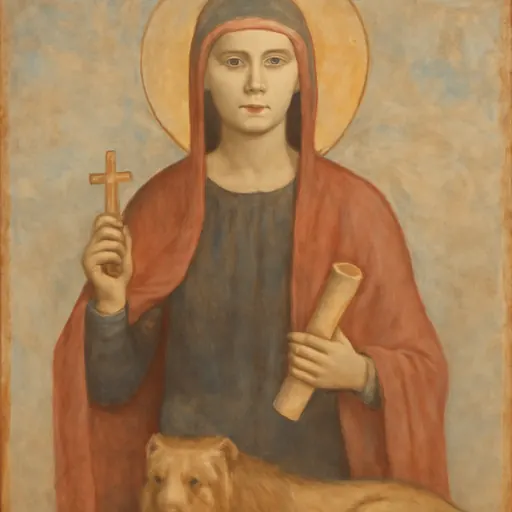
St. Euphemia of Chalcedon was a young Christian woman martyred at Chalcedon, across the Bosphorus from present-day Istanbul, around 304 under the emperor Diocletian. The Eastern churches call her the All-praised Great Martyr. The Council of Chalcedon met in her basilica in 451. Her feast day is September 16, and the East also keeps July 11 for her miracle at the council.
Who was St. Euphemia?
St. Euphemia was a young Christian woman of Chalcedon, a Greek city on the Asian shore of the Bosphorus, facing Byzantium, which would become Constantinople. She was put to death there for Christ around the year 304, during the persecution of the emperor Diocletian. Her name means "well-spoken" in Greek, or "of good report," and the Eastern churches give her the title Megalomartyr, Great Martyr, and Pansemnos, All-praised.
Hers is one of those cases where the martyrdom is old and well attested and the details are hard to pin down. Within a century of her death, Christians were gathering at her tomb. By the 5th century her basilica outside Chalcedon was large enough to host an ecumenical council. The full story of her trials, with the judge Priscus and the wheel and the lions, comes from a written passio of later centuries.
Today the name Euphemia also turns up in many places and on many other people. This page is about the martyr of Chalcedon. She is not Euphemia the 6th-century Byzantine empress, nor St. Euphemia of Aquileia and her companions, nor Blessed Euphemia of Racibórz, a Polish Dominican princess of the 14th century.

The life and martyrdom of St. Euphemia
What the oldest witness says
The earliest description of her death isn't a written life but a painting. In the late 4th century, St. Asterius, bishop of Amasea in Pontus, preached a sermon describing a picture on linen that hung in a portico by her tomb. In it a judge on a high seat looks down at the girl; soldiers drag her forward; executioners force her head back and pull out her teeth; she sits in prison raising her hands to a cross that appears above her; and finally she stands in the middle of a fire, unafraid. Asterius's sermon is precious for another reason. The Second Council of Nicaea read it aloud in 787 as evidence that Christians had honored holy images from early times.
So in the oldest witness Euphemia dies in the flames. That is as close to history as we can come: a young Christian of Chalcedon, tortured and put to death by fire for refusing to deny Christ.
The later passio
The fuller story, followed in the Orthodox life and in the Roman Martyrology, comes from a later written account. Its episodes are all traditional.
Euphemia was the daughter of a senator, Philophronos, and his wife Theodosia, both Christians. When Priscus, the proconsul of Chalcedon, ordered everyone to take part in a festival of the god Ares, forty-nine Christians hid together in one house rather than offer sacrifice. Euphemia, the youngest, was among them. They were found and tortured for nineteen days. Priscus sent the others on to the emperor but kept Euphemia back, hoping that alone she would give way.
She didn't. In the Orthodox life she is bound to a wheel set with blades, and the wheel stops on its own; an angel lifts her down and heals her. Two soldiers, Victor and Sosthenes, see angels in the furnace and refuse to throw her in; they become Christians and die as martyrs themselves. Other soldiers throw her into the fire, and she comes out unharmed. At last she is taken to the arena. The lions and bears lick her feet. A she-bear wounds her once, on the foot, and she dies. The Roman Martyrology tells it the same way: one beast bites her, the others lick her feet, and she gives up her spirit to God.
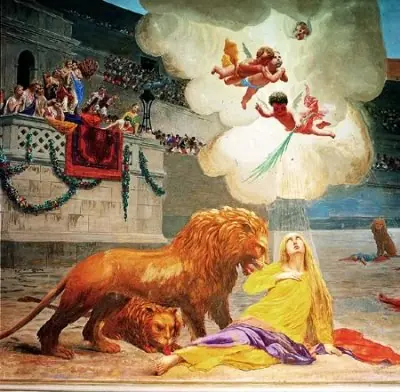
Her parents buried her near the city, and a church was built over her grave.
The miracles of St. Euphemia
The miracles connected with Euphemia come from very different sources and deserve different labels.
The blood at her shrine (reported)
The church historian Evagrius Scholasticus, writing in Antioch in the late 6th century, described her basilica at Chalcedon in loving detail: a great open court with columns, a roofed hall, and a round domed shrine where her body lay in a long silver coffin. He reported that at times the saint appeared in dreams to the bishop and asked him to come and "gather a vintage." Then the patriarch of Constantinople, the emperor and the people would come, and a sponge on an iron rod was passed through a small door in the coffin. It came out, he wrote, "covered with stains and clots of blood," which were shared with the faithful "in every place under the sun." He added that anyone who came near the coffin smelled a fragrance unlike any perfume. This is a reported miracle: a detailed early account, never formally examined.
The scrolls at the Council of Chalcedon (traditional)
In October 451, about 600 bishops met in her basilica for the Fourth Ecumenical Council. They were called to settle the dispute over how Jesus Christ is both God and man. Against those who said his humanity was swallowed up in a single divine nature, the council taught, with the Tome of Pope St. Leo the Great, that he is one person in two natures, "without confusion, without change, without division, without separation."
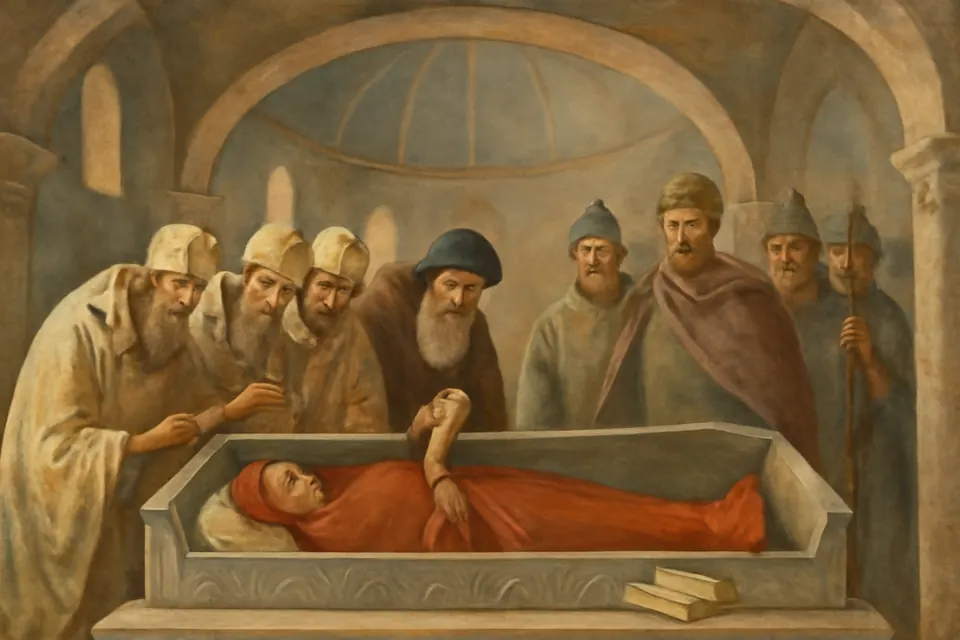
Byzantine tradition, kept in the Orthodox life for July 11, adds a miracle. When the debate stalled, Patriarch Anatolius of Constantinople proposed leaving the decision to the Holy Spirit through the martyr. Each side wrote its confession on a scroll, and both were laid on her breast. The emperor Marcian had the tomb sealed and guarded for three days while everyone fasted and prayed. When it was opened, the Orthodox scroll was in her right hand and the other lay at her feet. In one telling she raised her hand and gave the scroll to the patriarch. The acts of the council don't mention any of this, so it is traditional, but it is why icons sometimes show her holding a scroll and why the East calls her a guardian of the faith.
Her relics, from Chalcedon to Rovinj
The Orthodox life traces her relics through a long journey. When the Persians took Chalcedon in the early 7th century, her body was moved across the water to Constantinople, about 620. During the iconoclast troubles of the 8th century, the life says, the reliquary was thrown into the sea, recovered by sailors and taken to the island of Lemnos; it came back to Constantinople in 796. The Orthodox Church venerates her body today in the Patriarchal Church of St. George at the Phanar in Istanbul, and some portions in other churches, among them the Kykkos Monastery in Cyprus and the Alexander Nevsky Lavra in St. Petersburg.
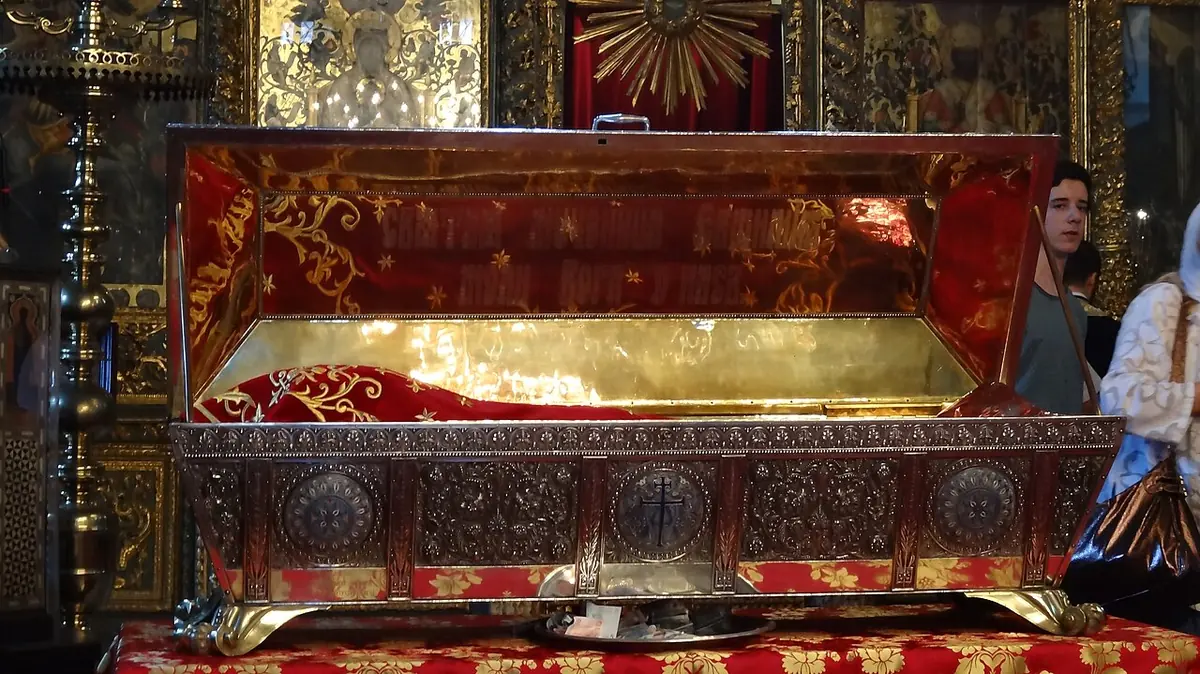
A second tradition belongs to Rovinj, a fishing town on the Istrian coast of Croatia. Local legend says that in the year 800 a marble sarcophagus drifted ashore at dawn like a stone ship. The townspeople couldn't move it with horses or oxen, until St. Euphemia appeared to a small boy, who hitched up his two young calves and pulled it easily up the hill to the church. Inside they found the body of a young woman and a parchment that read, "Hoc est corpus Euphemiae Sanctae," "This is the body of St. Euphemia." The story is traditional. The sarcophagus itself is a 6th-century Roman work, adapted in the 15th century.
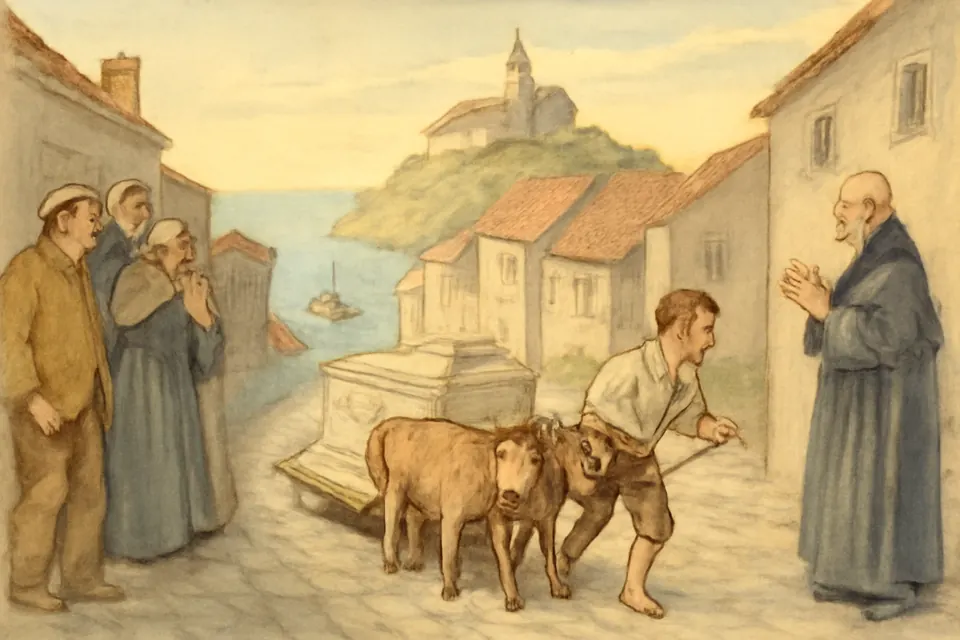
Both the Phanar and Rovinj speak of her body, and they can't both hold all of it. Large relics were often divided in the Middle Ages, and the honest answer is that we don't know how much of the saint rests in each place.

Why St. Euphemia is the patron saint of Rovinj
Rovinj built its baroque Church of St. Euphemia on the hilltop between 1725 and 1736, around the old shrine. Its bell tower, about 60 meters high and modeled on the campanile of St. Mark's in Venice, is crowned by a copper statue of the saint that turns with the wind. Every September 16 the town celebrates her feast, and the Istrian tourist board notes that Rovinj has long been the main gathering place of the region on that day.
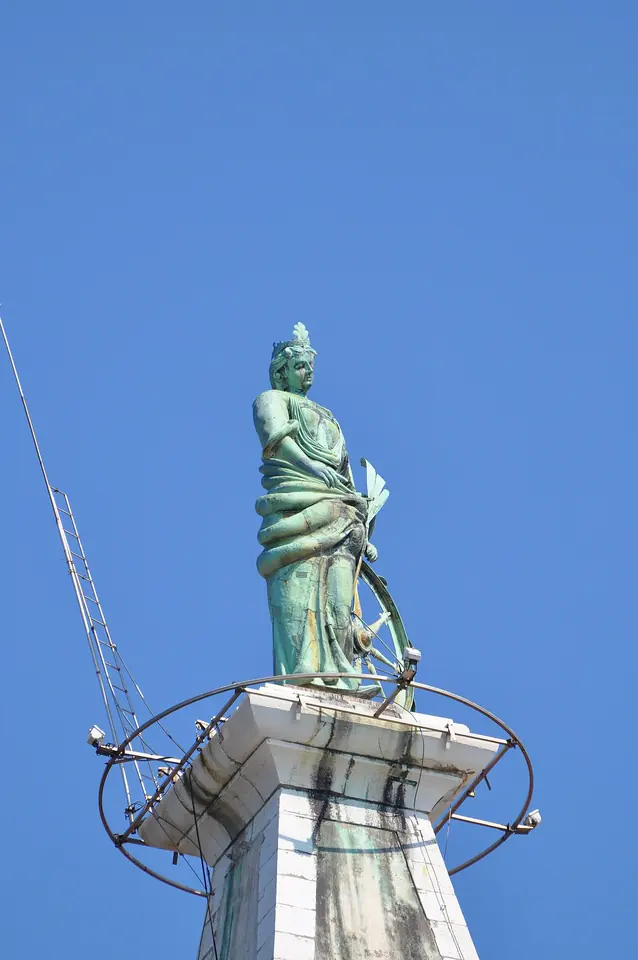
She has no other widely kept patronage. In the East, her part in the Council of Chalcedon has made her loved as a defender of the true faith, and the July 11 hymns call on her against heresies.
Symbols of St. Euphemia in art
Euphemia appears as a young woman, often richly dressed or crowned as a martyr. Her attributes all come from her passio:
- A lion, sometimes a bear: the beasts of the arena that would not harm her. In Western art this is her surest sign. In Mantegna's panel at the top of this page, the lion bites her arm.
- A sword in her breast: some Western versions of her legend end with a sword after the beasts refused to kill her. Mantegna shows it plunged into her chest.
- A wheel: the spiked wheel that stopped turning. It can confuse her with St. Catherine of Alexandria, who also carries a wheel; look for the lion.
- A palm and a lily: martyrdom and virginity, shared with St. Agnes, St. Agatha and St. Lucy.
- A scroll: in Eastern icons, the confession of faith from the Chalcedon miracle.
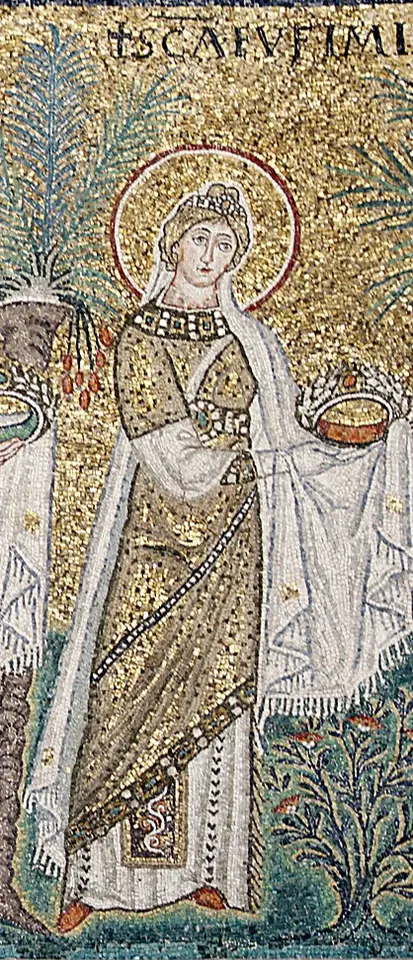
The oldest images show her without beasts or weapons. In the 6th-century mosaics of Ravenna she walks among the virgin martyrs in a jeweled robe, carrying her crown to Christ. Eastern icons show her in a red cloak with a cross, or with a scroll, and sometimes in a row of martyrs with St. Thecla and St. Barbara.
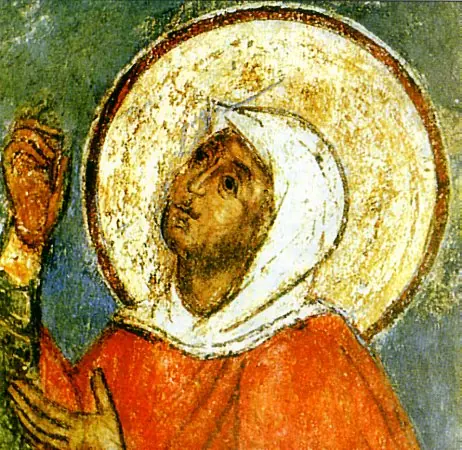
Flemish engravers of the 16th century, like Johann Sadeler after Maerten de Vos, put her among the models of Christian modesty with her palm, sword and lion.

Feast days and where she is honored
Her feast is September 16, the day of her martyrdom, in the Roman Martyrology and in the Orthodox and Eastern Catholic churches; see our feast days calendar. Until 1969 the General Roman Calendar commemorated her on that day, along with St. Lucy and St. Geminianus. The Byzantine churches keep a second feast on July 11 for the miracle at Chalcedon, and her reliquary at the Phanar is opened for the faithful to venerate on that day.
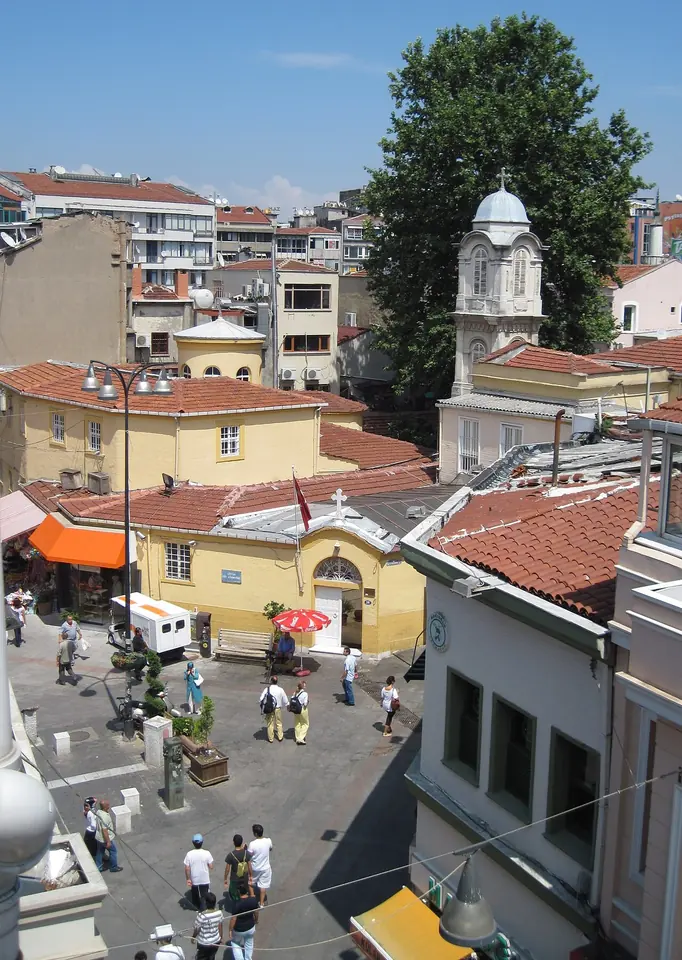
Her old city of Chalcedon is now Kadıköy, a busy district on the Asian side of Istanbul. Her great basilica is gone, but a small Greek Orthodox church of St. Euphemia stands in the market streets and serves the Metropolis of Chalcedon. In Italy, Grado, Spoleto, Venice and Milan have old churches in her name.
Prayer to St. Euphemia
The best-known prayer to St. Euphemia is the troparion of her feast in the Byzantine liturgy, sung on September 16. The Orthodox Church in America gives it in this translation:
Your lamb Euphēmia calls out to You, O Jesus, in a loud voice: "I love You, my Bridegroom, and in seeking You I endure suffering. In Baptism I was crucified so that I might reign in You, and I died so that I might live with You. Accept me as a pure sacrifice, for I have offered myself in love." Through her prayers, save our souls, since You are merciful.
The kontakion of the same feast asks her help "in order to be delivered from spiritual afflictions, and that we may draw forth the grace of your miracles." In the West there is no traditional prayer of her own; we ask her intercession in our own words, especially for courage and for faithfulness to the truth of the Church. St. Euphemia, pray for us.
Frequently asked questions
Who was St. Euphemia?
A virgin martyr of Chalcedon in Asia Minor, put to death about 304 in the persecution of Diocletian. Her basilica at Chalcedon was one of the great shrines of the Byzantine world, and the Fourth Ecumenical Council met there in 451.
When is St. Euphemia's feast day?
September 16, the day of her martyrdom, in the Roman Martyrology and in the Orthodox and Eastern Catholic calendars. The Byzantine churches also celebrate July 11 for the miracle at the Council of Chalcedon. Rovinj in Croatia keeps her feast on September 16 with its biggest celebration of the year.
What is the miracle of St. Euphemia at the Council of Chalcedon?
Byzantine tradition says that when the bishops could not settle the dispute over Christ's two natures, both parties wrote their confessions of faith on scrolls and laid them on her body. After three days of prayer the tomb was opened, and the Orthodox scroll was in her right hand while the other lay at her feet. The story is traditional; the council's own records do not tell it.
Where are the relics of St. Euphemia?
The Orthodox Church venerates her body in the Patriarchal Church of St. George at the Phanar in Istanbul. The town of Rovinj in Croatia keeps a stone sarcophagus that, by local tradition, washed ashore with her body in the year 800. Smaller relics are in other churches, including the Kykkos Monastery in Cyprus.
Why is St. Euphemia shown with a lion?
Her later legend says the lions in the arena would not harm her and licked her feet, until one beast gave her a single wound and she died. The lion became her most common attribute in Western art.
Sources
- Evagrius Scholasticus, Ecclesiastical History, Book 2, ch. 3: Description of the Church of St. Euphemia (trans. E. Walford, 1846). The basilica, her silver coffin and the miracle of her blood
- Orthodox Church in America: Greatmartyr Euphemia the All-praised (September 16)
- Orthodox Church in America: Commemoration of the miracle at the Fourth Ecumenical Council (July 11)
- Orthodox Church in America: Troparia and kontakia for September 16
- Christian Iconography: St. Euphemia in Art, Iconography, Legend. Asterius of Amasea's description of the painting at her tomb, and the later passio
- Istria Tourist Board: The legend of St. Euphemia, Rovinj
- Roman Martyrology, September 16