St. Eulogius of Alexandria, Patriarch and Friend of St. Gregory the Great
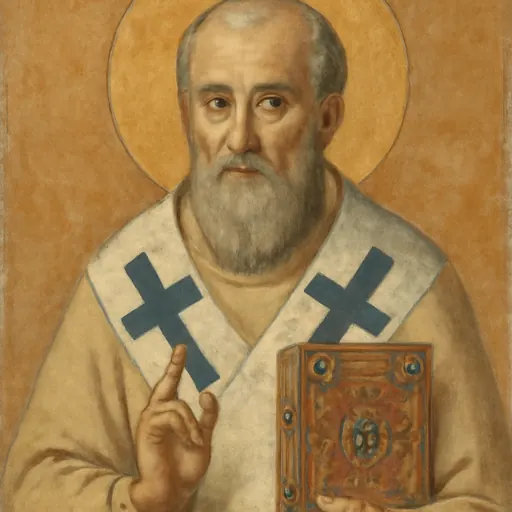
St. Eulogius of Alexandria was a Syrian monk who became patriarch of Alexandria about 580 and served until his death in 607 or 608. He defended the Council of Chalcedon against the Monophysites and was a close friend of Pope St. Gregory the Great. We keep his feast on September 13; the Orthodox Church honors him on February 13.
Who was St. Eulogius of Alexandria?
St. Eulogius of Alexandria was a monk from Syria who became patriarch of Alexandria, the see of St. Mark, St. Athanasius and St. Cyril. He governed it for some twenty-seven years, from about 580 until his death in 607 or 608. His great work was defending the faith of the Council of Chalcedon, that Christ is one Person in two natures, in a city where most Christians had rejected that council.
Most of what we know about him as a man comes from his friend Pope St. Gregory the Great, whose letters to him are among the warmest Gregory ever wrote. We keep the feast of St. Eulogius on September 13. Our Orthodox brothers and sisters honor him on February 13.
The life of St. Eulogius of Alexandria
Abbot at Antioch
Before he came to Egypt, Eulogius was abbot (in Greek, igumen) of the monastery of the Mother of God at Antioch, according to the Orthodox Church's life of him. Antioch, like Alexandria, was torn by the long quarrel over Chalcedon, and he seems to have learned there both the theology and the patience he would need. He was chosen patriarch of Alexandria about 579 or 580.
Patriarch of a divided city
Alexandria in his day had two patriarchs: the Chalcedonian one, in communion with Rome and Constantinople, and the far larger anti-Chalcedonian (Monophysite) church of the Egyptian people. Eulogius set himself to win hearts back by preaching and writing. The Catholic Encyclopedia lists what he wrote:
- a refutation of the Novatians, a rigorist sect that still had communities in Egypt;
- a work against the various Monophysite parties (Severians, Theodosians, Cainites and Acephali);
- eleven discourses defending Pope St. Leo the Great and the Council of Chalcedon;
- a treatise against the Agnoetae, who taught that Christ in his human nature did not know the day of judgment.
He sent the last of these to Gregory before publishing it. Gregory read it, made some remarks, and approved it unchanged. Apart from one sermon and some fragments, all of it is lost. The surviving sermon is for Palm Sunday, and St. Photius, the ninth-century patriarch of Constantinople, preserved summaries and quotations of the rest.
Letters between friends
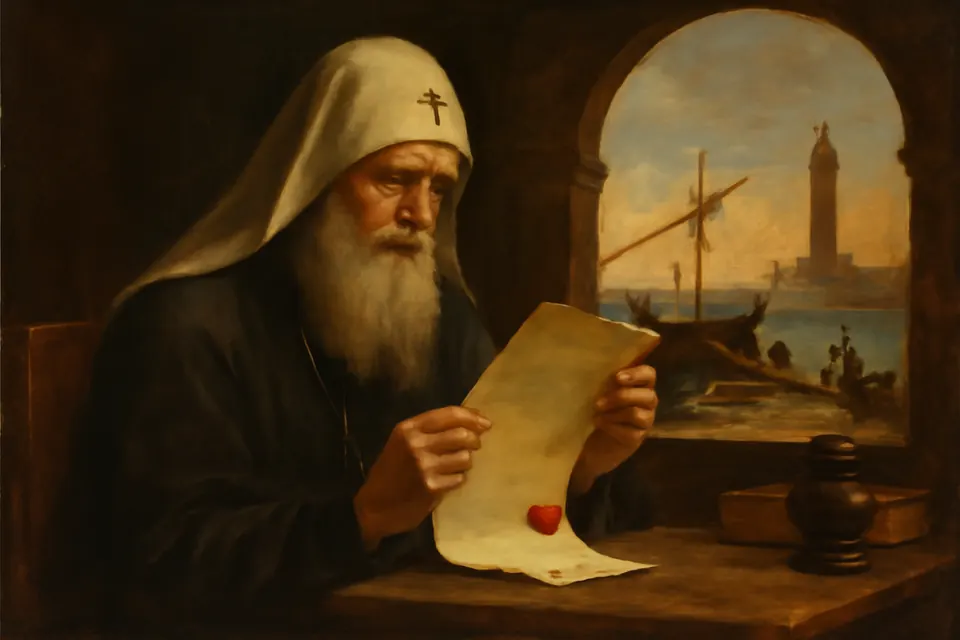
Their letters are full of affection and plain business. In one, Gregory apologizes that the timber he shipped to Alexandria was too short, because the ship was small, and refuses to be paid for larger beams: "how can we accept a price, when it is written, Freely you have received, freely give?" He thanks Eulogius for "the blessing of Saint Mark the Evangelist" sent from Alexandria. In the same letter he admits that he did not know of the collection of martyrs' acts by Eusebius of Caesarea that Eulogius had asked him for.
The most famous letter, written after Christmas of 597, tells Eulogius of the mission to England. Gregory had sent "a monk of my monastery" to "the nation of the Angli, placed in a corner of the world," and "at the solemnity of the Lord's Nativity ... more than ten thousand Angli are reported to have been baptized." That monk was St. Augustine of Canterbury. Gregory credits his friend's prayers: "your prayers are in the place where you are not, while your holy operations are shown in the place where you are."
The same letter shows the humility of both men. Eulogius had addressed Gregory as "Universal Pope" and written "as you have commanded." Gregory would have none of it: "This word, command, I beg you to remove from my hearing, since I know who I am, and who you are." And then: "my honour is the honour of the universal Church: my honour is the solid vigour of my brethren." The Catholic Encyclopedia also notes that Gregory praised Eulogius for defending the primacy of the Roman See.
Miracles of St. Eulogius
No miracles of St. Eulogius are approved or reported in the early sources. There are no traditional wonder stories of note either. His sanctity is seen best in his letters: a bishop who worked hard, prayed for the work of others far away, and took correction from a friend.
Symbols of St. Eulogius in art
He appears almost only in Byzantine art, and like most patriarchs he is recognized by his inscription rather than by a special attribute.
- Omophorion: the broad white stole with crosses worn by Eastern bishops, the sign of his office as patriarch.
- Book of the Gospels: the faith he preached and defended in writing.
- Letters or scrolls: sometimes shown for his writings and his correspondence with Gregory.
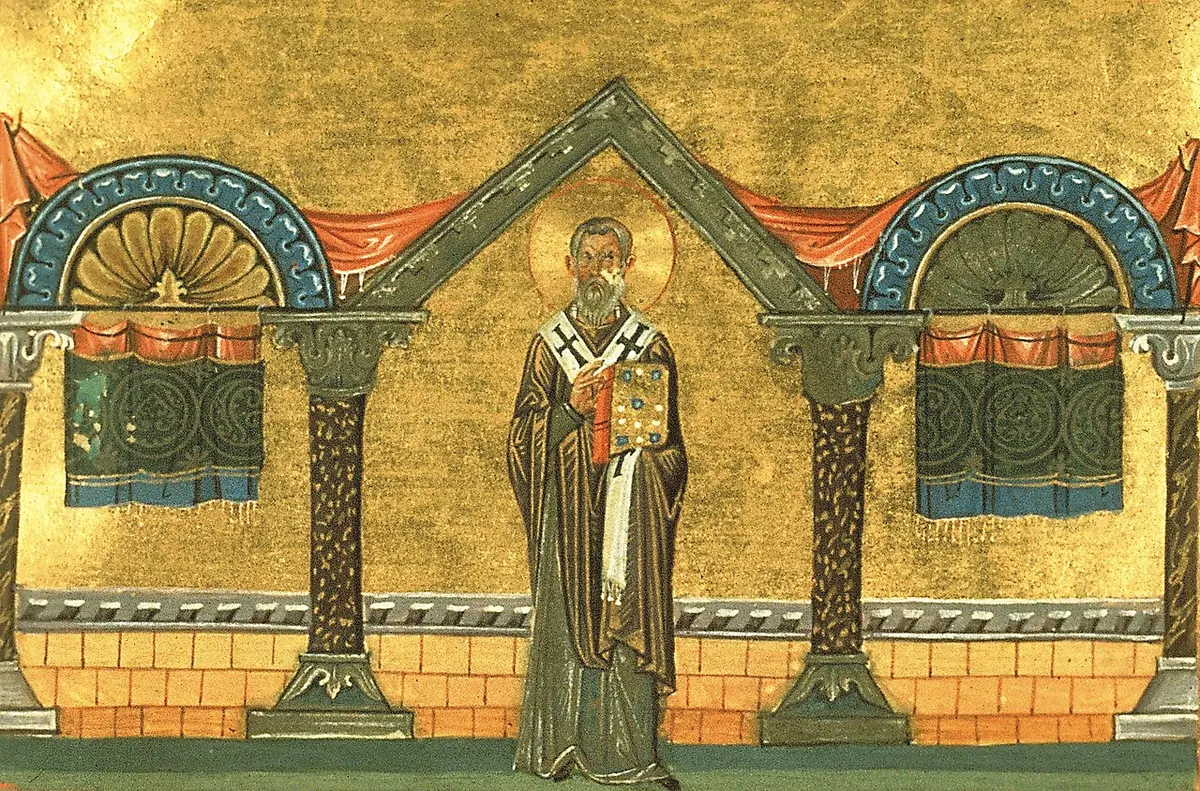
The miniature on this page comes from the Menologion of Basil II, made at Constantinople about 985 and now in the Vatican Library. It shows him as a gray-bearded bishop standing between two buildings, the usual way that manuscript frames a holy bishop.
Feast day
We keep his feast on September 13, as the Roman Martyrology lists it. In the Byzantine calendar he is remembered on February 13. His tomb and relics are not known today. See the other saints of September on our feast days page.
Praying with St. Eulogius
There is no traditional prayer to St. Eulogius in Western use; the Orthodox Church honors him with a troparion in its services for February 13. We can pray with the words Gregory wrote to him, that our prayers may reach "the place where you are not": for missionaries far away, for Christians divided over the faith, and for friendship among bishops.
St. Eulogius of Alexandria, friend of St. Gregory, pray for the unity of the Church, for the churches of Egypt, and for all who teach the faith with patience.
Frequently asked questions
Who was St. Eulogius of Alexandria?
A sixth-century patriarch of Alexandria. Before his election he was abbot of the monastery of the Mother of God at Antioch. As patriarch he wrote against the Novatians and the Monophysites, defended Pope St. Leo and the Council of Chalcedon, and kept up a warm friendship by letter with St. Gregory the Great.
When is the feast of St. Eulogius of Alexandria?
September 13 in the Roman Martyrology. The Orthodox Church keeps his memory on February 13.
What did St. Gregory the Great write to Eulogius?
Among other things, the news that more than ten thousand English had been baptized at Christmas through the monk Augustine, Gregory's missionary to England. In the same letter Gregory begged Eulogius not to call him Universal Pope, writing that his honor was the honor of the universal Church.
Do any writings of St. Eulogius survive?
Very little. The Catholic Encyclopedia says that apart from one sermon and a few fragments all his writings have perished. The surviving sermon is for Palm Sunday, and St. Photius preserved summaries and quotations of other works.
Keep exploring
Sources
- St. Eulogius of Alexandria, Catholic Encyclopedia (1909), New Advent. His works against the Novatians and Monophysites, the eleven discourses for Leo and Chalcedon, the treatise against the Agnoetae approved by Gregory, and the loss of nearly all his writings
- Gregory the Great, Registrum Epistolarum, Book VIII, Letter 30, To Eulogius (NPNF II, vol. 12), New Advent. The baptism of more than ten thousand English at Christmas, and Gregory's refusal of the title Universal Pope; quoted here
- Gregory the Great, Registrum Epistolarum, Book VIII, Letter 29, To Eulogius (NPNF II, vol. 12), New Advent. Eulogius's request for Eusebius's acts of the martyrs, and the timber Gregory shipped to Alexandria
- Saint Eulogius, Archbishop of Alexandria, Orthodox Church in America. Abbot of the monastery of the Mother of God at Antioch, the February 13 commemoration, and the surviving Palm Sunday sermon