St. Edith of Wilton: The King's Daughter Who Refused the English Crown

St. Edith of Wilton (961–984) was the daughter of King Edgar of England, raised and professed as a nun at Wilton Abbey in Wiltshire, where her mother was abbess. She cared for the poor and sick, refused the throne after her half-brother Edward was murdered, and died at twenty-three. Her feast day is September 16.
Who was St. Edith of Wilton?
St. Edith of Wilton was an Anglo-Saxon princess, the daughter of King Edgar of England, who spent her whole short life as a nun at Wilton Abbey in Wiltshire. She nursed the sick, fed the poor and prayed constantly, and when the English nobles offered her the crown after the murder of her half-brother, she said no. She died in 984, at only twenty-three, and was honored as a saint at once.
We keep her feast on September 16. Her name is often written Eadgyth or Editha, and older books call her Edith the Younger, to set her apart from an earlier royal Edith.

The life of St. Edith of Wilton
A daughter of King Edgar
Edith was born in 961. Her father was Edgar, who ruled England from 959 to 975; her mother was Wulfthryth, a noblewoman whom the young king had carried off. Alban Butler, following the old lives, says Edgar did seven years of penance for it under the direction of St. Dunstan. Wulfthryth refused to become his queen, took the veil at Wilton and soon became its abbess. She raised her daughter inside the convent.

A nun from childhood
Edith was professed very young; Butler notes that her father's consent was hard to win. The old lives describe her with the Gospel pair of Martha and Mary: busy serving her sisters and the poor, and quiet before God in prayer. She fed the hungry and dressed the sores of the sick, lepers among them, and wore a hair shirt under her clothes. When she was fifteen, Edgar offered her the rule of three abbeys. She declined them all and stayed under obedience to her mother.
She kept one royal habit. She dressed in fine clothes even in the convent, and when St. Ethelwold, the bishop of Winchester, took her to task, she is said to have answered that purity and humility could live under royal robes as well as under rags.
She refused the crown
Edgar died in 975, and Edith's half-brother Edward became king. In 978 (979 in some older books) Edward was murdered at Corfe, in Dorset. Dunbar's Dictionary of Saintly Women records that Edith dreamed that night that she had lost her right eye, and woke knowing her brother was dead. A party of nobles then asked her to leave the abbey and take the throne. Butler, quoting the author of her life, says "she preferred a state of humility and obedience to the prospect of a crown."

The church of St. Denis and her death
Edith built a church at Wilton in honor of St. Denis and invited Archbishop Dunstan to dedicate it. During the Mass he wept, and when asked why, he said that she would soon leave this world for everlasting light, while, in Butler's words, "we, said he, shall still continue sitting here below in darkness and in the shades of death." She died forty-three days later, on September 16, 984. Dunstan, who had been with her in her last illness, buried her in her own church.

Miracles and legends of St. Edith of Wilton
These stories come from the lives written after her death, beginning with Goscelin, a Flemish monk who wrote about a century later. All are traditional.
- The dream of the lost eye. She dreamed of losing an eye on the night her brother Edward was murdered.
- Dunstan's foresight. The archbishop knew at the dedication of her church that she would soon die.
- The vision after death. About a month after she died, Edith appeared in glory to her mother and told her the devil had tried to accuse her, but she had crushed his head.
- King Cnut's fright. Years later the Danish king Cnut laughed at the idea that a daughter of Edgar could be a saint. When her tomb was opened, the story goes, he was terrified and fell down in a faint, and he honored her from then on.
William of Malmesbury, writing in the early twelfth century, says her feast was kept with great devotion.
Symbols of St. Edith of Wilton in art
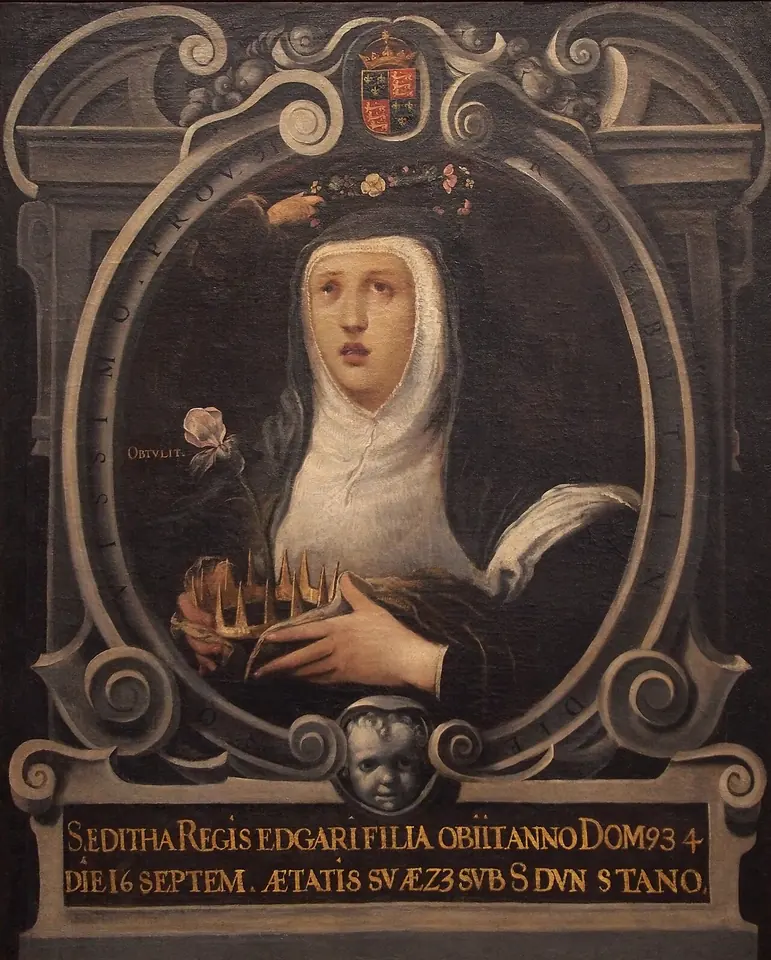
- A nun's veil over royal dress: a king's daughter who chose the cloister, and her fine clothes.
- A crown, held, set aside or pressed to her heart: the throne she refused.
- A book: her life of prayer and her learning.
- A rose: in some later paintings, a sign of purity and of a life cut short.
- A church: the church of St. Denis she built at Wilton.
Juan de Roelas painted her about 1605 for a church in Valladolid, in Spain, holding a small crown with a rose beside her; the Latin inscription below names her as King Edgar's daughter, who died on September 16 at twenty-three under St. Dunstan.
Feast day and where St. Edith of Wilton is honored
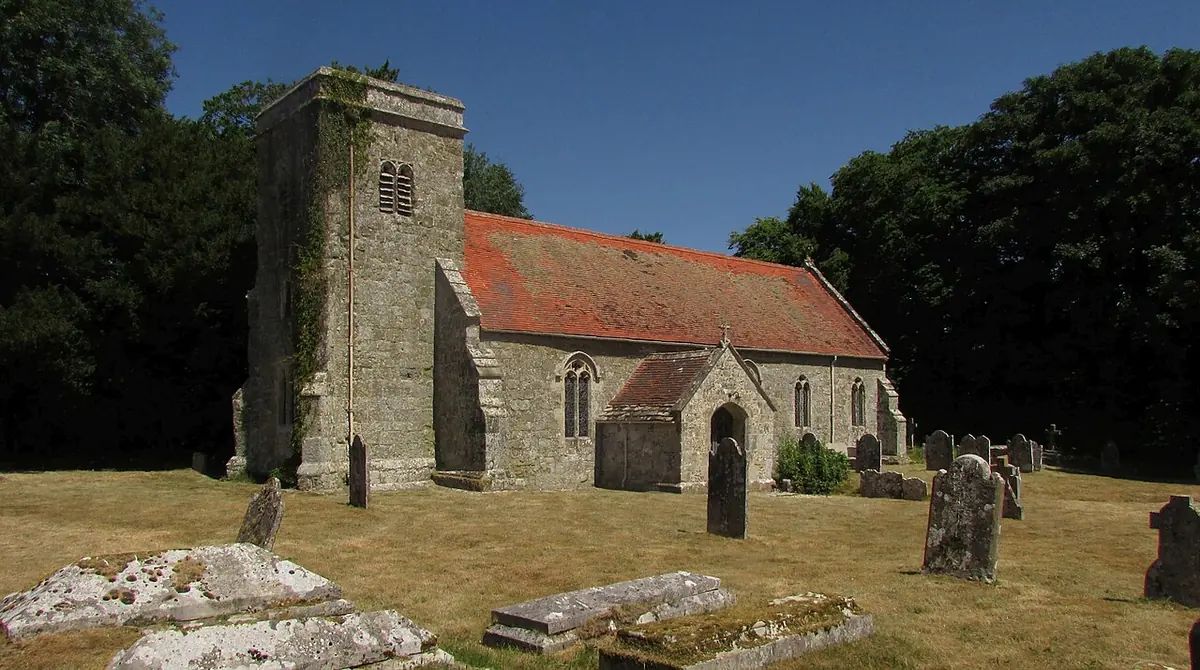
Her feast is September 16; see the feast day calendar. She is the patron of Wilton, and churches in Wiltshire and beyond carry her name, among them the little church of St. Edith of Wilton at Baverstock. Wilton Abbey was dissolved under Henry VIII, and her tomb and relics were lost; Wilton House now stands on the abbey site.
Prayer to St. Edith of Wilton
We have found no traditional prayer to St. Edith in the standard prayer books. We can ask her help simply, especially for young people choosing their path in life: "St. Edith of Wilton, pray for us."
Let us ask her to teach us to choose Christ over every crown the world offers, and to serve the poor and the sick as she did.
Frequently asked questions
When is the feast day of St. Edith of Wilton?
September 16, the day she died at Wilton in 984, at twenty-three.
Was St. Edith of Wilton a princess?
Yes. She was the daughter of King Edgar, who ruled England from 959 to 975, and Wulfthryth, who became abbess of Wilton. After her half-brother King Edward was murdered, nobles offered her the crown, and she refused it to remain a nun.
Why did St. Edith of Wilton wear fine clothes?
Her early biographers say she dressed richly even as a nun. When St. Ethelwold rebuked her, she is said to have answered that purity and humility can live under royal robes as well as under rags.
Where are the relics of St. Edith of Wilton?
She was buried at Wilton in the church of St. Denis that she had built, and St. Dunstan led her funeral. The abbey was dissolved in the 16th century and her relics have been lost; Wilton House now stands on the site.
Keep exploring
Sources
- Alban Butler, Lives of the Saints, vol. IX (September), St. Editha, Virgin (archive.org). birth in 961, the three monasteries at fifteen, the refusal of the throne, Dunstan's tears, death 43 days later on September 16, 984, William of Malmesbury on her feast
- Agnes Dunbar, A Dictionary of Saintly Women, vol. 1 (1904), St. Edith the Younger (archive.org). the dream of her brother's death, the reply about royal robes, the vision after death, the story of Cnut, patron of Wilton