St. Paphnutius of Thebes, the One-Eyed Confessor of Nicaea

St. Paphnutius of Thebes was a fourth-century bishop in Upper Egypt who lost his right eye and was sent to the mines in the last great persecution, then sat at the Council of Nicaea in 325. Socrates and Sozomen say he persuaded the council not to force married clergy to separate from their wives. His feast is September 11.
Who was St. Paphnutius of Thebes?
St. Paphnutius of Thebes was a bishop in Upper Egypt in the early fourth century, one of the confessors who came out of the last great Roman persecution with the marks of Christ on their bodies. He had lost his right eye and the use of his left leg, and he had been worked in the imperial mines. A few years later he sat among the bishops at the first ecumenical council, at Nicaea in 325, and the emperor Constantine bent to kiss the place where his eye had been.
We keep his memory on September 11, the day the Roman Martyrology gives him. There were several holy men named Paphnutius in Egypt, a common Coptic name, so it helps to say clearly which one this page is about: the confessor bishop of the Upper Thebaid, the "Paphnutius of Nicaea," not the desert father of Scetis or the martyr of Dendera.
Almost everything we know about him comes from three church historians of the fifth century, Socrates Scholasticus, Sozomen and Theodoret, who wrote about a hundred years after Nicaea. They agree on the essentials.
A monk of the desert
Socrates writes that "from a boy he had been brought up in a monastery, and was specially renowned above all men for his chastity." That places him among the first generations of Egyptian monks, the world of St. Anthony the Great, whose followers were filling the deserts along the Nile. Later lives call him a disciple of Anthony; the early historians do not say so, and we leave it as tradition.
He was made bishop of one of the cities of the Upper Thebaid, the long southern stretch of the Nile valley. Socrates does not name the city.
Maimed for Christ
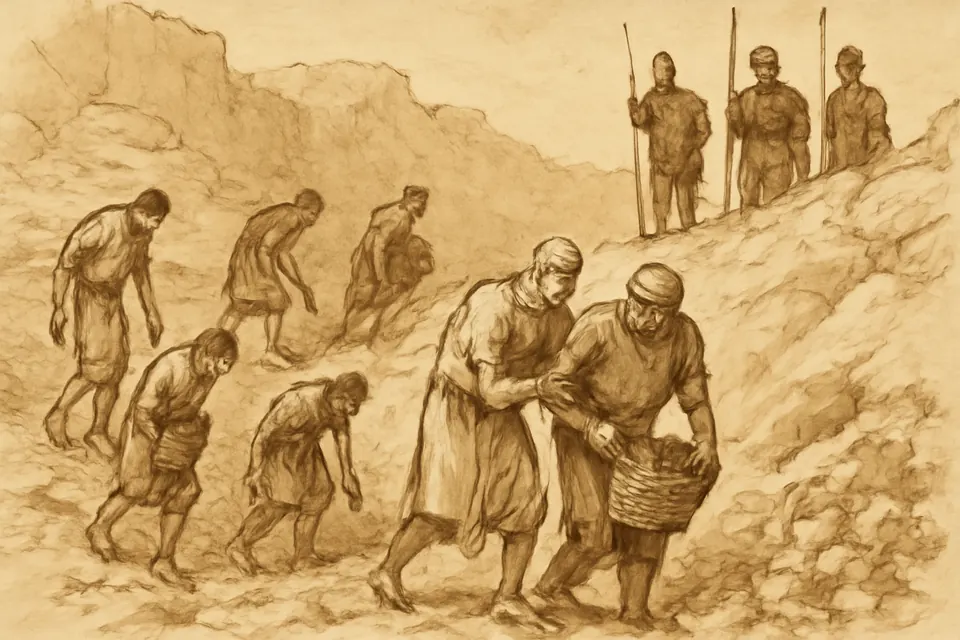
The persecution begun under Diocletian lasted longest in Egypt, where the Caesar Maximinus Daia pressed it hard until 313. Sozomen records what was done to Paphnutius and to Maximus, later bishop of Jerusalem: they were among the confessors "whom Maximinus condemned to work in the mines, after having deprived them of the right eye, and the use of the left leg." The authorities blinded and lamed prisoners in this way so they could not escape and could still work.
He survived. When the persecution ended, he went back to his flock, and Sozomen adds that God "wrought many miracles" through him, "controlling demons, and giving him grace to heal various kinds of sickness."
At the Council of Nicaea
In 325 Constantine called the bishops of the whole Church to Nicaea to answer the teaching of Arius, who denied that the Son is truly God. Theodoret, describing the bishops who came, says some "had had the right eye dug out, others had lost the right arm. Among these was Paphnutius of Egypt. In short, the Council looked like an assembled army of martyrs."
Socrates singles out two bishops "of extraordinary celebrity": Paphnutius and St. Spyridon of Cyprus, the shepherd bishop. Of Paphnutius he writes:
The emperor honored this man exceedingly, and often sent for him to the palace, and kissed the part where the eye had been torn out. So great devoutness characterized the emperor Constantine.

His word on married clergy
The best-known story about Paphnutius comes from the council's discussion of discipline. Some bishops wanted a new law that bishops, priests and deacons who had married before ordination should no longer live with their wives as husbands. Socrates and Sozomen both report that Paphnutius rose and asked them not to lay "so heavy a yoke on the ministers of religion," calling marriage honorable and the life of a man with his lawful wife chastity. He held to the old custom: a man ordained while single should not marry afterward, but a married man should not be parted from his wife. Socrates notes that he said this "although himself without experience of marriage." The council, he says, agreed and left the matter to each husband's conscience.
Historians still discuss how exactly this account fits the later canons of East and West on clerical continence, and the story itself appears first in Socrates, a century after the council. The Eastern Churches, Catholic and Orthodox, have kept the custom he described, ordaining married men to the priesthood while not allowing priests to marry after ordination.
At the Council of Tyre
Ten years later, in 335, the enemies of St. Athanasius gathered a synod at Tyre to condemn him. Sozomen tells a small, vivid story from it. Paphnutius, seeing the injustice, "arose, and took the hand of Maximus, the bishop of Jerusalem, to lead him away, as if those who were confessors, and had their eyes dug out for the sake of piety, ought not to participate in an assembly of wicked men." It is the last sight we have of him. We do not know when or where he died.
Miracles of St. Paphnutius
- Reported: healings and the casting out of demons. Sozomen records them as what was said of him, without describing a single case.
- No miracles at his tomb are recorded, and no tomb or relics are known today.
Symbols of St. Paphnutius in art
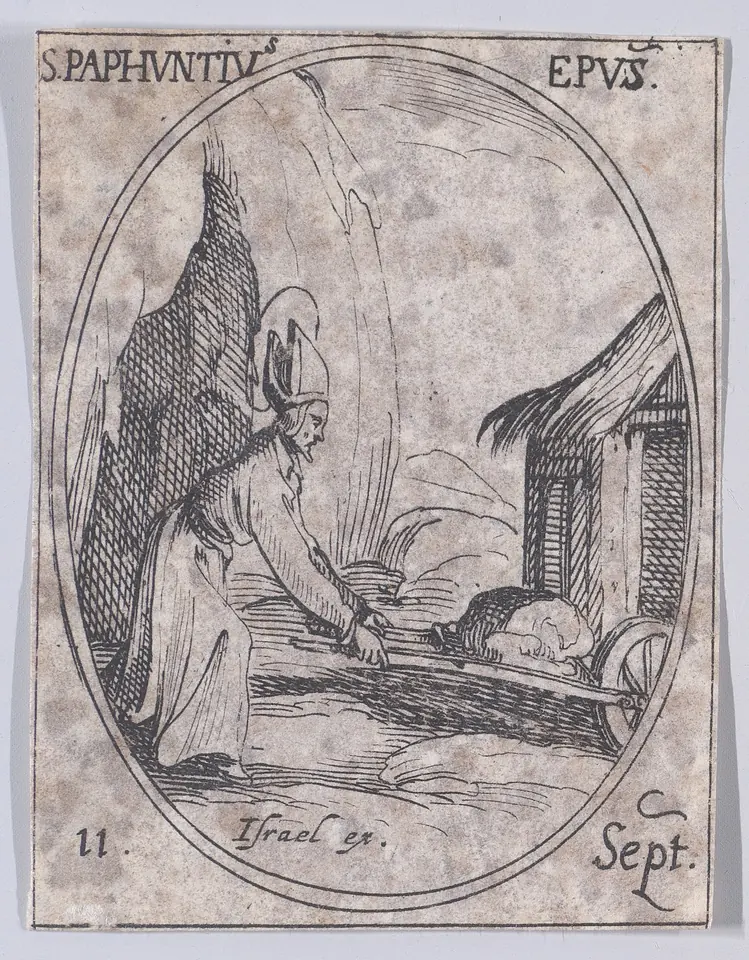
Paphnutius is rare in Western art. The clearest image is Jacques Callot's little etching for September 11 in his Images of All the Saints of the Year (1636), which shows him in a bishop's miter at hard labor with a barrow, recalling the mines. In Eastern icons a confessor bishop of Nicaea is shown in a bishop's omophorion holding the Gospel book. Look for:
- A missing or closed right eye: the wound he received for Christ.
- A staff or a lame leg: the hamstrung leg.
- Mining tools or a barrow: his sentence to the mines.
- The bishop's miter or omophorion: his office in the Thebaid.
Be careful in museums: many pictures labeled "Paphnutius" show the hermit Paphnutius of the desert fathers, a different man, often in a forest or desert with a monk's habit and no bishop's dress.
Feast day and prayer
We keep the feast of St. Paphnutius on September 11. See the feast day calendar for the other saints of September.
We have not found a traditional prayer to St. Paphnutius in the Latin books. Let us ask his intercession for Christians who suffer torture and forced labor for their faith today, for bishops, and for married priests and their families in the Eastern Churches. St. Paphnutius, confessor of Christ, pray for us.
Frequently asked questions
Who was St. Paphnutius of Thebes?
An Egyptian monk who became bishop of a city in the Upper Thebaid. He was a confessor, meaning he suffered for Christ but survived; he lost an eye and the use of a leg in the persecution of Maximinus, then attended the Council of Nicaea in 325.
When is the feast of St. Paphnutius?
September 11 in the Roman Martyrology. Be careful with the other saints named Paphnutius, such as the desert father of Scetis and the martyr of Dendera, who are remembered on other days.
What did St. Paphnutius say at the Council of Nicaea?
According to Socrates Scholasticus and Sozomen, when some bishops proposed that married bishops, priests and deacons should stop living with their wives, Paphnutius, though he had never married, urged them not to impose that burden. The council left the matter to each man's choice.
Why did Constantine kiss Paphnutius's eye?
To honor what he had suffered for Christ. Socrates writes that the emperor often sent for him to the palace "and kissed the part where the eye had been torn out."
Keep exploring
Sources
- Socrates Scholasticus, Church History, Book I, ch. 11: Of the Bishop Paphnutius. His lost eye, Constantine's kiss, and his speech on married clergy at Nicaea
- Sozomen, Ecclesiastical History, Book I, chs. 10 and 23. The right eye and left leg, the mines under Maximinus, his miracles, and the Nicaea debate
- Sozomen, Ecclesiastical History, Book II, ch. 25. He leads Maximus of Jerusalem out of the Council of Tyre
- Theodoret, Ecclesiastical History, Book I, ch. 6. "Among these was Paphnutius of Egypt": the maimed confessors at Nicaea