St. Guy of Anderlecht
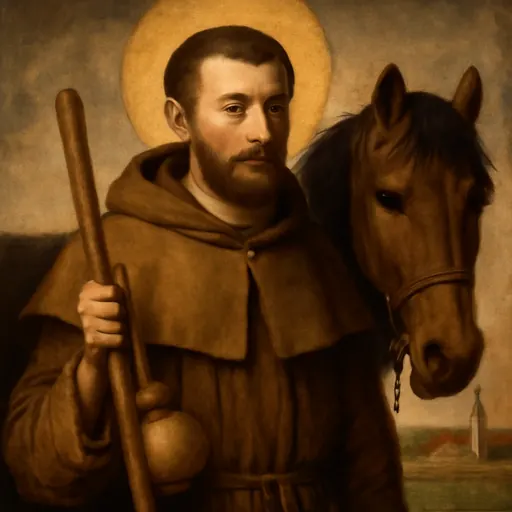
St. Guy of Anderlecht (Guidon, Guido), "the poor man of Anderlecht," was a farmhand and sacristan near Brussels who made a long pilgrimage on foot to Rome and Jerusalem and died soon after coming home, about 1012. He is the patron of horses, cattle and farm workers, and his feast is September 12. His relics rest in the collegiate church of Anderlecht.
Who was St. Guy of Anderlecht?
St. Guy of Anderlecht, called Guidon in French and Guido in Dutch, was a poor layman of Brabant who died about 1012 in Anderlecht, now part of Brussels. The people called him "the poor man of Anderlecht." He never became a priest or a monk. He worked the fields, kept a church clean, tried his hand at trade and lost, and then walked to Rome and Jerusalem as a pilgrim. He came home worn out and died among his own people. We keep his feast on September 12.
The commune of Anderlecht is frank about how little is known: the facts of his life are so few, and the stories so legendary, that some historians doubt he existed at all, and even the traditional date of his death is disputed. Yet his relics are real, and they have a story of their own.

The life of St. Guy of Anderlecht
Nearly everything we know comes from one source, the Vita sancti Guidonis Confessoris ("Life of St. Guidon the Confessor"). Scholars think a canon of Anderlecht wrote it about 1112, a century after his death. The first part tells his life very briefly. The second, much longer, tells how his grave was found and lists his miracles.
Farmhand and sacristan
Guy was the son of poor country people near Anderlecht. A traditional story says that while he knelt in prayer, angels drove the plow for him. As a young man he became sacristan of the church of Our Lady at Laeken, sweeping the floor, caring for the altar and and ringing the bell.

The failed venture and the long pilgrimage
He then tried his hand at trade on the river Senne and, the legend says, lost everything. Guy took the loss as a lesson about the love of money and set out on foot as a penitent, first to Rome and then to the Holy Land. Tradition says he was away for seven years.
Death at Anderlecht
The Vita gives the cause of his death. Worn down by hunger, thirst, cold and heat on the long road home, he died "exhausted by great labor and a flow of blood." Researchers read this as a hemorrhage or dysentery, and people later prayed to him against dysentery. He was buried in the cemetery beside the old church of Anderlecht.
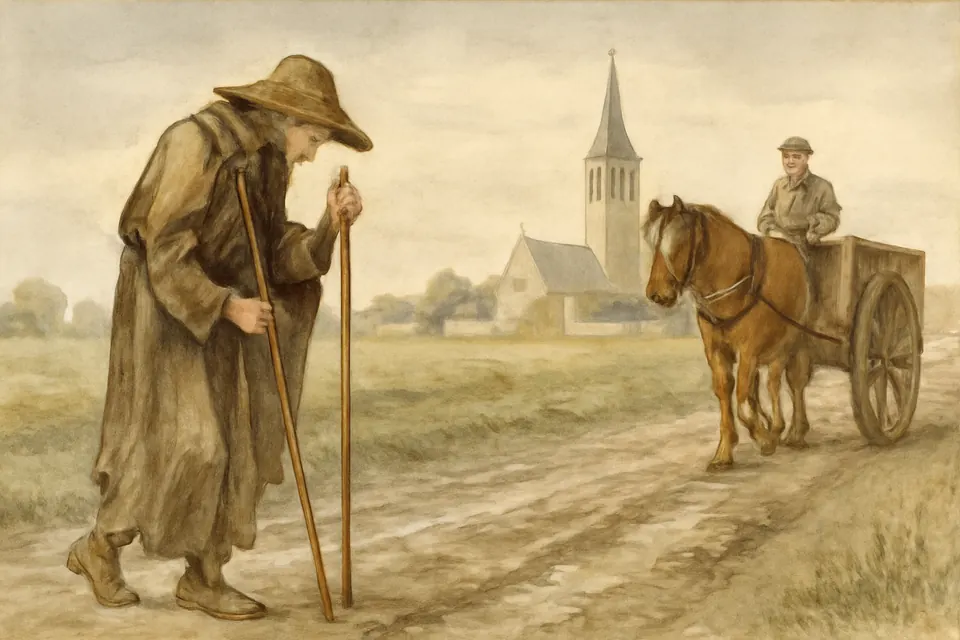
The relics of St. Guy
The Vita says his forgotten grave was found by chance and that miracles followed. Under Bishop Gerard II of Cambrai (1076–1092), the clergy and people fasted three days, dug up his bones, washed them in the water of a nearby spring and buried them in the middle of the church. The water was kept, and the Vita says the sick who drank it were healed: a traditional miracle. On June 24, 1112, Bishop Odo of Cambrai raised the relics to the altar, which at that time was how a bishop canonized a saint.
The relics did not stay home. A document of 1438 lists 33 outings in one year, the arm or the whole shrine carried to villages across Brabant for Mass and Vespers.
In October 2013, with the archdiocese's permission, the shrine was opened and the bones studied at the Université Libre de Bruxelles. The team found the skeleton of a European man aged 30 to 40. A radiocarbon test of the left femur placed it between 890 and 1020. Most of the skeleton lies in a silver shrine made in 1851 by François Henri Van Beveren of Mechelen, now kept under the canopy of the high altar; his right forearm bone is shown in an eighteenth-century monstrance in the sacristy. A strip of parchment found with the bones, written in the twelfth or thirteenth century, reads S(ancti) Widonis confessoris Christi reliquie, "relics of St. Guido, confessor of Christ."

Where the relics of St. Guy of Anderlecht are kept: see them on the relics map →
Why St. Guy is the patron saint of horses and farm animals
Anderlecht's Royal Brotherhood of St. Guido, founded in 1632, remembers him as "protector of animals, especially cattle and horses." Every year after Pentecost a pilgrimage came to Anderlecht with the brotherhood of the coachmen of Brussels, and for the brotherhood's 300th anniversary in 1932 it became a great spectacle. As a former sacristan he is also honored by sacristans.
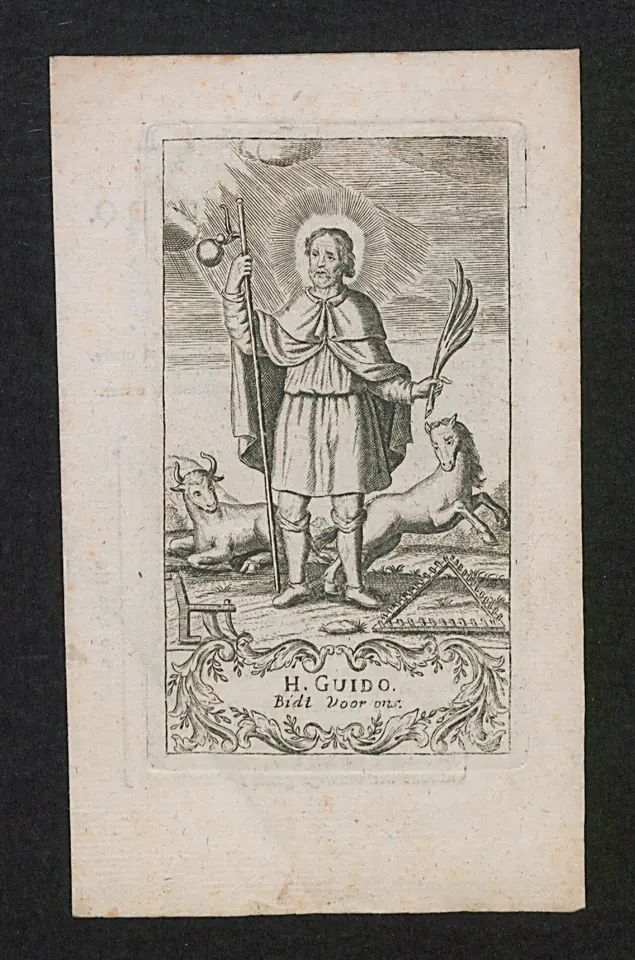
Symbols of St. Guy of Anderlecht in art
- Pilgrim's staff, hat and cloak: the walker to Rome and Jerusalem.
- Plow, horses and an angel: the legend of the angel plowing while he prayed.
- Horse and ox at his feet: his care for farm animals.
- Palm or rosary: signs of holiness in popular prints.
In the crypt of the collegiate church a blue-stone slab is called his tomb. Pilgrims used to crawl through the narrow gap beneath it, hoping their prayers would be answered; the worn stone shows how long the custom lasted. A life-size wooden statue of the saint in the crypt once stood over St. Guidon's spring at the foot of the rue de l'Institut, and the chapel of Our Lady of Grace has late-medieval wall paintings of his legend.

Feast day and prayer
His feast is September 12. The Royal Brotherhood carries his shrine through Anderlecht in procession. Old devotional prints of him carry the simplest prayer: Sancte Guido, ora pro nobis, "St. Guido, pray for us." Let us ask him to watch over farm workers and their animals, over sacristans, and over pilgrims on the road.

Find more saints of the countryside on our patron saints index and feast days calendar.
Frequently asked questions
Who was St. Guy of Anderlecht?
A poor man of Brabant, remembered as a farmhand, a sacristan at the church of Our Lady in Laeken, a small trader on the Senne river and finally a pilgrim to Rome and the Holy Land. He returned to Anderlecht worn out and died there, traditionally on September 12, 1012.
Why is St. Guy the patron saint of horses?
Farmers of Brabant took him as protector of their animals, especially cattle and horses. Brussels coachmen made an annual pilgrimage to his shrine after Pentecost, and his legend shows angels plowing with horses while he prayed.
When is St. Guy of Anderlecht's feast day?
September 12. Anderlecht's Royal Brotherhood of St. Guidon carries his relics in procession on that day.
Are St. Guy's relics authentic?
Scientists of the Université Libre de Bruxelles studied the skeleton in his shrine in 2013. It belongs to a European man aged 30 to 40, and radiocarbon dating placed the bone between 890 and 1020, the period in which he is said to have lived.
Keep exploring
- Patron saint pages
- Animals
- Feast-day calendar
- Saints remembered in SeptemberSaint of the dayWhat saint is my birthday?
- Relics
- Where the relics are kept (map)
- More
- Saints A to ZPatron saints A to ZExplore every section
Sources
- Daumas, Leroy et al., Les reliques de saint Guidon: esquisse historique et étude anthropologique du squelette extrait de la châsse, Anthropologica et Præhistorica 127 (2019)
- Commune d'Anderlecht: Saint Guidon d'Anderlecht, entre légende et histoire
- Commune d'Anderlecht: Collégiale des Saints Pierre et Guidon
- Commune d'Anderlecht: Royal Brotherhood of St. Guido, exhibition brochure (2011)