St. Alonso de Orozco

St. Alonso de Orozco (1500–1591) was a Spanish Augustinian friar, royal preacher to Charles V and Philip II, and a much-loved spiritual writer, whom Madrid called the saint of San Felipe. He lived in deep poverty, served the sick, the prisoners and the poor, and founded houses of friars and contemplative nuns. He was canonized in 2002, and we keep his feast on September 19.
Who was St. Alonso de Orozco?
St. Alonso de Orozco was a Spanish Augustinian friar of the sixteenth century, a preacher at the royal court in Madrid who never stopped living like a poor man. He was born in Oropesa, in the province of Toledo, on October 17, 1500, and died in Madrid on September 19, 1591, at almost ninety-one. The people of Madrid called him el santo de San Felipe, the saint of St. Philip's, after the friary where he lived. He disliked the name.
He is also a writer worth knowing. His many books of prayer and Christian living, in Spanish and Latin, belong to the golden age of Spanish spirituality, the age of St. Teresa of Ávila and St. John of the Cross. Pope John Paul II canonized him in 2002.
From Oropesa to the Augustinians
His father was governor of the castle at Oropesa. Alonso began school in nearby Talavera de la Reina and spent three years as a choirboy in the cathedral of Toledo, where he learned music. At fourteen his parents sent him to the University of Salamanca, where an older brother was already studying.
In Lent of 1520, St. Thomas of Villanova preached a series of sermons in Salamanca on the psalm In exitu Israel de Aegypto, "When Israel went out of Egypt." They settled Alonso's vocation. He entered the Augustinian friary of Salamanca and made his vows in the hands of Thomas of Villanova himself.

He was ordained a priest in 1527, and his superiors quickly saw his gift for preaching. From the age of thirty he held one office after another in the order. The Vatican biography notes that, strict as he was with himself, he governed others with understanding.
The voyage that ended in the Canaries
In 1549, longing for martyrdom, he set out as a missionary to Mexico. He got as far as the Canary Islands, where a severe attack of arthritis nearly killed him. The doctors forbade him to go on, and he came home.
Preacher to the emperor
In 1554, while he was prior of the friary in Valladolid, then the seat of the court, Alonso was named royal preacher to the emperor Charles V. When the court moved to Madrid in 1561 under Philip II, he moved too, to the friary of San Felipe el Real. He held the post for the rest of his life.
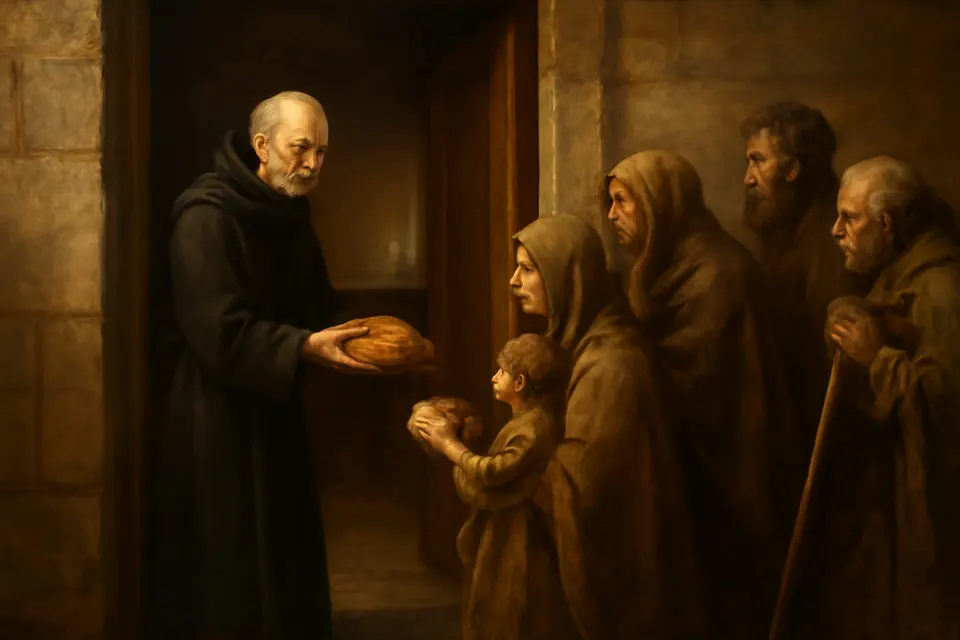
The office came with a salary and freedom from his superiors. He refused both. He lived as a plain friar under obedience, ate one meal a day at noon, and slept about three hours a night, saying that was enough for the next day's work. The Vatican biography describes his cell: a table for a bed, cut vine branches for a pillow, one chair, a candle, a broom and a few books. He chose a room near the door so he could answer the poor who knocked.
He visited the sick in the hospitals and the prisoners in the jails, and he went out to the poor in the streets and their homes. People of every class loved him. Princess Isabel Clara Eugenia, the dukes of Alba and Lerma, and the writers Lope de Vega and Francisco de Quevedo all later testified in his cause.
His writings
St. Alonso wrote steadily all his life, for ordinary Christians as much as for religious. His titles say what he meant them for: Rule for a Christian Life (1542), Garden of Prayer and Mount of Contemplation (1544), Spiritual Treasury (1551), The Art of Loving God and Neighbor (1567), The Book of the Gentleness of God (1576), Memorial of Holy Love (1576) and a Treatise on the Crown of Our Lady (1588).
His love for the Blessed Virgin ran through all of it. The Vatican biography says he was convinced he wrote at her command. That conviction rests on his own experience and on traditional accounts, not on any formally examined vision.
He also wrote on the history and spirit of his order, and he founded new houses of Augustinian friars and of contemplative nuns. That work fed a movement of recollection, a return to a stricter and more prayerful life, within the order.
A death that moved Madrid
In August 1591 he fell ill with a fever. He kept celebrating Mass every day, as he always had through every illness, saying with some humor that "God does no harm to anybody." Philip II came to see him, with the heir to the throne and Princess Isabel. The cardinal archbishop of Toledo, Gaspar de Quiroga, fed him with his own hands and then asked for his blessing.
He died on September 19, 1591, in the College of the Incarnation, which he had founded two years before. The building is now the seat of the Spanish Senate. Quevedo testified that the crowds broke down the church doors looking for something to keep: a splinter of his bed, a scrap of his clothes or shoes, a piece of his hair shirt. Cardinal Quiroga kept the saint's wooden cross for himself.

Beatification and canonization
Pope Leo XIII beatified Alonso de Orozco on January 15, 1882. Pope John Paul II canonized him on Pentecost Sunday, May 19, 2002, with four others. In his homily the Pope said that Alonso's "pastoral dedication to serving the poorest in the hospitals and prisons makes him a model for all who, under the guidance of the Spirit, base their entire life on the love of God and of their neighbour." The healing approved for the canonization is not described in the Vatican's published biography, so we leave it unnamed here.
Symbols of St. Alonso de Orozco in art
- The black Augustinian habit with hood and leather belt, the dress of his order.
- Pen and book, for the writer and preacher.
- An image of the Virgin Mary, for his devotion and the tradition that he wrote at her bidding.
- A wooden cross, recalling the one he carried and Cardinal Quiroga kept.
In Bartolomé González's painting of 1624, he is the young friar kneeling with a book before Thomas of Villanova. Later statues and paintings tend to show him as an old, thin friar in black.
Feast day and where he is honored
We keep the feast of St. Alonso de Orozco on September 19, the day of his death. His body rests in Madrid in the church of the cloistered Augustinian nuns, a community he founded, on Calle de la Granja. Oropesa, his birthplace, also honors him. See the feast day calendar for other saints of September.
Let us ask St. Alonso, who served the poor at the king's court, to pray that our work and our success never make us forget the people knocking at our door.
Frequently asked questions
Who was St. Alonso de Orozco?
A Spanish Augustinian priest born in Oropesa in 1500, who became royal preacher at the court of Charles V and Philip II but lived as a poor friar in Madrid, caring for the poor and writing many books of devotion. He died in 1591.
When is the feast day of St. Alonso de Orozco?
September 19, the day he died in 1591.
When was Alonso de Orozco canonized?
Pope John Paul II canonized him in Rome on Pentecost Sunday, May 19, 2002. Pope Leo XIII had beatified him on January 15, 1882.
What did St. Alonso de Orozco write?
Many devotional books in Spanish and Latin, among them the Rule for a Christian Life (1542), the Garden of Prayer and Mount of Contemplation (1544), the Spiritual Treasury (1551), The Art of Loving God and Neighbor (1567) and a treatise on the Crown of Our Lady (1588).
Keep exploring
Sources
- Vatican: Alonso de Orozco, biography (1500–1591), for the canonization of May 19, 2002. Birth on October 17, 1500, his vows before Thomas of Villanova, the voyage to Mexico, the royal preachership, his cell, his books, his last illness, his death in the College of the Incarnation, the crowds seeking relics, and his beatification in 1882
- Pope John Paul II, Homily for the canonization of five Blesseds, May 19, 2002. The canonization and the Pope's words on his service to the poor in hospitals and prisons
- Saint Alfons from Orozco, 19th September (Maltese Augustinian Province). His remains in the monastery of the cloistered Augustinian sisters of Madrid