St. Agnes of Assisi, Sister of St. Clare
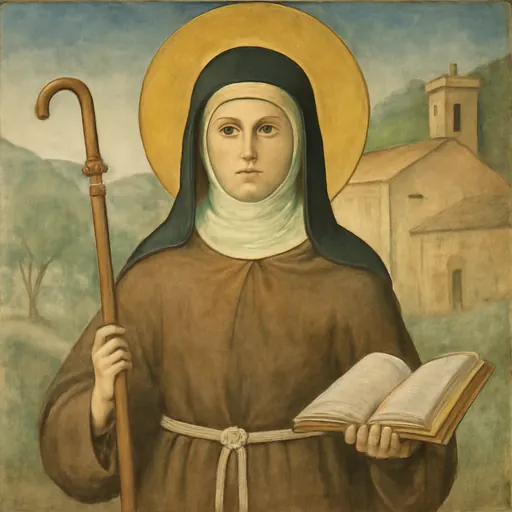
St. Agnes of Assisi (1197–1253) was the younger sister of St. Clare and one of the first Poor Clares. When she ran away to join Clare in 1212, twelve armed relatives tried to drag her home, and, the earliest Life of St. Clare says, her body became too heavy to move. She later founded and led the Poor Ladies of Monticelli near Florence. We keep her feast on November 16.
Who was St. Agnes of Assisi?
St. Agnes of Assisi was the younger sister of St. Clare and one of the first women to follow St. Francis in the Order of Poor Ladies, later called the Poor Clares. She is not St. Agnes of Rome, the virgin martyr, nor St. Agnes of Bohemia, the princess to whom Clare wrote her letters. She was a girl of fifteen who left a rich home in Assisi to share her sister's poverty, and who became an abbess and founder in her own right.
The Catholic Encyclopedia gives her family: her father was Count Favorino Scifi, her mother was Blessed Hortulana, and her cousin Rufino was one of the "Three Companions" of St. Francis. She spent her childhood between the family palace in Assisi and the castle of Sasso Rosso on Mount Subasio. She was born in 1197 or 1198.
Following Clare
On the night of March 18, 1212, Clare slipped out of her father's house to give herself to God under the guidance of Francis. The Life of St. Clare ascribed to Thomas of Celano, written within a few years of Clare's death, says that Clare prayed hard for the sister she had left behind. They were "of different temperaments," it says, but "attached to each other by a deep mutual love." Sixteen days later Agnes came to her and said she wanted to give herself wholly to God. Clare embraced her:
I give thanks to God, most sweet sister, that He hath hearkened to my solicitude concerning thee.
The two sisters were staying at the church of Sant'Angelo di Panzo, near Assisi, where Clare had found shelter with Benedictine nuns.
The miracle at Sant'Angelo di Panzo
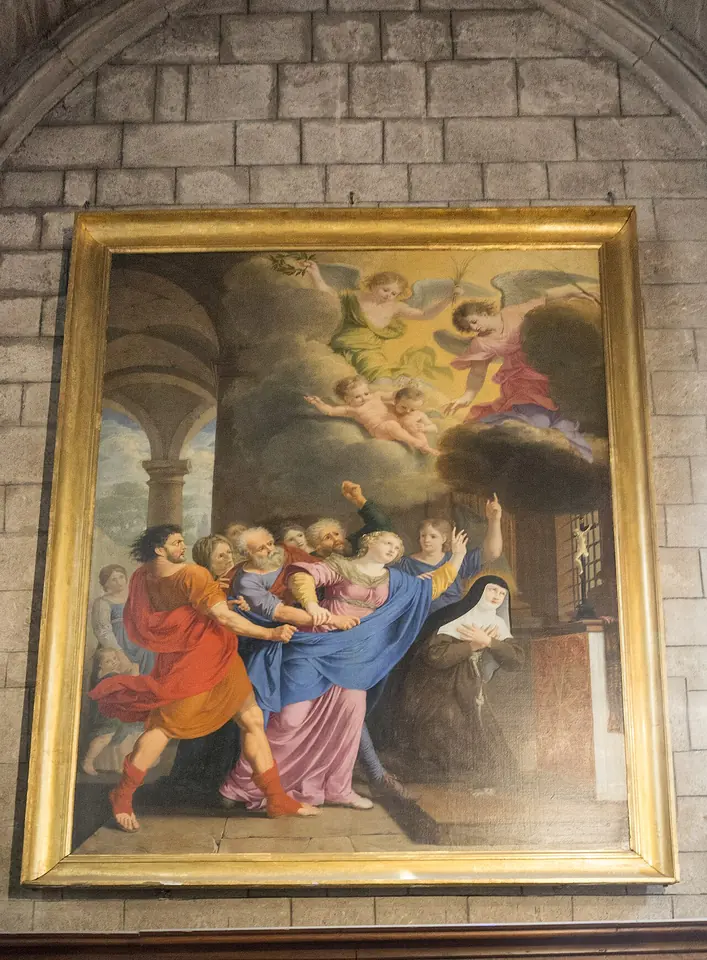
The next day twelve men of the family came, "infuriated with rage," pretending to come in peace. They had given up on Clare; they wanted Agnes. When she refused to leave her sister, one of the knights, the Life says, rushed at her "sparing neither blows nor kicks" and tried to drag her away by the hair. She cried out:
Help me, dearest sister, and suffer me not to be taken from Christ the Lord.
They hauled her down the slope, tearing her clothes and leaving her hair on the path. Clare, in tears, knelt in prayer. Then "suddenly the body of Agnes as she lay on the ground seemed to be fixed there," so that several strong men could not carry her across a little brook, even when farm workers ran from the vineyards to help. They mocked what they could not explain: "She was eating lead all night." When her uncle Monaldo raised his arm to strike her a deadly blow, "a terrible pain suddenly seized the arm he had raised," and it tormented him for a long time.
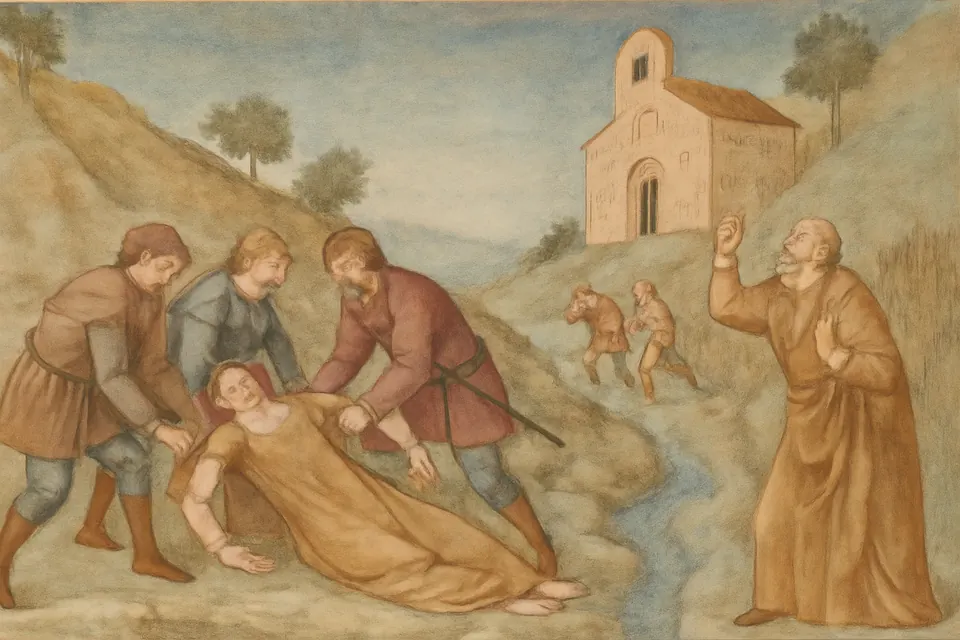
This miracle is traditional: it comes from the earliest Life of St. Clare and has been told in the Franciscan family ever since, but it was never examined in a formal process. Clare came down and begged the men to leave her sister in her care, and they went away. Agnes "arose cheerfully," and Francis cut her hair with his own hands.

Abbess of Monticelli
Francis soon settled the sisters at San Damiano, the little church he had rebuilt below Assisi, and other women joined them. Their mother Hortulana and their youngest sister Beatrice later entered the community too. The Catholic Encyclopedia says Agnes's companions felt she "seemed to have discovered a new road to perfection known only to herself."
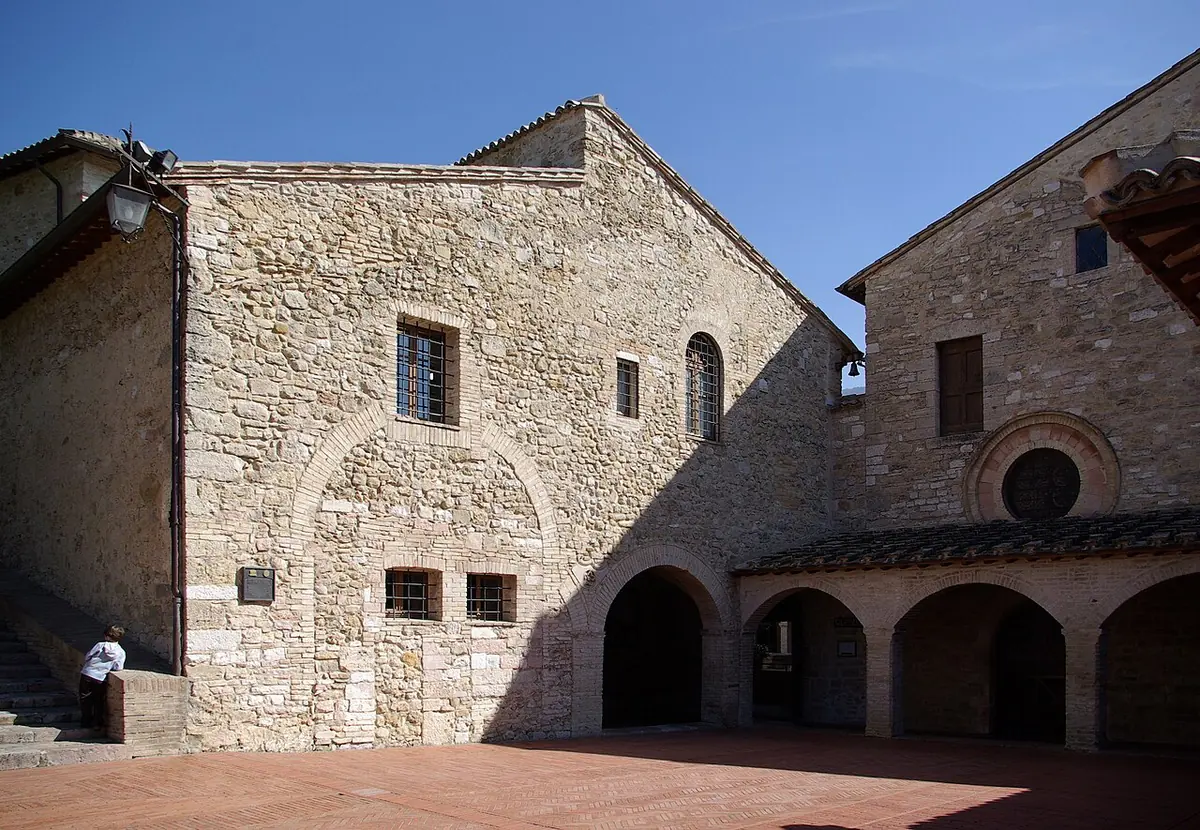
About 1219, young as she was, Agnes was sent to lead a community of Poor Ladies at Monticelli near Florence. From there she founded houses at Mantua, Venice and Padua. A letter she wrote to Clare after their parting still exists, and the Catholic Encyclopedia calls it "touchingly beautiful in its simplicity and affection." She stayed loyal all her life to Clare's hard-won ideal of real poverty.
The death of St. Agnes of Assisi
Early in 1253 Clare called Agnes back to San Damiano, and Agnes was with her when she died that August. The Life of St. Clare tells how Agnes begged her sister not to leave her, and Clare answered: "It is pleasing to God, dearest sister, that I go hence. But, as for thee, cease weeping, for thou shalt come to the Lord soon after myself."

It came true. Agnes died on November 16, 1253, three months after Clare. She is buried in the Basilica of Santa Chiara in Assisi, near her mother and her sisters. The Catholic Encyclopedia reports that God "glorified her tomb after death by numerous miracles"; those healings are reported, not formally examined.

Symbols of St. Agnes of Assisi in art
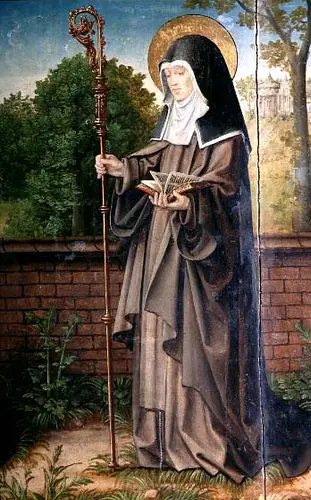
Agnes is painted as a Poor Clare, in a brown habit with a white cord, a white wimple and a black veil. As an abbess she often holds a crozier and a book. She is easiest to recognize beside Clare and their mother Hortulana, as in the Swedish altarpiece on this page, where Clare holds a lamp, Hortulana a cross, and Agnes a book.

Her other common scene is the attack at Sant'Angelo, with men pulling at a girl who will not move.
Prayer to St. Agnes of Assisi
We have found no traditional English prayer to St. Agnes of Assisi with a clear source. Let us ask her help in our own words:
St. Agnes of Assisi, you held fast to Christ when the world tried to drag you away. Pray for us, that nothing may separate us from Him, and pray for all Poor Clares and for all who are called to follow Him in poverty. Amen.
Find more Franciscan saints in our feast days calendar and patron saints index.
Frequently asked questions
Who was St. Agnes of Assisi?
The younger daughter of Count Favorino Scifi and Blessed Hortulana of Assisi, and the sister of St. Clare. Sixteen days after Clare left home to follow St. Francis in 1212, Agnes followed her. She became abbess of the Poor Ladies at Monticelli near Florence and founded other houses in northern Italy.
What miracle is St. Agnes of Assisi known for?
When her relatives tried to carry her away from the church of Sant'Angelo di Panzo, her body became so heavy that they could not lift her, and her uncle Monaldo's raised arm was struck with terrible pain. The Life of St. Clare ascribed to Thomas of Celano tells the story.
When is the feast of St. Agnes of Assisi?
November 16, the day she died in 1253, a few months after St. Clare. Pope Benedict XIV allowed the Franciscan Order to celebrate her feast.
Is St. Agnes of Assisi the same as St. Agnes of Bohemia?
No. Agnes of Assisi was St. Clare's sister. Agnes of Bohemia was a Czech princess who founded the Poor Clares in Prague and received St. Clare's famous letters. A third saint, St. Agnes of Rome, was a virgin martyr of the early Church.
Keep exploring
- Appears in
- Female saints
- Feast-day calendar
- Saints remembered in NovemberSaint of the day
- More
- Saints A to ZPatron saints A to ZExplore every section
Sources
- Catholic Encyclopedia (1907): St. Agnes of Assisi. Family, Monticelli, the houses at Mantua, Venice and Padua, her burial and Benedict XIV's permission for the feast
- The Life of Saint Clare ascribed to Fr. Thomas of Celano, trans. Paschal Robinson (1910). The flight of Agnes and the miracle at Sant'Angelo di Panzo; Clare's promise on her deathbed; notes on dates