St. Catherine of Bologna
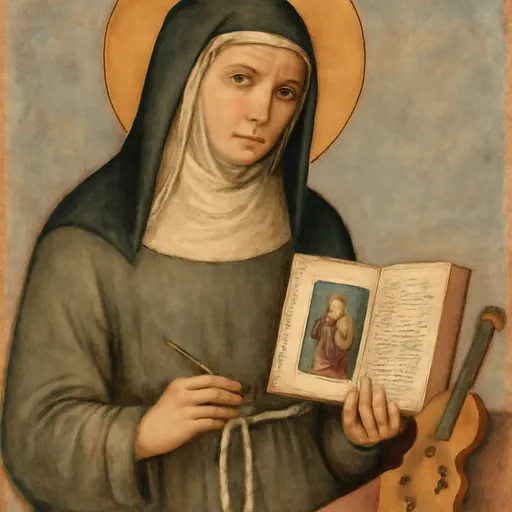
St. Catherine of Bologna (1413–1463), born Caterina de' Vigri, was a Poor Clare nun, painter, musician and spiritual writer who founded and led the Corpus Domini monastery in Bologna and wrote the Seven Spiritual Weapons. Her incorrupt body sits upright in a chapel of the Corpus Domini church in Bologna, which is why she is called the seated saint. Her feast day is March 9, and she is honored as a patron of artists.
Who was St. Catherine of Bologna?
Catherine was born Caterina de' Vigri in Bologna on September 8, 1413. She grew up as a lady-in-waiting at the court of the Este family in Ferrara, one of the most cultured courts in Italy, where she learned Latin, music, painting and the fine art of illuminating manuscripts. At fourteen she left the court for a small community of devout women, which became a convent of Poor Clares. She spent most of her life there, as baker, laundress, portress and novice mistress, and in 1456 she was sent to found a new Poor Clare monastery in her home city. She died its abbess on March 9, 1463.
She left behind a book, The Seven Spiritual Weapons, written to help her sisters fight temptation, along with paintings, illuminated pages and poems. And she left behind her body. Eighteen days after she was buried, the sisters exhumed it and found it intact. For more than five centuries it has been kept in Bologna, and for most of that time it has been seated upright in a chair, which is why people call her the seated saint.
Please don't confuse her with the other Catherines on this site. St. Catherine of Siena was a Dominican who died in 1380, St. Catherine of Genoa was a married laywoman who ran a hospital, and St. Catherine of Alexandria was an early martyr. Catherine of Bologna is the Franciscan nun, the painter, the one who sits.
The life of St. Catherine of Bologna
A girl at the Este court
Her father, Giovanni de' Vigri, was a lawyer from Ferrara who taught at Padua and carried out diplomatic work for Niccolò III d'Este, the Marquis of Ferrara. Her mother, Benvenuta Mammolini, was from Bologna. Pope Benedict XVI, who devoted a general audience to Catherine in December 2010, admitted that "not much information about Catherine's infancy and childhood is available and not all of it is reliable."
When she was about ten, she went to Ferrara as a companion to Margherita, the marquis's daughter. Benedict lists what she learned there: music, painting and dancing, poetry, the viola, "miniature-painting and copying," and Latin. The court was brilliant and also brutal. In 1425 the marquis had his wife, Parisina, executed together with his son Ugo for adultery, and the next year, according to the shrine's timeline, Catherine left the court.
Temptations and a Franciscan rule
She joined a group of young women living together under a laywoman named Lucia Mascheroni. Catherine later wrote about these years in the third person: she entered God's service "illumined by divine grace... with an upright conscience and great fervour." They were also years of darkness. She suffered fierce temptations, came close to despair, and for a time doubted that Christ was truly present in the Eucharist. That trial ended, she wrote, with a vision that gave her a clear certainty of the Real Presence.
The community split between those who wanted an Augustinian life and those drawn to St. Francis. Catherine chose St. Clare's rule, and in 1432 she and her companions were clothed as Poor Clares in the new Corpus Domini monastery in Ferrara. The friars of the nearby church guided them, and the sisters heard St. Bernardine of Siena preach. In 1431 she had a vision of the Last Judgment that drove her to pray harder for sinners.
Baker, portress, novice mistress
For a woman raised at court, the work was humbling, and Benedict notes that she did all of it "with love and ready obedience": she washed clothes, sewed, baked bread and looked after the animals. She served at the convent door and in the parlor, where people came to the grille to talk with the sisters. She found these interruptions of her prayer hard but accepted them.
Out of obedience she became novice mistress, though she thought herself unfit. It was during these years that she received the vision most painted afterward, on a Christmas night. Having asked permission to spend the night in the church, she recited a hundred Hail Marys while she waited for midnight. At that hour, she wrote, the Virgin Mary appeared and placed the newborn Christ Child, wrapped in white cloths, in her arms.

Abbess in Bologna
In 1456 the city of Bologna asked for a monastery of Observant Poor Clares. Catherine was chosen to lead it. She had hoped to die in Ferrara and, the shrine says, fell ill with sorrow at leaving. On July 22, 1456, she set out with a group of sisters, among them her own mother, who had entered the convent as a widow. Her superior in Ferrara is remembered as saying, "Know and be certain that I am giving you another Saint Clare."
She arrived sick and seemingly near death, then recovered. The new community grew to about sixty sisters within a year. Catherine served one term as abbess and was glad to step down, but the next abbess went blind, and Catherine had to take up the office again.

Her death
About a year before she died, Catherine heard an angel singing in the garden: "The Glory of God shall be seen in you." From then on, the shrine says, she often sang those words, accompanying herself on her viola. Early in 1463 she gathered the sisters for the last time in chapter. After receiving the last sacraments, she gave her confessor the manuscript of The Seven Spiritual Weapons, which she had kept hidden. She died on March 9, 1463, repeating the name of Jesus three times.

A Poor Clare who knew her, Sister Illuminata Bembo, wrote her life a few years later under the title Specchio di illuminazione ("Mirror of Illumination"). It is the oldest account and the source of most of the stories told here. Bologna honored Catherine as blessed for centuries. The shrine dates her formal beatification to 1703, and Pope Clement XI canonized her on May 22, 1712. The 1908 Catholic Encyclopedia names Benedict XIII as the pope who canonized her, but the Vatican's own account gives Clement XI.
The incorrupt body of St. Catherine of Bologna
Following the Poor Clare rule, the sisters buried Catherine without a coffin. According to the shrine, sweet scents came from the grave, and after eighteen days they dug her up. The body was intact and fragrant, the face and nose only a little flattened, and those soon returned to their natural shape. The scent filled the church and the convent and clung to the hands of those who touched her.
The shrine's account goes on: her pale skin slowly turned a reddish amber, and her body gave off a fragrant liquid, sometimes clear like water and sometimes mixed with blood. The sisters collected it in a small vial, which is still shown in the church during her octave each March.
Because the monastery was enclosed, visitors could not come in to see her. For about twelve years the sisters lifted the body and held it up at a small grate so the faithful could see her. Then, the shrine says, at the abbess's request, Catherine "bent forward and took a seated position." She has been kept seated ever since, today in a glass case in her own chapel, dressed in her habit.

Her face and hands are dark now, after more than five centuries. Incorruption was not among the miracles examined for her canonization, so this encyclopedia labels it reported. What is certain is that she has been on view, seated, for most of the past five centuries, and that Bologna has never stopped coming to her.
The miracles of St. Catherine of Bologna
Most of what follows comes from Sister Illuminata Bembo's life and from the shrine's own account:
- The vision of the Christ Child on Christmas night: reported. Catherine described it herself.
- The forgiveness of her sins: reported. In 1429, after a good confession, she was given in a vision the assurance that God had forgiven her everything, an experience Benedict XVI describes as "a very strong experience of divine mercy."
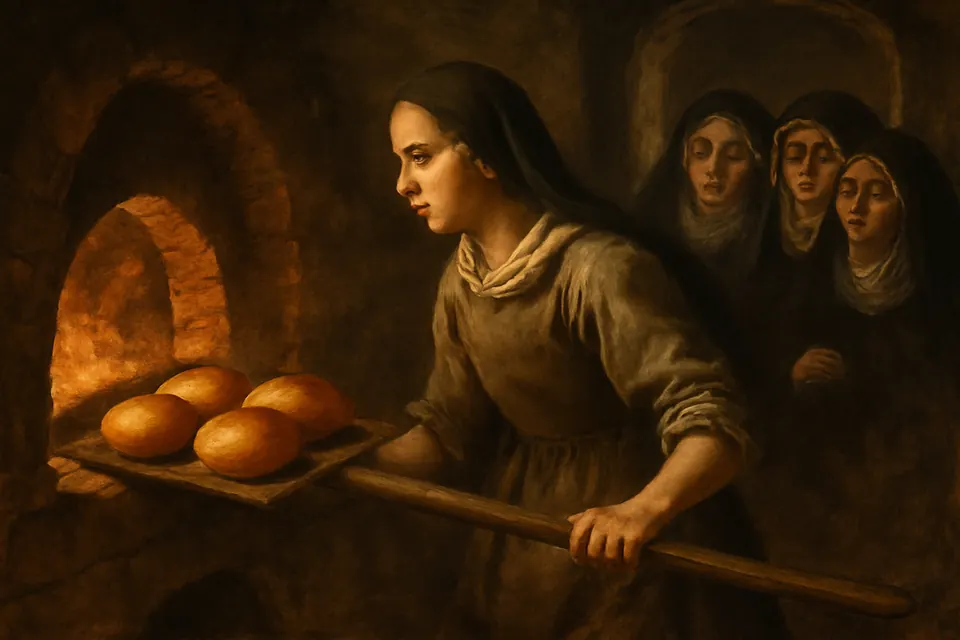
- The bread in the oven: traditional. In Ferrara, when she served as the convent baker, Catherine put the bread in the oven, said "I entrust you to Christ," and went to hear a sermon that lasted more than four hours. The sisters expected the bread to be burnt. It came out perfectly baked, and they all wanted to taste it.
- St. Joseph's bowl: traditional. As portress, Catherine opened the door to a pilgrim from the Holy Land, who left her a small bowl of a clear material, saying the Child Jesus had drunk from it. He never came back for it, and Catherine believed he was St. Joseph. She told the sisters to show it to the public every March 19, and many cures were reported through it. The bowl is kept by the Poor Clares of Corpus Domini in Ferrara.
- The incorrupt and seated body: reported (incorruption) and traditional (the seating).
- Graces after her death: reported. Queen Isabella of Naples (Isabella of Chiaramonte), who owned a devotional booklet by Catherine, received a grace through her and came to Bologna to give her crown to the saint. That crown was later stolen.
The Seven Spiritual Weapons
Le sette armi spirituali is Catherine's best-known work: part autobiography, part handbook for novices. She speaks of herself in the third person when she tells of the graces God gave her, and in the first person when she confesses her sins. Its opening, in the shrine's translation, sets the tone:
At the beginning and at the end of this battle, one must pass through the stormy sea, that is, through many distressing temptations and fierce struggles.
Benedict XVI summarized the seven weapons this way:
1. always to be careful and diligently strive to do good; 2. to believe that alone we will never be able to do something truly good; 3. to trust in God and, for love of him, never to fear in the battle against evil, either in the world or within ourselves; 4. to meditate often on the events and words of the life of Jesus, and especially on his Passion and his death; 5. to remember that we must die; 6. to focus our minds firmly on memory of the goods of Heaven; 7. to be familiar with Sacred Scripture, always cherishing it in our hearts so that it may give direction to all our thoughts and all our actions.
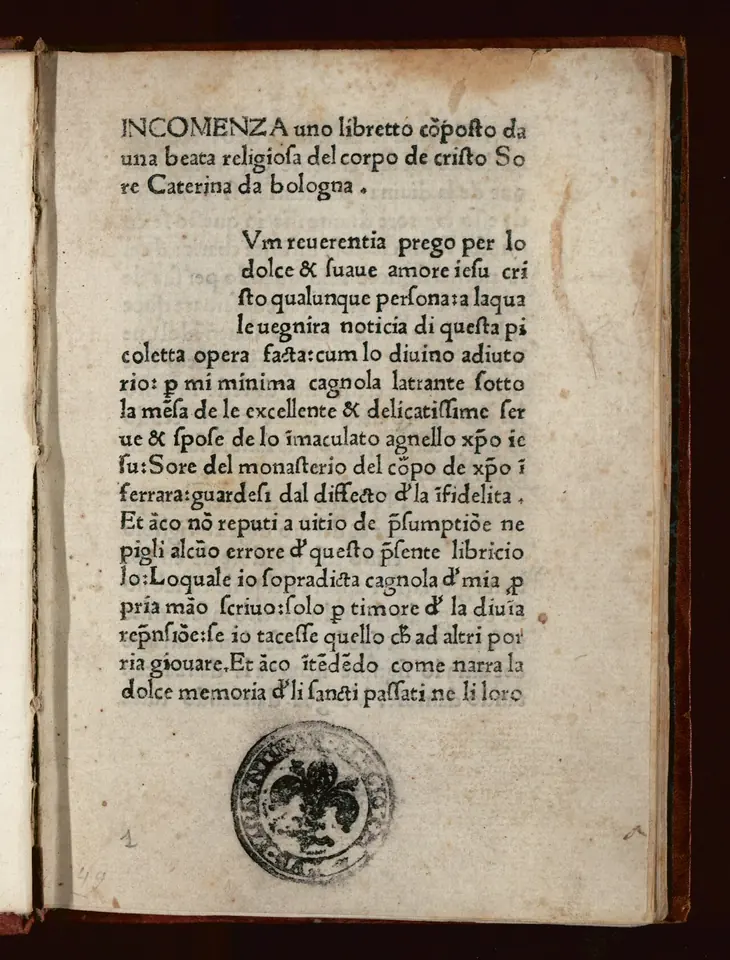
The book was printed in Bologna around 1475, only twelve years after her death, together with a short life of the saint. That early edition survives in the BEIC digital library.
Why St. Catherine of Bologna is the patron saint of artists
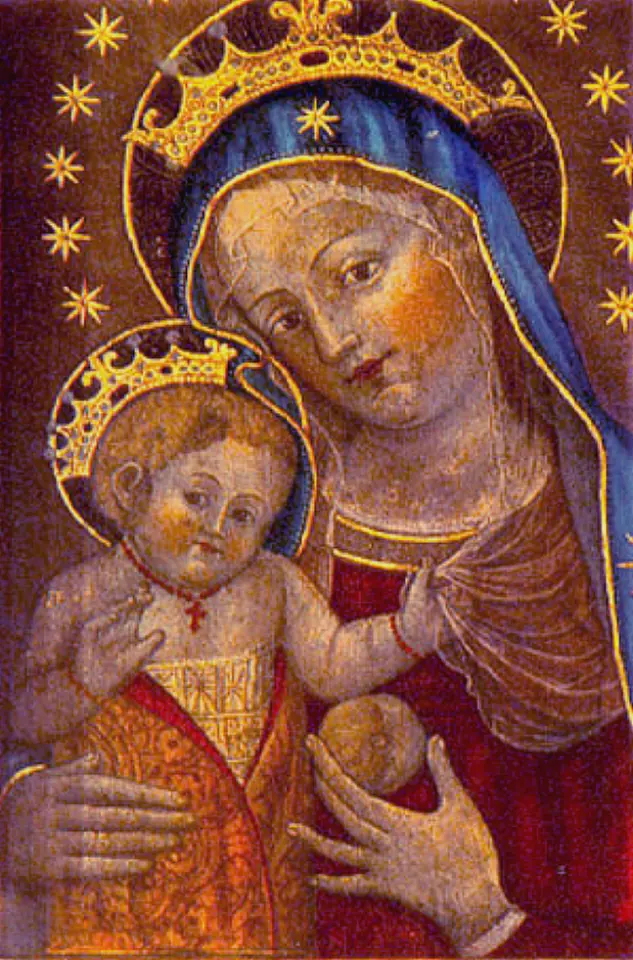
Few saints were trained artists. Catherine was. She painted on panels, illuminated the pages of her own breviary with small pictures, wrote poems and hymns in Italian and Latin, and played the viola. The shrine keeps several of her works in her chapel: the Madonna of the Pomegranate at the top of this page, her breviary with its miniatures, and the little viola itself, which the shrine describes as a 15th-century viella, an extremely rare surviving medieval instrument.
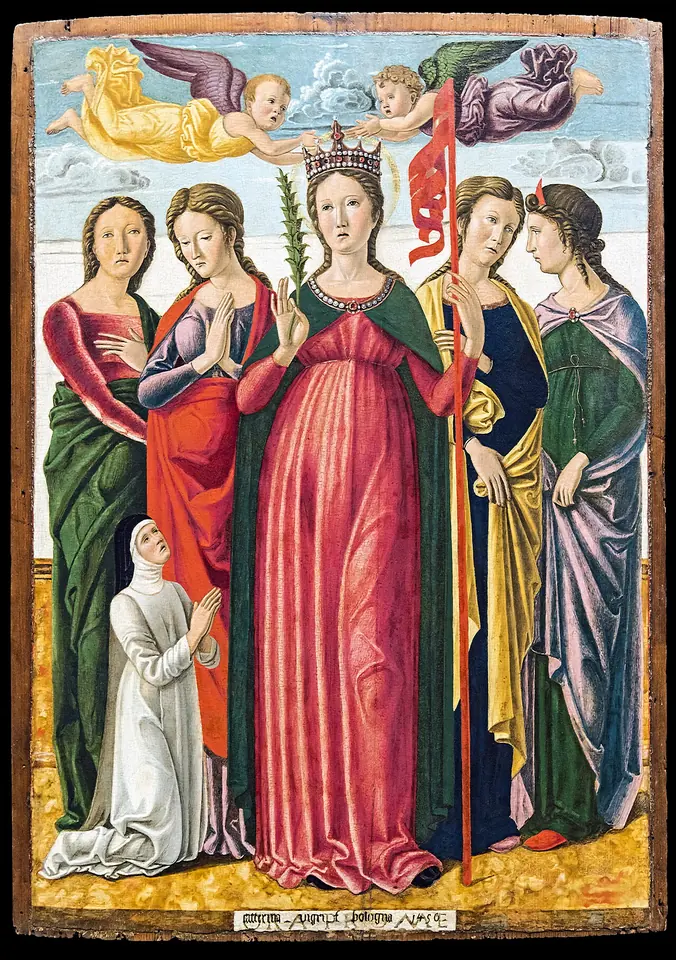
The Gallerie dell'Accademia in Venice has a panel of St. Ursula and her companions dated 1456 and attributed to her, with a small kneeling nun at the saint's feet.
Her other patronages come from her life. People pray to her against temptation because she knew it well and wrote her book to help others resist it. And she is one of the patrons of Bologna, her birthplace, the city she came back to as abbess and where she still sits.
See more saints and their causes on our patron saints page.
Symbols of St. Catherine of Bologna in art
Catherine is almost always shown as a Poor Clare: a gray-brown or dark habit with a knotted cord, a white wimple and a black veil. To tell her from St. Clare and other Franciscan nuns, look for:
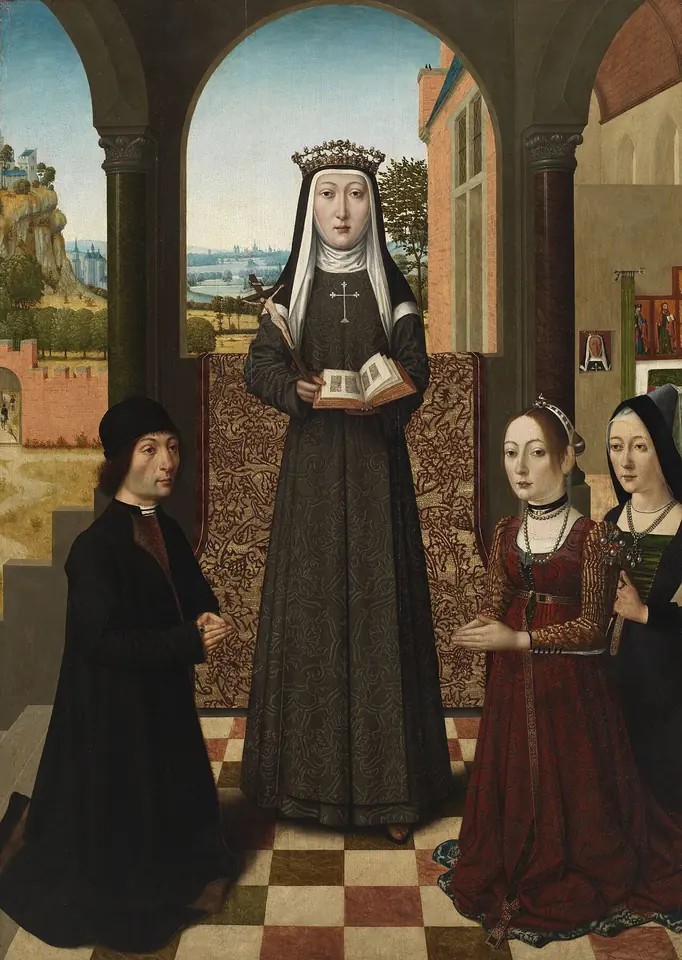
- A book: her Seven Spiritual Weapons, or her breviary. In the Courtauld panel she holds it open toward us.
- A crown: several early images crown her, as in the Courtauld panel and the 1711 print. A crown is a common sign of a holy virgin, and her shrine also once kept the real crown that Queen Isabella of Naples gave her.
- The Christ Child in her arms: the Christmas vision, often with the Virgin Mary handing him to her.
- A small viola or a paintbrush: her music and her art.
- Seated on a chair or throne: the way pilgrims have seen her body for centuries. Devotional prints often show her enthroned like this.
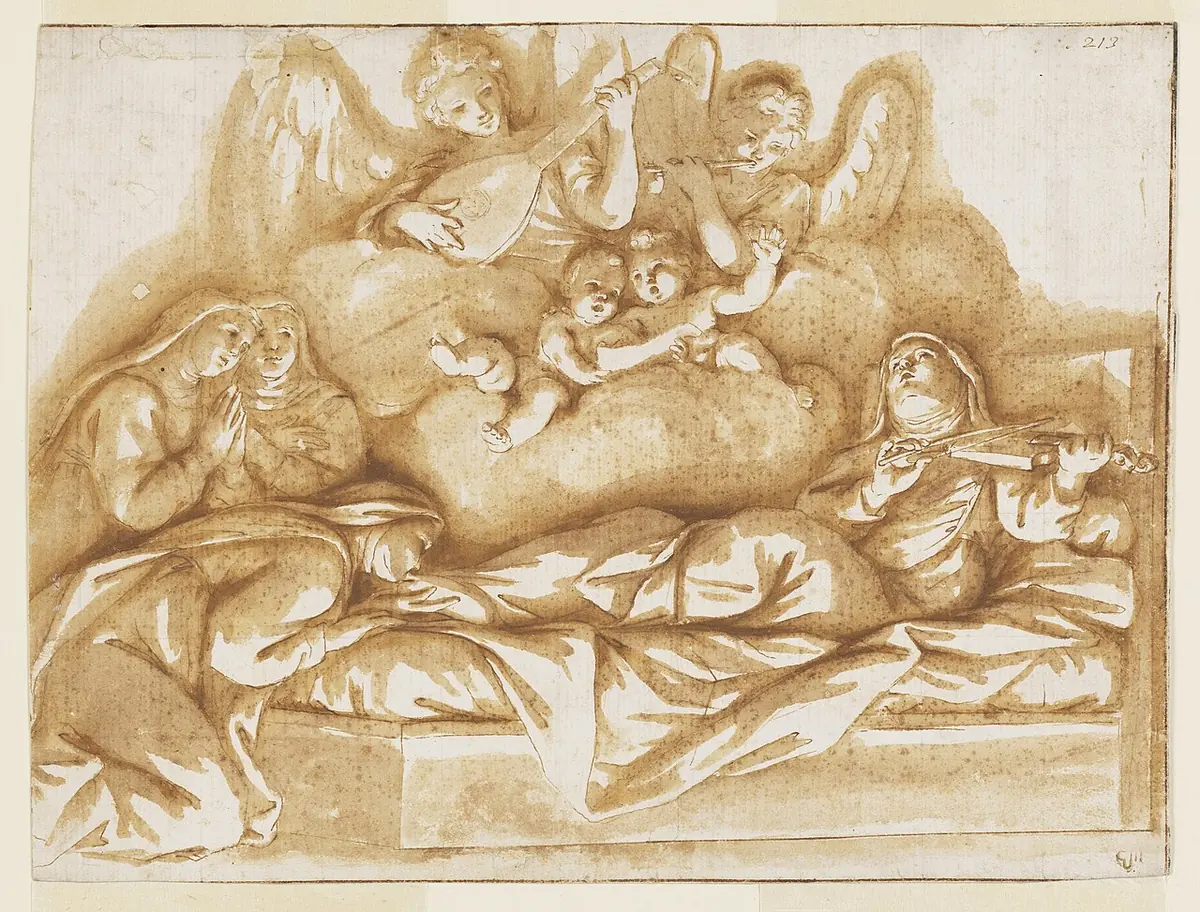
- Angels making music: at her death, as in a 17th-century design for her church.
The Courtauld Gallery's panel by the anonymous painter called the Master of the Baroncelli Portraits, described as the earliest known painting of her, shows her standing crowned in a black habit, holding a book, with three donors kneeling at her sides.
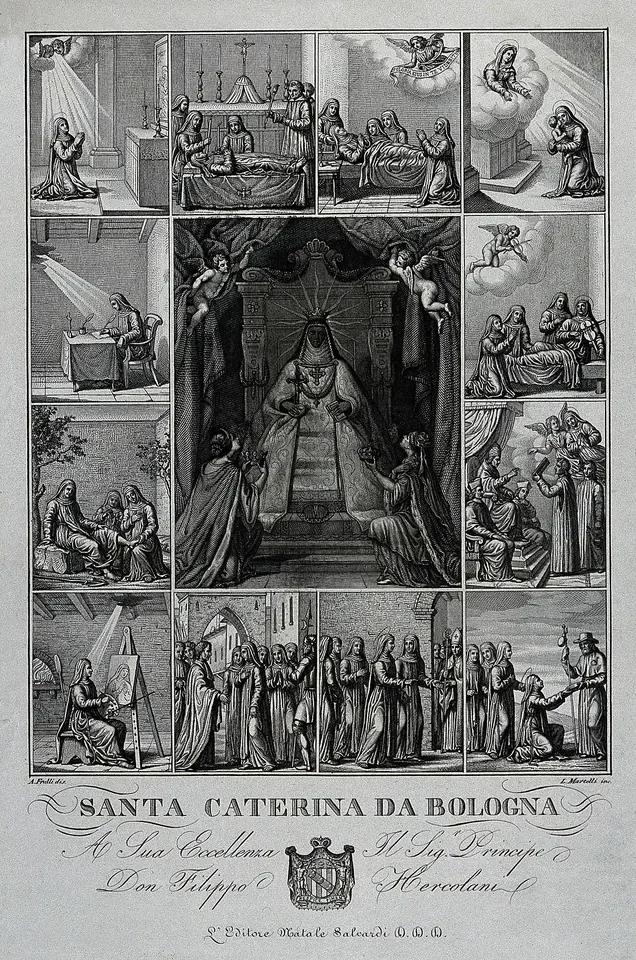
Later Italian engravings often put her seated figure in the center and surround it with small scenes from her life: the Christmas vision, her work as baker and portress, her death and the finding of her body.
Visiting St. Catherine of Bologna: the Corpus Domini shrine
Her monastery and church stand on Via Tagliapietre, in the old center of Bologna. The people of the city call it simply the Church of the Saint. The present church was built between 1477 and 1480, after Catherine's death, by the Tuscan architects Nicolò Marchionne and Francesco Fucci. Its terracotta portal is traditionally attributed to the sculptor Sperandio da Mantova. Cardinal Giacomo Monti gave the interior a Baroque makeover in 1687, with frescoes by Marcantonio Franceschini.
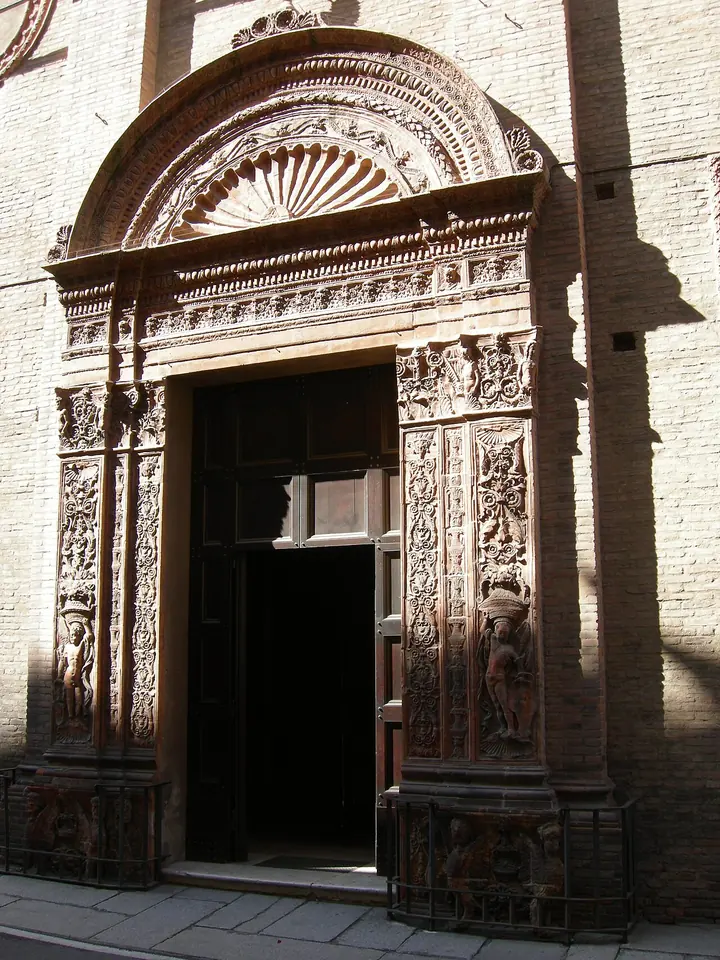
The building has been through a great deal. Napoleon's government suppressed the monastery and the nuns could not return until 1816. In October 1943 an Allied bombing aimed at the barracks next door destroyed the vaults and much of the decoration, and shattered the portal, which was later pieced back together. The Poor Clares lived in the monastery until 2023, when the last sisters moved elsewhere. Today the Identes Missionaries care for the shrine. Two famous scientists are buried in the church: Luigi Galvani, the pioneer of "animal electricity," and Laura Bassi, one of the first women to teach at a university.
Catherine's chapel is open several days a week at set hours. When it is closed, you can still see her through a round grated window to the left of the high altar.

St. Catherine of Bologna's feast day
We keep her feast on March 9, the day of her death. It is in the Franciscan calendar and the Roman Martyrology, though not on the General Roman Calendar, which gives March 9 to St. Frances of Rome. In Bologna the shrine celebrates an octave from March 8 to 16, when her chapel opens every day, groups from across the city take turns leading the prayers, and the vial of fluid from her body is shown. You can find her neighbors on the calendar on our feast days page.
Prayer to St. Catherine of Bologna
We have not found a traditional prayer to St. Catherine of Bologna in the standard English prayer books, and we won't make one up and put it in her mouth. Two texts can guide us.
The first is the angel's song she sang in her last year, which the shrine has written above her body:
The Glory of God shall be seen in you.
The second is the prayer with which Pope Benedict XVI closed his audience on her in 2010:
Let us ask God, through the intercession of Our Saint, for the gift to achieve courageously and generously the project he has for us, so that he alone may be the firm rock on which our lives are built.
Let us ask St. Catherine to pray for us when we are tempted, when faith feels dark, and when obedience asks for something we would not have chosen. She knew all three. Artists may ask her to pray that their work, like hers, gives glory to God.
Frequently asked questions
Why is St. Catherine of Bologna's body seated?
After her death in 1463 the sisters exhumed her body, found it incorrupt, and for years lifted it up to show it to visitors through a grate. The shrine's account says that about twelve years later, at the abbess's request, the body bent forward into a sitting position. It has been kept seated in her chapel ever since. The incorruption is reported; the seating story is traditional.
Is St. Catherine of Bologna really incorrupt?
Her body has been on view since the 15th century and is described as incorrupt by the shrine, the Catholic Encyclopedia and Pope Benedict XVI. It is dark with age, as you would expect after more than five centuries. This encyclopedia labels the incorruption reported, since it was not one of the miracles formally approved for her canonization.
Where can I see St. Catherine of Bologna?
At the Santuario del Corpus Domini, Via Tagliapietre 19, in the old center of Bologna. Her chapel is open at set hours several days a week, and on other days you can see her through a round grated window to the left of the high altar. Hours change, so check with the shrine before you go.
What are the Seven Spiritual Weapons?
Catherine's short book on spiritual combat, which she handed to her confessor just before she died. The seven weapons are: diligence in doing good, distrust of oneself, trust in God, remembering the Passion of Jesus, remembering that we must die, remembering the joys of heaven, and the memory of Holy Scripture.
Why is St. Catherine of Bologna the patron saint of artists?
She was a trained painter and illuminator of manuscripts, as well as a musician and poet. Her own paintings, including the Madonna of the Pomegranate and the miniatures in her breviary, are still kept beside her body in Bologna.
When is St. Catherine of Bologna's feast day?
March 9, the day she died in 1463. It is kept in the Franciscan calendar and the Roman Martyrology, and Bologna celebrates it with an octave of prayer from March 8 to 16.
Is Catherine of Bologna the same as Catherine of Siena?
No. Catherine of Siena was a Dominican laywoman who died in 1380 and is a Doctor of the Church; her feast is April 29. Catherine of Bologna was a Poor Clare nun who was born in 1413. Pope Benedict XVI spoke about them in back-to-back audiences in 2010, calling Catherine of Bologna "another less well known Saint who has the same name."
Who canonized St. Catherine of Bologna?
Pope Clement XI, on May 22, 1712. The 1908 Catholic Encyclopedia credits Pope Benedict XIII, but the Vatican's own account and the shrine both give Clement XI.
Sources
- Benedict XVI, General Audience of 29 December 2010: Saint Catherine of Bologna. Her family and life, the Seven Weapons, her death repeating the name of Jesus three times, canonization by Clement XI on May 22, 1712
- Santuario Corpus Domini, Bologna: Saint Catherine of Bologna. Exhumation after 18 days, the seated body, the viola, the bread and St. Joseph's bowl, the angel's song, Queen Isabella's crown, beatification in 1703
- Santuario Corpus Domini, Bologna: History of the Sanctuary. The church of 1477–1480, the 1943 bombing, the nuns' departure in 2023, the March 8–16 octave, the Galvani and Bassi tombs
- Catholic Encyclopedia (1908): St. Catherine of Bologna
- Le sette armi spirituali, Bologna, about 1475 (BEIC digital library, via Wikimedia Commons)
- Roman Martyrology, March 9