St. Enda of Aran

St. Enda of Aran was an Irish prince of Oriel who gave up war and rule to become a monk, studied in Britain, and about 484 founded a monastery at Killeany on Inis Mór, the largest of the Aran Islands. Aran became the training ground of the great Irish saints, including Brendan, Ciarán and Columba. He died very old, about 530–540, and we keep his feast on March 21.
Who was St. Enda of Aran?
St. Enda of Aran was an Irish chieftain who laid down his spear, became a monk, and built on a bare limestone island in the Atlantic the monastery where a whole generation of Irish saints learned the monastic life. His monastery at Killeany, on Inis Mór, the largest of the three Aran Islands at the mouth of Galway Bay, was in the words of the Catholic Encyclopedia "the greatest sanctuary and nursery of holiness throughout all the 'land of Erin.'" He died very old, about 530 to 540, and we keep his feast on March 21.
Enda (in Irish Éanna, in Latin Endeus) lived in the age just after St. Patrick. What we know of him comes from a Latin life printed by the Irish Franciscan John Colgan in the seventeenth century and from the traditions of the islanders. Bishop John Healy retold that life in 1890 in his history of Ireland's ancient schools, and we follow his account, keeping in mind that the old lives mix history with legend.
The warrior prince
Enda was of royal blood. His father, Conall Derg, was king of Oriel, a territory that stretched from Lough Erne to the sea at Dundalk. When his father died, Enda became chieftain and, Healy says, "took a chieftain's share in the wild work of mutual pillage and slaughter" of his day.
His sister Fanchea had other plans for him. She was a nun with a small convent at Rossory, near what is now Enniskillen. The old life tells that Enda came to her gate fresh from a raid and asked to marry one of the young women in her care. Fanchea offered the girl a choice between Christ and an earthly husband; the girl chose Christ and soon after "fell quietly asleep in the Lord." Fanchea showed her brother the dead girl's face and warned him, "so shall you soon be if you repent not your sins." Enda was shaken to the heart, gave up his principality and resolved to become a monk.
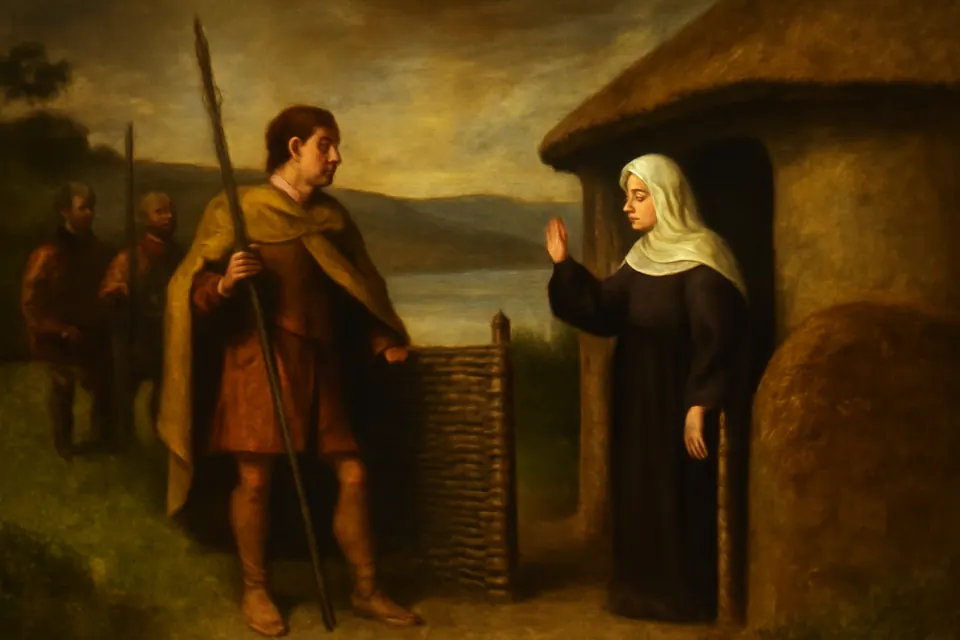
The life adds a homely story. Once, while he was building a monastery at Killany in County Louth, raiders passed by and Enda grabbed a pole to fight. Fanchea told him to put his hand to his head. He felt his tonsure, remembered whose soldier he now was, and dropped the weapon.
Training in Britain and Rome
Fanchea knew he still had much to learn and sent him across the sea to the monastery of Rosnat, under a master called Mancenus. Healy agreed with the Scottish historian Skene that Rosnat was most likely Candida Casa, the "White House" at Whithorn in Galloway founded by St. Ninian, though some placed it in Wales. Healy guesses Enda went there between 470 and 480.
The life also sends him on to Rome, where he is said to have founded a monastery, until Fanchea came after him and made him promise to come home within the year. He kept the promise and landed at Drogheda.
Aran of the Saints
Enda wanted solitude. His sister Darenia was married to Aengus, king of Munster, the king St. Patrick had baptized, and the Aran Islands belonged to Aengus. The king tried to talk him out of it, warning that the islanders were hostile pagans, and offered him good land in the Golden Vale instead. Enda insisted, and Aengus granted him Aran. Since Aengus died about 484, Healy dates the grant before that year.
Enda landed in the little bay below the village that still carries his name, Killeany (Cill Éinne, "Enda's church"), and built his first monastery there. As disciples came, the Catholic Encyclopedia says, he divided the island among several houses, each with its own superior, while he kept charge of them all.

The life on Aran was hard and simple. The monks slept on the ground or on straw in their stone cells, with no fire however wild the weather. They fished, grew patches of oats and barley between the rocks, ground their corn by hand and wove their own clothes from undyed wool. They drank neither wine nor mead. The Catholic Encyclopedia says that "Enda himself never tasted flesh meat." Their study was the Scriptures.

The school of the saints
Almost every great founder of the next generation came to Aran. St. Brendan the Navigator came for Enda's blessing before his voyages. St. Finnian of Clonard, the "tutor of the saints of Erin," came to learn from him. St. Columba ground corn and herded sheep there, and later called Aran "the Sun of all the West." St. Jarlath of Tuam and many others spent time on the island.
The best loved of all was St. Ciarán, the carpenter's son. When God called Ciarán away to found Clonmacnoise, the Catholic Encyclopedia says, Enda and his monks walked with him to the shore, "whilst their eyes were dim with tears."

Miracles and legends
- Traditional: the conversion story of Fanchea and the girl who died in peace, from Colgan's Latin life.
- Traditional: the tonsure that stopped Enda from fighting the raiders.
Symbols of St. Enda in art
Old pictures of Enda are almost unknown, so his symbols come from his story:
- The habit and the old Irish tonsure: the prince who became a monk.
- An abbot's staff: the father of the monasteries of Aran.
- A currach: the hide-covered boat of the islands, recalling the saints who came and went across the sound.
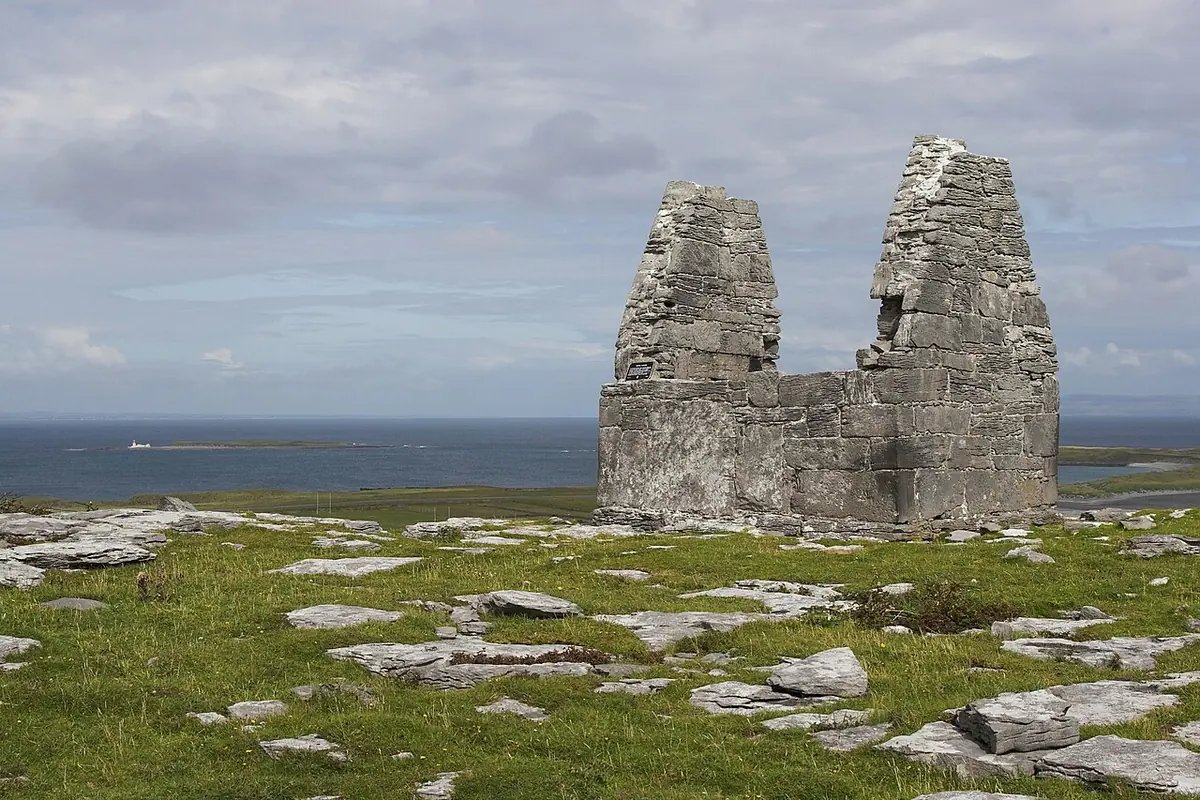
- A small stone church by the sea: Teaghlach Éinne at Killeany.
His grave and his feast
Enda was buried beside his little oratory, Teaghlach Éinne, near the shore at Killeany. Healy writes that 127 saints lie in the graveyard around it and that Enda's own grave, marked by a flat stone, lies a few paces northwest of the door, sometimes hidden by drifting sand. Churches and parishes bearing his name are found in Clare, Galway, Meath, Limerick and Laois.
We keep his feast on March 21; see our feast day calendar.
Prayer to St. Enda
We have found no traditional English prayer to him. Let us pray in our own words: St. Enda of Aran, who gave up a kingdom for Christ and taught saints to pray, pray for us, for Ireland, and for all who seek God in silence.
Frequently asked questions
Who was St. Enda of Aran?
A fifth- and sixth-century Irish saint, son of a king of Oriel, who became a monk through the urging of his sister St. Fanchea and founded the island monastery of Killeany on Inis Mór. He is often called a father of Irish monasticism.
When is the feast of St. Enda?
March 21.
Where is St. Enda buried?
At Killeany on Inis Mór, beside the small church called Teaghlach Éinne, in a graveyard where tradition says 127 saints are buried.
Which saints studied with St. Enda on Aran?
The old lives name St. Ciarán of Clonmacnoise, St. Brendan the Navigator, St. Columba and St. Jarlath of Tuam among those who came to him, and say St. Finnian of Clonard visited.
Keep exploring
Sources
- John Healy, Insula Sanctorum et Doctorum, or Ireland's Ancient Schools and Scholars (Project Gutenberg). Chapter on the monastic school of St. Enda: his family, Fanchea, Rosnat, the grant of Aran from Aengus, Teaghlach Éinne and his grave
- Catholic Encyclopedia (1907): The Monastic School of Aran. His disciples, the rule of life on the island, and Columba's words on Aran