St. Christina of Persia, Virgin and Martyr

St. Christina of Persia was a noblewoman of the Persian Empire, born Yazdoi, who left the Zoroastrian religion to be baptized, took the name Christina, and died a virgin martyr in the sixth century. Her life was written by the Syriac monk Babai the Great, though only its preface survives. The Roman Martyrology honors her on March 13.
Who was St. Christina of Persia?
St. Christina of Persia was a young noblewoman of the Persian Empire who was born into the Zoroastrian religion of the Sasanian kings, came to faith in Christ, and gave her life for Him as a virgin martyr in the sixth century. Her family called her Yazdoi. At baptism she took the name Christina, which means "Christian." The Church of the East remembered her, the churches of Jerusalem and Georgia sang her feast within a few decades of her death, and the Roman Martyrology still names her: "In Persia, St. Christina, virgin and martyr." We keep her memory on March 13.
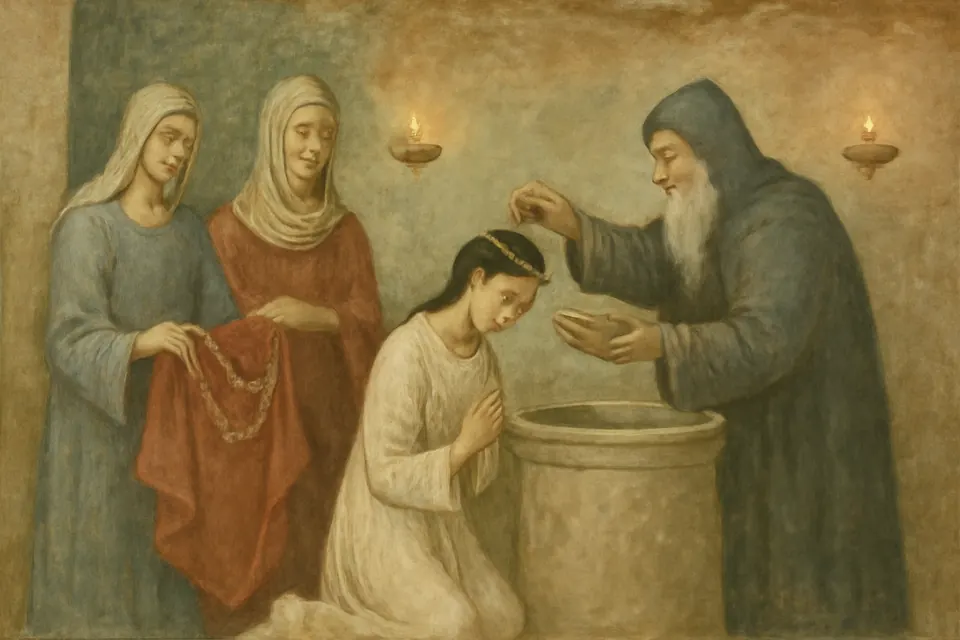
We know very little about her, and we should say so plainly. Her full life is lost. What remains is a single preface in Syriac, a handful of calendar entries, and the faith of the Christians who kept her name. That is enough to honor her, and not enough to tell her story in detail.
The life of St. Christina of Persia
A noble convert in the Persian Empire
Christina lived in the Sasanian Empire, which ruled Persia and Mesopotamia from the third century until the Arab conquest. Its state religion was Zoroastrianism. Christians of the Church of the East lived there in large numbers and were often tolerated. But a Persian of noble Zoroastrian family who became a Christian was treated as an apostate, and could pay with her life. Many of the martyrs of the Persian Church died for exactly this reason.
Christina was such a convert. Her biographer, the monk Babai, began his account by explaining her two names. In the French translation published by the Syriaca.org project, he says she was called Yazdoi "when she was a pagan," and that "in her new birth of adoption, the pledge of life," she chose to be called Christina, "a name that does not pass away" (our English rendering).
Virgin and martyr
The Roman Martyrology calls her a virgin as well as a martyr. Later martyrologies place her death under King Khosrow I, who reigned from 531 to 579, and the Greek tradition says she died under beating with rods. The exact year, the place and the details of her trial are not known.
We can be sure of one thing from the calendars: her memory spread fast. The Georgian version of the Lectionary of Jerusalem, from the early seventh century, already lists her feast on March 15. So within a few generations of her death, pilgrims and monks in the Holy City were praying in her honor alongside the great martyrs of the early Church.

Babai the Great, her biographer
The life of Christina was written by Babai the Great, who died in 628. He was abbot of the Great Monastery on Mount Izla in northern Mesopotamia and the leading theologian of the Church of the East in his day. He wrote several lives of martyrs, including that of George of Izla, another convert from the Persian nobility, who was put to death in 615.

Only the preface of Babai's life of Christina survives. The Syriac text was printed by Paul Bedjan in 1894, in the fourth volume of his Acts of the Martyrs and Saints, pages 201 to 207, from a manuscript copied from a codex of the Chaldean archdiocese of Diyarbakir. The Syriaca.org catalog also records an ancient Armenian version of the text. Small as it is, the preface was enough for scholars to connect the Persian Yazdoi with the Christina of the calendars.
The miracles of St. Christina of Persia
No miracles of Christina are recorded in the surviving sources. Her witness is her martyrdom: a young woman of rank who gave up family, wealth and safety rather than deny the Christ she had come to know. Any further details of her sufferings found in later retellings are traditional, and the oldest sources do not confirm them.
Symbols of St. Christina of Persia in art
We know of no old painting or icon that certainly shows St. Christina of Persia. Modern images of her, like the ones on this page, usually show:
- A young woman in Persian dress, for her noble Sasanian family.
- A martyr's palm, the sign of victory in martyrdom.
- A cross, for the faith she chose at baptism.
- A crown, sometimes, for virginity and martyrdom.
Be careful in museums and churches: almost every painting of a "St. Christina" shows St. Christina of Bolsena, the Roman virgin martyr honored on July 24, often with arrows or a millstone.
Feast day and how to honor her
The Roman Martyrology names her on March 13. The Georgian calendar of Ioane Zosime, compiled in the tenth century from older Jerusalem sources, gives her on March 14 and again on March 15. See our feast days calendar for other saints of March.
Her memory is a gift to the Christians of Iran and Iraq, who still bear witness to Christ in the lands where she lived, and to every believer who has left family or position to follow Him. Saints like St. Ephrem and St. Isaac the Syrian belong to the same Syriac-speaking world.
Prayer to St. Christina of Persia
We know of no traditional prayer to St. Christina of Persia in English. We may ask her, in our own words, to pray for converts who pay a high price for their faith, and for the persecuted Church in the Middle East. St. Christina of Persia, virgin and martyr, pray for us.
Frequently asked questions
When is the feast of St. Christina of Persia?
March 13 in the Roman Martyrology. The oldest Georgian calendars, based on the liturgy of Jerusalem, kept her on March 15 or March 14.
What was St. Christina of Persia's original name?
Yazdoi. Her biographer Babai the Great wrote that she was called Yazdoi while she was a pagan, and at her new birth in baptism she chose to be called Christina, 'a name that does not pass away.'
Is St. Christina of Persia the same as St. Christina of Bolsena?
No. St. Christina of Bolsena is an early Roman virgin martyr honored on July 24 at Lake Bolsena in Italy. St. Christina of Persia lived centuries later in the Sasanian Empire and is honored on March 13.
Why is so little known about St. Christina of Persia?
Her full life, written in Syriac by Babai the Great in the early seventh century, has been lost except for its preface. What survives is that preface, her name in the calendars of Jerusalem and Georgia, and the brief entry in the Roman Martyrology.
Keep exploring
Sources
- Syriaca.org: Christine Yazdouy (text), work 336. Babai the Great as author, the preface on her names Yazdoi and Christina, the edition by Bedjan, the surviving manuscript and an ancient Armenian version
- The Cult of Saints in Late Antiquity (University of Oxford): Christina-Yazdoi, martyr in Persia, S01385. Her commemoration on March 15 in the Georgian Lectionary of Jerusalem and on March 14 and 15 in the calendar of Ioane Zosime
- Paul Bedjan, Acta Martyrum et Sanctorum, vol. IV (Paris, 1894), pp. 201–207. The Syriac text of Babai's surviving preface
- The Roman Martyrology (1916 English edition), March 13