St. Heribert of Cologne, Archbishop, Friend of the Poor and Bringer of Rain
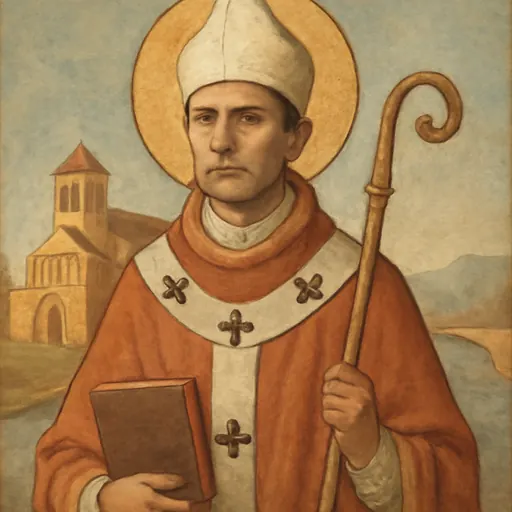
St. Heribert of Cologne (about 970–1021) was chancellor to Emperor Otto III and archbishop of Cologne from 999 until his death. He founded the abbey of Deutz and was loved for his care of the poor. By tradition his prayer brought rain to a parched land, so Cologne honors him as a patron for rain. His feast is March 16.
Who was St. Heribert of Cologne?
St. Heribert of Cologne was the archbishop of Cologne from 999 to 1021, a statesman who served two emperors and a shepherd remembered above all for his love of the poor. He founded the abbey of Deutz on the right bank of the Rhine, and there he was buried. The people of Cologne began calling him a saint almost as soon as he died, and they still ask his help when the fields are dry, because tradition says his tears once brought down the rain.
The life of St. Heribert
Worms and Gorze
Heribert was born at Worms around 970, the son of a nobleman named Hugo. He studied at the cathedral school of Worms and then spent time at the Benedictine abbey of Gorze in Lorraine, one of the great reforming monasteries of the age. Back in Worms he became provost of the cathedral. He was ordained a priest in 994.
Chancellor to Otto III
The young emperor Otto III made him chancellor for Italy in 994 and, four years later, for Germany as well. The Catholic Encyclopedia calls him "the most influential adviser of Otto III." He traveled with Otto to Rome, and he was still in Italy in 999 when the clergy of Cologne chose him as their archbishop. At Benevento, on July 9, 999, he received the pallium from Pope Sylvester II.
Baring-Gould, drawing on the Life written by Lantbert of Deutz about twenty years after Heribert's death, says he took the news "with great regret," and on Christmas Eve walked barefoot to his cathedral. He was consecrated on Christmas Day.

The emperor's body and a hard road
In January 1002 Heribert stood at the deathbed of Otto III, who died in Italy aged only twenty-one. While he was carrying the emperor's body and the imperial insignia back to Germany, he was held captive for a time by Duke Henry of Bavaria, the future Emperor Henry II, whose claim to the throne Heribert had at first opposed.

Once Henry was elected king, Heribert accepted him and served him faithfully, but the king did not fully trust him. Only in 1021, the year of Heribert's death, did Henry see his mistake and humbly ask the archbishop's pardon.
The abbey of Deutz
According to the Archdiocese of Cologne, Heribert had promised Otto on his deathbed that he would found a monastery. He kept the promise. Within the ruins of an old Roman fort at Deutz, across the river from the city, he built a Benedictine abbey and a great round church, which he dedicated in 1020. He also rebuilt the church of the Holy Apostles in Cologne.
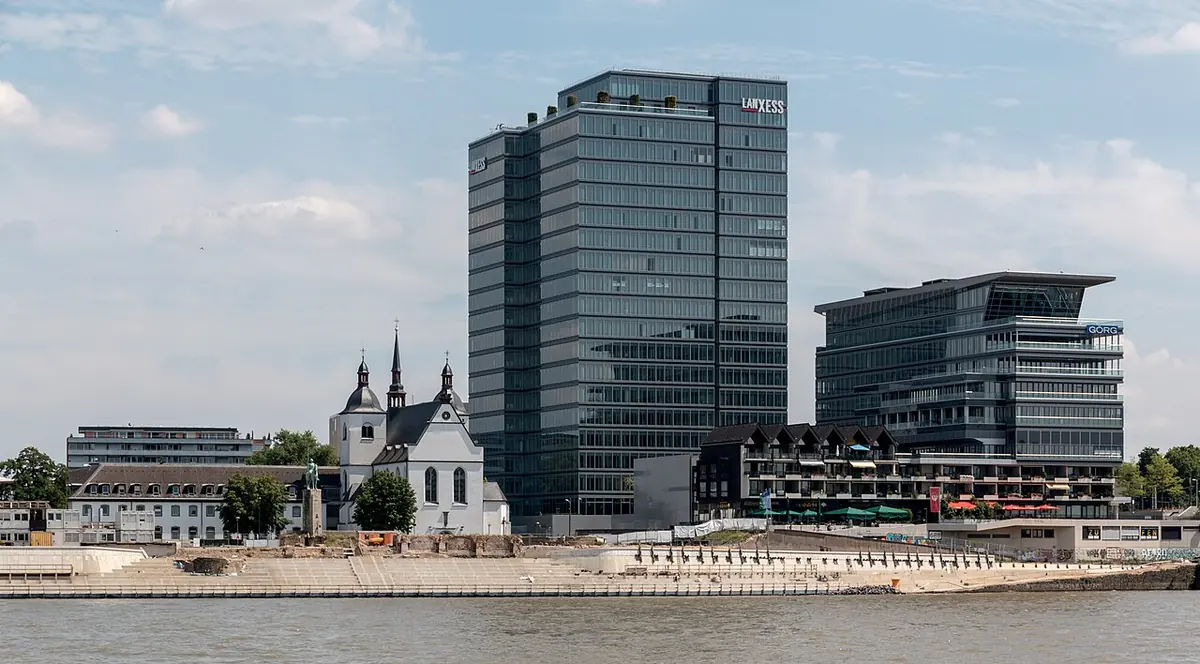
He fell ill with fever on a pastoral visitation and died in Cologne on March 16, 1021. He was buried in his abbey at Deutz.
The miracles of St. Heribert
The rain (traditional). Lantbert's Life tells that during a long drought, when the cattle of the poor were dying, Heribert led a procession to the church of St. Severinus in Cologne. Kneeling at the altar, he bowed his head on his hands and wept for his people, and he did not lift it until a thunderstorm broke over the church. This is why Cologne calls him its patron for rain. He was honored as a saint even during his lifetime, and his cult grew at Deutz after his death. The Catholic Encyclopedia records that Pope Gregory VII canonized him between 1073 and 1075, long before the modern process with its formally approved miracles existed.

Why St. Heribert is invoked for rain
The rain story is the heart of his popular cult. The Archdiocese of Cologne still calls him the patron for rain ("Patron für Regen"), and its tribute marking a thousand years since his death is titled "Archbishop, Saint and Rainbringer." The church where he prayed was St. Severinus, named for an early bishop of Cologne, not the better-known St. Severinus of Noricum.
Symbols of St. Heribert in art
- Archbishop's vestments and pallium: his office at Cologne.
- Crozier and book: the shepherd and teacher.
- A church in his hands: the founder of Deutz, in some later images.
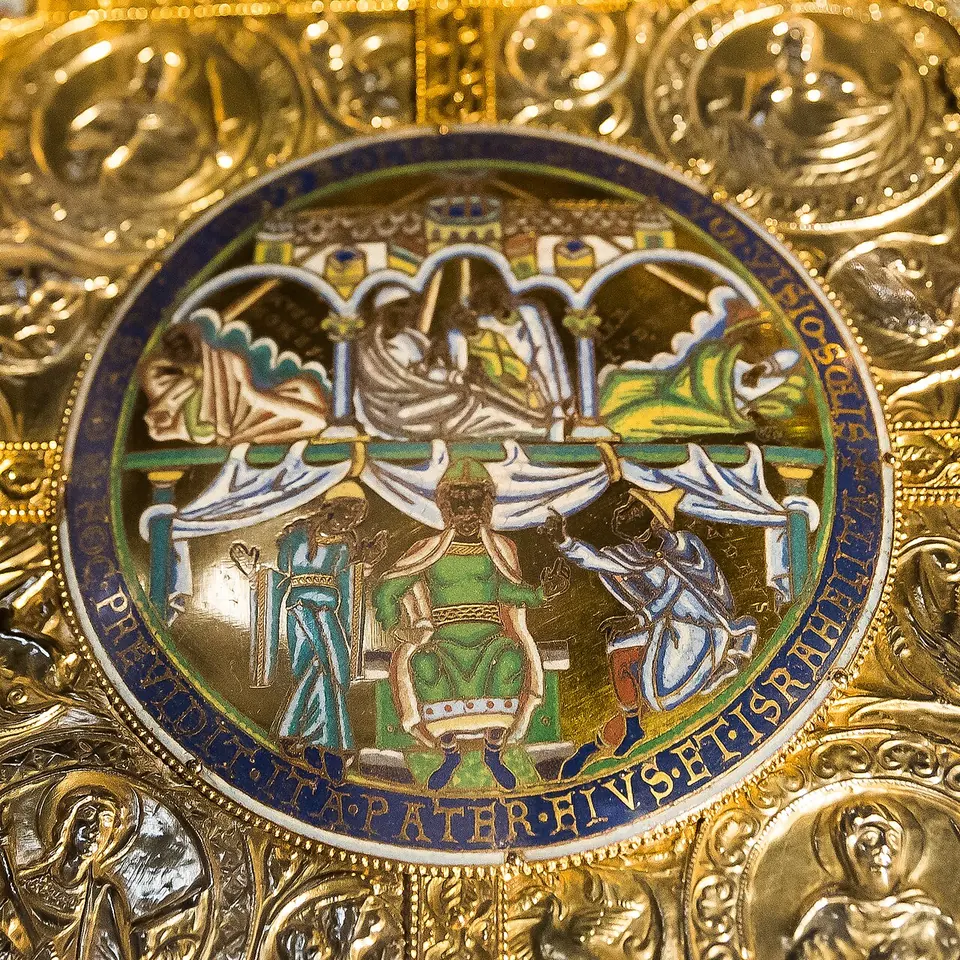
The greatest image of him is the Heribert Shrine itself. On the end panel he sits enthroned as bishop, flanked by figures of Charity and Humility, and the twelve enamel medallions on the roof tell his life from his birth onward.
Feast day and relics
His feast is March 16. On August 30, 1147, his bones were raised from the tomb, and in the following decades the goldsmiths of the Rhine and Meuse made the shrine that holds them. The parish describes its enamels as all part of the original twelfth-century work. The shrine stands today behind the altar of the parish church of St. Heribert in Cologne-Deutz, and Cologne keeps August 30 as a second feast. The old abbey church, Alt St. Heribert, now serves the Greek Orthodox community of Cologne. Browse more saints on our feast days page.
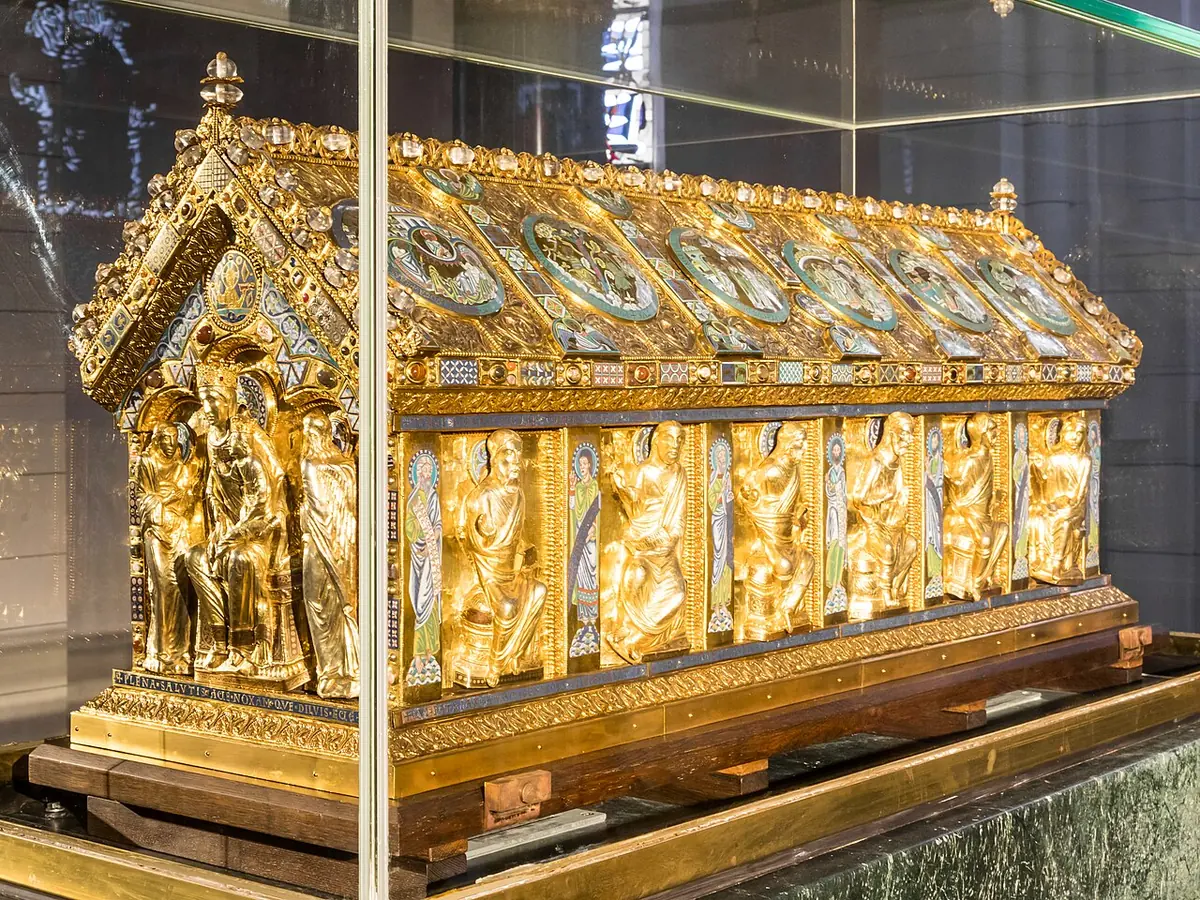
Where the relics of St. Heribert of Cologne are kept: see them on the relics map →
Prayer to St. Heribert
We know of no widely used traditional prayer to St. Heribert in English. When the land is dry, we can join the people of Cologne in asking his help simply:
St. Heribert, you wept before the altar for your hungry people until the rain came. Pray for us and for all who work the land, and teach us to care for the poor as you did.
Frequently asked questions
Who was St. Heribert of Cologne?
A German churchman born at Worms around 970, educated there and at the abbey of Gorze, who became chancellor for Emperor Otto III and in 999 archbishop of Cologne. He founded the Benedictine abbey of Deutz and died on March 16, 1021.
Why is St. Heribert invoked for rain?
His medieval Life by Lantbert of Deutz tells that during a drought he led a procession to the church of St. Severinus and wept in prayer at the altar until a storm broke. The Archdiocese of Cologne still calls him its patron for rain.
Where are the relics of St. Heribert?
In the Heribert Shrine, a gilded reliquary with enamel scenes of his life, made in the decades after his bones were raised on August 30, 1147. It stands behind the altar of the parish church of St. Heribert in Cologne-Deutz.
When is the feast of St. Heribert?
March 16, the day he died. Cologne also remembers the raising of his relics on August 30.
Keep exploring
Sources
- St. Heribert, Catholic Encyclopedia (1910), New Advent. Birth at Worms, Gorze, chancellor for Italy and Germany, pallium from Sylvester II on July 9, 999, consecration on Christmas Day, captivity under Henry II, canonization by Gregory VII between 1073 and 1075
- S. Baring-Gould, The Lives of the Saints, vol. 3 (March), Project Gutenberg. The Life by Lambert (Lantbert) of Deutz, the barefoot entry into Cologne, the procession and prayer for rain at St. Severinus
- 1000 Jahre Heribert von Köln – Erzbischof, Heiliger und Regenbringer, Erzbistum Köln. Patron for rain, the raising of his bones on August 30, 1147, his promise to Otto III to found a monastery, the abbey church dedicated in 1020, Alt St. Heribert now used by the Greek Orthodox community
- Sankt Heribert, Seelsorgebereich Deutz/Poll. The Heribert Shrine behind the altar, its enamels from the twelfth century, the medallions telling his life