St. Aristobulus of Britannia
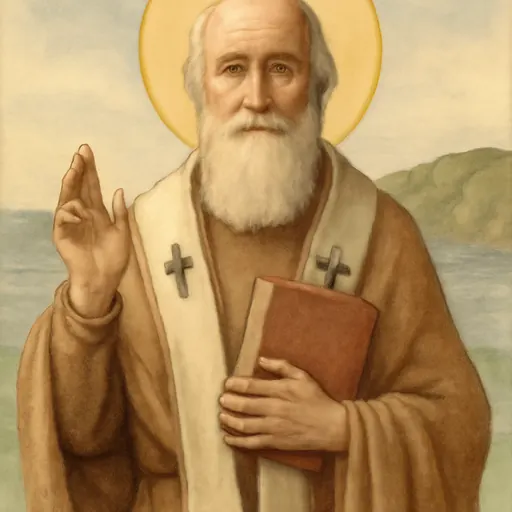
St. Aristobulus of Britannia is a first-century Christian whose household St. Paul greets in Romans 16:10. The Orthodox Church honors him as one of the Seventy Apostles, brother of St. Barnabas and first bishop of Britain, and the old Roman Martyrology says he ended a life of preaching the Gospel by martyrdom. We keep his feast on March 15.
Who was St. Aristobulus of Britannia?
St. Aristobulus of Britannia is one of the shadowy, beloved figures of the apostolic age. His name appears once in the New Testament, in the greetings at the end of St. Paul's Letter to the Romans. The Orthodox Church honors him as one of the Seventy Apostles whom Christ sent out ahead of him (Luke 10:1), as the brother of St. Barnabas, and as the first bishop of Britain. The Western Church has kept his name too: the old Roman Martyrology remembers him on March 15 as "a disciple of the Apostles."
How much of this is history? The honest answer is very little, and we will be careful to separate what Scripture says, what the early lists say, and what later tradition added.
What Scripture says
In Romans 16, Paul sends greetings to a long list of believers in Rome. In verse 10 he writes:
Salute Apelles approved in Christ. Salute them which are of Aristobulus' household.
That is all (King James Version). Paul greets the household of Aristobulus, which in Roman usage could mean his family, his slaves and freedmen, or both. He does not greet Aristobulus himself. Some readers have taken this to mean Aristobulus was away from Rome when the letter was written, around the year 57. Others think he had already died, and that "those of Aristobulus" were simply people who had belonged to his house.

What the tradition says
One of the Seventy
Early Christians liked to give names to the Seventy disciples of Luke 10, and the people Paul greets in Romans 16 were natural candidates. A Greek list On the Seventy Disciples, long attributed to St. Hippolytus of Rome but now thought to be later, includes "Aristobulus, bishop of Britain," next to Narcissus, bishop of Athens, and Herodion, bishop of Tarsus.
The Eastern life
The life read in the Orthodox Church today, as given by the Orthodox Church in America, says Aristobulus was born on Cyprus, was the brother of the Apostle Barnabas, and traveled with St. Paul. Paul made him a bishop and sent him to preach in Britain, where he suffered beatings and mockery from the pagans, won many of them to Christ, and finally reposed in peace among the people he had evangelized. The same life notes that "some sources say he suffered a martyr's death in Wales at an advanced age," and that the stories about his earlier life conflict. Some identified him with Zebedee, father of James and John; others with St. Peter's father-in-law. The OCA's own verdict: "Most of these are unreliable."
In the West
The old Roman Martyrology, in its entry for March 15, gives a single line: "the birthday of St. Aristobulus, a disciple of the Apostles, who terminated by martyrdom a life spent in preaching the Gospel." It does not mention Britain.

What we can say
No early British writer mentions Aristobulus, and the story of his mission there rests on Greek lists written far from Britain. We do not know when or where he died. What we know is that Paul loved and greeted his household, and that the whole Church, East and West, has kept his name for well over a thousand years as a disciple who spent himself preaching Christ. Later writers built many theories on him, linking him to Glastonbury or to the family of Herod, and none of them has good evidence behind it.
Miracles
No miracles are recorded for St. Aristobulus. The traditional account of his mission in Britain speaks of many conversions among hostile pagans, which is the only wonder his life claims.
Symbols of St. Aristobulus in art
St. Aristobulus appears mostly in Orthodox icons, often grouped with other apostles of the Seventy whose names come from Romans 16. Look for:
- Bishop's vestments, especially the omophorion, the broad stole with crosses worn by Eastern bishops, because tradition makes him bishop of Britain.
- A Gospel book, for his preaching.
- A raised hand in blessing.
- The gray hair and long beard of an elder of the apostolic generation.
In the Russian Lives of the Saints printed between 1903 and 1911, he stands with Sts. Narcissus and Apelles in the illustration for their shared commemoration.

Feast day
We keep his feast on March 15, the day of the Roman Martyrology and of Greek usage. Orthodox churches on the Julian calendar keep him on March 16, and he is commemorated again on October 31 with Sts. Stachys, Amplias, Urban, Apelles and Narcissus, and on January 4 with all the Seventy. See our feast days page for other saints of March.
Prayer to St. Aristobulus
The Orthodox Church sings this troparion to him, in the translation of the Orthodox Church in America:
Holy Apostle Aristobulus, entreat the merciful God, to grant our souls forgiveness of transgressions.
Let us join that prayer, and ask St. Aristobulus to pray for the Church in Britain and Ireland, and for every household where the faith is passed on quietly, as it was in his.
Frequently asked questions
Who was Aristobulus in the Bible?
St. Paul writes in Romans 16:10, "Salute them which are of Aristobulus' household" (King James Version). The verse greets members of his household rather than Aristobulus himself, and Scripture says nothing more about him.
When is the feast day of St. Aristobulus?
March 15 in the Roman Martyrology and in Greek usage, March 16 on the Julian calendar, with further commemorations on October 31 and on January 4, the Synaxis of the Seventy.
Was St. Aristobulus really the first bishop of Britain?
That is the Eastern tradition. A list of the Seventy attributed to St. Hippolytus names "Aristobulus, bishop of Britain," but the list is now thought to be later than Hippolytus, and no early British record mentions him. The Roman Martyrology honors him as a disciple of the Apostles and martyr without naming Britain.
Did St. Aristobulus die a martyr?
Traditions differ. The Roman Martyrology says he ended his life by martyrdom. The Orthodox Church in America's life says he reposed in peace in Britain, adding that some sources say he was martyred in Wales.
Keep exploring
Sources
- Pseudo-Hippolytus, On the Seventy Disciples (Ante-Nicene Fathers, vol. 5), at New Advent. Lists "Aristobulus, bishop of Britain," as number 29
- Orthodox Church in America: Apostle Aristobulus of the Seventy, Bishop of Britain (March 16). Cyprus, Barnabas, the conflicting traditions, his mission and repose, his other commemorations
- Orthodox Church in America: Troparion and kontakion of the Apostle Aristobulus. Text of the troparion
- The Roman Martyrology (1916 English edition), on archive.org. March 15