St. Paul Aurelian (St. Pol de Léon), First Bishop of Léon

St. Paul Aurelian, called St. Pol de Léon in Brittany, was a sixth-century Welsh monk and pupil of St. Illtud who crossed to Armorica, founded monasteries and became the first bishop of Léon. He is one of the seven founder saints of Brittany, and his feast is March 12.
Who was St. Paul Aurelian?
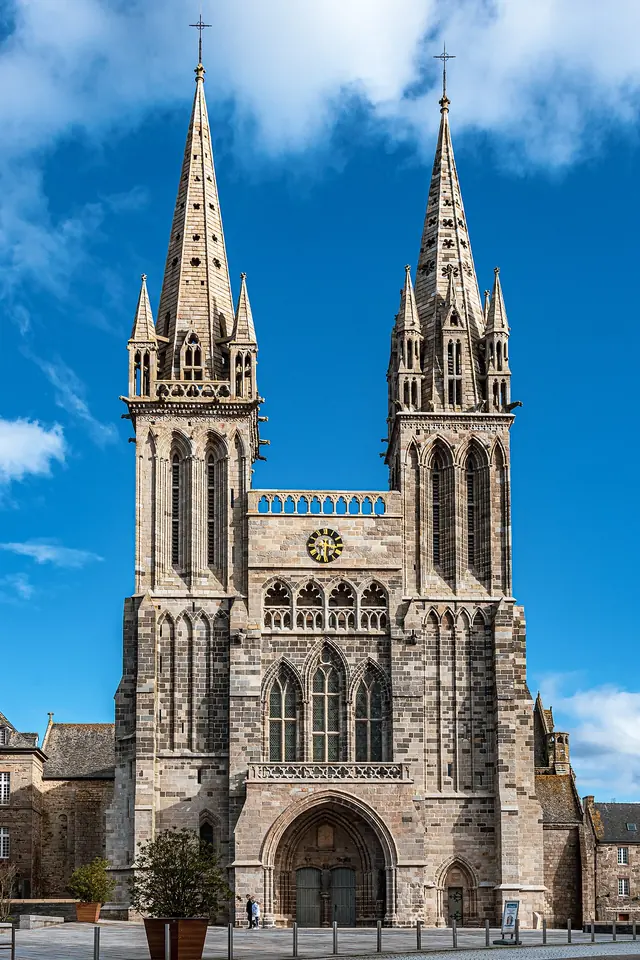
St. Paul Aurelian, St. Pol de Léon to the Bretons, was a monk from Wales who crossed the sea in the sixth century and became the first bishop of Léon, the far northwest corner of Brittany. The cathedral town of Saint-Pol-de-Léon bears his name, and so do the villages of Lampaul on Ouessant, Lampaul-Ploudalmézeau and Lampaul-Guimiliau. With Sts. Samson, Malo, Brieuc, Tugdual, Corentin and Patern he is counted among the seven founder saints of Brittany. We keep his feast on March 12.
Nearly all we know comes from one source, the Life of St. Paul Aurelian written in 884 by Wrmonoc, a monk of Landévennec, who says he reworked an older life. Three centuries separate him from his subject, and the book mixes real places and people with wonder stories. The summary below follows the account of Sabine Baring-Gould and John Fisher, who studied the manuscripts in their Lives of the British Saints (1913).
From Wales to Brittany
Paul was born, the Life says, in Penychen in Glamorgan, the son of a count named Perphius, and he had brothers and three holy sisters, one of them Sitofolla, the Sidwell of Exeter. As a boy he went to St. Illtud's school, where his companions included St. David, St. Samson and St. Gildas. At sixteen he went off with a band of companions to live as a hermit, was ordained priest and lived on water, fish and vegetables.
He then served a king called Mark, who wanted him as bishop. Paul refused and asked instead for one of the king's seven bells. The king said no, and Paul left. After visiting his sister on the coast of Cornwall, where the parish of Paul near Penzance still bears his name, he sailed for Armorica.
Ouessant, Lampaul and Batz
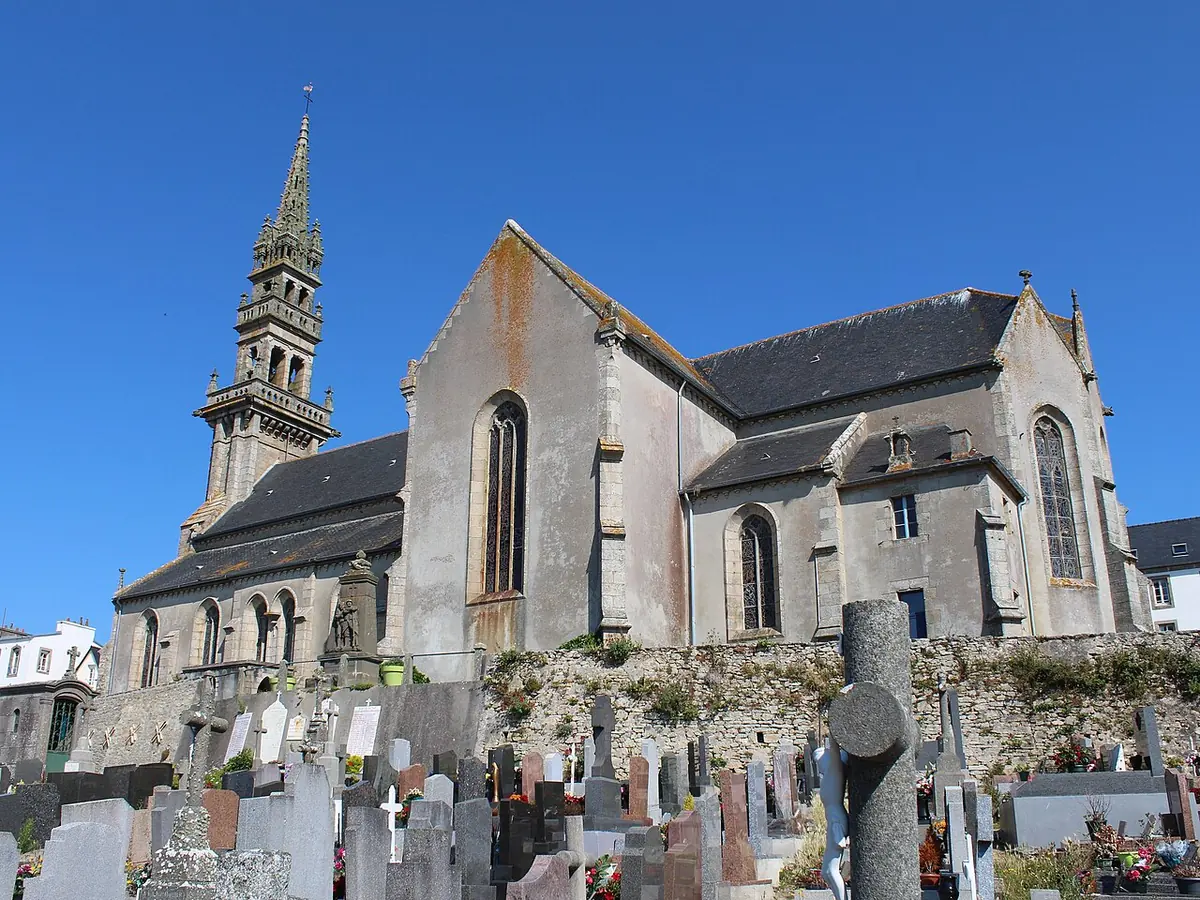
He landed first on the island of Ouessant, where he built a small monastery of a chapel and thirteen huts near a good spring; the village of Lampaul and its church keep his name. He crossed to the mainland and founded another house at Lampaul-Ploudalmézeau, then went east looking for the local ruler, a count named Withur, whose rule had been confirmed by the Frankish king Childebert.
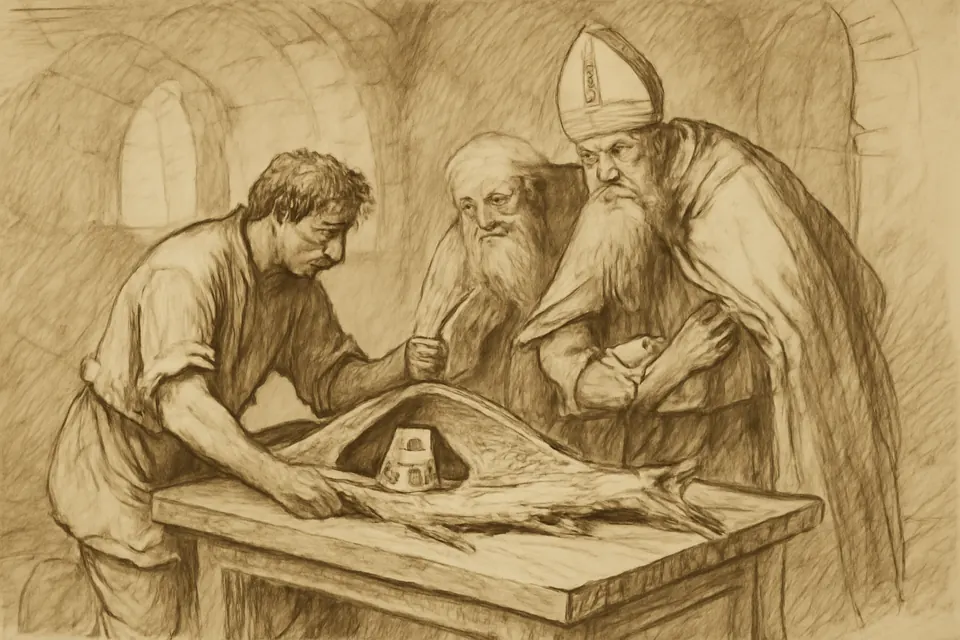
He found Withur on the Île de Batz, just offshore, copying the Gospels by hand. The two were cousins, both from Gwent. As Paul told the story of his quarrel with King Mark over the bell, a fisherman came in with a great salmon, and when it was opened the very bell was inside it. Withur gave Paul the bell, his book of the Gospels, the island of Batz and the ruins of a Roman fort on the mainland, where Paul founded the monastery that grew into the town of Saint-Pol-de-Léon.
The first bishop of Léon
Withur wanted Paul made bishop; Paul refused. So the count sent him to Paris with sealed letters for King Childebert, which asked the king to have Paul consecrated as soon as he read them. Paul came home a bishop. He preached through the country, built chapels and set up monastic cells. In old age, the Life says, he handed his charge to his nephew Joevin and, after Joevin died, to Tigernomagle, then to Cetomerin, and retired to Batz.
He died on the Île de Batz at a great age, on March 12, a Sunday. His Life says he had grown so frail that the sun seemed to shine through his hands. Baring-Gould and Fisher reckoned his death to about 579; other writers prefer 573. His Life gives his age as over one hundred, and some historians suspect that the stories of more than one Paul were joined together.
The dragon of Batz
The best-loved story of St. Pol is the dragon. A monstrous serpent was ravaging the Île de Batz. Paul went out, wound his stole around its neck, led it to the edge of the sea and threw it into the waters. A later Breton life sets the taming at Le Faou instead. Baring-Gould and Fisher offer readings of the story, as a picture of the triumph over paganism or over a persecuting ruler, but in Breton churches it is simply St. Pol and his dragon, and children know it by heart.

Miracles of St. Paul Aurelian
All the wonders in his Life are traditional, written down three centuries after his death:
- The bell found inside the salmon.
- The dragon of Batz cast into the sea.
- In Cornwall, the pebbles his sister laid along the shore that grew into rocks and stopped the sea from eating the land.
- The springs that rose where he told his thirsty companions to dig.
Relics and holy places
The cathedral of Saint-Pol-de-Léon keeps the bell called Hirglas, which tradition identifies with Withur's gift, and a reliquary altar in his honor. Baring-Gould and Fisher describe the bell as about seven and a half inches high. A woven stole, said to be his, was kept on Batz. Tradition says part of his relics were later taken to the abbey of Fleury on the Loire, where a monk also made a summary of his Life.
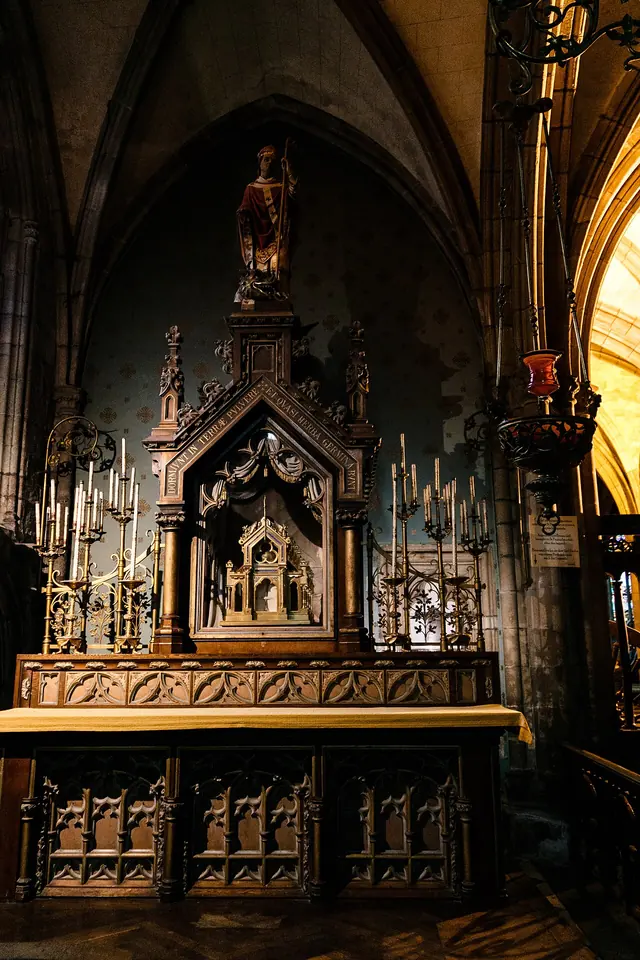
Where the relics of St. Paul Aurelian are kept: see them on the relics map →
Symbols of St. Paul Aurelian in art
Breton statues, windows and banners show him as a bishop. Look for:
- A dragon at his feet or bound by his stole: the serpent of Batz. This is his surest sign.
- A bell: Hirglas, the bell he asked of King Mark.
- A fish: the salmon that brought the bell back.
- Miter and crosier: the first bishop of Léon.
Don't confuse him with St. Paul the Apostle, who holds a sword and book, or with St. Michael or St. George, who fight their dragons with weapons; St. Pol simply leads his dragon away.

Feast day and prayer
We keep the feast of St. Paul Aurelian on March 12. Paul in Cornwall honors him on October 10. See the feast day calendar for the other saints of March.
He is invoked in a tenth-century Celtic litany of the saints, but we have found no traditional prayer addressed to him alone. Let us ask him to pray for Brittany and Wales, for those who leave their homeland to bring Christ to others, and for all who live by the sea. St. Pol, pray for us.
Frequently asked questions
Who was St. Paul Aurelian?
A sixth-century monk from Wales who settled in northwest Brittany, founded monasteries and became the first bishop of Léon. The town of Saint-Pol-de-Léon, its cathedral, and several Breton villages named Lampaul ("church of Paul") are named for him.
Is St. Pol de Léon the same as St. Paul Aurelian?
Yes. Pol is the Breton form of Paul; Aurelian (Aurelianus) was his family name according to his Life.
What is the legend of St. Paul Aurelian and the dragon?
His ninth-century Life says a monstrous serpent was terrorizing the Île de Batz. Paul bound it with his stole, led it to the edge of the sea and cast it into the waters. It is a traditional story, not history, and historians have read it in several ways.
When is the feast of St. Paul Aurelian?
March 12 in Brittany. Paul in Cornwall keeps October 10, the day his relics were moved.
Keep exploring
Sources
- S. Baring-Gould and John Fisher, The Lives of the British Saints, vol. 4 (1913): S. Paulus Aurelianus. Summary of Wrmonoc's Life of 884, the manuscripts, the bell Hirglas and the stole of Batz, the dragon, and his feast days
- Dictionary of Welsh Biography: Paulinus (Peulin), saint. Whether Paul Aurelian is the same as Paulinus of Carmarthenshire, judged doubtful