St. Giuseppina Vannini

St. Giuseppina Vannini (1859–1911) was a Roman orphan, twice sent away from religious life for poor health, who in 1892 founded the Daughters of St. Camillus with Blessed Luigi Tezza to care for the sick. She led the congregation until her death. She was beatified in 1994 and canonized by Pope Francis on October 13, 2019. Her feast is February 23.
Who was St. Giuseppina Vannini?
St. Giuseppina Vannini was a Roman sister who founded the Daughters of St. Camillus, a congregation of women devoted to caring for the sick. She lost both parents as a small child, was turned away from religious life twice because of her poor health, and was nearly thirty-two before she found her path. Then she gave the rest of her life to the sick and to the sisters she formed. Pope Francis canonized her on October 13, 2019, and we keep her feast on February 23.
An orphan of Rome
She was born in Rome on July 7, 1859, the second of three children of Angelo Vannini and Annunziata Papi, and was baptized the next day at Sant'Andrea delle Fratte with the names Giuditta Adelaide Agata. Her father, a cook, died suddenly in 1863, and her mother three years later. The three children were separated. Giuditta was taken into the Conservatorio Torlonia in Rome, run by the Daughters of Charity of St. Vincent de Paul, while an aunt, Anna Maria, looked after her like a second mother.
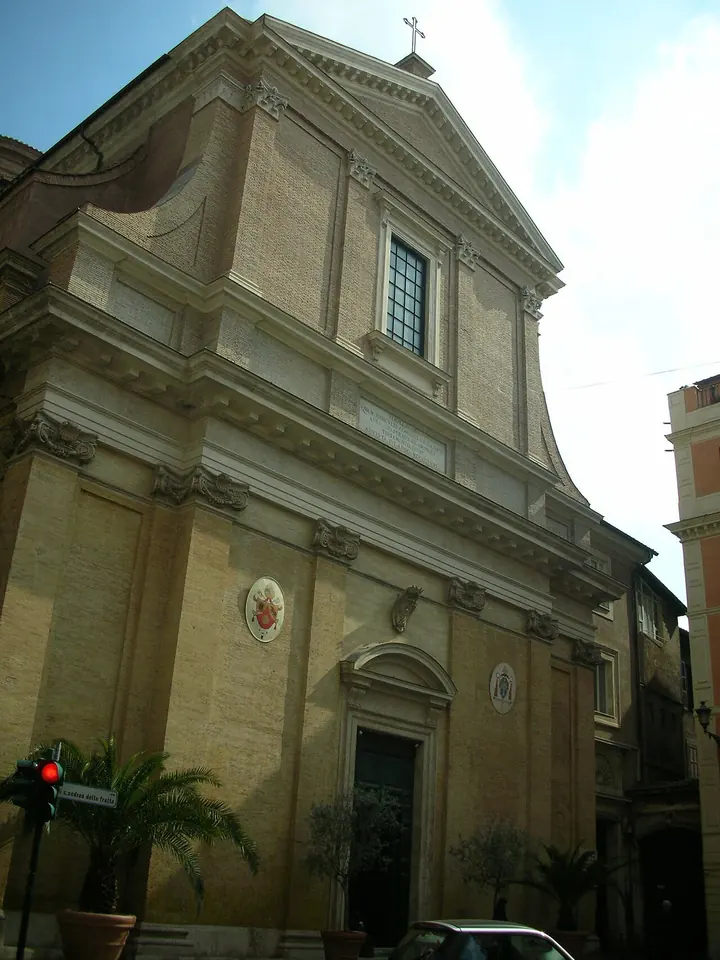
She received First Communion and Confirmation on March 19, 1873, earned a diploma as a kindergarten teacher, and learned to speak and write French well.
Two closed doors
In 1883 she entered the novitiate of the Daughters of Charity at Siena, but she was frail and was soon sent away. Readmitted later, she served at Montenero and Bracciano until 1888, when she was dismissed for good. Her superiors decided she had no vocation. She was twenty-nine. The official biography of her congregation says she was often found embroidering to earn her bread, her face wet with tears.
The meeting with Father Tezza
In December 1891 she joined a retreat in Rome for French-speaking women. The scheduled preacher fell through, and the Camillian priest Blessed Luigi Tezza took his place. At the end of the retreat Giuditta went to his confessional and told him her story and her longing to give herself to God. Tezza told her he hoped to found a congregation of women in the spirit of St. Camillus de Lellis, and he asked whether she would help him. She prayed about it and said yes.

On January 15, 1892, she and two other young women moved into rooms on Via Merulana. On February 2 they received the scapular of the Camillian tertiaries, marked with the red cross, in the room at the Maddalena where St. Camillus had died, which had been made a chapel. Her sisters count that day as the birthday of their congregation. On March 19 Giuditta took the habit and the name Sister Maria Giuseppina.

Mother of the Daughters of St. Camillus
She made her perpetual vows on December 8, 1895, and was elected superior. She held that office until she died. The beginnings were hard. Pope Leo XIII twice declined to approve the new institute, and in 1900 Father Tezza was sent to Peru and never returned to Europe. From then on the weight of the congregation rested on her, and the two founders guided the sisters by letter.
The Daughters of St. Camillus took the four vows of their founder's tradition, including service to the sick even at the risk of one's life. They nursed in homes and hospitals, and houses opened in Cremona in 1893 and Mesagne in 1894, then in France, Belgium and Buenos Aires. "Always see in the sick the image of the suffering Jesus," she told her sisters; Pope John Paul II quoted these words at her beatification. She also liked to say that "the only basis of holiness is humility."

In 1909 the Cardinal Vicar of Rome approved the Rule and made the institute a congregation of diocesan right. Worn out, with a weak heart, she died at the house on Via Giusti in Rome on the night of February 23, 1911. The congregation then had sixteen houses in Europe and the Americas. Papal approval followed in 1931.
The miracles of St. Giuseppina Vannini
Both miracles in her cause are approved:
- Buenos Aires, 1958. A healing obtained through her intercession was investigated in Argentina. In 1993 the medical consultants of the Congregation for the Causes of Saints judged the cure rapid, complete, lasting and scientifically inexplicable. It opened the way to her beatification on October 16, 1994.
- Sinop, Brazil, 2007. On February 19, 2007, the construction worker Arno Celson Klauck fell more than ten meters, head down, into the elevator shaft of a nursing home being built in her name. As he fell he cried out, "Mother, help me!" He was found conscious, with only a cut lip, and went back to work three days later. Pope Francis approved the miracle on May 13, 2019.
Symbols of St. Giuseppina Vannini in art
St. Giuseppina lived in the age of photography, and most images of her are photographs and modern portraits. Look for:
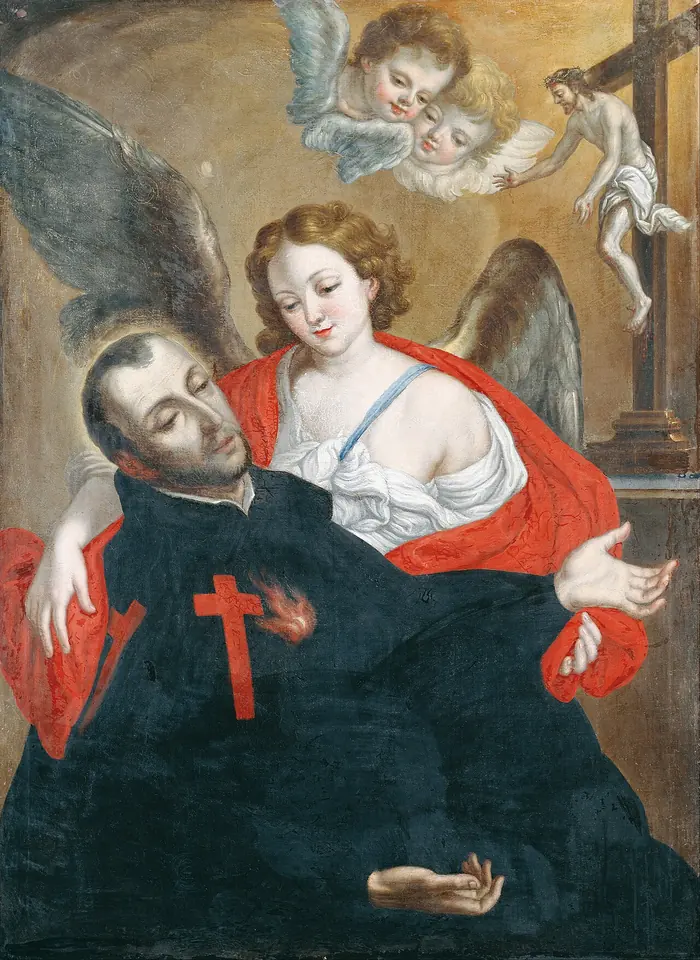
- The black habit with the large red cross: the sign of St. Camillus, worn by her sisters.
- A crucifix: her call to see the suffering Christ in every sick person.
- The sick at her side: the work she gave her life to.
The same red cross marks St. Camillus himself in older art, as in Cristóbal Lozano's eighteenth-century painting.
Feast day and prayer
We keep the feast of St. Giuseppina Vannini on February 23. Her sisters care for the sick today on four continents, and their general house is at Grottaferrata, near Rome. See the feast day calendar for the other saints of February.
We do not know of a traditional prayer to her that we can cite. Let us ask her to pray for nurses and caregivers, for the sick and the dying, and for anyone who has been told there is no place for them: St. Giuseppina Vannini, pray for us.
Frequently asked questions
Who was St. Giuseppina Vannini?
Born Giuditta Vannini in Rome in 1859 and orphaned as a small child, she was raised by the Daughters of Charity. In 1892, with the Camillian priest Luigi Tezza, she founded the Daughters of St. Camillus, a congregation of sisters who serve the sick, and she governed it until she died in 1911.
What miracle led to the canonization of Giuseppina Vannini?
On February 19, 2007, Arno Celson Klauck, a construction worker in Sinop, Brazil, fell more than ten meters down an elevator shaft in a nursing home being built in her name. He cried out to her as he fell and came out with only a cut lip. The Church approved the event as a miracle in 2019.
When is the feast of St. Giuseppina Vannini?
February 23, the day she died in Rome in 1911.
Who was canonized with Giuseppina Vannini?
On October 13, 2019, Pope Francis canonized her with John Henry Newman, Mariam Thresia Chiramel Mankidiyan, Dulce Lopes Pontes and Marguerite Bays.
Keep exploring
Sources
- Dicastery for the Causes of Saints: Giuseppina Vannini (1859–1911). Her family, novitiate, meeting with Tezza, the approvals, the 1958 healing, the beatification homily and her liturgical memorial
- Figlie di San Camillo: Biografia Santa Giuseppina Vannini 1859–1911. The founding on February 2, 1892, her vows, Tezza's departure for Peru and her death
- Figlie di San Camillo: Il Miracolo. The fall of Arno Celson Klauck at Sinop and the steps of the canonization process