St. John Joseph of the Cross

St. John Joseph of the Cross (1654-1734) was a barefoot Franciscan friar from Ischia who spent his life in Naples serving the poor and guiding souls. His one habit was so patched that he was called 'the friar of a hundred patches.' We keep his feast on March 5, and he is a patron of Ischia.
Who was St. John Joseph of the Cross?
St. John Joseph of the Cross was a barefoot Franciscan friar, born on the island of Ischia in the Bay of Naples, who spent nearly his whole life in Naples and the towns around it. He belonged to the strict reform of St. Peter of Alcantara. He was poor to the point of rags, so gentle that the people of Naples counted him a living saint, and a guide to some of the holiest men of his day. He died on March 5, 1734, and was canonized in 1839.
We keep his feast on March 5. He is not the Spanish Carmelite St. John of the Cross, though the names are easily confused.

A boy from Ischia
He was born on August 15, 1654, to a devout and well-to-do family, the Calosirto, and baptized Carlo Gaetano. His parents sent him to study with the Augustinian friars on the island, and there, Vatican News recounts, he fell in love with Jesus and heard His call. From his mother's home he learned a love for the Virgin Mary that never left him.
At sixteen he crossed to Naples and entered the convent of Santa Lucia al Monte, among the Alcantarines, the barefoot Franciscans of St. Peter of Alcantara's reform. The Catholic Encyclopedia says he was the first Italian to join that reform, which had begun in Spain. He made his profession on June 24, 1671, and took the name John Joseph of the Cross. He chose to make the rule harsher still for himself: he would never own a pair of shoes.
Friar, builder and superior
Still young, he was sent to Piedimonte, in the hills north of Naples, to help found a new friary, and he worked on the building with his own hands. Nearby he built a little hermitage in the woods, called "La Solitudine," the Solitude, where the friars could withdraw to pray. It is still a place of pilgrimage. He was ordained a priest much against his will, because he thought himself unworthy.
As a superior he always took the lowest jobs in the house. In 1702 he was made vicar provincial of the Italian Alcantarines. These were hard years: the Spanish and Italian friars of the reform had divided, and for some twenty years he worked for their reunion while enduring unjust criticism and even slander. He answered it with a vow of silence. His consolation, Vatican News records, was a simple sentence: "All that God permits, He permits for our good."
"The friar of a hundred patches"
John Joseph owned one habit for his whole life. As it wore out he patched it, and patched the patches, until the people of Naples called him frate cento pezze, the friar of a hundred patches. He said he wore the patches the way a knight wears his decorations.
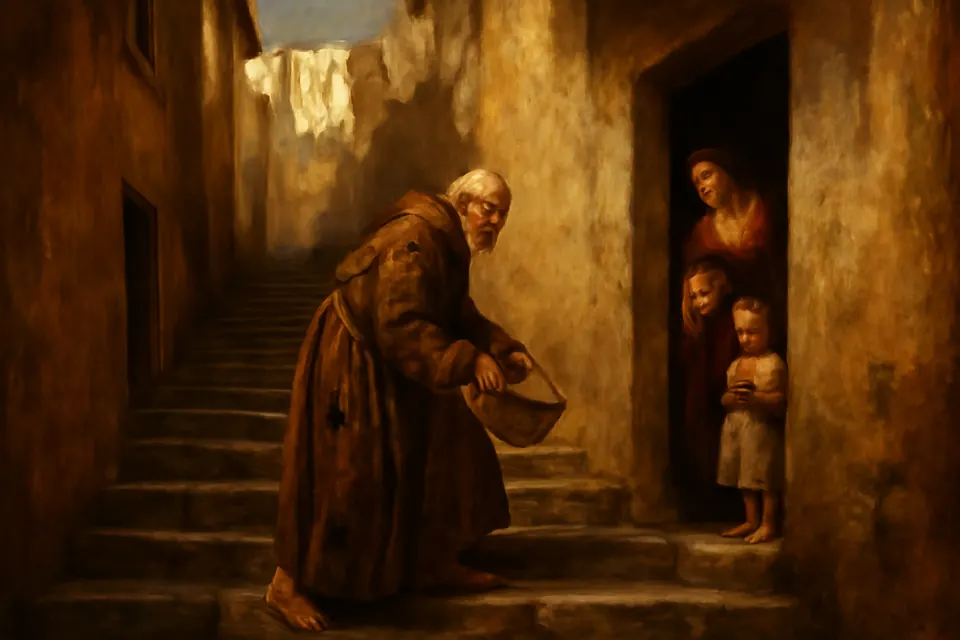
He fasted constantly, drank no wine and slept about three hours a night. He did not wait for the poor to come to him: he went looking for them in the streets, the hovels and the attics of the city. Even when ill he would not spare himself for souls. His counsel was sought by St. Alphonsus Liguori and St. Francis de Geronimo, among others.
The miracles of St. John Joseph of the Cross
In his lifetime and after, many reported wonders were told of him. Vatican News lists bilocation, prophecy, reading of hearts, levitation, healings, and even the raising of a dead person to life. The Catholic Encyclopedia says people of every rank brought him their sick. Such reports were examined in the long process that ended with his beatification in 1789 and his canonization in 1839, but we have not found a reliable account of which particular miracles the Church approved, so we leave them as reported.
His love for Our Lady
He kept a small picture of the Virgin Mary on his desk as superior, and before any decision he would look at it a long time and pray. He urged his penitents to love her as he did, because she "will console you, help you, and lift you out of your troubles." His last words to the young friar who sat with him as he died were a commendation of her: "I commend Our Lady to you."

He died at Santa Lucia al Monte on March 5, 1734. Pope Pius VI beatified him in 1789, and Pope Gregory XVI canonized him on May 26, 1839, together with St. Alphonsus Liguori, St. Francis de Geronimo, St. Pacificus of San Severino and St. Veronica Giuliani.
Symbols of St. John Joseph of the Cross in art
Paintings and holy cards show him simply:
- A patched Franciscan habit: his one habit, mended a hundred times, the sign of his poverty.
- Bare feet: the barefoot rule of St. Peter of Alcantara, which he kept strictly.
- A crucifix: the cross he took into his religious name.
- An image of the Virgin: his lifelong devotion to Mary.
On Ischia he is honored in many churches, including an altar in the church of San Gaetano at Forio with a painting by Alfonso Di Spigna.

His relics and his island
His tomb at Santa Lucia al Monte in Naples drew the faithful for more than two centuries. On September 30, 2003, his relics were brought home to Ischia and placed in the Franciscan church of Sant'Antonio alla Mandra at Ischia Ponte. Ischia honors him as its co-patron with St. Restituta.

Where the relics of St. John Joseph of the Cross are kept: see them on the relics map →
Prayer to St. John Joseph of the Cross
Vatican News gives this prayer to him, asking for strength in sickness and trials (our translation from the Italian):
St. John Joseph of the Cross, obtain for us your joy and serenity in sickness and in trials, remembering that suffering is a great gift of God and must be offered to the Father pure, without being spoiled by our complaints. Following your example, we want to bear everything with patience, without making our pain weigh on others. We ask for the strength to thank the Lord not only when He gives us joy but also when He permits sickness and the various trials.
See the feast day calendar for the other saints of March.
Frequently asked questions
Who was St. John Joseph of the Cross?
Carlo Gaetano Calosirto, born on Ischia in 1654, who entered the barefoot Franciscans of St. Peter of Alcantara at sixteen and took the name John Joseph of the Cross. He became superior of the Italian Alcantarines, a sought-after spiritual director in Naples, and died there on March 5, 1734.
When is the feast of St. John Joseph of the Cross?
March 5, the day he died in Naples in 1734. On Ischia he is honored as co-patron of the island with St. Restituta.
Is St. John Joseph of the Cross the same as St. John of the Cross?
No. St. John of the Cross was the Spanish Carmelite mystic and Doctor of the Church who died in 1591. St. John Joseph of the Cross was an Italian Franciscan of the next century.
Who canonized St. John Joseph of the Cross?
Pope Gregory XVI, on May 26, 1839, together with St. Alphonsus Liguori and St. Francis de Geronimo, both of whom had known him and sought his advice.
Keep exploring
Sources
- Catholic Encyclopedia (1910): St. John Joseph of the Cross. First Italian to join the Alcantarine reform, his penances, vicar provincial in 1702, beatified 1789 and canonized 1839. It gives his death as 1739 in error; he died in 1734.
- Vatican News: San Giovanni Giuseppe della Croce (March 5, Italian). His profession on June 24, 1671, "La Solitudine," the vow of silence, "frate cento pezze," his last words, and the prayer for strength in trials (our translation)
- Il Piccolo: San Giovanni Giuseppe della Croce (March 5, 2022, Italian). The transfer of his relics from Santa Lucia al Monte, Naples, to Sant'Antonio alla Mandra, Ischia Ponte, on September 30, 2003