St. Flavian of Constantinople

St. Flavian of Constantinople was the patriarch of Constantinople (about 447–449) who condemned the monk Eutyches for denying that Christ has a true human nature. Pope St. Leo the Great wrote him the famous Tome, but the violent Robber Council of Ephesus deposed him in 449, and he died of his injuries on the way into exile. We keep his feast on February 18.
Who was St. Flavian of Constantinople?
St. Flavian of Constantinople was patriarch of the imperial capital in the late 440s, a gentle pastor who found himself at the center of the hardest fight of his century: the question of who Jesus Christ is. He condemned the monk Eutyches for teaching that Christ's humanity was swallowed up in his divinity. For that he was deposed, beaten and exiled by a council that Pope St. Leo the Great would call a gang of robbers. He died within days.
We keep his feast on February 18. His story is short, but the faith he defended is the faith we confess at every Mass: one Lord Jesus Christ, true God and true man.

The life of St. Flavian
A priest of the Great Church
Little is known of his early years. The Orthodox life says he was a priest of the cathedral of Constantinople who had charge of its sacred vessels. When Patriarch St. Proclus died (Baring-Gould gives October 24, 447), Flavian was chosen to succeed him.
He made an enemy almost at once. Baring-Gould, following the old Greek historians, says the powerful court chamberlain Chrysaphius expected the customary present from a new patriarch, and Flavian would not pay it. Chrysaphius was the godson of Eutyches.
The synod of 448
Eutyches was the elderly abbot of a large monastery in the city, respected and well connected. In November 448 Bishop Eusebius of Dorylaeum accused him before Flavian's local synod of denying that Christ, after the Incarnation, has two natures. Flavian tried to soften things. When Eutyches sent word that he was ill, the patriarch answered, as Baring-Gould records it: "We are old friends of his; we will wait till he is better, and then let him come and confess that he has erred."

Eutyches finally came later that month, escorted by soldiers and an imperial official. Pressed, he would not confess two natures in Christ after the union. The synod deposed and excommunicated him. Eutyches appealed to Rome, and Flavian sent Pope Leo the record of the trial.
The Tome of Leo
Leo answered on June 13, 449, with the letter we now call the Tome, addressed to Flavian. It is one of the great documents of the Church's teaching on Christ. In one line Leo explains how the two natures act in the one person:
For each form does what is proper to it with the co-operation of the other; that is the Word performing what appertains to the Word, and the flesh carrying out what appertains to the flesh.
The Robber Council
Meanwhile Emperor Theodosius II, steered by Chrysaphius, had called a general council at Ephesus. It opened on August 8, 449, under Dioscorus of Alexandria, who backed Eutyches. Leo's letter was never read. Flavian, as the accused, was not allowed to sit as a judge, and when he rose to protest that he had no chance to defend himself, he was ignored. The council cleared Eutyches and then voted to depose Flavian and Eusebius.
The Catholic Encyclopedia sums up the testimony later given at Chalcedon: bishops knelt and begged for mercy for Flavian, soldiers and a mob of monks were let into the church, the secretaries were stopped from taking notes, and some bishops signed a blank sheet out of fear. Witnesses said Dioscorus and the monk Barsumas struck Flavian. The papal deacon Hilarus, the future Pope St. Hilarius, cried out one word, Contradicitur, "it is opposed," and escaped with difficulty.
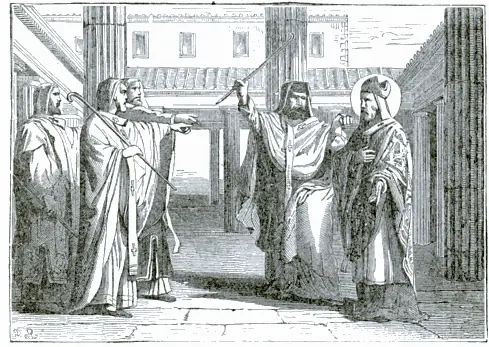
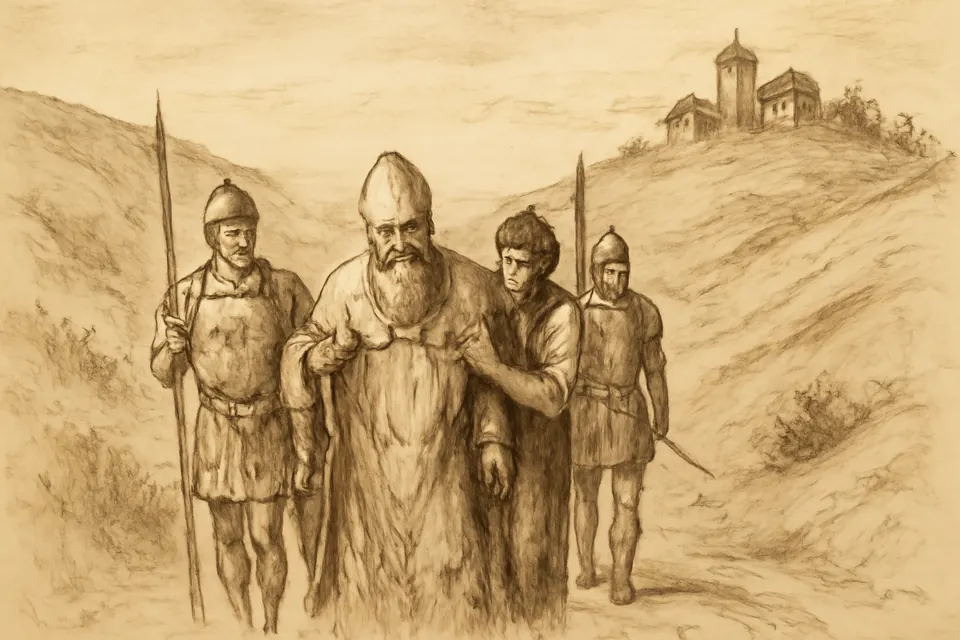
Flavian had already written an appeal to the pope. He was sent into exile and died a few days later in Lydia, in August 449. Leo, not yet knowing he was dead, declared the council's acts null.
After his death
In 450 Theodosius died, and his sister St. Pulcheria came to power. The Orthodox life says she had Flavian's body brought back to Constantinople. The Council of Chalcedon in 451 accepted Leo's Tome, condemned Dioscorus and honored Flavian's memory. Leo called him a second Abel.
Miracles and legends
No miracles are recorded of Flavian in the early sources; his glory is his witness.
- The crewless ship of Giulianova: traditional. A legend kept in the Adriatic town of Giulianova says that a ship carrying his relics, sent toward Ravenna, came ashore there with no crew. The town took the name Castel San Flaviano, and it still claims his bones in a Renaissance urn in its Duomo. We have found no early source for this.
Symbols of St. Flavian in art
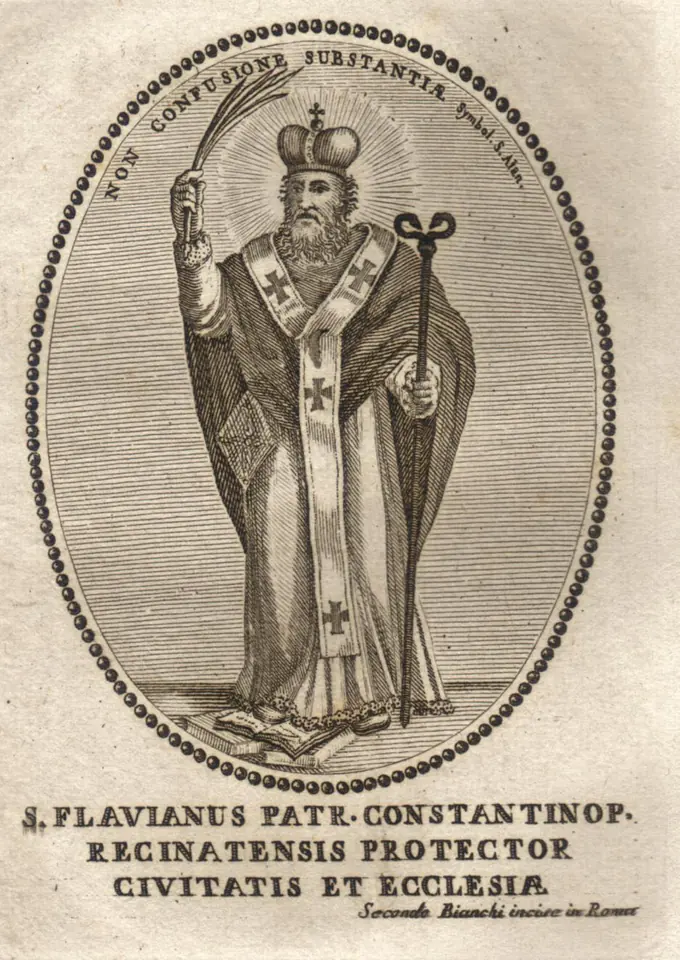
Flavian is shown as a bishop. Byzantine art paints him in the white vestments of a patriarch with a Gospel book, as in the Menologion of Basil II. In Italy, where he is patron of Giulianova and Recanati, he wears a Latin miter and cope, sometimes with a palm for his martyrdom. An old engraving made for Recanati shows him holding a palm and a pastoral staff under the motto non confusione substantiae, "not by confusion of substance," a phrase from the Athanasian Creed about the union of God and man in Christ.

Feast day and where he is honored
The Roman Martyrology and the Orthodox Church keep his feast on February 18. The 1916 English edition of the Martyrology reads that he "for having defended the Catholic faith at Ephesus, was buffeted and kicked by the partisans of the impious Dioscorus, and being banished, ended his life within three days." Giulianova also celebrates him on November 24, the traditional day his relics landed. See our feast days calendar for other saints of February.
Prayer to St. Flavian
The Orthodox Church sings a troparion for his feast (tone 8). It praises him as a champion of Orthodoxy, a teacher of purity and true worship and an adornment of bishops, and asks him to intercede for our salvation. The OCA prints the full text on its website.
Let us ask St. Flavian to pray for bishops who must stand for the truth under pressure, for all who are treated unjustly, and for the unity of Christians in the one faith in Christ, true God and true man. St. Flavian, pray for us.
Frequently asked questions
When is the feast day of St. Flavian of Constantinople?
February 18 in the Roman Martyrology and in the Orthodox calendar. Some calendars give February 16 or 17, and Giulianova in Italy also keeps November 24.
What is the Tome of Leo?
A doctrinal letter Pope St. Leo the Great addressed to Flavian in June 449. It explains that Christ is one person in two natures, divine and human, and was later accepted by the Council of Chalcedon in 451.
How did St. Flavian die?
At the Second Council of Ephesus in August 449, called the Robber Council, he was deposed and attacked by partisans of Dioscorus of Alexandria. He was sent into exile and died a few days later in Lydia. The Roman Martyrology says he ended his life within three days.
Was St. Flavian a martyr?
The Roman Martyrology and older calendars honor him as a martyr because he died from the violence he suffered for defending the faith. The Orthodox Church calls him Flavian the Confessor.
Keep exploring
Sources
- Catholic Encyclopedia: Robber Council of Ephesus. The 448 synod, the votes, the violence, Hilarus's 'Contradicitur', Flavian's appeal and his death in Lydia
- Pope St. Leo the Great, Letter 28 to Flavian (the Tome), New Advent. Quotation from the Tome
- Orthodox Church in America: Saint Flavian the Confessor, Patriarch of Constantinople. His earlier post as keeper of the church vessels, his death in August 449, and the return of his relics under Pulcheria
- Orthodox Church in America: Troparia and kontakia for February 18. Text of his troparion
- Sabine Baring-Gould, The Lives of the Saints, vol. 2 (February), on archive.org. The refused court fee, the synod dates of November 1448, Onesiphorus's plea and Leo's 'second Abel'
- The Roman Martyrology (Baltimore, 1916), February 18. His entry, 'buffeted and kicked' and dead within three days