St. Romanus of Condat

St. Romanus of Condat (about 400–463) was a monk who, at about thirty-five, went alone into the forests of the Jura mountains to live as a hermit. His brother St. Lupicinus joined him, disciples followed, and together they founded the abbeys of Condat (today's Saint-Claude), Lauconne, La Balme and Romainmôtier, among the first monasteries of the Jura. We keep his feast on February 28.
Who was St. Romanus of Condat?
St. Romanus of Condat was a monk of fifth-century Gaul who walked into the forests of the Jura mountains to live alone with God and ended up as the father of a whole family of monasteries. With his younger brother St. Lupicinus he founded Condat, on the site of today's Saint-Claude in France, and Romainmôtier, in today's Switzerland, which still bears his name. He died in 463 or 464, and we keep his feast on February 28.
Two lives of him survive from soon after his death: one by St. Gregory of Tours in his Life of the Fathers, and an anonymous Life of Saints Romanus, Lupicinus and Eugendus written by a monk of Condat. Almost all we know comes from these, and from the many later retellings based on them.
Into the Jura
Romanus was born about 400. According to Baring-Gould, who follows Montalembert's Monks of the West, he was trained in the monastery of Ainay near Lyon. At about thirty-five he left his family's house for good. He carried a copy of the Lives of the Fathers of the Desert, the stories of St. Anthony the Great and the hermits of Egypt, together with some tools and vegetable seeds. He climbed into the high, wild country of the Jura and found a place shut in by three steep slopes where two streams met. The place was called Condat.
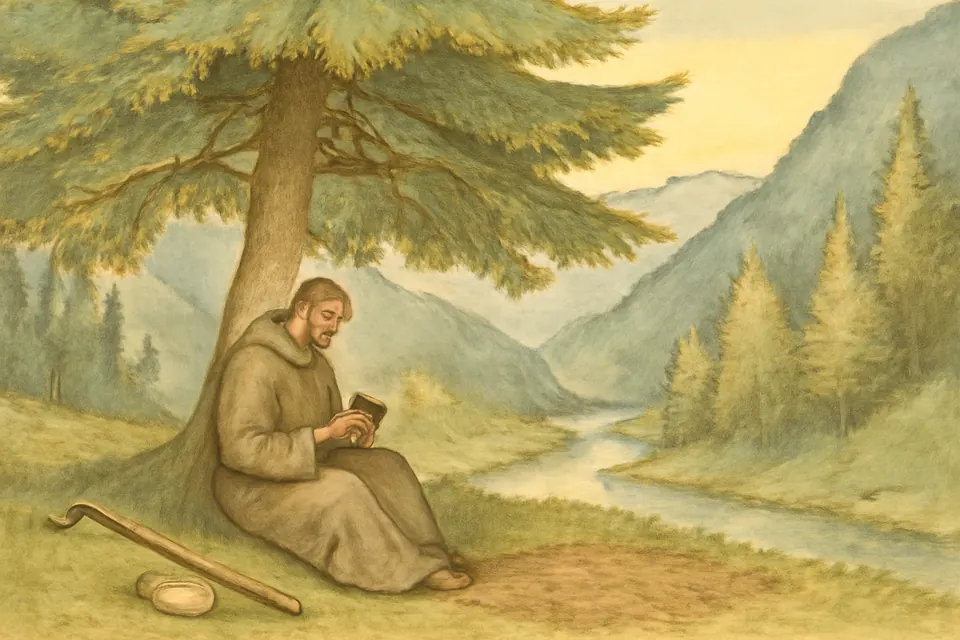
At first he had no house at all. He sheltered under a huge fir tree, whose spreading branches reminded him of the palm tree that once sheltered St. Paul the First Hermit in Egypt. There he read, prayed and planted his garden, safe from visitors because the paths were so hard.
Two brothers, many monks
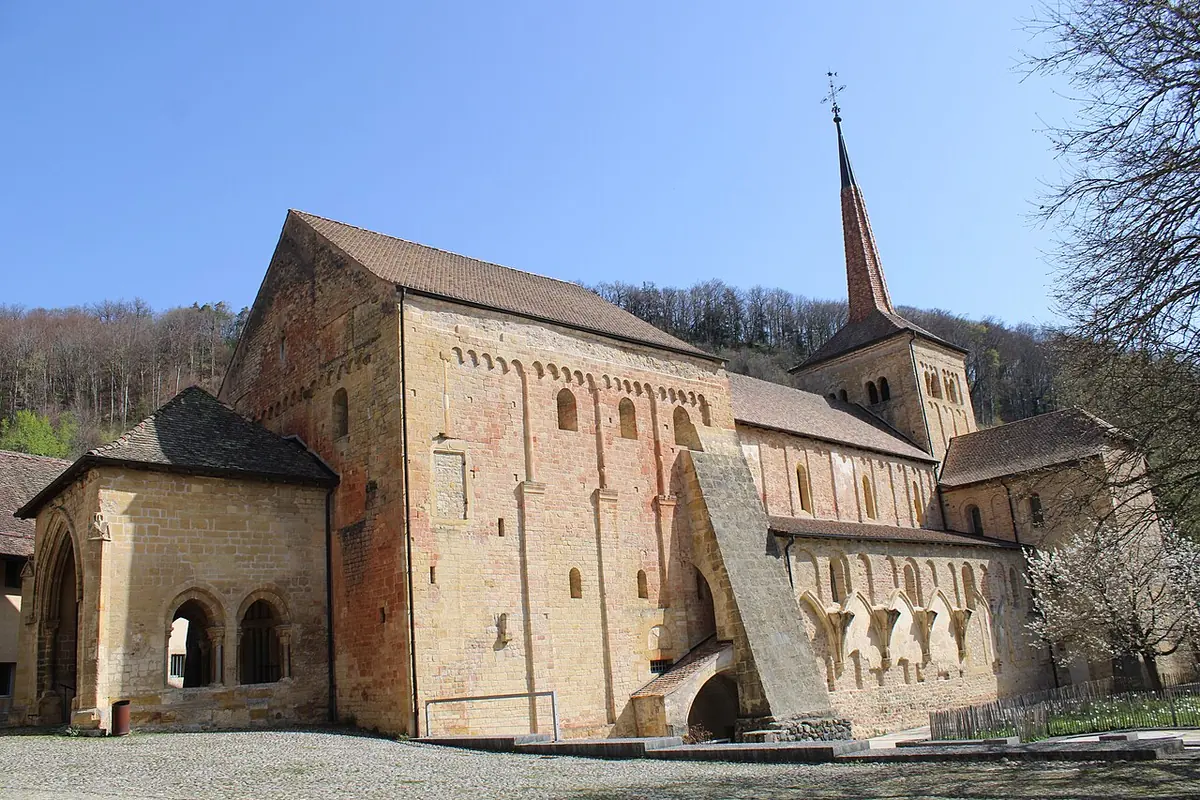
His brother Lupicinus came to join him, then others, so many that the brothers had to found new houses: Lauconne, later called Saint-Lupicin, where Lupicinus would be buried; La Balme, later Saint-Romain-de-Roche; and Romainmôtier, across the mountains in what is now the canton of Vaud. Among their disciples was St. Eugendus, who later ruled Condat. On a rock nearby their sister governed a community of women.
The monks lived in separate cells and met for prayer and meals. They wore wooden clogs and tunics of skins sewn together, and suffered, the early life says, from snow in winter and heat reflected off the rock walls in summer. In 444 Romanus went to Arles and was ordained a priest by St. Hilary of Arles.
The brothers were very different. Lupicinus was the sterner. Once, disgusted at how carefully the brothers cooked, he tipped fish, herbs and roots into a single pot, and twelve offended monks walked out. "It would have been better," Romanus told him, "not to have come hither, than to be a cause of dispersion to our monks." Lupicinus answered that the departing brothers were only straw blown off the grain. But it was Romanus, gentle and patient, who went after the twelve and brought them back, and each of them later became the superior of a community.
The miracles of St. Romanus
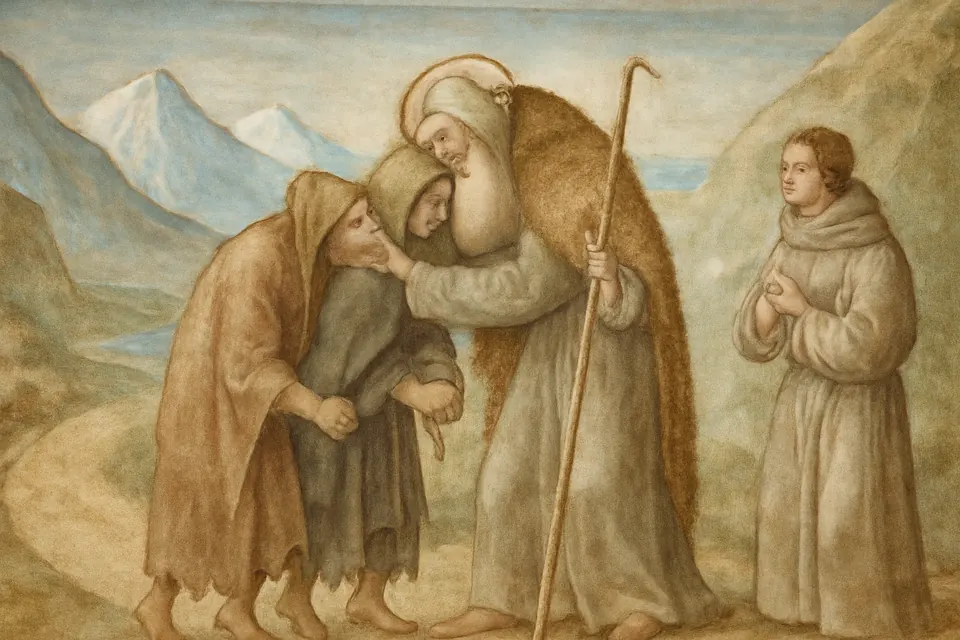
- Traditional: on a pilgrimage to Agaunum, the shrine of St. Maurice and the Theban Legion in the Valais, Romanus met two lepers on the road and healed them with a kiss. The news reached Geneva, and the bishop, clergy and people came out to welcome him. The story comes from the early lives and is honored as tradition; it was never formally examined.
His death
When he knew he was dying, Romanus sent for his sister from her convent and for Lupicinus, entrusted his monks to his brother, and fell asleep in Christ in 463 or 464. He was buried at La Balme, the house of his sister's community, which took the name Saint-Romain-de-Roche.
Symbols of St. Romanus of Condat in art
Romanus is shown as an old monk with a long beard, sometimes in a tunic of skins, holding an abbot's staff and a book, the Lives of the Desert Fathers he carried into the mountains. A fir tree behind him recalls his first shelter at Condat, and some images add the two lepers he embraced. He often appears with his brother Lupicinus, the two of them together as the founders of the Jura monasteries. In the churches of the Jura you will know him by the forest setting, the book and the company of his brother.
Feast day and where he is honored
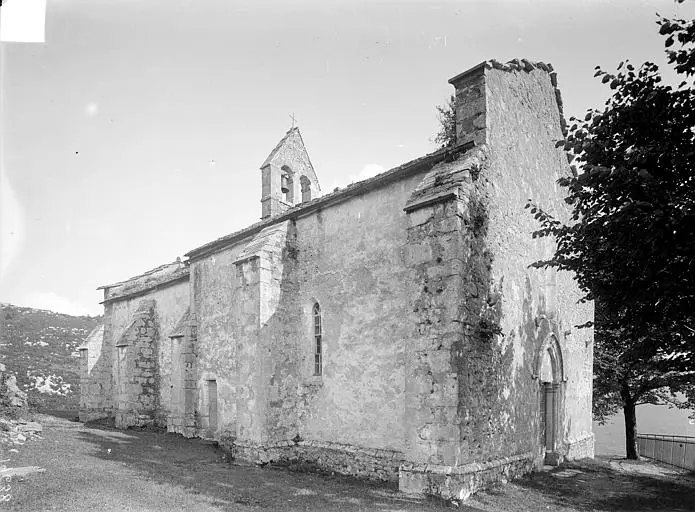
We keep his feast on February 28, the day given in the Roman Martyrology. See the feast day calendar. The small chapel of Saint-Romain-de-Roche, above the valley near Saint-Claude, keeps his tomb, and Romainmôtier keeps his name.
There is no traditional prayer to St. Romanus of Condat in common use. Let us ask him, who went into the forest with a book and a handful of seeds, to pray for monks and hermits, for those who seek God in silence, and for the gift of gentleness when others walk away.
Frequently asked questions
Who was St. Romanus of Condat?
A fifth-century monk of Gaul who became a hermit in the Jura mountains about 435. With his brother Lupicinus he founded and ruled several monasteries, including Condat (now Saint-Claude in France) and Romainmôtier (in Switzerland). He was ordained a priest by St. Hilary of Arles in 444 and died in 463 or 464.
When is the feast of St. Romanus of Condat?
February 28.
Is Saint-Claude named after St. Romanus?
No. Romanus founded the abbey of Condat there, but the town later took its name from St. Claude, a seventh-century abbot of the same monastery whose shrine drew great pilgrimages. Romainmôtier in Switzerland, "the monastery of Romanus," does keep his name.
Where is St. Romanus of Condat buried?
At the monastery of La Balme, where his sister led the nuns, now the village and chapel of Saint-Romain-de-Roche in the commune of Pratz, Jura.
Keep exploring
Sources
- Catholic Encyclopedia (1912): Saints Romanus (no. 5, Abbot of Condat). His dates, the four monasteries, St. Eugendus, ordination by St. Hilary of Arles in 444, burial at La Balme, the feast of February 28, and the two ancient lives
- Sabine Baring-Gould, The Lives of the Saints, vol. 2 (February), February 28. Ainay, the fir tree, the book and the seeds, the sister's community, the quarrel over the cooking pot, the pilgrimage to Agaunum and the two lepers, after Montalembert and the early lives