St. Pamphilus of Caesarea, Priest, Bible Scholar and Martyr
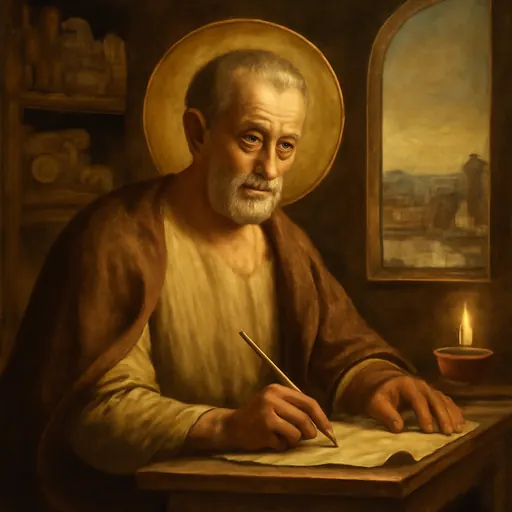
St. Pamphilus of Caesarea was a priest of Caesarea in Palestine who gathered the greatest Christian library of the ancient world and spent his life copying and correcting the Holy Scriptures. After two years in prison he was beheaded in the Great Persecution in 309. We keep his feast on February 16 with the companions who died with him.
Who was St. Pamphilus of Caesarea?
St. Pamphilus of Caesarea was a priest and scholar who gave his life twice over to the Word of God: first in years of patient copying of the Scriptures, then in martyrdom. He lived at Caesarea, the Roman capital of Palestine on the Mediterranean coast, and there he built a library of Christian books that scholars used for three centuries. His pupil Eusebius of Caesarea, the first great historian of the Church, loved him so much that he took the name "Eusebius of Pamphilus."
Eusebius called him "a man thrice dear to me" and wrote a life of him in three books. That life is lost, but Eusebius's account of his death survives, and so does a short portrait in the Catholic Encyclopedia drawn from Eusebius, St. Jerome and the Byzantine scholar Photius.
The life of St. Pamphilus
From Beirut to Alexandria
Pamphilus came from a noble family of Beirut and was well educated there. He sold all his property, gave the money to the poor and joined the company of those who lived an ascetic life. He went to study at Alexandria under Pierius, head of the famous Catechetical School, the school once led by St. Clement of Alexandria and by Origen.
The library of Caesarea
He settled at Caesarea, was ordained a priest, and opened a school of theology. His great labor was producing accurate copies of the Bible. Notes copied into the margins of ancient biblical manuscripts still mention his corrections. St. Jerome wrote that Pamphilus "transcribed the greater part of the works of Origen with his own hand," and Jerome owned twenty-five volumes of Origen's commentaries in Pamphilus's handwriting, which he treasured as a relic of the martyr.
Pamphilus did not hoard his books. A passage of the lost life quoted by Jerome says he supplied poor scholars with what they needed to live, and did not merely lend copies of the Scriptures but gave them away; he kept a supply on hand for the purpose, and gave copies to women devoted to study as well. The jewel of the library was Origen's own copy of the Hexapla, the Old Testament in six parallel columns. The collection seems to have survived until the Arab capture of Caesarea in 638.
Arrest and two years in prison
The Great Persecution under Diocletian began in 303. In November 307 Pamphilus was brought before the governor of Palestine, refused to sacrifice to the gods, was cruelly tortured and sent to prison. He did not stop working. With Eusebius he wrote an Apology for Origen, defending the great Alexandrian teacher, and went on correcting manuscripts in his cell.

The martyrdom of February 16, 309
Eusebius tells the end in The Martyrs of Palestine. Pamphilus had been in prison two years with the old deacon Valens of Jerusalem, who knew the Scriptures by heart, and Paul of Jamnia. Then five young Egyptian Christians, coming home from visiting confessors in the mines of Cilicia, were arrested at the gates of Caesarea. When the governor Firmilian asked the first of them his name, he gave the name of a prophet; asked his country, he answered "Jerusalem," meaning the Jerusalem above. The governor tortured him to learn where this city might be.
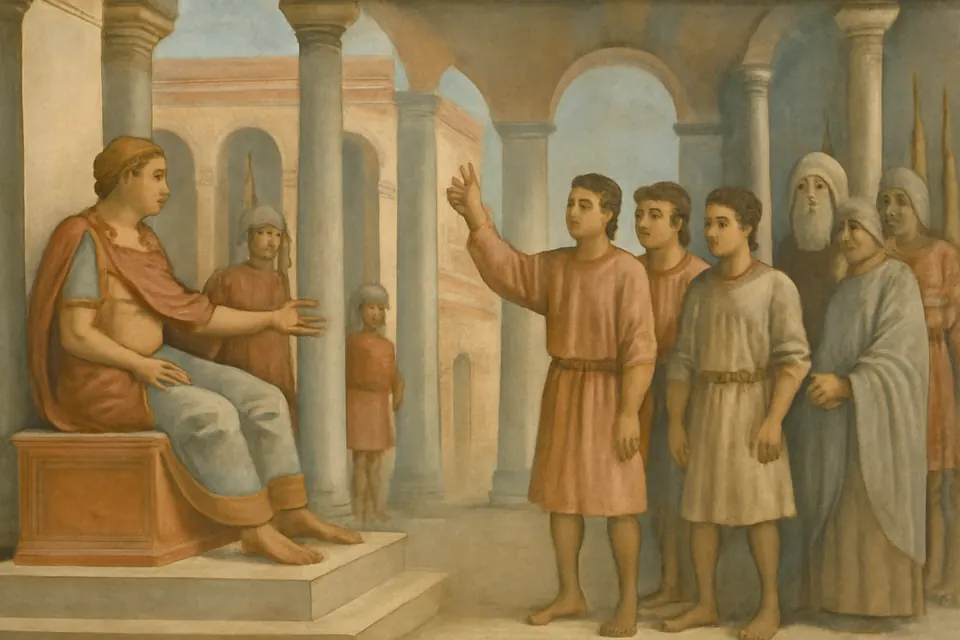
All were condemned to be beheaded, Pamphilus with them. As sentence was given, Porphyrius, a young servant of Pamphilus whom he had taught, called out from the crowd asking to bury the bodies. He was burned alive, calling at the end on Jesus the Son of God. Seleucus, a former soldier, brought the news to Pamphilus and was taken and killed; Theodulus, an old servant of the governor's household, embraced the martyrs and was crucified; Julian of Cappadocia knelt to venerate their bodies and was burned. Twelve in all died, and Eusebius notes they were "counted worthy of apostolic grace and number." The date he gives, the fourteenth day before the Kalends of March, is February 16.
The miracles of St. Pamphilus
The Orthodox life records that the martyrs' bodies lay unburied for four days, yet neither beasts nor birds touched them, until the embarrassed authorities let the Christians bury them. This is a traditional account. No other miracles are attached to his name; his witness is his work and his blood.
Symbols of St. Pamphilus in art
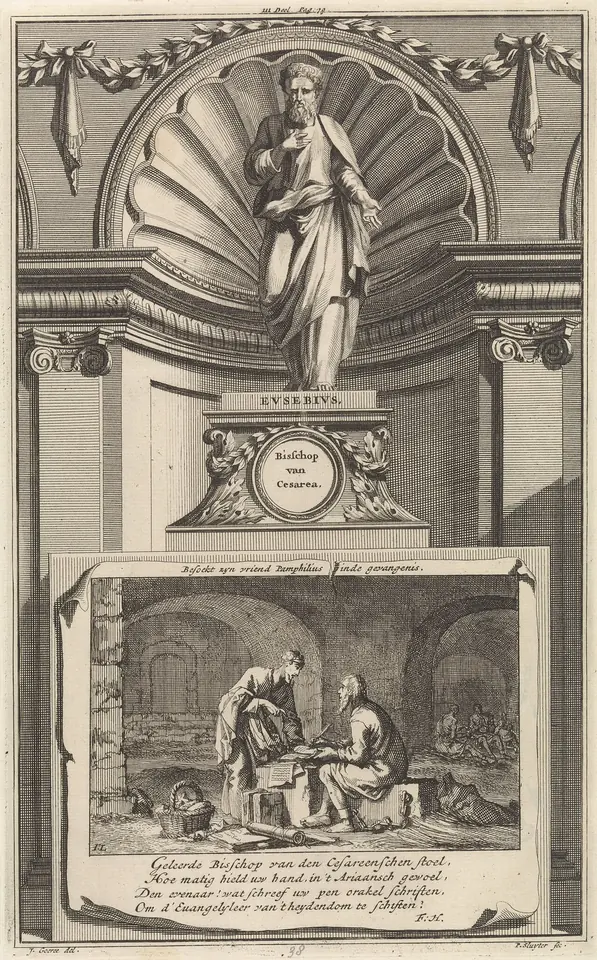
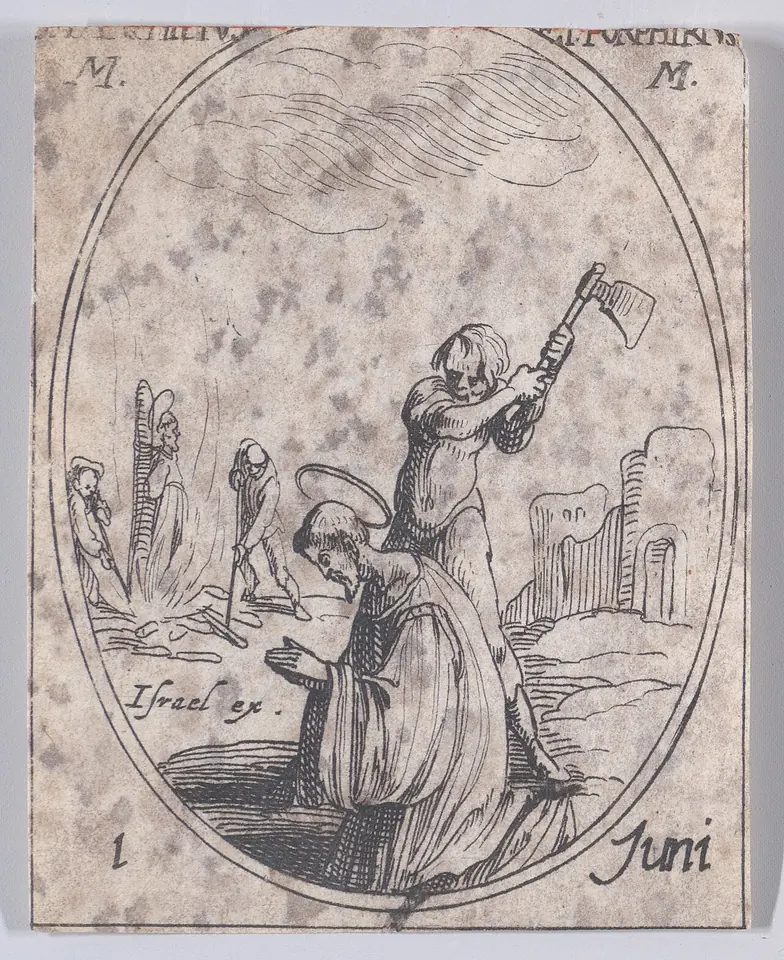
Pamphilus is rarely painted alone. In Byzantine manuscripts such as the Menologion of Basil II he appears among his companions at the moment of their beheading. Western prints, like Callot's, show him kneeling under the executioner's sword or axe, often with the young Porphyrius. Where he appears as a scholar he holds a book or scroll of the Scriptures and a pen, sometimes with a martyr's palm. The scene of Eusebius visiting him in prison, engraved for a Dutch book on the Church Fathers in 1698, is one of the few images of his friendship with his pupil.
Feast day and Caesarea today
The Roman Martyrology and the Orthodox Church keep February 16 for Pamphilus and his companions. Caesarea Maritima is now an archaeological park on the coast of Israel, and nothing of his library survives above ground.

Praying with St. Pamphilus
We know of no traditional English prayer to St. Pamphilus. He is a fitting patron to ask for anyone who studies, translates, copies or teaches the Scriptures. Let us ask him: holy Pamphilus, you gave away your books so that others might know God's Word, and you gave your life rather than deny it; pray for us, that we may love the Scriptures and live by them.
Frequently asked questions
Who was St. Pamphilus of Caesarea?
A wealthy man of Beirut who gave away his property, studied at Alexandria under Pierius, and became a priest at Caesarea in Palestine. There he built a famous library and school and devoted himself to making accurate copies of the Bible. He was martyred in 309.
When is the feast of St. Pamphilus?
February 16, with Sts. Valens, Paul, Porphyrius, Seleucus, Theodulus, Julian and five Egyptian martyrs. Some older Western calendars kept him on June 1.
What was the library of Caesarea?
The collection Pamphilus built at Caesarea, rich in manuscripts of the Bible and of Origen's works, including Origen's own Hexapla. St. Jerome consulted it, and Eusebius of Caesarea, Pamphilus's pupil, wrote his histories with it.
Who wrote the life of St. Pamphilus?
His disciple Eusebius of Caesarea wrote a life in three books, now lost. What survives is Eusebius's account of his martyrdom in The Martyrs of Palestine, chapter 11.
Keep exploring
Sources
- Eusebius, The Martyrs of Palestine, chapter 11 (New Advent). The eyewitness account of the martyrdom of Pamphilus and his eleven companions, the date, the answer about the heavenly Jerusalem and the death of Porphyrius
- Pamphilus of Caesarea (Catholic Encyclopedia, 1911). His birth at Beirut, study under Pierius, the library and Hexapla, Jerome's twenty-five volumes of Origen, the Apology for Origen and the arrest in November 307
- Martyrologio Romano, February 16 (Italian translation, Vatican website). The Roman Martyrology entry for Pamphilus and his companions on February 16
- Martyrs Pamphilius the Presbyter, Valens the Deacon, and those with them (Orthodox Church in America). The Orthodox commemoration and the bodies left unburied for four days