St. Simeon of Jerusalem, Kinsman of the Lord
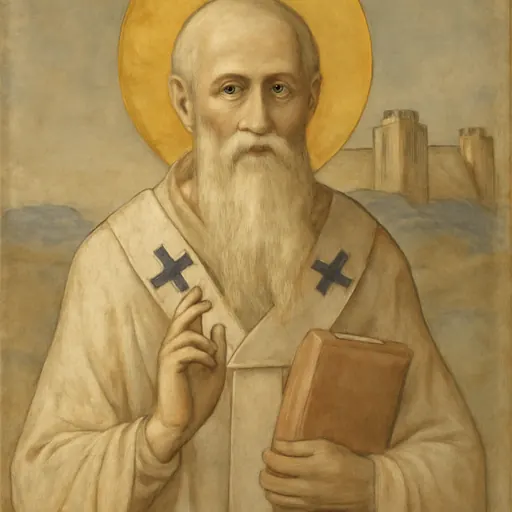
St. Simeon of Jerusalem was the son of Clopas and a cousin of Jesus, chosen to lead the church of Jerusalem after the martyrdom of St. James. Under the Emperor Trajan he was accused of being a Christian and a descendant of David, tortured for many days, and crucified at the age of 120, according to the second-century historian Hegesippus. His feast is February 18 in the West and April 27 in the East.
Who was St. Simeon of Jerusalem?
St. Simeon of Jerusalem was a cousin of Our Lord and the second bishop of Jerusalem, the man who led the Mother Church of all Christians after St. James was killed. He lived to an astonishing age, and in the reign of the Emperor Trajan he gave his life on a cross, as his Lord had done.
Almost everything we know comes from Hegesippus, a Christian writer of the second century, whose words Eusebius of Caesarea copied into his Church History about the year 325. That makes the story old and close to the events, though it is brief.
He is not St. Simeon the God-Receiver, the old man who took the infant Jesus in his arms in the Temple. Nor is he Simeon called Niger, one of the teachers at Antioch in Acts 13:1.

The life of St. Simeon
A kinsman of the Lord
Simeon's father was Clopas. St. John names "Mary the wife of Clopas" among the women standing by the cross (John 19:25), and Hegesippus adds that Clopas was a brother of St. Joseph. So Simeon grew up as a first cousin, in the Jewish way of reckoning, of Jesus of Nazareth. Eusebius thought it reasonable that Simeon "was one of those that saw and heard the Lord," given how long he lived and the fact that the Gospel mentions his mother.
The Orthodox Church counts him among the Seventy disciples whom Jesus sent out (Luke 10). Some writers, including the Catholic Encyclopedia, identify him with the Simon named among the Lord's "brethren" in Matthew 13:55. These links are old traditions rather than facts the Gospels state outright.
Chosen to follow St. James
When James, "the brother of the Lord" and first bishop of Jerusalem, was martyred in the 60s, the apostles and disciples who were still living met together, along with the Lord's relatives. Eusebius writes: "They all with one consent pronounced Symeon, the son of Clopas, of whom the Gospel also makes mention; to be worthy of the episcopal throne of that parish." He was, Eusebius adds, a cousin of the Lord.

It was a hard time to lead that flock. Roman armies crushed the Jewish revolt and destroyed Jerusalem and its Temple in the year 70. Eusebius says the Christians of the city had been warned to leave for Pella, across the Jordan, before the siege. The Catholic Encyclopedia judges that Simeon, already their bishop, "probably then went to Pella with the others." He went on shepherding that small, scattered church for decades after the city fell.
Eusebius places him alongside St. Ignatius of Antioch as one of the great bishops of that first generation after the apostles.
Trial and crucifixion under Trajan
Roman emperors watched the family of David closely, fearing a Jewish king. Around the year 106 or 107, under Trajan, some heretics denounced Simeon to the governor Atticus "on the ground that he was a descendant of David and a Christian." Hegesippus tells the rest:
And after being tortured for many days he suffered martyrdom, and all, including even the proconsul, marveled that, at the age of one hundred and twenty years, he could endure so much. And orders were given that he should be crucified.

Hegesippus adds that his accusers were themselves arrested when the authorities searched for descendants of David. After Simeon's death, Eusebius says, "a certain Jew by the name of Justus succeeded to the episcopal throne in Jerusalem," one of the many thousands of Jews who had come to believe in Christ.
How old was St. Simeon?
Hegesippus gives his age as one hundred and twenty. Modern readers sometimes wonder about that number, and we cannot check it. What we can say is that the figure comes from a writer who lived only a generation or two later and who knew the church of Palestine. Whatever his exact years, Simeon was a very old man who had known the first disciples, and perhaps the Lord himself, when he went to his death.
Miracles and legends
No miracles of St. Simeon are recorded. The marvel the early Church remembered was his endurance: a man of great age who withstood days of torture so steadily that even the Roman official was astonished. His crucifixion is attested by Hegesippus, the oldest source we have, and is not a later legend. His place among the Seventy disciples is traditional, kept by the Eastern churches.
Symbols of St. Simeon in art
- Omophorion and Gospel book: Eastern icons show him as a hierarch, a bishop in the white stole with crosses, holding the Gospels.
- Cross: the manner of his death. The Menologion of Basil II, a Byzantine book of saints made about the year 985, shows him stretched upon a cross before the walls of a city.
- Very long white beard: his extreme old age.
Western art rarely shows him by himself. In the East he appears in calendar icons among the saints of late April, so look for the name inscribed beside him.

Feast day and how we honor him
We keep the memory of St. Simeon on February 18, the date long found in the Roman Martyrology. The Orthodox Church and the Byzantine Catholic churches honor him on April 27 as "Hieromartyr Simeon, kinsman of the Lord." No tomb or relics of St. Simeon are known. You can find other saints of these days on our feast days page.
Praying with St. Simeon of Jerusalem
There is no traditional Western prayer to St. Simeon. The Orthodox Church sings this troparion on his feast (Tone 1, as the Orthodox Church in America gives it):
The Church glorifies you as a kinsman of Christ, O Hierarch Simeon, and as a steadfast martyr, for courageously you destroyed all deceptions and preserved the Faith.
Therefore, we celebrate your holy memory today, and by your prayers, we receive the remission of our sins.
And the kontakion (Tone 2):
As one who has become a citizen of Zion on high, you had been ordained to the throne of Zion below. You guided your flock to the heavenly sheepfold, blessed Simeon, and for the sake of Christ, you were crucified, imitating His passion.
Let us ask St. Simeon to pray for the Christians of Jerusalem and the Holy Land today, for bishops who must guide their people through war and exile, and for the very old, that they may hold to Christ until the end as he did.
Frequently asked questions
Who was St. Simeon of Jerusalem?
The second bishop of Jerusalem, after St. James. He was the son of Clopas, whom the historian Hegesippus calls a brother of St. Joseph, which makes Simeon a cousin of Jesus. He led the Jewish-Christian church of Jerusalem for about forty years and was crucified under Trajan around 107.
Was St. Simeon of Jerusalem related to Jesus?
Yes. Eusebius, quoting Hegesippus, says Clopas was Joseph's brother, so Simeon was the Lord's cousin. The early Church called him one of the 'relatives of the Lord,' and the Orthodox Church honors him as 'kinsman of the Lord.'
How did St. Simeon of Jerusalem die?
He was crucified. Hegesippus wrote that heretics accused him before the governor Atticus of being a Christian and of David's line; he was tortured for many days, astonished everyone by his endurance at 120 years of age, and was ordered to be crucified.
When is the feast of St. Simeon of Jerusalem?
February 18 in the Roman Martyrology tradition, and April 27 in the Orthodox and Byzantine Catholic churches.
Keep exploring
Sources
- Eusebius, Church History, Book III (trans. A. C. McGiffert), New Advent. Chapters 11 and 32: his election after James, his kinship with Jesus, and Hegesippus's account of his trial before Atticus and crucifixion at 120
- Jerusalem (A.D. 71-1099), Catholic Encyclopedia (1910), New Advent. Simeon's place as second bishop, the probable move to Pella, and his crucifixion about 106 or 107
- Hieromartyr Simeon, kinsman of the Lord, second Bishop of Jerusalem, Orthodox Church in America. The Eastern tradition, his place among the Seventy, and his commemoration on April 27
- Hieromartyr Simeon, kinsman of the Lord: Troparion and Kontakion, Orthodox Church in America. Text of the troparion and kontakion quoted on this page