St. Lucy Yi Zhenmei: Catechist and Martyr of Guizhou
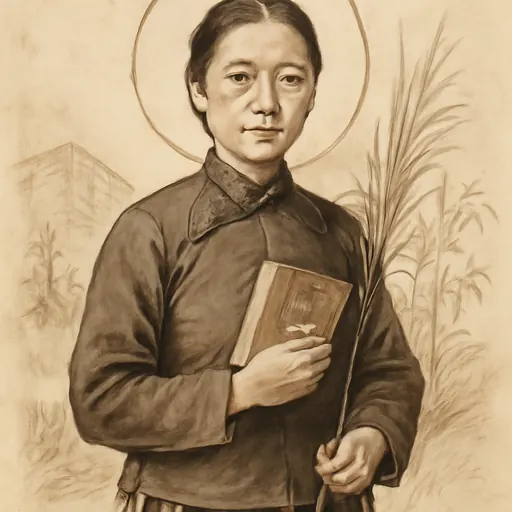
St. Lucy Yi Zhenmei (1815–1862) was a Catholic laywoman from Mianyang in Sichuan who spent her life teaching the faith to children and women, and who was beheaded in Guizhou for refusing to renounce Christ. She is honored on February 19, the day of her martyrdom, and with the Martyr Saints of China on July 9.
Who was St. Lucy Yi Zhenmei?
St. Lucy Yi Zhenmei was a Chinese laywoman who spent her life teaching the Catholic faith to children and women in Sichuan, refused to take money for it, and died a martyr in the neighboring province of Guizhou in 1862. She is one of the 120 Martyr Saints of China whom Pope John Paul II canonized in Rome on October 1, 2000.
She was born a Catholic on December 9, 1815, in Mianyang, Sichuan, the youngest child of her family. Old French books call her "Bienheureuse Lucie Y." We remember her on February 19, the day she was beheaded, and with all the martyrs of China on July 9.
The sources for her life are short: the Vatican's biography for the canonization lists her simply as a lay catechist among the five Martyrs of Guizhou, and the fuller account comes from the biographies prepared by Chinese Catholics for the canonization. What follows keeps to those.
The life of St. Lucy Yi Zhenmei
A vow at twelve
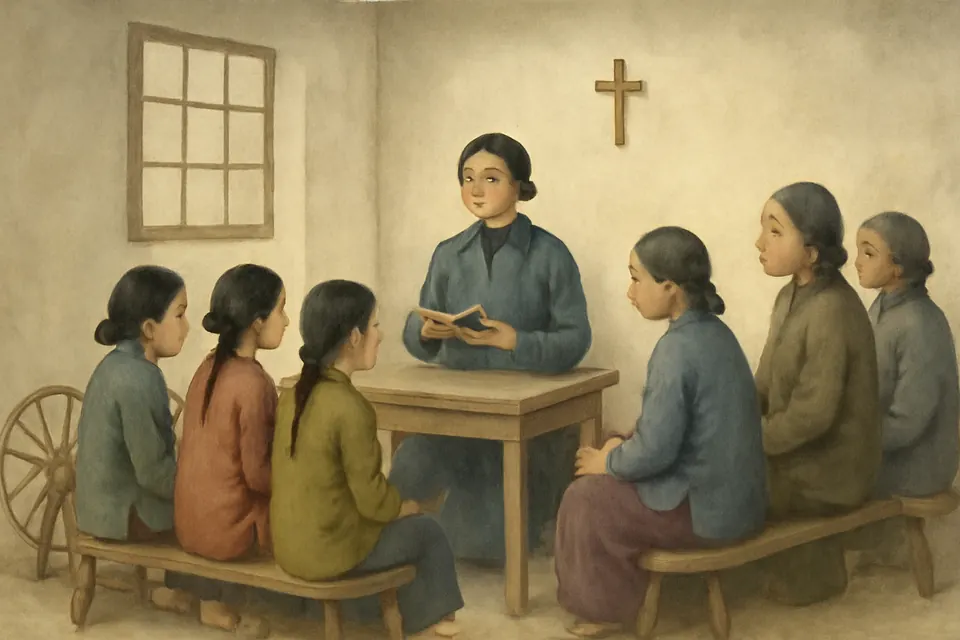
Lucy was a devout child, and at twelve she made a private vow to belong to God alone and never marry. She loved to read, and she kept studying as she grew up. When she was twenty she fell gravely ill. Her brother, who practiced medicine, treated her, and she recovered. After that illness she lived almost like a nun in her family's home, spending hours each day in prayer while she helped support the household. Her mother taught her to spin, and spinning became part of her daily work.
A teacher who would not be paid
After her father died she lived with her mother and brother and used her free hours to teach the faith to the children of the neighborhood. The parish priest of Mianyang noticed how well she knew her catechism and asked her to teach in the parish school. Four years later her brother moved to Chongqing to practice medicine, and Lucy and her mother went with him. There, too, the priest asked her to instruct the women of the parish. When she was offered pay, she refused it and offered her work to God.
Guiyang and the mission
Some years later her brother moved again, to Guiyang, the capital of Guizhou, and during this time her mother died. Lucy wanted to keep working for the Gospel, and for her own safety she lived in a house of consecrated lay virgins. Poor health sent her home for a time. In 1861 Bishop Hu asked her to come back and teach in the house again, and she went, though her relatives opposed it.
Martyrdom
In early 1862 Lucy set out with Father Jean-Pierre Néel, a French priest of the Paris Foreign Missions Society, to open a new mission at Jiashanlong. Just then the provincial administrator of Guizhou, Tian Xingshu, began to stir up hatred against Christians, and a local magistrate took his side. Father Néel and three catechists, John Zhang Tianshen, Martin Wu Xuesheng and John Chen Xianheng, were arrested and condemned to death without a proper trial.
On February 18, the day of their execution, the prisoners passed Lucy on the road. She was arrested too, tried that same day and sentenced to death when she would not deny her faith. At noon the next day, February 19, 1862, she was beheaded. She was about forty-six. Christians risked their lives to carry the bodies of all five martyrs to the seminary grounds at Liuchongguan for burial.

The Martyrs of Guizhou and the saints of China
Lucy is the only woman among the five Martyrs of Guizhou of 1862. They were part of a long line: the Vatican biography also lists three catechists beheaded at Maokou in 1858, among them the laywoman Agatha Lin Zao, and four martyrs of Qingyanzhen in 1861, among them the widow Martha Wang Luo Mande, who cooked for the seminary. Pope Pius X beatified the five Martyrs of Guizhou on May 2, 1909.
Pope John Paul II canonized them on October 1, 2000, with Augustine Zhao Rong and 119 companions: 87 Chinese Catholics and 33 missionaries who died between 1648 and 1930. In the homily he said the testimonies left by these martyrs "allow us to glimpse in them a state of mind marked by deep serenity and joy." St. Josephine Bakhita and St. Katharine Drexel were canonized in the same Mass.
As martyrs, Lucy and her companions did not need a miracle for beatification; the Church recognized that they died for the faith. No miracles, approved or reported, are attributed to her in the sources consulted here.

Why St. Lucy Yi Zhenmei is a patron of catechists
She was a catechist in the plainest sense: a laywoman who taught children and women the faith, year after year, for no pay. Catechists and Catholic teachers, especially in Chinese communities, look to her as one of their own. See more patron saints of teachers and all the patron saints.
Symbols of St. Lucy Yi Zhenmei in art
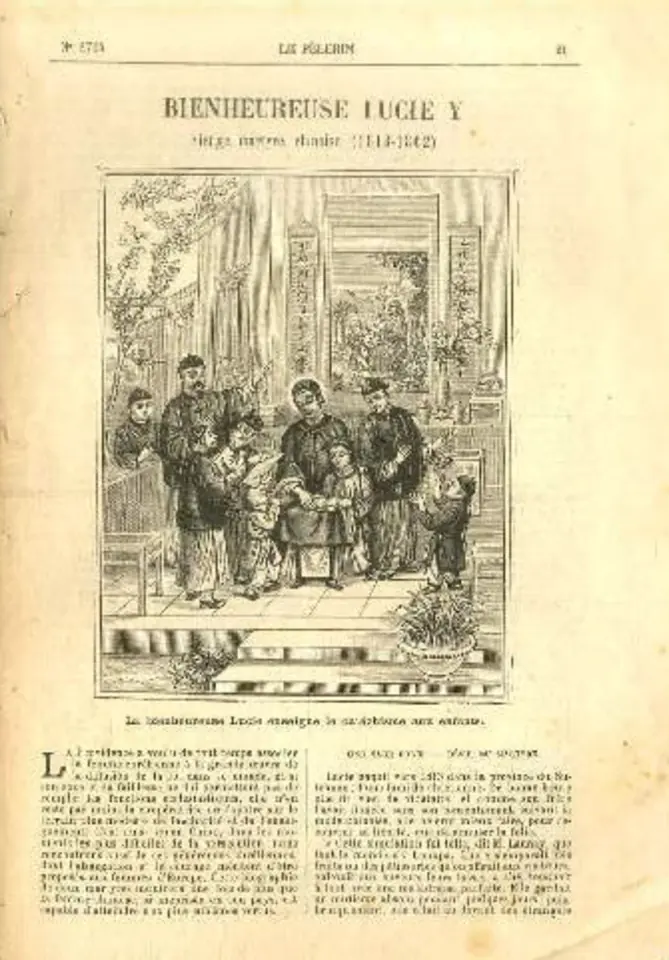
There is no old tradition of images of Lucy Yi; most pictures of her are modern or come from late nineteenth- and early twentieth-century French mission magazines. Look for these:
- The palm: the sign of a martyr.
- Chinese dress of the Qing period: a plain, high-collared jacket, often dark blue or black.
- A book or catechism: her life of teaching.
- Children around her: the engraving in Le Pèlerin shows her teaching in a courtyard.
- A lily: her vow of virginity, kept from the age of twelve.
In group icons and reliefs of the Martyr Saints of China she usually stands among the laywomen. She should not be confused with St. Lucy of Syracuse, the Roman virgin martyr with the lamp and the eyes on a dish, whose name she bore.
Feast day
We honor her on February 19. The General Roman Calendar keeps the memorial of St. Augustine Zhao Rong and companions, the Martyr Saints of China, on July 9. See the feast day calendar.
Prayer to St. Lucy Yi Zhenmei
No prayer written by Lucy survives. On July 9 the Church prays the collect of the Martyrs of China in the Roman Missal, and we can ask her help in our own words, especially for catechists, for teachers who work without reward and for the Church in China. A simple invocation is enough: "St. Lucy Yi Zhenmei, pray for us."
Let us ask her to give us her quiet courage, the kind that keeps teaching the faith for decades and does not turn back on the road.
Frequently asked questions
When is the feast day of St. Lucy Yi Zhenmei?
February 19, the anniversary of her martyrdom in 1862. In the General Roman Calendar she is celebrated with St. Augustine Zhao Rong and the other Martyr Saints of China on July 9.
How did St. Lucy Yi Zhenmei die?
In February 1862 she was on her way to help open a new mission in Guizhou when she met the missionary priest Jean-Pierre Néel and three Chinese catechists being led to execution. She was arrested, tried the same day and condemned when she would not give up her faith. She was beheaded at noon on February 19, 1862.
When was St. Lucy Yi Zhenmei canonized?
Pope Pius X beatified her with the other four Martyrs of Guizhou on May 2, 1909. Pope John Paul II canonized her on October 1, 2000, with Augustine Zhao Rong and 119 companions, the Martyr Saints of China.
Keep exploring
- Patron saint pages
- Teachers
- Feast-day calendar
- Saints remembered in FebruarySaint of the dayWhat saint is my birthday?
- More
- Saints A to ZPatron saints A to ZExplore every section
Sources
- Vatican: Augustine Zhao Rong and 119 companions, martyrs in China (biography for the canonization of October 1, 2000). the five Martyrs of Guizhou, February 18 and 19, 1862; Lucy Yi Zhenmei, lay catechist
- John Paul II, Homily for the canonization of the Martyrs of China, October 1, 2000
- Chinese Martyrs Association: St. Lucy Yi Zhenmei, 1815–1862 (archived). birth date, vow at twelve, teaching in Mianyang and Chongqing, the meeting on the road, beatification May 2, 1909