St. Amata of Assisi, Niece of St. Clare
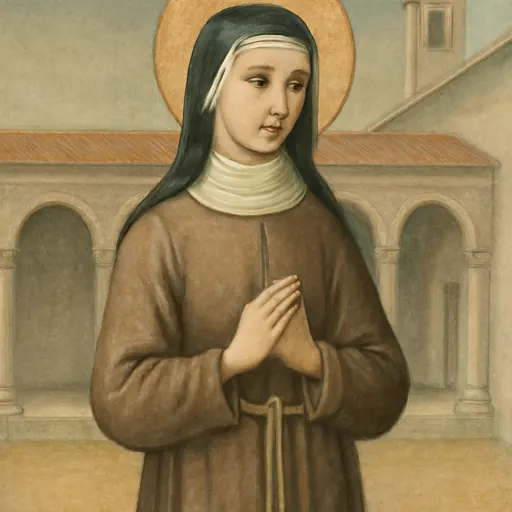
St. Amata of Assisi (died about 1255) was the niece of St. Clare, a lively young woman of Assisi about to marry, whom Clare's prayers and words drew to the Poor Clares at San Damiano. Clare later healed her of a long illness with the sign of the cross, and Amata nursed her aunt at her death and told what she had seen when the Church gathered testimony for Clare's canonization. Franciscans, who call her Blessed Amata, keep her memory on February 20.
Who was St. Amata of Assisi?
St. Amata of Assisi was the niece of St. Clare, a young woman of a noble Assisi family who seemed headed for an ordinary, comfortable marriage. Instead she ended her days as one of the first Poor Clares at San Damiano, the little convent below the town where Clare lived for over forty years. She was healed by her aunt, nursed her aunt at her death, and helped tell the world who Clare was.
Her name means "beloved" in Latin, and it is still a common religious name among the Poor Clares. In the Franciscan family she is called Blessed Amata, and her memory is kept on February 20. Popular listings often call her St. Amata; her honor comes from long local and Franciscan tradition rather than a formal canonization.
What we know of her is short and precious, and it comes from people who knew her: the Life of St. Clare written soon after Clare's death, and the sworn testimony the sisters gave in 1253.

A worldly girl and a praying aunt
Amata's father was a nobleman, Martino, and her mother was one of Clare's sisters. Agnes Dunbar's Dictionary of Saintly Women (1904), drawing on the Franciscan historian Luke Wadding, says her parents meant her to marry, and that as a girl she "was pleased with dress and worldly vanity." Clare "grieved for the peril in which she saw her, and prayed that she might strive to please God rather than men."
The Poor Clares of Rockford, Illinois, tell the turning point this way. Already engaged, Amata went to San Damiano to ask her aunt's prayers for the marriage. Clare answered by speaking to her of the glory of being espoused to Christ. Amata stayed. When her friends and her fiancé came to bring her home, she would not be moved. Dunbar sums it up: "Her prayer was heard; Amata was soon inspired with a disgust for the world and desire for a religious life."
She was not the only one of the family to come. Clare's sister St. Agnes, their mother Ortolana, and Amata's own sister Balbina all joined the Poor Ladies. Wadding lists Amata and Balbina in the community at San Damiano in 1238. The early Life of Clare puts it simply: "the sister drew her sisters, and the aunt her nieces."
Healed by the sign of the cross
The best-documented moment of Amata's life is her healing. The Life of St. Clare, ascribed to Thomas of Celano and written within a few years of Clare's death, records it among Clare's miracles:
Another among the Sisters, Amata by name, had been afflicted with dropsy for thirteen months; exhausted, moreover, by fever, coughing and a pain in the side, she was confined to bed. Clare, being moved to compassion for her, had recourse to the aid of her noble remedy. She made the sign of the Cross upon Amata in the name of her Christ and immediately restored her to the fullness of health.
The Rockford Poor Clares add a detail from the canonization testimony: her belly was so swollen that she could hardly bend forward. This is a reported miracle, sworn to by eyewitnesses in the process for Clare's canonization in 1253. It was Clare's sanctity the Church was examining, and the sisters' testimony was part of the case that led Pope Alexander IV to canonize Clare in 1255.

At Clare's deathbed
Amata was one of the sisters who nursed Clare through her last illness in the summer of 1253. The Rockford Poor Clares quote the process of canonization: on the Friday before her death, when Amata was alone with her, Clare asked her, "Did you see the King of Glory as I saw?" Clare died on August 11, 1253.
That November, papal commissioners came to San Damiano and took sworn statements from the sisters. Amata was among them, and her memories of her aunt's prayer, penance and cures went into the record. She lived long enough to see it bear fruit. She died about 1255 and, Dunbar says, was buried with her sister Balbina, who had gone on to lead a new community of Poor Clares near Spello.

Symbols of St. Amata in art
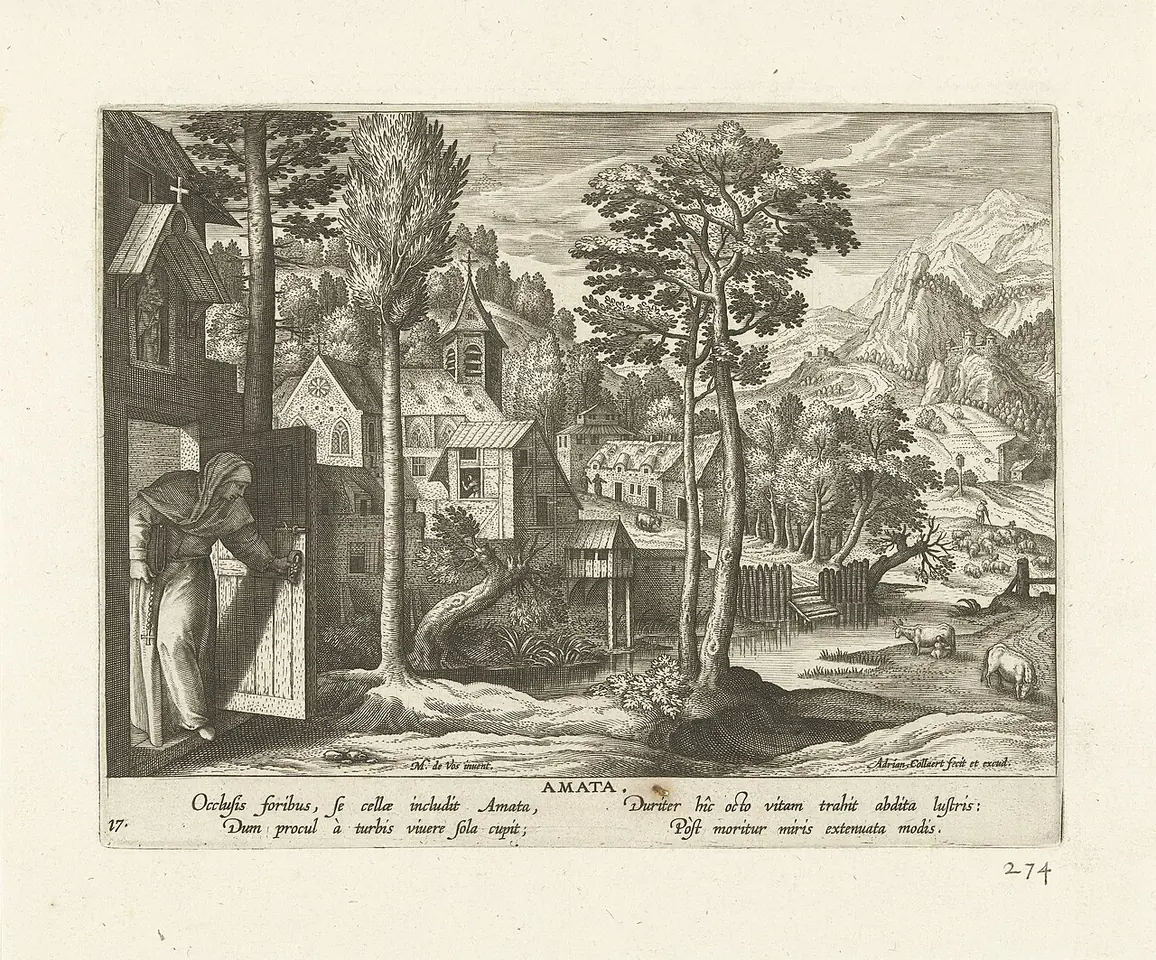
Images of Amata are rare. When she appears, she wears the plain habit, cord and veil of the Poor Clares, often in scenes of Clare's life: lying sick while Clare blesses her, or kneeling at Clare's deathbed. The Flemish engraving on this page, from a series of holy women hermits designed by Maerten de Vos, shows a veiled woman shutting the door of her cell, a picture of a heart that has closed itself to the world in order to be open to God.
Feast day and prayer
Franciscans keep the memory of Blessed Amata on February 20. Her story belongs with those of St. Clare and St. Francis, and it is a hopeful one for every family that prays for a son or daughter far from God. Clare did not argue Amata into the convent. She prayed for her first.
We know of no traditional prayer to Blessed Amata, and we will not invent one in her name. Let us ask her to pray for us: for young people deciding their future, for the sick waiting on God's mercy, and for aunts, uncles and grandparents who quietly pray a child home. See the feast day calendar for the other saints of February.
Frequently asked questions
Who was St. Amata of Assisi?
A niece of St. Clare of Assisi, the daughter of Clare's sister. She gave up a planned marriage to join her aunt's Poor Ladies at San Damiano, lived there for many years, cared for Clare in her last illness and died about 1255.
How did St. Clare heal Amata?
The Life of St. Clare says Amata had suffered from dropsy for thirteen months, with fever, cough and a pain in her side, and was confined to bed. Clare made the sign of the cross over her in the name of Christ and she was restored to full health.
When is St. Amata's feast day?
February 20 in Franciscan tradition. She is usually called Blessed Amata there, and she is not listed in the Roman Martyrology.
Keep exploring
Sources
- The Life of Saint Clare, ascribed to Thomas of Celano, translated by Paschal Robinson (1910), at archive.org. The healing of Amata of dropsy (p. 55); Robinson notes that tradition makes her Clare's niece
- The Life and Legend of the Lady Saint Clare, translated by Charlotte Balfour (1910), at archive.org. Wadding lists Amata and her sister Balbina in the San Damiano community in 1238
- Agnes B. C. Dunbar, A Dictionary of Saintly Women, vol. 1 (1904), at archive.org. Bl. Amata, Feb. 20: her worldly youth, Clare's prayer, her cure and burial with her sister (p. 50)
- Poor Clare Colettine Nuns of Rockford, Illinois: Blessed Amata of Assisi (archived 2024). Her testimony at Clare's process of canonization and Clare's words to her before death