St. Geltrude Comensoli, Foundress of the Sacramentine Sisters of Bergamo

St. Geltrude Comensoli (1847–1903) was an Italian woman from Bienno, near Brescia, who founded the Sacramentine Sisters of Bergamo for perpetual adoration of Jesus in the Eucharist and, at Pope Leo XIII's wish, for the care of young working women. Pope Benedict XVI canonized her in 2009. Her feast is February 18.
Who was St. Geltrude Comensoli?
St. Geltrude Comensoli was an Italian woman whose whole life turned on Jesus in the Blessed Sacrament. Born Caterina Comensoli in the mountain village of Bienno, in the Val Camonica above Brescia, she spent years as a domestic servant before founding the Sacramentine Sisters of Bergamo in 1882. Her sisters keep perpetual adoration of the Eucharist and, at the request of Pope Leo XIII, care for and educate young working women. She died in Bergamo on February 18, 1903, and Pope Benedict XVI canonized her in 2009.
Her motto was simple: "Jesus, loving You and making others love You." We keep her feast on February 18.

The life of St. Geltrude Comensoli
A child who "was thinking"
Caterina was born on January 18, 1847, the fifth of ten children of Carlo Comensoli and Anna Maria Milesi, and was baptized the same day. Even as a little girl she was drawn to quiet prayer. When people asked what she was doing, she would answer, "I am thinking."
The Holy See's biography tells a lovely story from her seventh year. Too young for First Communion by the custom of the time, she wrapped herself in her mother's black shawl one morning before dawn, slipped into the nearby church of St. Mary, and received Communion at the altar rail without anyone noticing. From then on, she said, she had sworn eternal love to Jesus. While still a girl she gathered friends into a "Guard of Honor" to keep Our Lord company in the tabernacle, which so often stood alone in the empty church.

Illness, service and a growing call
In 1862 she entered the Sisters of Charity at Lovere, founded by St. Bartolomea Capitanio, but she fell seriously ill and was sent home. After she recovered, her family's money troubles sent her into domestic service, first in the house of Fr. G. B. Rota, parish priest of Chiari and later bishop of Lodi, and then with the Countess Fé-Vitali. Both households would matter later. At Christmas 1876 she wrote out a demanding rule of life for herself, and on the feast of Corpus Christi 1878, with her confessor's permission, she made her vow of chastity perpetual. Alongside her work she taught the children of San Gervasio, near Bergamo.
Leo XIII changes her plan
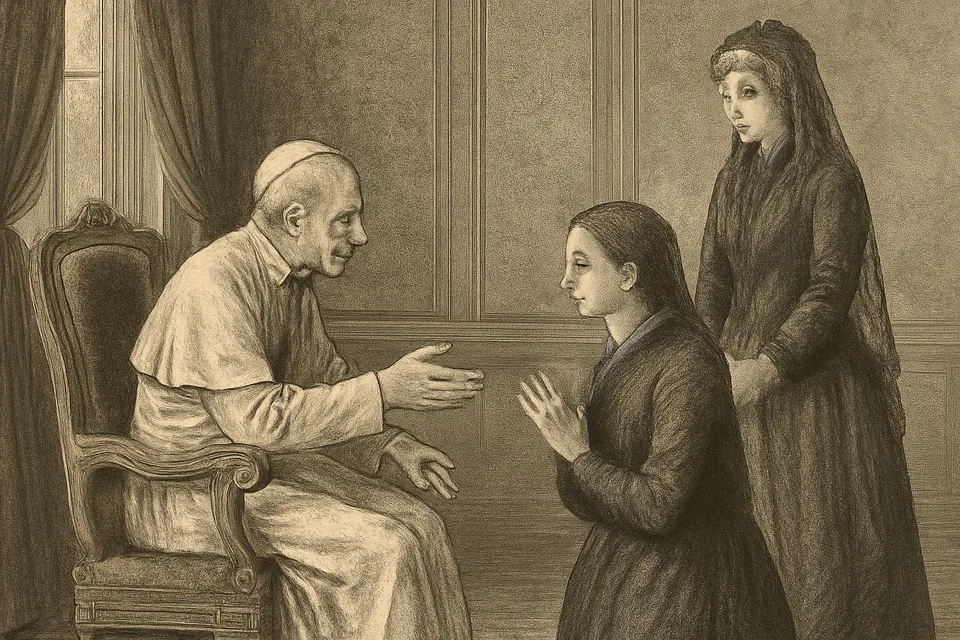
In 1880, traveling to Rome with the Fé-Vitali family, Caterina spoke with Pope Leo XIII about her dream of a religious institute devoted to adoring the Eucharist. The Pope widened the plan: he asked her to add the education of young women who worked in the new factories. She obeyed. With the support of Bishop Guindani of Bergamo and her spiritual director, Fr. Francesco Spinelli (now St. Francesco Spinelli), she and two companions began the Sacramentine Sisters on December 15, 1882, with their first hour of adoration before the Blessed Sacrament. Two years later she took the name Sister Geltrude of the Blessed Sacrament.
Trials and fruit
The "tender little plant," as the biography calls it, nearly died in its first years. Financial and other troubles forced the sisters out of Bergamo. Bishop Rota of Lodi, her old employer, took them in and gave them a house at Lavagna di Comazzo, and on September 8, 1891, he granted the institute canonical recognition. On March 28, 1892, Mother Geltrude brought the community back to Bergamo. There she led it until her death at midday on February 18, 1903, her head bowed toward the Church of Adoration. The poor, her favorite people, were already calling her a saint.
Miracles and the road to sainthood
Her cause opened in Bergamo on February 18, 1928, and gathered testimony on her virtues and on graces reported through her intercession. St. John XXIII declared her Venerable on April 26, 1961. St. John Paul II beatified her on October 1, 1989, and Pope Benedict XVI canonized her on April 26, 2009, in St. Peter's Square, together with St. Arcangelo Tadini, St. Bernardo Tolomei, St. Nuno Álvares Pereira and St. Caterina Volpicelli. Beatification and canonization each required a healing approved by the Church; the public Vatican sources we consulted do not describe those cases, so we leave them unnamed here.
In his homily that day, Pope Benedict said that adoration of Christ in the Eucharist became "the habitual condition of her existence," and that her institute set out to translate "charity contemplated" in the Eucharistic Christ into "charity lived" for one's needy neighbor.
Why St. Geltrude Comensoli is honored
She has no formal patronage. She is loved as an apostle of Eucharistic adoration and as a friend of young working women, the two works Leo XIII joined in her hands. Anyone who keeps a holy hour, or who works with young people far from home, can turn to her. Browse others on our patron saints page.

Symbols of St. Geltrude Comensoli in art
Because she lived in the age of photography, most images of her follow her surviving portrait rather than an old artistic tradition. Here is how to recognize her:
- Black habit and white wimple: the dress of her Sacramentine Sisters, with a crucifix hanging on her breast.
- The monstrance: the clearest sign of her mission of perpetual adoration; she is often shown kneeling before it or near it.
- Joined hands and lowered eyes: her quiet, recollected prayer, the "thinking" of the little girl from Bienno.
- Young women at her side: in devotional pictures, a reminder of the factory girls Leo XIII entrusted to her.
Feast day and where she is honored
Her feast is February 18. Her body was moved from the Bergamo cemetery on August 9, 1926, to the Mother House of her institute, where it rests in a chapel next to the Church of Adoration. Her birthplace in Bienno is marked with a plaque. See other saints of the season on our feast days page.
Praying with St. Geltrude Comensoli
We know of no English prayer to her with a citable origin, but her own motto is a prayer in itself: "Jesus, loving You and making others love You." The best way to honor her is to spend time before the Blessed Sacrament, as she did. Let us ask her: St. Geltrude, you who found your whole vocation in the presence of Jesus in the Eucharist, pray that we may love Him there and carry that love to those who need it most.
Frequently asked questions
Who was St. Geltrude Comensoli?
Born Caterina Comensoli in Bienno in 1847, she worked for years as a domestic servant, then founded the Sacramentine Sisters of Bergamo in 1882, devoted to adoring the Blessed Sacrament and to educating young women who worked in factories. She took the name Geltrude of the Blessed Sacrament and died in Bergamo in 1903.
When is the feast of St. Geltrude Comensoli?
February 18, the anniversary of her death in 1903.
When was Geltrude Comensoli canonized?
Pope Benedict XVI canonized her in St. Peter's Square on April 26, 2009. St. John Paul II had beatified her on October 1, 1989.
Where is St. Geltrude Comensoli buried?
Her body rests in a chapel next to the Church of Adoration at the Mother House of the Sacramentine Sisters in Bergamo, where it was brought from the city cemetery in 1926.
Keep exploring
Sources
- Geltrude Comensoli (1847-1903) - Biography (Holy See). Her secret First Communion, service with Fr. Rota and the Fé-Vitali family, the audience with Leo XIII, the founding in 1882, the 1926 translation and the stages of her cause
- Holy Mass for the Canonization of Five New Saints, Homily of Benedict XVI (April 26, 2009). The Pope's words on her "charity contemplated" and "charity lived"
- Geltrude Comensoli - Dicastero delle Cause dei Santi. Beatification and canonization dates and the liturgical memorial of February 18 (in Italian)