St. Finan of Lindisfarne, Irish Monk and Bishop of Northumbria
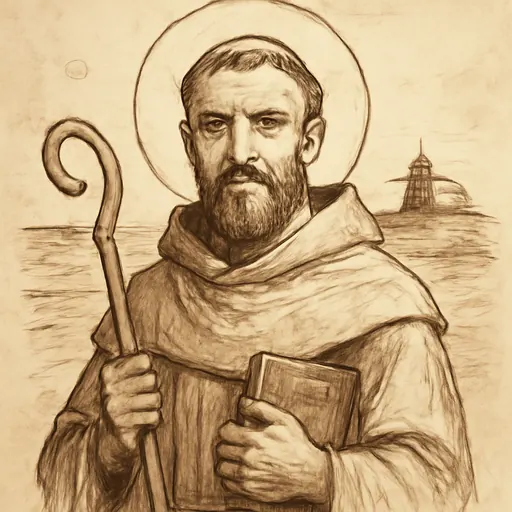
St. Finan of Lindisfarne (died 661) was an Irish monk of Iona who became bishop of Lindisfarne after St. Aidan in 651. In ten years he built Lindisfarne's church of hewn oak, baptized the kings of the Middle Angles and the East Saxons, and sent out the missionaries who began the conversion of the Midlands and Essex. His feast is February 17.
Who was St. Finan of Lindisfarne?
St. Finan of Lindisfarne was an Irish monk sent from St. Columba's monastery of Iona to lead the Church in Northumbria after the death of St. Aidan in 651. For ten years he was bishop on the tidal island of Lindisfarne, and from there the faith spread to two more English peoples, the Middle Angles and the East Saxons. Bede, our only real source, records that Finan baptized both their rulers. We keep his feast on February 17.
Do not mix him up with the two Irish teachers named Finnian, St. Finnian of Clonard and St. Finnian of Movilla, who lived a century earlier.
The life of St. Finan of Lindisfarne
From Iona to Holy Island
Bede says Finan "had likewise come from the same monastery of Hii," that is, Iona, and that he was "ordained and sent by the Scots," the word Bede uses for the Irish. When Aidan died in 651, Finan succeeded him "and continued a considerable time in the bishopric." King Oswy of Northumbria, who had been baptized and taught by the Irish, was his friend and supporter.
A church of oak and reeds
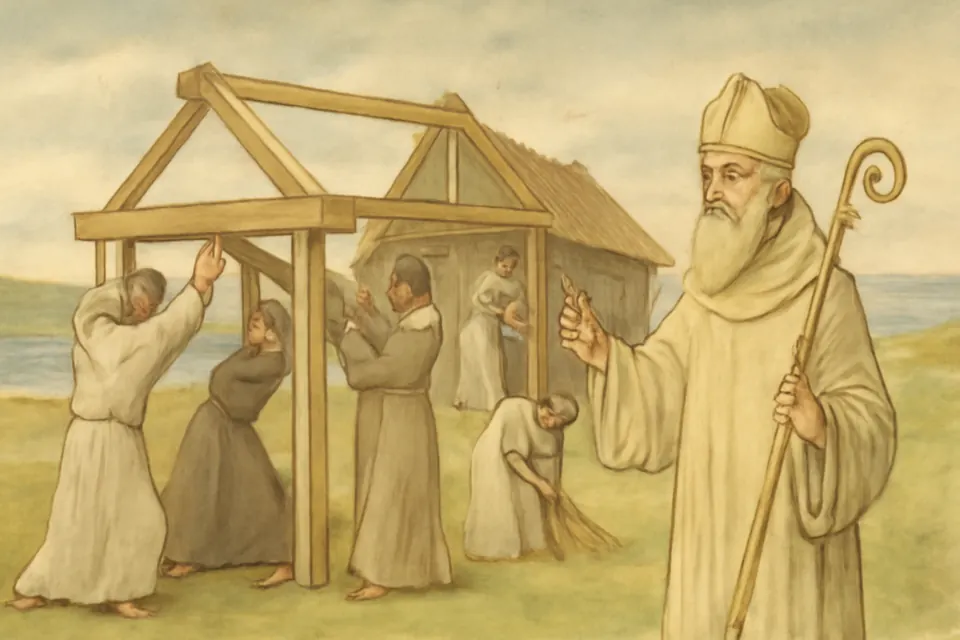
On Lindisfarne, Finan built the church of the bishop's see. Bede notes that "after the manner of the Scots, he made it, not of stone, but of hewn oak, and covered it with reeds." Years later Archbishop Theodore dedicated it to St. Peter, and Bishop Eadbert covered roof and walls with lead. Nothing of it survives; the red sandstone ruins on the island today belong to the priory built after the Norman Conquest.
Two royal baptisms
The best-known part of Finan's work came through royal friendships. Peada, son of the pagan King Penda of Mercia and ruler of the Middle Angles, wanted to marry Oswy's daughter. Oswy's condition was that he become a Christian. Bede says Peada declared he would be baptized "even though he should be refused the virgin," and "he was baptized by Bishop Finan, with all his earls and soldiers," at a royal estate called At the Wall, near Hadrian's Wall.

Peada went home with four priests: Cedd, Adda, Betti and Diuma. Not long after, Sigebert, king of the East Saxons, also came to Oswy and was baptized by Finan at the same place.
Bishops for new peoples
Finan then sent out shepherds. When Cedd came back to Lindisfarne after a successful mission in Essex, Finan, "finding how successful he had been in the work of the Gospel," made him bishop of the East Saxons, calling two other bishops to share in the consecration. He also ordained Diuma as bishop of the Middle Angles and the Mercians. Through these men, the faith that Iona had brought to Northumbria reached the middle and south of England.

Easter and his temper
Finan kept Easter by the Irish reckoning, as Aidan had. Bede, who loved the Roman date, tells how an Irishman named Ronan, trained in Gaul or Italy, argued with him. He "could not prevail upon Finan, but, on the contrary, made him the more inveterate by reproof... being of a hot and violent temper." It is an honest glimpse of a strong man. Finan died in 661, and three years later his successor Colman lost the debate at the Synod of Whitby.
Miracles of St. Finan
Bede records no miracles of Finan himself. The wonder Bede does tell from his years is about Aidan: the wooden post Aidan leaned on when he died would not burn when Penda's army set fire to the church around it. That miracle is reported by Bede and belongs to Aidan, but it happened while Finan was bishop.
Symbols of St. Finan in art
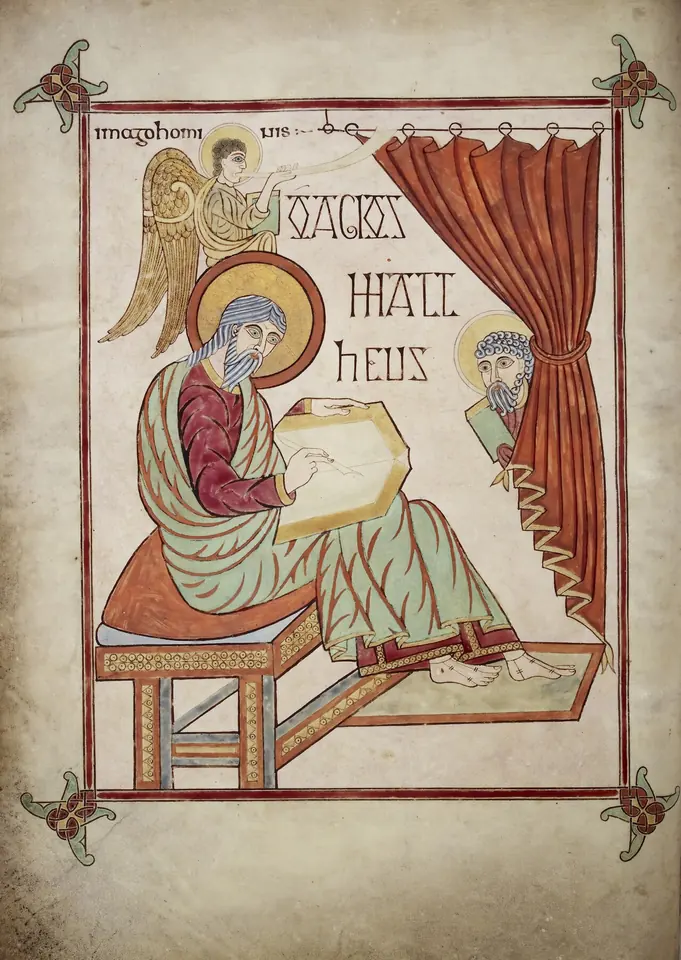
There is no old image of Finan. When he appears in modern art, he is shown like the other Irish monk-bishops of Lindisfarne:
- A crozier, the shepherd's staff of a bishop.
- A Gospel book, for his preaching and the baptisms he gave.
- A plain monk's habit and the Irish tonsure, shaved across the front of the head.
Feast day and where he is honored
His feast is February 17. The Roman Martyrology remembers him as a bishop and abbot "rich in extraordinary doctrine and zeal for evangelisation." His grave is unknown. Pilgrims honor him with Aidan and St. Cuthbert on Holy Island, reached by a causeway across the sands at low tide. See our feast days calendar.

Prayer to St. Finan
We know of no traditional prayer to St. Finan. We may ask him to pray for missionaries, for bishops who must send others out, and for unity among Christians who disagree. St. Finan of Lindisfarne, pray for us.
Frequently asked questions
When is the feast of St. Finan of Lindisfarne?
February 17. The Roman Martyrology names him on that day, "rich in extraordinary doctrine and zeal for evangelisation."
Who came before and after St. Finan at Lindisfarne?
St. Aidan, who died in 651, came before him. After Finan died in 661, Colman became bishop and led the Irish side at the Synod of Whitby in 664.
Is St. Finan of Lindisfarne the same as St. Finnian?
No. St. Finnian of Clonard and St. Finnian of Movilla were sixth-century Irish teachers who never served in England. Finan of Lindisfarne lived a century later.
Did St. Finan keep the Roman date of Easter?
No. Like Aidan, he kept the Irish reckoning of Easter. Bede says the Irish priest Ronan argued with him about it but could not persuade him.
Keep exploring
Sources
- Bede, Ecclesiastical History of England, Book III (Medieval Sourcebook). Chapters 17, 21, 22 and 25 to 26 (his coming from Iona, the baptisms at Ad Murum, the consecrations of Cedd and Diuma, the oak church and the Easter dispute with Ronan)
- Sabine Baring-Gould, The Lives of the Saints, vol. 2 (February), Project Gutenberg. The calendars that keep his feast, and a summary of his episcopate
- Roman Martyrology (2004), February 11 to 20, GCatholic. Feast on February 17