St. Gerasimus of the Jordan, the Desert Abbot and His Lion
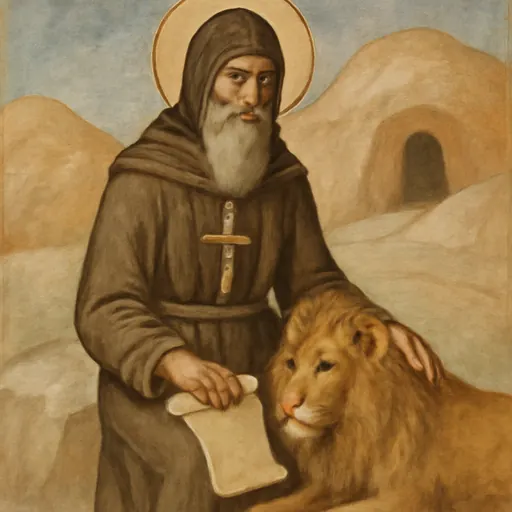
St. Gerasimus of the Jordan (died 475) was a monk from Lycia who founded a famous lavra near the Jordan River and ruled it with a strict, gentle discipline. Tradition says he drew a thorn from a lion's paw and the lion served him until his death. We keep his feast on March 5 (March 4 in the East).
Who was St. Gerasimus of the Jordan?
St. Gerasimus of the Jordan was a fifth-century desert abbot who founded a lavra, a settlement of hermits around a central monastery, near the Jordan River, a short walk from Jericho. He came from Lycia in Asia Minor, tested his vocation in the Egyptian desert, and settled by the Jordan about 450. There he guided dozens of monks with a rule known for its hardness and its kindness. He died on March 5, 475, and both East and West honor him; we keep his feast on March 5, and the Byzantine churches on March 4.

Most people meet him without knowing it. The lion that sits at St. Jerome's feet in so many Western paintings began, it seems, as the lion of Abba Gerasimus.
The life of St. Gerasimus
From Lycia to the Jordan
According to the Orthodox Church in America's life, Gerasimus received the monastic tonsure young and went into the desert of the Thebaid in Egypt. About 450 he arrived in Palestine. For a time, in the turmoil after the Council of Chalcedon (451), he followed the teaching of Eutyches, which saw only a divine nature in Christ. The great abbot St. Euthymius brought him back to the orthodox faith, and the two became close. The Roman Martyrology remembers exactly this: that Euthymius led him back to the true faith, and that Gerasimus then gave his monks "a model of discipline and life."
The lavra and its rule
About 455 he settled roughly a mile from the Jordan and built a monastery for beginners, with cells for hermits scattered around it. The anonymous sixth-century Life, summarized by the Bollandist scholar Joseph-Marie Sauget, counts up to seventy cells. Newcomers lived in community for some years before they could become hermits.
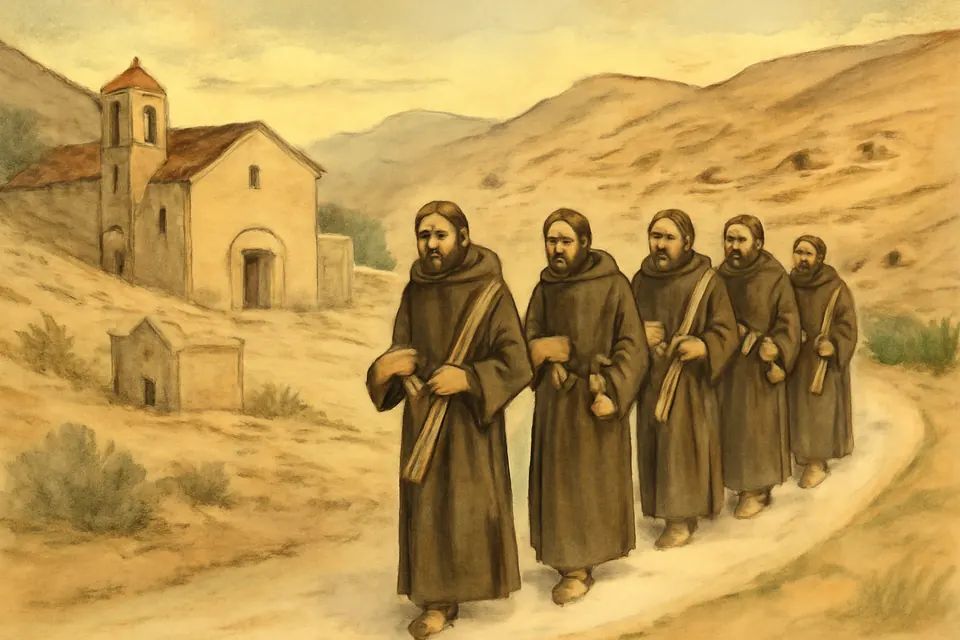
The hermits spent five days alone, weaving baskets from palm branches and praying. They lit no fire and ate only dry bread, roots and water. On Saturday and Sunday they gathered at the monastery for the Divine Liturgy and Holy Communion, then went back to their cells with bread, water and a bundle of palm fronds. Each owned an old habit and a mat. No cell was locked, so that any brother could rest there or take what he needed.
Lent in the desert
Gerasimus was harder on himself than on anyone. During Great Lent, the OCA life says, he ate nothing until he received Holy Communion on Easter. Each year he went out into the desert with Euthymius for the fast, taking along his beloved disciple St. Cyriacus. When Euthymius died in 473, Gerasimus saw angels carrying his soul to heaven, went at once to his monastery with Cyriacus, and buried him. Two years later, on March 5, 475, Gerasimus himself died peacefully among his brothers.
The miracles of St. Gerasimus and the lion
The famous story is traditional. Its oldest form is in The Spiritual Meadow of John Moschus, a monk who toured the monasteries of Palestine and wrote about 600, more than a century after Gerasimus's death.
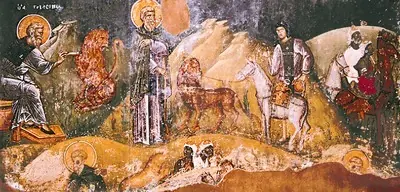
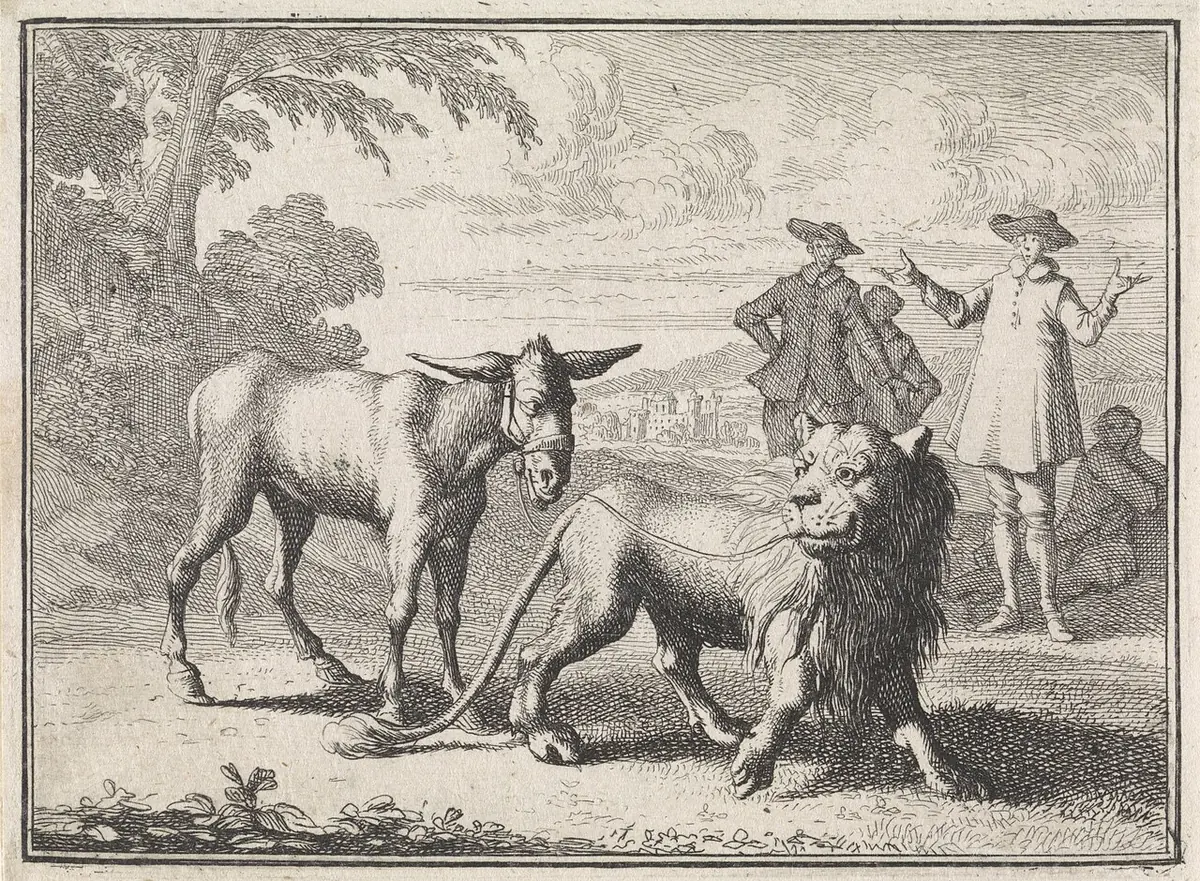
One day by the Jordan a lion came limping to the abbot with a thorn driven deep into its paw. Gerasimus drew it out, cleaned the wound and bound it. The lion would not leave him. The monks gave it a task: to guard the donkey that carried their water from the river. When camel drivers stole the donkey, the brothers assumed the lion had eaten it, and the abbot made the lion carry the water in its place. Later the lion found the donkey with the caravan and led it home, camels and all, to the great surprise of the monks.
According to the Life summarized by Sauget, the lion stayed with Gerasimus about five years. When the old man died, the lion would not eat. It was led to his grave, lay down on it, and died there.
The Orthodox Church honors Gerasimus with the title wonderworker, and its hymns speak of healings granted "to all" through his prayers. We know of no individual healing at his tomb recorded in an early source.
Why St. Gerasimus is honored
He has no formal patronage. He is honored as a father of Palestinian monasticism, a master of the life that joins solitude and community, and a man whose gentleness reached even a wild beast. People who love animals have a special fondness for him. See our patron saints page for patrons of particular causes.
Symbols of St. Gerasimus in art
- The lion: his unmistakable sign, lying at his feet or lifting its paw to him; the lion means the peace with creation that holiness restores.
- The thorn: icons often show the moment he draws it out, the story's beginning.
- The donkey and camels: in narrative cycles, such as the Thessaloniki fresco on this page, the rest of the story.
- Monastic habit and long gray beard: the dress of a desert elder; he often holds a scroll with words of monastic teaching.
- Rocky desert and a monastery: the Jordan wilderness where he lived.
How do you tell him from St. Jerome? Jerome usually wears a cardinal's red hat or robe and works at books in a study, or beats his breast with a stone. Gerasimus is a monk in a dark habit, in the desert, often in an Eastern icon. Joseph-Marie Sauget explains that the lion passed to Jerome because the two names sounded alike; in later Latin Jerome was often Geronimus.
Feast day and where he is honored
The Roman Martyrology keeps him on March 5; the Byzantine churches on March 4. His lavra lay in ruins by the end of the thirteenth century, and its hermits moved to the nearby monastery of Calamon. Today the Greek Orthodox Monastery of St. Gerasimus at Deir Hajla, near Jericho, keeps his memory in the same stretch of desert. No relics of him are known to be venerated today. Find other saints of the season on our feast days page.
Prayer to St. Gerasimus
The Orthodox Church sings this troparion on his feast, in the OCA's translation:
O citizen of the desert and angel in the body, / you were shown to be a wonderworker, O God-bearing Gerasimos, our Father. / You received heavenly gifts through fasting, vigil, and prayer, / healing the sick, and the souls of those who run to you with faith. / Glory to Him Who strengthened you. / Glory to Him Who crowned you. / Glory to Him Who, through you, works healing for all.
Let us ask holy Gerasimus to pray for us, that our hearts may become as peaceful as his desert, and as merciful.
Frequently asked questions
Who was St. Gerasimus of the Jordan?
A fifth-century monk from Lycia in Asia Minor who settled near the Jordan River about 450, founded a lavra for hermits and monks there, and died on March 5, 475. He was a friend of St. Euthymius the Great.
What is the story of St. Gerasimus and the lion?
John Moschus, writing about 600, tells that Gerasimus drew a thorn from a lion's paw by the Jordan. The lion stayed with him, guarded the monastery's donkey, and after the abbot's death lay down on his grave and died there. It is a traditional story, not a formally approved miracle.
Is St. Jerome's lion really St. Gerasimus's lion?
Very likely. The Bollandist scholar Joseph-Marie Sauget notes that the lion story belongs first to Gerasimus and was later attributed to Jerome because the names sounded alike (Jerome was called Geronimus in later Latin).
When is the feast of St. Gerasimus of the Jordan?
March 5 in the Roman Martyrology and March 4 in the Byzantine churches.
Keep exploring
Sources
- Venerable Gerasimus of the Jordan - Orthodox Church in America. His Lycian origin, the Thebaid, his rule, his Lenten fast, his disciple Cyriacus and the vision at the death of St. Euthymius
- Venerable Gerasimus of the Jordan, Troparion and Kontakion - Orthodox Church in America. Source of the troparion quoted on this page
- San Gerasimo, Anacoreta (Joseph-Marie Sauget) - Santi e Beati. The Roman Martyrology entry, the sixth-century anonymous Life, the seventy cells, the lion's five years with him, his death on March 5, 475, and the later fate of the lavra (in Italian)
- John Moschus, The Spiritual Meadow, chapter 107. The earliest telling of the lion story, written about 600