St. Mesrop Mashtots, the Monk Who Gave Armenia Its Alphabet
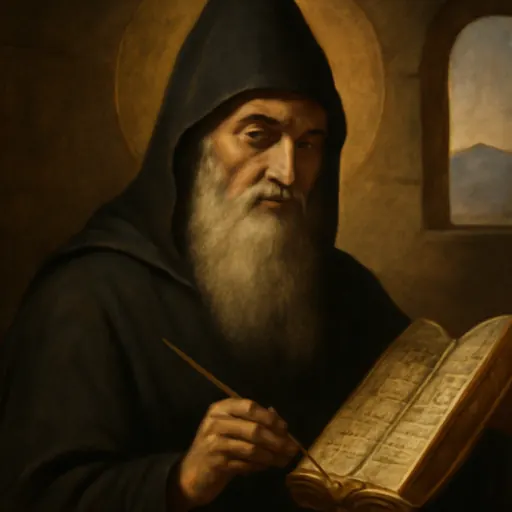
St. Mesrop Mashtots (about 361–440) was an Armenian monk and teacher who invented the Armenian alphabet around 405 and, with the Catholicos St. Sahak, led the translation of the Bible into Armenian. Armenians honor him as the father of their written language and as the first of the Holy Translators. His feast is kept on February 17 in Western calendars, and the Armenian Church honors him again each October.
Who was St. Mesrop Mashtots?
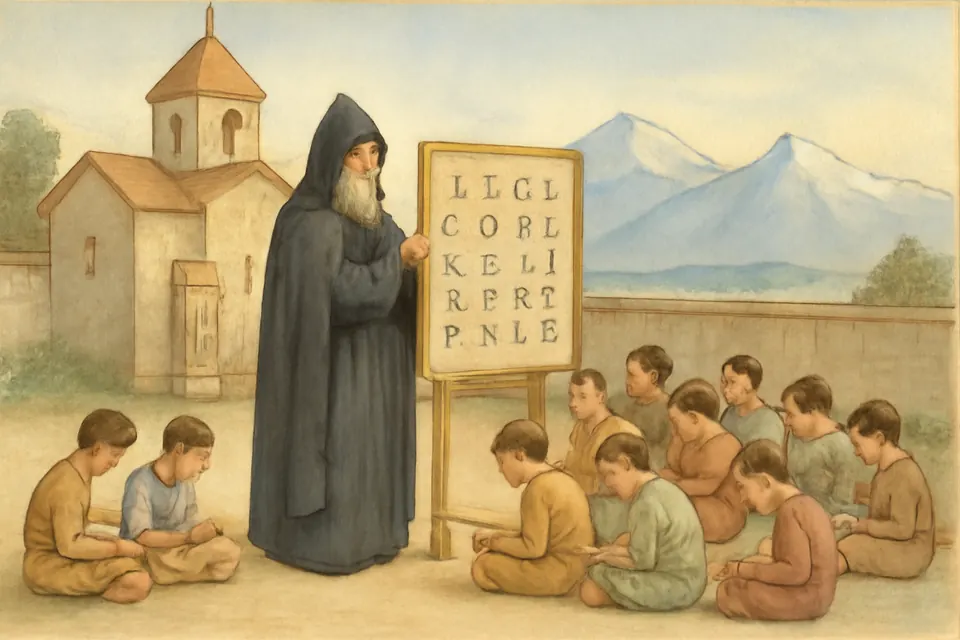
St. Mesrop Mashtots was an Armenian monk of the fifth century who gave his people their alphabet. Before him, Armenians spoke their own language but wrote in Greek, Syriac or Persian letters, and the Scriptures and the liturgy were read to them in Syriac, a tongue most of them could not follow. Around 405 Mesrop designed a set of letters made for the sounds of Armenian. Within a generation the Bible, the Creed and the prayers of the Church were in Armenian, and a written literature had begun.
Armenians call him the first of the Holy Translators. The Church honors him with St. Sahak the Great, the Catholicos who worked beside him, and we keep his memory on February 17.
The life of St. Mesrop
Courtier, then monk
Most of what we know comes from The Life of Mashtots by Koriun, his own pupil, written within a few years of his death. Mesrop was born about 361 at Hatsik in the province of Taron, the son of a man named Vardan. He learned Greek as a boy and served in the royal chancery of the Armenian kings, writing out the king's decrees in Greek, Syriac and Persian characters, since Armenian had no script of its own.
He left the court to become a monk. Koriun tells of hard years of fasting, vigils and Scripture. Then he went to preach in the district of Goghtn, where the local prince Shabit welcomed him. There he saw the problem plainly: he could preach, but his converts had no way to read the Word of God for themselves.
The alphabet
Mesrop shared his concern with the Catholicos St. Sahak, a descendant of St. Gregory the Illuminator, and with King Vramshapuh. Both supported him. A set of letters found by a Syrian bishop named Daniel proved unequal to the language, so Mesrop took a group of young men to the schools of Edessa and Samosata. Koriun writes that God granted him "letters for the Armenian language," which he "designed, named, determined, their order." At Samosata a Greek scribe named Rufanos gave the letters their finished shape.
The first sentence ever written in the new script was the opening of the Book of Proverbs: "To know wisdom and instruction, to perceive the words of understanding." The Catholic Encyclopedia counts 36 letters in Mesrop's alphabet; two more were added in the twelfth century.
Later Armenian tradition, as told by the historian Movses Khorenatsi, says the letters came to Mesrop in a vision of a right hand writing on stone. That account is traditional; Koriun simply calls the alphabet a gift from God after long prayer and labor.
Schools and the Bible
Back in Armenia, Mesrop opened schools and trained scribes. Koriun says he also devised an alphabet for the Georgians and another for the Caucasian Albanians, a people of what is now Azerbaijan, and preached among them. Modern historians still debate how much of the Georgian script was his work.
With Sahak, he sent pupils to Edessa, Constantinople and Alexandria to bring back good Greek manuscripts. The Armenian Bible, translated afresh from the Greek Septuagint, was completed about 434, and it is still the Bible of the Armenian Church. The councils of Nicaea, Constantinople and Ephesus and many writings of the Greek Fathers followed; some of those Fathers survive today only in their Armenian versions.

His holy death
Sahak died in 439, and Mesrop looked after the Church for six months more. Koriun was close at hand. He writes that after a few days of illness Mesrop sat up among his disciples, raised his hands to heaven and commended them to God's grace. "There was seen a luminous vision resembling a cross over the dwelling where the blessed one was dying," Koriun says, adding that "this was seen by everyone with his own eyes." This is a reported sign, written down by an eyewitness disciple. The commander Vahan Amatuni and the people carried his body with candles, torches and crosses to Oshakan and buried him there.
Why St. Mesrop is the patron of translators
The Armenian Church gives a feast to the Holy Translators: Mesrop, Sahak and the pupils who carried the Bible and the Fathers into Armenian. Translators, teachers and scholars in Armenia look to him as their patron. Every Armenian schoolchild learns his name, and Yerevan's great library of ancient manuscripts, the Matenadaran, is called the Mesrop Mashtots Institute. See more causes on our patron saints page.
Symbols of St. Mesrop in art
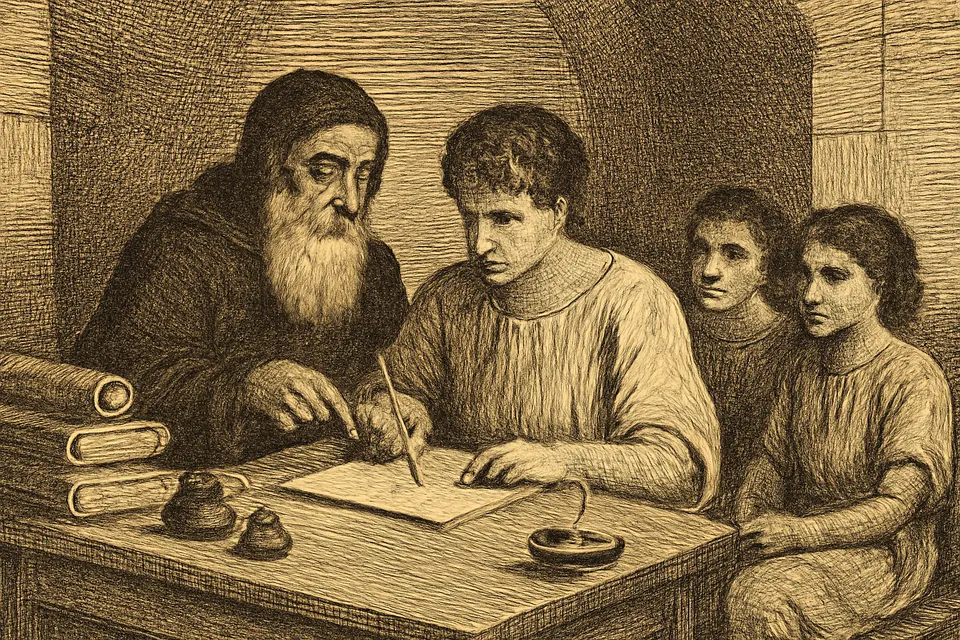
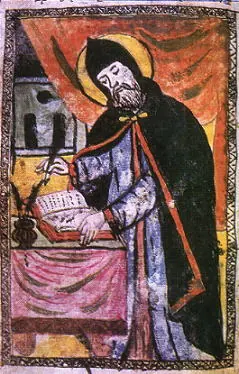
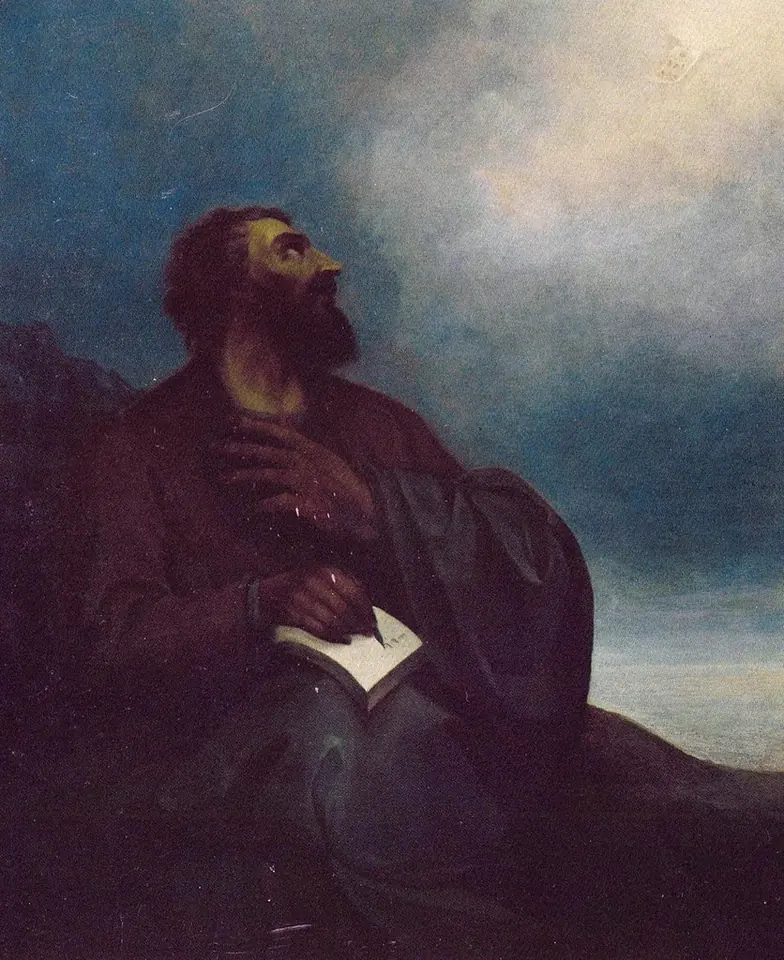
Armenian painters show St. Mesrop as a monk in a black habit with the tall, pointed hood of an Armenian vardapet, or teacher. He almost always has a pen and an open book, often with the Armenian letters written out on the page or on a tablet. A light or hand from heaven points to the tradition that the alphabet was a gift of God. In scenes of teaching he sits with St. Sahak, in patriarch's robes, while pupils write at a table before them.
The 1882 portrait by Stepanos Nersisyan in the Catholicos's residence at Etchmiadzin shows him alone on a hillside, looking up, a page on his knee.
His tomb at Oshakan
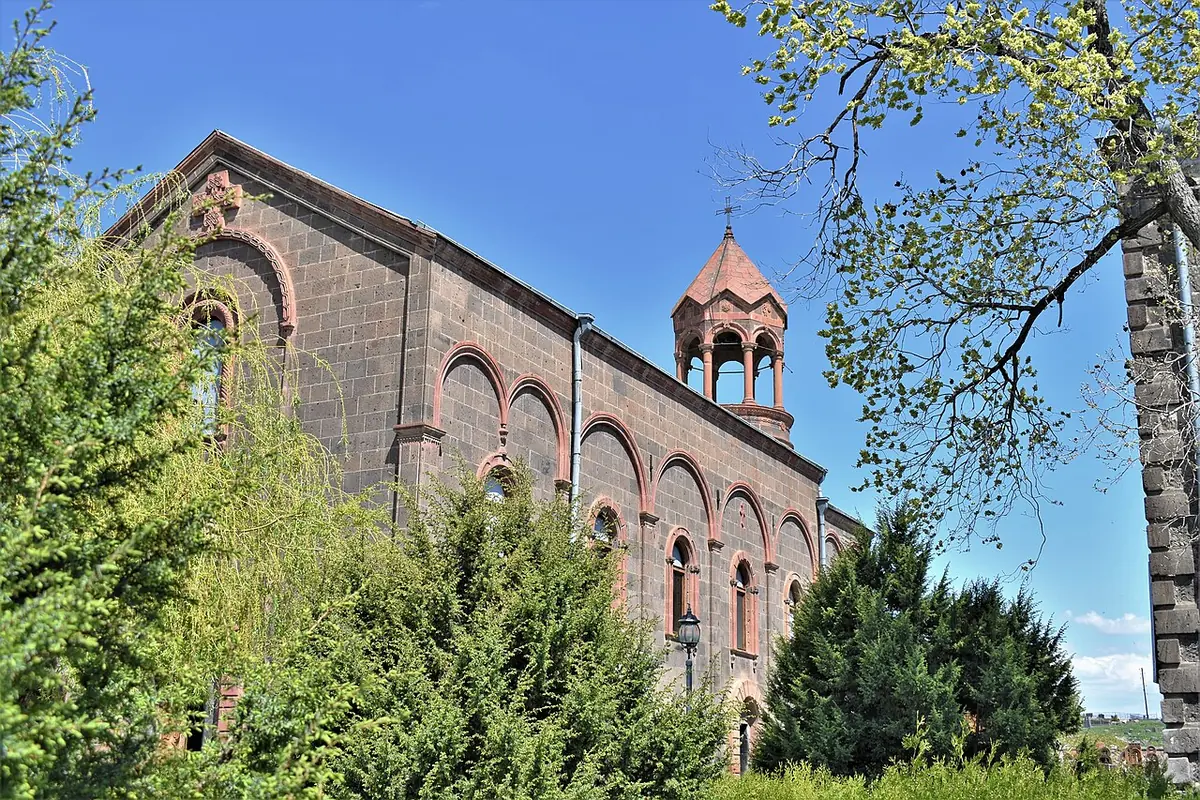
Three years after his death, Koriun writes, Vahan Amatuni built "a marvelous church with finely hewn, sculptured stones" over Mesrop's grave at Oshakan and appointed Mesrop's pupil Tadik to serve there. Pilgrims still come to pray at the tomb, and schoolchildren come with their teachers.
Prayer to St. Mesrop Mashtots
We have found no traditional prayer to St. Mesrop in the standard prayer books. The Armenian Church honors him in its hymns and in the Divine Liturgy on the Feast of the Holy Translators. Let us ask St. Mesrop, who labored so that a whole people could read the Word of God, to pray for all who translate, teach and bring the Scriptures to new readers. Find other saints of February on our feast days page.
Frequently asked questions
What is St. Mesrop Mashtots known for?
He created the Armenian alphabet in the early 400s so that Armenians could read the Scriptures and pray the liturgy in their own language. He then trained pupils, opened schools and, with the Catholicos St. Sahak, oversaw the translation of the Bible into Armenian.
What was the first sentence written in the Armenian alphabet?
His disciple Koriun says the first words translated were the opening of the Book of Proverbs: "To know wisdom and instruction, to perceive the words of understanding" (Proverbs 1:2).
When is the feast of St. Mesrop Mashtots?
February 17 in Western calendars. The Armenian Church honors him with St. Sahak and their disciples at the Feast of the Holy Translators, kept on a Saturday in October.
Where is St. Mesrop Mashtots buried?
In the village of Oshakan, northwest of Yerevan, in the church that bears his name. Koriun describes the funeral procession that carried his body there with candles, torches and crosses.
Keep exploring
Sources
- Koriun, The Life of Mashtots, translated by Bedros Norehad (1964), archive.org. The first sentence translated (Proverbs 1:2), the scribe Rufanos at Samosata, the Georgian alphabet, his death and the sign of the cross, burial at Oshakan
- Catholic Encyclopedia (1911): Mesrob. His birth at Hatsik, his time as royal secretary, the 36 letters, the Bible translation completed about 434, the February 19 commemoration