St. Alexis Falconieri

St. Alexis Falconieri (about 1200–1310) was one of the Seven Holy Founders of the Servite Order, the Servants of Mary. A rich Florentine merchant's son, he gave everything away, begged in the streets for his brothers, refused out of humility to become a priest, and outlived all the other founders, dying at about 110. We honor him with them on February 17.
Who was St. Alexis Falconieri?
St. Alexis Falconieri was one of the Seven Holy Founders of the Servite Order, and the humblest of them. Born in Florence about 1200, the son of Bernard Falconieri, a wealthy merchant and one of the leaders of the Florentine republic, he gave up his fortune and spent the rest of his long life begging bread for his brothers. He would not be ordained a priest; he thought himself unworthy. He lived to be about 110, outlived all six of his companions, and died on Monte Senario on February 17, 1310.
The Church honors him with the other six founders on February 17, the anniversary of his death.
The Seven Holy Founders
In the early 1200s Florence was rich, proud and torn by civil war between Guelphs and Ghibellines. Seven young merchants of good family belonged to a confraternity of laymen called the Laudesi, the "Praisers of Mary," who met to sing her praises. The Vatican's Dicastery for the Causes of Saints names them: Bonfilius, the leader; Bonagiunta; Manettus; Amideus; Sostene and Hugh, who were close friends; and finally Alexis.
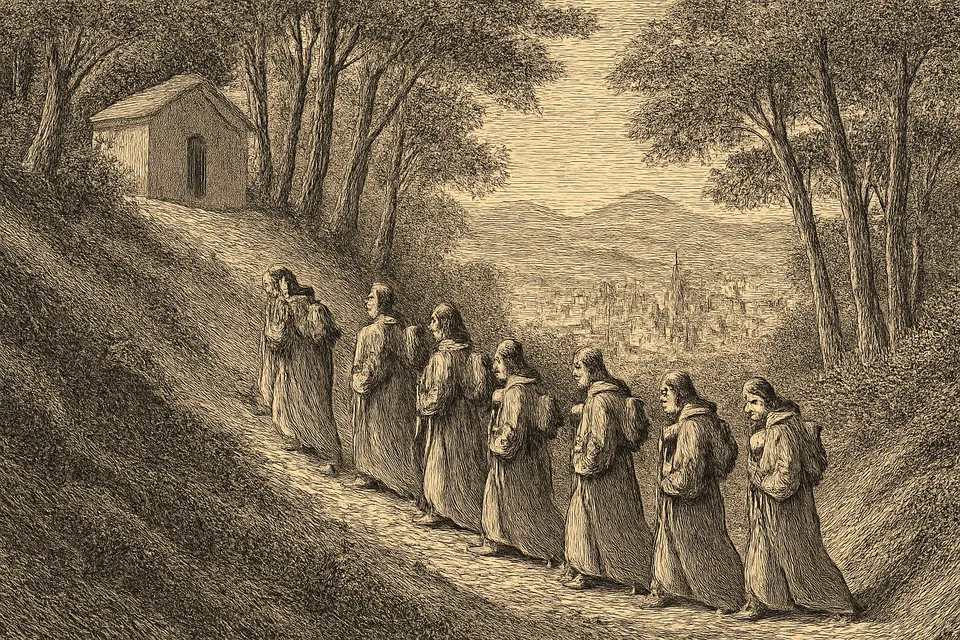
The Catholic Encyclopedia tells how, on the feast of the Assumption in 1233, the Blessed Virgin appeared to the seven and asked them to leave the world. They gave their goods to the poor, and on September 8 that year they began to live together at Villa Camarzia, a house just outside the city. Soon they withdrew to the lonely summit of Monte Senario, about eleven miles north of Florence, where the bishop gave them land. There, tradition holds, Our Lady appeared again, gave them a black habit and asked them to found the order of her Servants. They took the Rule of St. Augustine at the end of the 1230s.

A lay brother who begged in the streets
The other founders were ordained priests in time. Alexis refused. The Catholic Encyclopedia says that "so deep and sincere" was his humility that "though he lived to the great age of hundred and ten years, he always refused to enter the priesthood, of which he deemed himself unworthy."
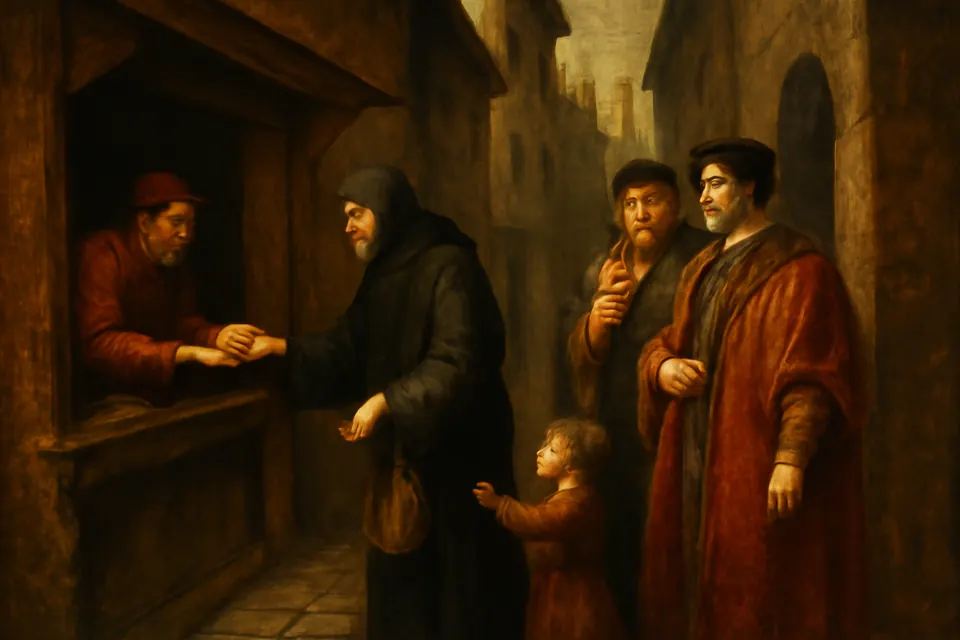
His work was to care for the brothers' material needs. He went through the streets of Florence with an alms bag, asking for bread at the doors of the same merchants he had once done business with as an equal. People who had known him as a rich young man saw him begging, and many were moved.
The church at Cafaggio
Alexis supervised the building of a small church at Cafaggio, just outside the walls of Florence, finished in 1252 with money from Chiarissimo Falconieri. The miraculous image of the Annunciation venerated there drew so many people that the little church grew into the Basilica of the Santissima Annunziata, still the mother church of the Servites.
Uncle of St. Juliana
Chiarissimo's daughter was St. Juliana Falconieri, foundress of the Servite sisters known as the Mantellate. The Catholic Encyclopedia says she was trained in holiness under her uncle's "personal direction." One honest note: the Bollandists, the Jesuit scholars who study the lives of the saints, raised doubts whether Alexis truly belonged to the Falconieri family, as the Servite historian Franco Andrea Dal Pino reports. The family tie is the tradition of the order.

The last of the seven
The Servites grew quickly, and they nearly perished. In 1274 the Second Council of Lyons moved to suppress the newer mendicant orders, and the Servites survived only through the long efforts of their general, St. Philip Benizi. Final papal approval came from Pope Benedict XI in 1304. The Dicastery notes that of the seven founders, only Alexis lived to rejoice in it.
He died on Monte Senario on February 17, 1310, "at almost 110 years of age." According to the Catholic Encyclopedia, witnesses said that the Child Jesus appeared to him visibly as he died.
The miracles of St. Alexis Falconieri
- Traditional: the apparitions of Our Lady to the seven founders in 1233 and on Monte Senario, the origin of the Servite Order.
- Reported: the appearance of the Infant Jesus at his deathbed, which, the Catholic Encyclopedia says, was "attested by eyewitnesses."
Pope Clement XI approved the public veneration of Alexis on December 1, 1717, and of his six companions in 1725. Pope Leo XIII canonized all seven together in 1888.
Symbols of St. Alexis Falconieri in art
- The black Servite habit, the color of Our Lady's mourning at the Cross.
- A long white beard, for the great age he reached.
- The alms bag or basket, for his years of begging for the community.
- The Christ Child, who by tradition came to him at his death, as in Poccetti's fresco in Florence.
He is usually painted among the seven founders. To pick him out, look for the oldest, white-bearded brother, or a name on a cartouche, as on the Pistoia panels and the Siena window.

Feast day and where he is honored
We keep the memorial of the Seven Holy Founders on February 17. See the feast day calendar. Servite communities around the world keep it as a feast.
The Dicastery for the Causes of Saints records that a single tomb at Monte Senario holds the remains of the seven founders. Pilgrims climb the mountain to pray where Alexis lived and died, and visit the Santissima Annunziata in Florence, the church he helped to build.

There is no traditional English prayer to St. Alexis alone. The Servites pray to Our Lady of Sorrows with all seven founders; see Our Lady of Sorrows and the Seven Sorrows Rosary. Let us ask St. Alexis to pray for lay brothers and sisters in religious life, for all who serve others in hidden ways, and for the grace of a humble heart.
Frequently asked questions
Who was St. Alexis Falconieri?
One of seven Florentine merchants who left the world in 1233 and founded the Order of the Servants of Mary (the Servites). He never became a priest, served his brothers by begging and by seeing to their material needs, guided his niece St. Juliana Falconieri, and died at Monte Senario in 1310, the last of the seven.
How old was St. Alexis Falconieri when he died?
About 110. The Catholic Encyclopedia gives his birth as 1200 and his death as February 17, 1310, and the Vatican's Dicastery for the Causes of Saints says he died "at almost 110 years of age."
When is his feast day?
February 17, the anniversary of his death, when the Church keeps the optional memorial of the Seven Holy Founders of the Servite Order.
Was St. Alexis Falconieri a priest?
No. He believed himself unworthy of the priesthood and remained a lay brother all his life.
Keep exploring
Sources
- Catholic Encyclopedia (1907): St. Alexis Falconieri. His family, his begging, his refusal of the priesthood, the church at Cafaggio, Juliana, the Infant Jesus at his death, Clement XI's decrees of 1717 and 1725
- Dicastero delle Cause dei Santi: Sette Santi Fondatori. Villa Camarzia on September 8, 1233, Monte Senario, the approval of 1304, his death at almost 110, the canonization of 1888, the single tomb at Monte Senario
- Catholic Encyclopedia (1912): Order of Servites. The names of the seven, the Laudesi, the apparitions of 1233 and 1240, and the first approvals
- Dizionario Biografico degli Italiani: Santa Giuliana Falconieri (Franco Andrea Dal Pino, 2001). The Bollandists' doubts whether Alexis belonged to the Falconieri family