Pope St. Lucius I

Pope St. Lucius I was bishop of Rome for only eight months, from 253 to 254. He was sent into exile soon after his election, came home to a joyful welcome, and upheld the Church's mercy toward Christians who had denied the faith under persecution and later repented. The Roman Martyrology keeps his feast on March 5, and medieval Denmark took him as the patron of Zealand.
Who was Pope St. Lucius I?
Pope St. Lucius I was the bishop of Rome from 253 to 254, one of the shortest and hardest pontificates of the early Church. He was elected after Pope St. Cornelius died in exile, was banished himself soon after, and came home to a city that poured out to greet him. He died in March 254, eight months after his election.
Very little is known of his life before that. The Liber Pontificalis, the old book of the popes, says he was a Roman and that his father was named Porphyrius, but the Catholic Encyclopedia notes that no one knows where its author found this. What we can trust comes from the letters of St. Cyprian, bishop of Carthage, who knew him and wrote to him.

The life of St. Lucius
Elected in a time of persecution
The emperor Gallus had renewed the persecution of Christians, and Cornelius had been banished from Rome for the faith. When Cornelius died in exile in the summer of 253, the Roman clergy chose Lucius in his place. Within a short time he too was sent away. The oldest papal list says simply: "Hic exul fuit et postea nutu Dei incolumis ad ecclesiam reversus est." He was an exile, and afterward, by God's will, he returned safe to his church.
St. Cyprian's letter of welcome
Cyprian had already written once to congratulate Lucius on his election and his banishment. When he heard that Lucius was home, he wrote again, to Lucius, his companions in exile and the whole Roman Church:
But now also we no less congratulate you and your companions, and the whole fraternity, that the benignant and liberal protection of the Lord has brought you back again to His own with the same glory, and with praises to you; that so the shepherd might be restored to feed his flock, and the pilot to manage the ship, and the ruler to govern the people.

Cyprian adds that the glory of a confessor is not less because he lives. The three young men in the fiery furnace and Daniel among the lions were no less faithful for being spared.

Mercy for the lapsed
The great question of those years was what to do with the "lapsed," Christians who had denied Christ to save their lives during the persecution of Decius and now begged to return. The rigorist Novatian, who had set himself up as a rival bishop of Rome, refused them pardon forever. Lucius stood with Cornelius and Cyprian. In a later letter Cyprian says that both popes, "filled with the spirit of the Lord," had written that the lapsed should be given peace, and that once they had done penance they must not be denied communion.
Death and burial
Lucius died at the beginning of March 254. The Chronograph of 354 gives his burial as March 5, the Hieronymian Martyrology March 4; the Catholic Encyclopedia suggests he died on the fourth and was buried on the fifth. He was laid in the papal vault of the Catacomb of Callixtus on the Appian Way, near his predecessors. When the archaeologist Giovanni Battista de Rossi excavated the vault in the nineteenth century, he found a broken piece of the original epitaph bearing his name in Greek: LOUKIS.
His archdeacon, Stephen, succeeded him. Later popes moved his relics from the catacomb into the city, to San Silvestro in Capite or to Santa Prassede; the record does not settle which.
Was St. Lucius a martyr?
Not in the sense of dying for the faith. The Liber Pontificalis says he was beheaded under the emperor Valerian, but Valerian's first edict against Christians came only in 257. Cyprian does call Cornelius and Lucius "blessed martyrs," and the Catholic Encyclopedia explains this as an honor for his exile. The Roman calendar of 354 lists him among the bishops, not the martyrs. The Martyrology today calls him "an outstanding witness of the faith" who faced the troubles of his time "with moderation and prudence." He is honored as a confessor, one who suffered for Christ and lived.
St. Lucius in Denmark
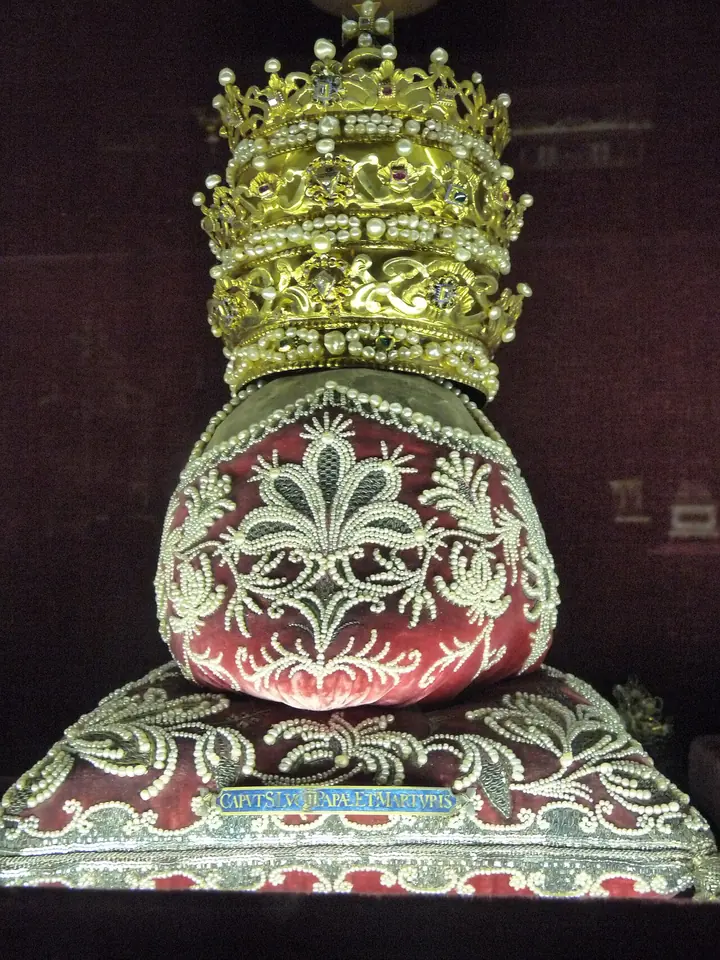
The most surprising chapter of his story is Danish. Around 1100 Lucius became the patron of Roskilde Cathedral and of the island of Zealand, and a skull said to be his became the cathedral's most precious relic. A legend written at Roskilde tells of its dangerous voyage north from Rome, including a meeting with a sea monster in the Baltic. Another tradition says demons haunting Roskilde Fjord feared nothing but this skull. These are traditional stories, not historical records.
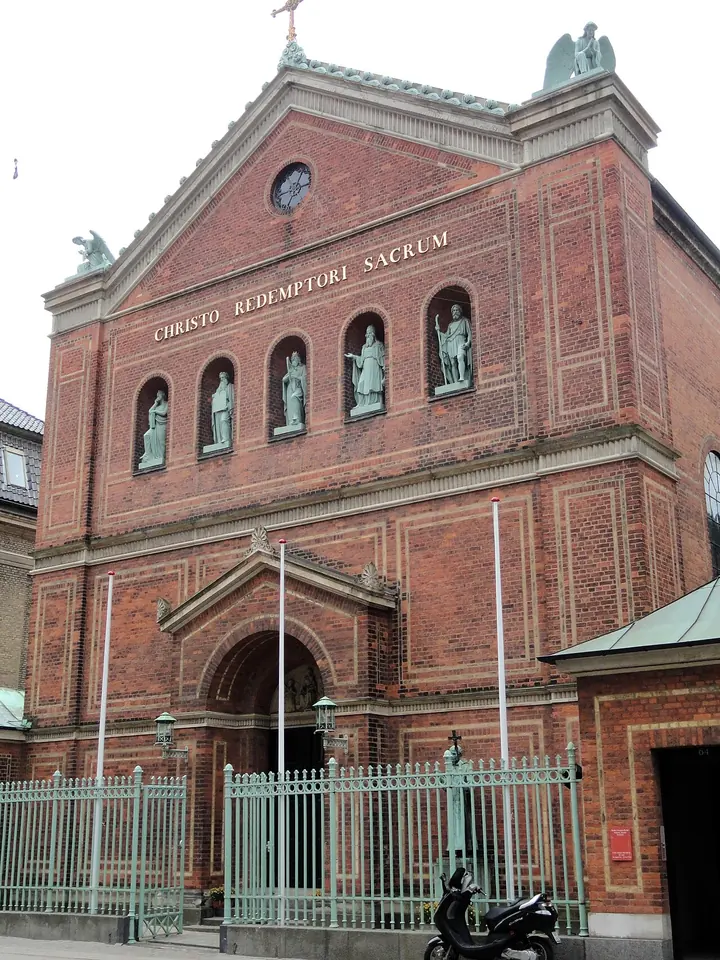
After the Reformation the relic was taken from the cathedral. It passed into the royal art collection and then to the National Museum, which in 1908 deposited it in the Catholic cathedral of Copenhagen, St. Ansgar's. In 1910 a goldsmith in Cologne, Alois Kreiten, made the reliquary bust that holds it today.
In 2014 a Norwegian researcher noticed that the skull shared an inventory number with another skull once thought to be a Norwegian king's. The National Museum had it carbon-dated, and the result placed it between 340 and 431, about a century after Lucius died. The Danish encyclopedia Lex concludes that it most likely came from the early Christian catacombs of Rome. It is a relic of an unknown Christian of the fourth century, then, and the faithful who prayed before it for nine hundred years were still praying to the saint it was named for.
Symbols of St. Lucius in art
Lucius has no single attribute of his own, so look for the signs of an early pope:
- Pallium: the white woolen band with black crosses worn by the bishop of Rome, as in Cavalieri's engraving.
- Papal vestments and tiara: later artists, and the Munich reliquary, give him the triple crown of a much later papacy, an anachronism that simply says "pope."
- Martyr's palm: older images show it because the Liber Pontificalis called him a martyr.
- Book of the Gospels: the sign of a bishop who taught and guarded the faith.
In a series of papal portraits, such as Cavalieri's 1580 book or the medallions in the Basilica of St. Paul Outside the Walls, he is identified by his name and his place in the line of popes.
Feast day and prayer
We keep the memory of St. Lucius on March 5, the date in the current Roman Martyrology. Before 1969 his feast stood on March 4, and from 1621 it was only commemorated in the Mass of St. Casimir on that day. He is no longer on the General Roman Calendar, so his day is kept in the Martyrology and local calendars.
There is no traditional prayer to St. Lucius that we can trace. The Church's own words about him make a good starting point for our prayer. Let us ask him, who knew exile and, in St. Cyprian's words, returned to the Church "greater than he had left it", to pray for all who are driven from their homes for their faith, for bishops who must be both merciful and firm, and for every Christian who has fallen and wants to come back.
St. Lucius, pray for us.
Frequently asked questions
When is the feast day of Pope St. Lucius I?
March 5 in the current Roman Martyrology. Older calendars kept him on March 4, and some sources still give that date.
Was Pope Lucius I a martyr?
The Liber Pontificalis says he was beheaded under Valerian, but that persecution began only in 257, after his death. St. Cyprian called him a martyr because of his exile, and the Chronograph of 354 lists him among the bishops, not the martyrs. We honor him as a confessor who suffered exile for Christ.
Is the skull of St. Lucius in Copenhagen really his?
No. The skull kept since 1908 in St. Ansgar's Cathedral was Roskilde Cathedral's chief relic in the Middle Ages, but a carbon-14 test in 2014 dated it to between 340 and 431, a century after Lucius died. It most likely came from the early Christian catacombs of Rome.
Why is St. Lucius the patron saint of Zealand?
His supposed skull was brought to Roskilde around 1100, and he became the patron of Roskilde Cathedral and of the Danish island of Zealand.
Keep exploring
Sources
- Catholic Encyclopedia (1910): Pope St. Lucius I. His exile and return, his stand on the lapsed, the dates of his death, the epitaph LOUKIS and the later transfer of his relics
- St. Cyprian of Carthage, Epistle 57, to Lucius, Bishop of Rome, Returned from Banishment (New Advent)
- Roman Martyrology 2004, March (GCatholic). March 5 entry
- Lauge Olaf Nielsen, Lucius 1., Lex (Den Store Danske). Roskilde's relic, the sea-monster legend, the 1910 reliquary and the 2014 carbon dating
- The Copenhagen Post (2014): Skull and cross wires