St. Linus, Pope and Successor of St. Peter

St. Linus was the first bishop of Rome after St. Peter, the second pope, leading the Church in Rome from about 67 to about 76 or 79. St. Irenaeus says the apostles handed the office to Linus, the one St. Paul greets in 2 Timothy 4:21. His feast day is September 23, and he is named in the Roman Canon.
Who was St. Linus?
St. Linus was the first bishop of Rome after St. Peter, and so the second pope. He led the Christians of Rome in the hard years after Peter and Paul were put to death under Nero, from about 67 until about 76 or 79. We know very little else about him for certain, and that is worth saying plainly. What we do know comes from some of the oldest witnesses the Church has.
The most important is St. Irenaeus, bishop of Lyon, writing around the year 180 to show that the Church's teaching had come down unbroken from the apostles. He gives the list of Roman bishops as it stood in his own day:
The blessed apostles, then, having founded and built up the Church, committed into the hands of Linus the office of the episcopate. Of this Linus, Paul makes mention in the Epistles to Timothy. To him succeeded Anacletus; and after him, in the third place from the apostles, Clement was allotted the bishopric.
Every ancient list of the popes, from Irenaeus to the historian Eusebius and the Liberian Catalog of 354, puts Linus directly after Peter. Each time we hear Linus named at Mass, we hear that same chain of witnesses reaching back to the apostles.
Linus in the Bible
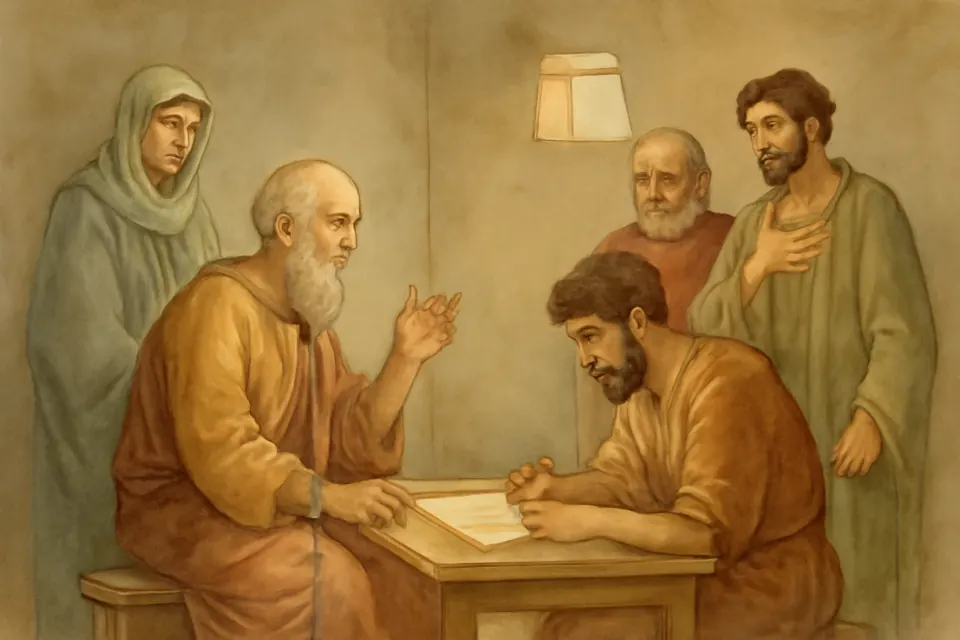
St. Paul's Second Letter to Timothy is written from Rome, near the end of the apostle's life, when he is a prisoner and expects to die soon. As he closes, he passes on greetings from the Christians around him:
Make haste to come before winter. Eubulus and Pudens, and Linus and Claudia, and all the brethren, salute thee. (2 Timothy 4:21, Douay-Rheims)
Irenaeus identifies this Linus with the bishop, and Eusebius follows him, calling Linus Paul's "companion at Rome." The Catholic Encyclopedia (1910) is careful here: we cannot be sure whether the identification rests on an old and reliable memory or grew from the shared name. Still, it is a lovely thought that the man who carried on Peter's work in Rome was one of the faithful few who stood by St. Paul in his last imprisonment.
The Apostolic Constitutions, a church order compiled around 380, goes further and calls him "Linus the son of Claudia," taking the Claudia of the same verse as his mother. That is a late guess, and we should hold it lightly.
Bishop of Rome after Peter and Paul
Eusebius, writing his Church History in the early 300s, says simply: "After the martyrdom of Paul and of Peter, Linus was the first to obtain the episcopate of the church at Rome." Later in the same book he says that Linus, "who had been bishop of the church of Rome for twelve years, delivered his office to Anencletus" in the second year of the emperor Titus, about the year 80. The Liberian Catalog gives his time in office as twelve years, four months and twelve days, though the calendar dates it attaches to them cannot be right.
Not every early writer counted the same way. Tertullian, around 200, reported that Peter had ordained St. Clement himself, and St. Jerome later said many Latins counted Clement as Peter's first successor. Some 4th-century writers tried to reconcile the lists by suggesting that Linus helped govern the Roman church while Peter was still alive. The Catholic Encyclopedia finds no historical basis for that and holds with Irenaeus: Linus took up the office after the apostles' deaths.
What did he do as bishop? The sources are silent. He led a small, scattered community that had just lost both of its apostles to Nero's persecution, and he held it together for a dozen years. Sometimes holiness is exactly that: faithful, unrecorded shepherding through a grim time.
What the Liber Pontificalis adds
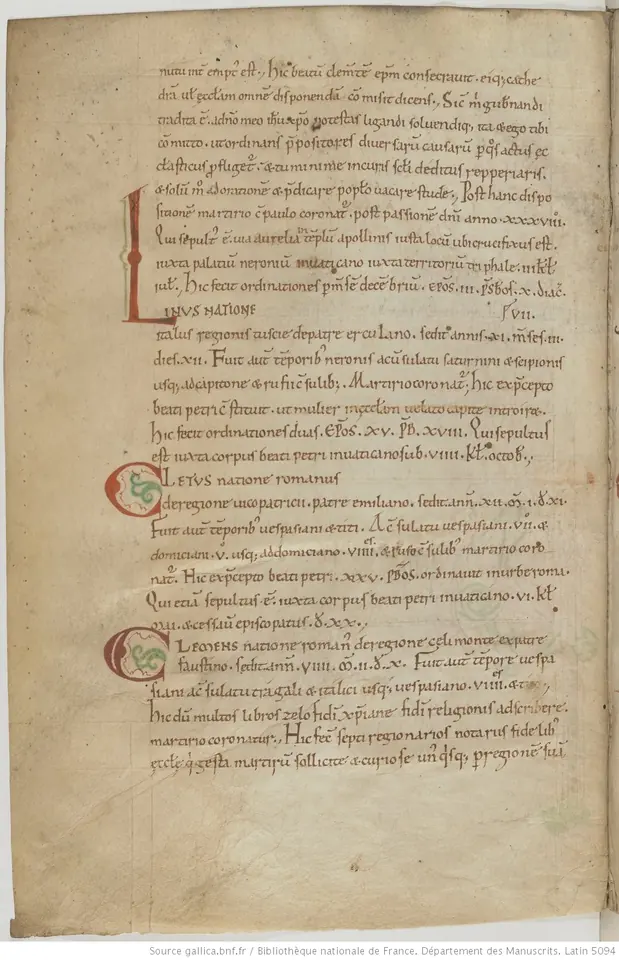
The Liber Pontificalis, a collection of short papal lives first compiled in the 6th century, gives Linus a few more details, which the Catholic Encyclopedia treats with caution:
- His home: it says he was an Italian from Tuscany and that his father was named Herculanus. The source of this claim is unknown.
- A decree on veils: it says he ordered, "in conformity with the ordinance of St. Peter," that women cover their heads in church. The encyclopedia calls this apocryphal, borrowed from St. Paul's words in 1 Corinthians 11.
- Martyrdom: it calls him a martyr. The encyclopedia says this "cannot be proved and is improbable," because there is no record of persecution of the Roman church between Nero and Domitian, and Irenaeus names only Telesphorus among the early Roman bishops as a martyr.
- Burial: it says he was buried on the Vatican hill "beside St. Peter," and gives September 23 as his day.
A later letter about the martyrdom of Peter and Paul was also circulated under Linus's name. It is apocryphal and later than the accounts it draws on.
The tomb of St. Linus
Was Linus really buried near Peter? It is quite possible. Peter was certainly buried at the foot of the Vatican hill, and it would be natural for the first bishops of Rome to want to lie near him.

In 1615, workers building the present Confession at the high altar of St. Peter's found several sarcophagi, and one of them bore the word LINUS. For a while it was hailed as his tomb. But a manuscript by the antiquarian Torrigio shows that other letters stood beside the word, so it was part of a longer name, perhaps Aquilinus or Anullinus, and the archaeologist Giovanni Battista de Rossi showed that the place of the find ruled it out. No tomb of Linus has been identified since. His resting place, like much of his life, is known to God.
St. Linus in the Mass
Most Catholics have heard the name Linus without noticing. In the Roman Canon, the First Eucharistic Prayer, the priest names the saints with whom the Church on earth is united: after the Virgin Mary and the twelve apostles come twelve martyrs, and the first five of them are popes, "Linus, Cletus, Clement, Sixtus, Cornelius." The Catholic Encyclopedia notes that these are, with the single exception of St. Cyprian, local saints of Rome, which is natural in what was first the local liturgy of the Roman church.
So every time the Roman Canon is prayed, anywhere in the world, the second pope is named at the altar. Let us pause the next time we hear it and thank God for him.
Dante remembered him too. In the Paradiso, St. Peter himself complains of the corruption of later popes and recalls the early bishops who gave their lives for the Church, in Longfellow's translation:
The spouse of Christ has never nurtured been
On blood of mine, of Linus and of Cletus,
To be made use of in acquest of gold.
Volterra, his home by tradition
The hill town of Volterra in Tuscany has long claimed Linus as its own son, and the Church there honors him as its patron. When St. John Paul II wrote to the bishop of Volterra on September 23, 1999, ten years after his own visit to the town, he called the day the "festa di san Lino, Papa e Martire" and recalled that, "according to the ancient tradition," Linus came from Volterra before Providence called him to succeed Peter. He entrusted the diocese to the intercession of "san Lino Martire, Patrono della Diocesi."
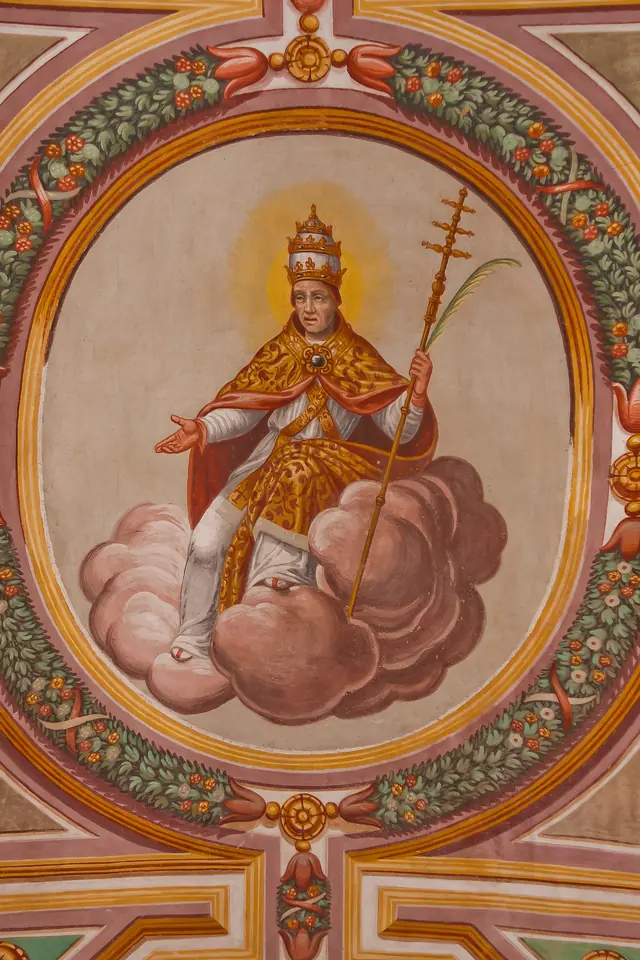
In the town a church dedicated to San Lino stands where local tradition places his family's house, and its ceiling shows him in glory.
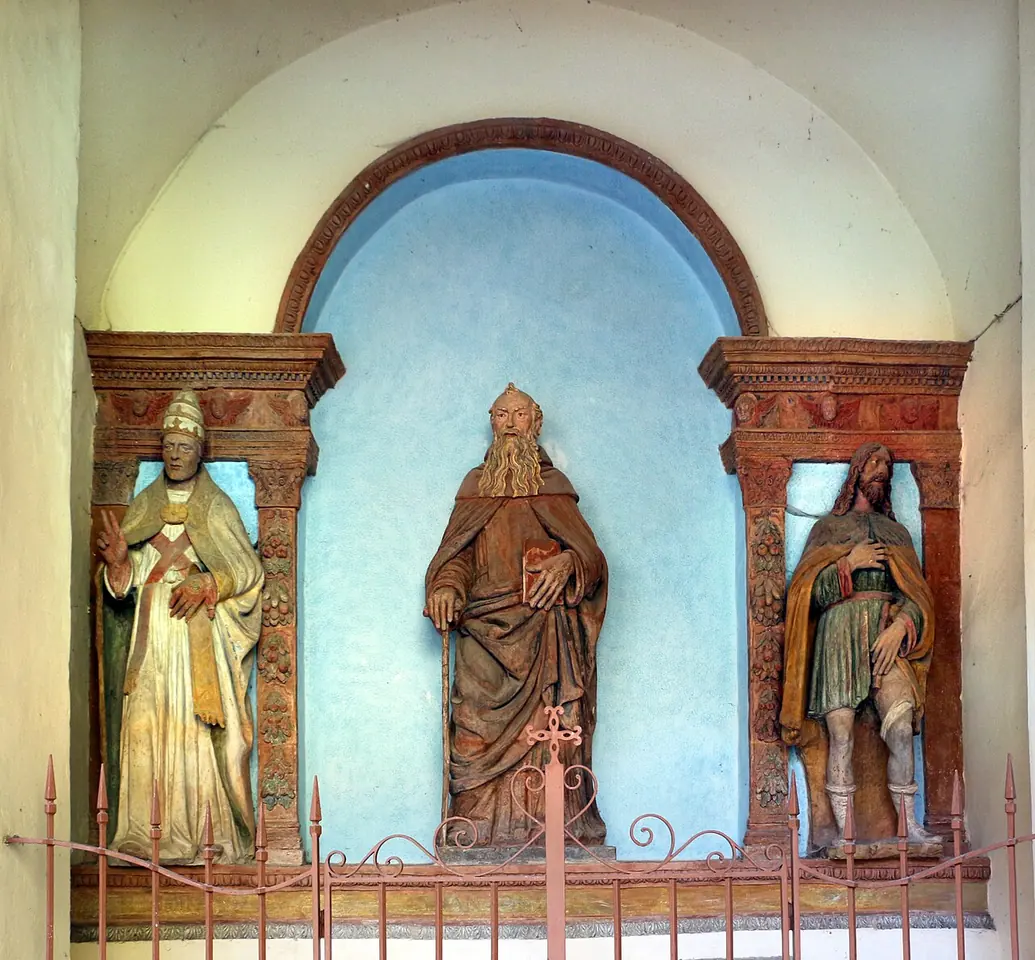
Not far from Volterra, at the pilgrimage church of San Vivaldo near Montaione, a group of painted terracotta statues from the early 1500s places Linus, in papal white, beside St. Anthony the Abbot and St. Roch.
St. Linus in the Eastern Church
The Orthodox Church honors Linus as one of the Seventy apostles sent out by the Lord in Luke 10. On November 5 it keeps him together with Patrobus, Hermes, Gaius and Philologus, all of whom are named in St. Paul's letters, and the Orthodox Church in America's life says simply that "Saint Linus (2 Tim 4:21) was a successor to the Apostle Peter at Rome." The troparion of the day asks these five apostles to entreat the merciful God to forgive our transgressions.
Symbols of St. Linus in art
Linus is not often painted on his own, and he has no attribute that belongs to him alone. You will usually recognize him by his place in a series of popes or by a name written beside him. Look for:
- Papal dress: in Western art from the Renaissance on, a tiara, a cope and a papal cross, as on the ceiling at Volterra and the statue at San Vivaldo. These are anachronisms, since 1st-century bishops wore none of them, but they mark him as Peter's successor.
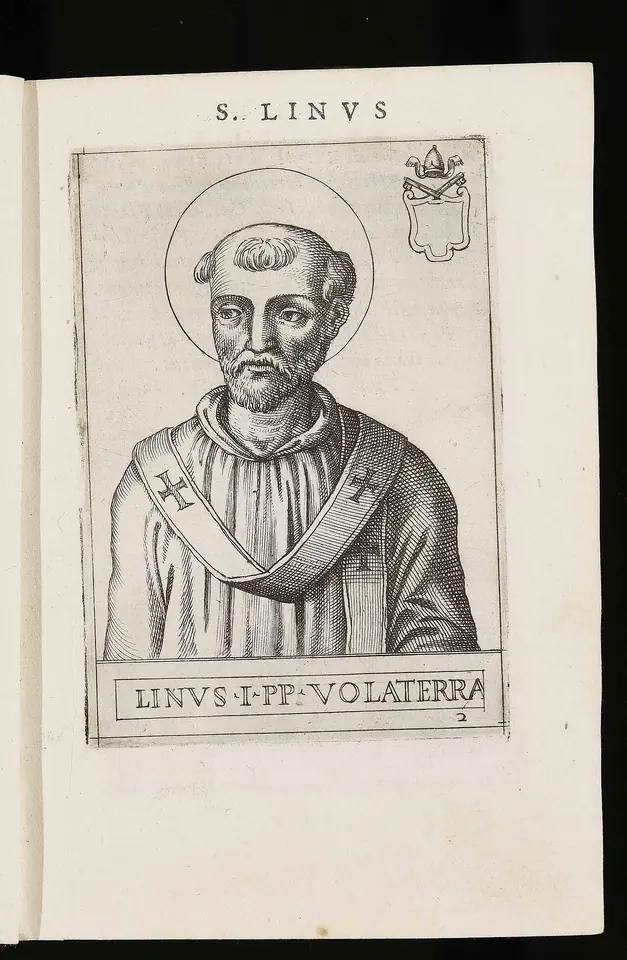
- The pallium: the white woolen band with black crosses, as in Cavalieri's 1580 portrait.
- The martyr's palm: from the tradition, kept in the Liber Pontificalis and the Roman Canon, that he died a martyr.
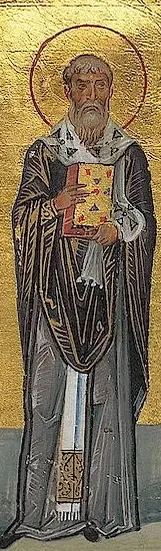
- A Gospel book and the omophorion: in Byzantine images such as the Menologion of Basil II, where he appears as one of the Seventy.
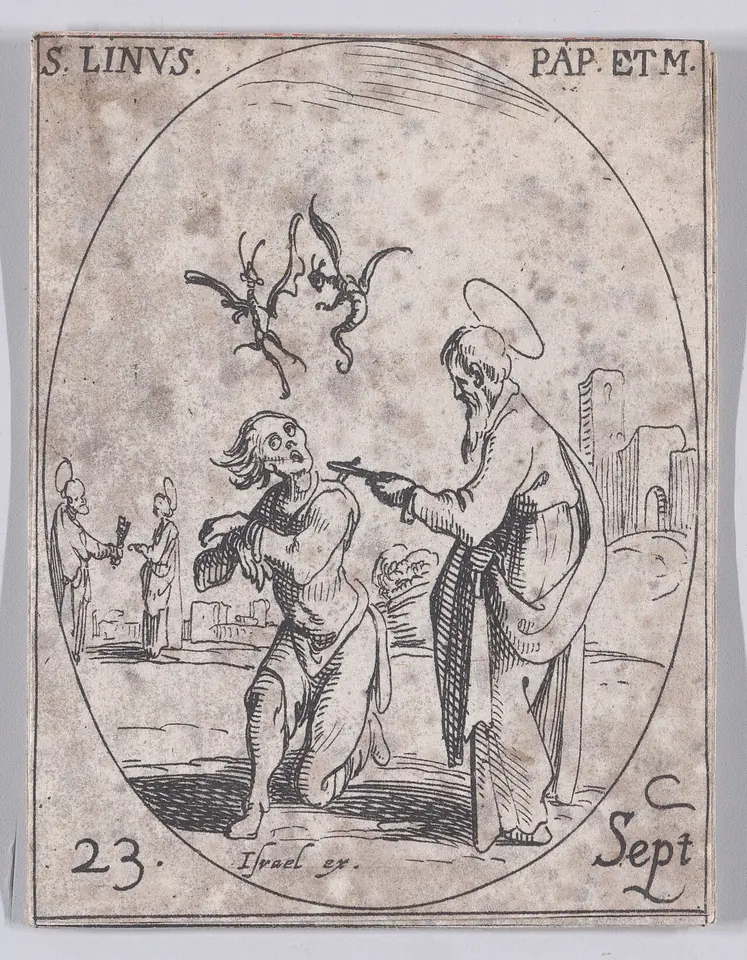
Jacques Callot's engraving for September 23, from his 1636 book of the saints of the year, shows him freeing a kneeling man from demons, who flee into the air. The scene is traditional at most: none of the early sources records a miracle worked by Linus.
Prayer to St. Linus
We know of no traditional prayer or novena to St. Linus in the standard prayer books. The Church's great prayer naming him is the Roman Canon itself, in which the priest asks God that "through their merits and prayers" we may be defended in all things by his protecting help, and in the East the troparion of November 5 given above.
On his feast, let us ask St. Linus to pray for the pope, for the bishops who succeed the apostles today, and for every pastor who must hold a frightened flock together through hard times. St. Linus, pray for us.
Frequently asked questions
Who was the first pope after St. Peter?
St. Linus. Every early list of the bishops of Rome, those of St. Irenaeus, Eusebius and the Liberian Catalog of 354 among them, names Linus directly after Peter, followed by Anacletus (Cletus) and then Clement. Tertullian and some later Latin writers put Clement first, but the Catholic Encyclopedia judges the list in Irenaeus the more reliable.
Is St. Linus mentioned in the Bible?
Probably. At the end of his Second Letter to Timothy, St. Paul writes from Rome, "Eubulus and Pudens, and Linus and Claudia, and all the brethren, salute thee" (2 Timothy 4:21, Douay-Rheims). St. Irenaeus says this is the same Linus who became bishop of Rome. The Catholic Encyclopedia notes we cannot be sure whether that identification rests on an old source or on the shared name.
When is the feast of St. Linus?
September 23, the date given in the Liber Pontificalis and kept in the Roman Martyrology. It is not on today's General Roman Calendar, where September 23 is the memorial of St. Pio of Pietrelcina, but Volterra keeps it as the feast of its patron. The Orthodox Church honors him on November 5 as one of the Seventy apostles.
Was St. Linus a martyr?
The Liber Pontificalis calls him a martyr, and the Roman Canon names him among the martyrs it honors, but the Catholic Encyclopedia says his martyrdom "cannot be proved and is improbable," since no persecution of the Roman Church is recorded between Nero and Domitian, and Irenaeus names only Telesphorus among the early Roman bishops as a martyr.
Where is St. Linus buried?
The Liber Pontificalis says he was buried on the Vatican hill beside St. Peter. That is quite possible, but no tomb has been identified. A sarcophagus found in 1615 during work on St. Peter's was once taken to be his because it bore the letters LINUS, but those letters belonged to a longer name such as Aquilinus.
Keep exploring
Sources
- Catholic Encyclopedia (1910): Pope St. Linus. The Liber Pontificalis claims, the doubtful martyrdom and the 1615 sarcophagus
- St. Irenaeus, Against Heresies, Book III, chapter 3
- Eusebius, Church History, Book III. Linus first after Peter and Paul (III.2) and his twelve years (III.13)
- Apostolic Constitutions, Book VII. "Linus the son of Claudia" (VII.46)
- Catholic Encyclopedia (1908): Canon of the Mass. The five popes among the twelve martyrs of the Communicantes
- St. John Paul II, Message to Bishop Giuseppe Bertelli of Volterra (September 23, 1999). Linus as a native of Volterra by ancient tradition and patron of the diocese
- Orthodox Church in America: Apostles Patrobus, Hermes, Linus, Gaius, and Philologus, of the Seventy
- Dante, Paradise, Canto XXVII, trans. Henry Wadsworth Longfellow (Project Gutenberg)