St. Mary of Bethany, Sister of Martha and Lazarus
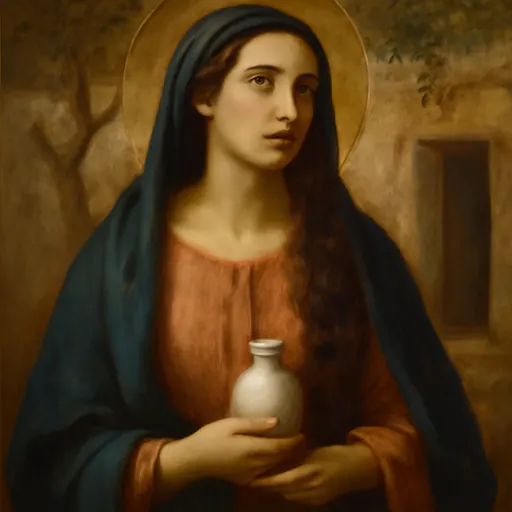
St. Mary of Bethany was the sister of St. Martha and St. Lazarus and a disciple of Jesus. The Gospels show her sitting at his feet, weeping at her brother's death, and anointing Jesus with nard before his Passion. Since 2021 the Church keeps her feast with her siblings on July 29; the Orthodox honor her on June 4.
Who was St. Mary of Bethany?
St. Mary of Bethany was the sister of Martha and Lazarus, who lived in Bethany, a village on the Mount of Olives about two miles from Jerusalem. Their house was a home for Jesus when he came up to the city, and the Gospel of John says simply that "Jesus loved Martha and her sister and Lazarus" (John 11:5). Mary appears three times in the Gospels, and each time she is at the feet of Jesus: listening, grieving and anointing him.
The Church keeps her memory on July 29 with her sister and brother. In 2021 the Congregation for Divine Worship wrote of that household: "Martha generously offered him hospitality, Mary listened attentively to his words and Lazarus promptly emerged from the tomb."

Mary in the Gospels
The better part
Luke tells how Martha welcomed Jesus into her home. Her sister Mary "sat beside the Lord at his feet listening to him speak," while Martha was "burdened with much serving" and asked Jesus to send Mary to help. He answered:
Martha, Martha, you are anxious and worried about many things. There is need of only one thing. Mary has chosen the better part and it will not be taken from her.
The footnote of the New American Bible points out how unusual this was: in first-century Judaism, sitting at a teacher's feet was the posture of a disciple, and Mary takes it as a woman.
At the death of Lazarus
When Lazarus died, Martha went out to meet Jesus first and then called her sister. Mary "rose quickly," John writes, and "when Mary came to where Jesus was and saw him, she fell at his feet and said to him, 'Lord, if you had been here, my brother would not have died.'" Seeing her weeping, Jesus was deeply moved, and he wept too, before calling Lazarus out of the tomb.

The anointing at Bethany
Six days before Passover, the family gave a supper for Jesus. Martha served, Lazarus was at table, and:
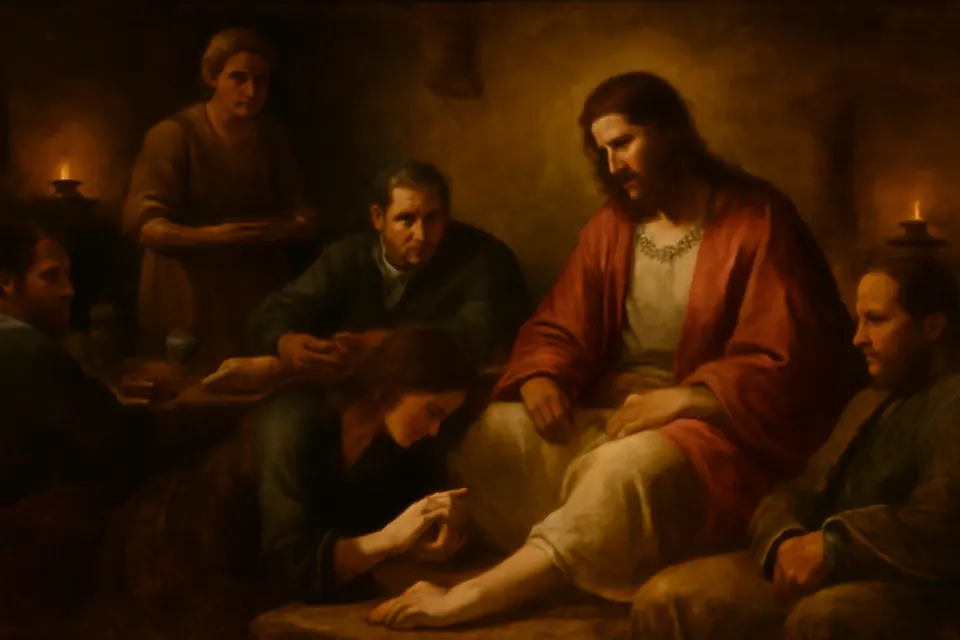
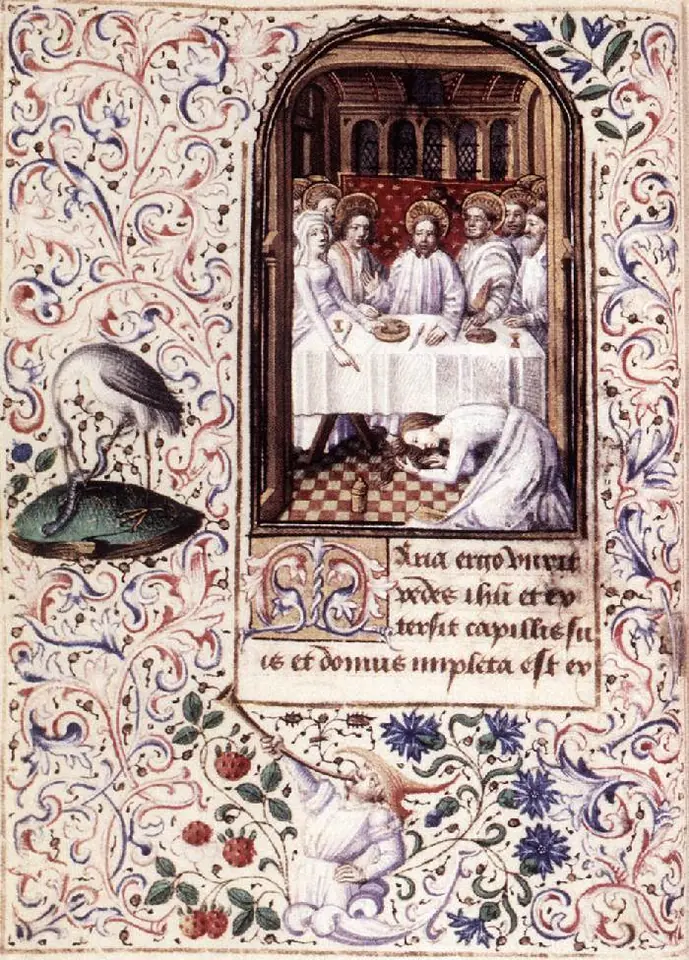
Mary took a liter of costly perfumed oil made from genuine aromatic nard and anointed the feet of Jesus and dried them with her hair; the house was filled with the fragrance of the oil.
Judas complained that the oil could have been sold for three hundred days' wages. Jesus defended her: "Leave her alone. Let her keep this for the day of my burial" (John 12:7). Matthew and Mark tell of the same supper at Bethany with an unnamed woman, and Mark adds Jesus' promise that what she had done would be told in her memory wherever the Gospel is preached (Mark 14:9).
Mary of Bethany and Mary Magdalene
For most of Western history Mary of Bethany was not honored under her own name. In a sermon of 591, Pope St. Gregory the Great taught that Mary of Bethany, Mary Magdalene and the unnamed "sinner" who wept on Jesus' feet in Luke 7 were one woman, and most Latin writers followed him. The Catholic Encyclopedia of 1910 still argued for that view, while admitting that "it is impossible to demonstrate the identity of the three." The Greek Fathers, it notes, "as a whole, distinguish the three persons," and the Orthodox Church has always kept separate days for them.
The 1969 reform of the Roman Calendar stopped treating them as one in the liturgy, and the 2021 decree went further. It speaks of "the traditional uncertainty of the Latin Church about the identity of Mary," which had left Martha alone on July 29, and says it "has been resolved in recent studies and times." Pope Francis therefore placed Mary beside Martha and Lazarus. Many Western paintings still show her with the jar of ointment and long hair of the Magdalene, so the two are easily confused in art. Read more on our St. Mary Magdalene page.
Later traditions
Scripture says nothing of Mary after the Resurrection. The Orthodox tradition, as the OCA's life of the sisters tells it, is that after the stoning of St. Stephen, Lazarus was driven out of Jerusalem and his sisters helped him preach the Gospel; they died in Cyprus, where Lazarus became the first bishop of Kition, now Larnaca. A medieval French legend instead brings the family by boat to Provence, but there the Mary of the story is the Magdalene. Both are traditional accounts, and no relics are venerated as hers apart from those of the Magdalene.
Why St. Mary of Bethany is the model of contemplatives
Mary has no formal patronage, but from early Christian writers onward, Martha and Mary became a picture of two callings: Martha the active life of service, Mary the contemplative life of prayer and listening. Contemplative monks and nuns have looked to her ever since, and every Christian who sets aside time to sit quietly before the Lord is doing what she did. See more on our patron saints page.
Symbols of St. Mary of Bethany in art
In paintings of "Christ in the house of Martha and Mary," Mary is the one seated at Jesus' feet, often with an open book in her lap, while Martha stands with a dish, a jug or keys. Alessandro Allori's 1605 canvas even carries the words Optimam partem elegit, "she has chosen the best part," over the scene. In pictures of the supper at Bethany she kneels with an alabaster jar and long unbound hair to anoint Jesus' feet, the same attributes as Mary Magdalene, which is why Western artists so often merged them. In Orthodox icons she appears among the Myrrh-bearing Women at the empty tomb, or prostrate at Christ's feet in icons of the Raising of Lazarus.

Feast day and where she is honored
We keep her memorial with Martha and Lazarus on July 29. The Orthodox celebrate the sisters on June 4 and on the Sunday of the Myrrh-bearing Women. At Bethany, now al-Eizariya, the Franciscan Church of St. Lazarus stands near the traditional tomb of Lazarus, and pilgrims pray there for the family who welcomed Jesus. Find other late-July saints on our feast days page.
Prayer for the memorial of Sts. Martha, Mary and Lazarus
On the memorial of Sts. Martha, Mary and Lazarus, July 29, the Church prays a collect from the Roman Missal. It asks God that the example of his saints might lift us toward a better life, so that as we remember these three friends of the Lord we may also follow their deeds. The official English text is in the 2011 translation of the Roman Missal, found in any missal or in the Mass texts for the day.
Let us ask St. Mary of Bethany to teach us to choose the better part: to sit still at the feet of Jesus, to bring him our grief, and to pour out for him what is most precious to us. St. Mary of Bethany, pray for us.
Frequently asked questions
Is Mary of Bethany the same as Mary Magdalene?
The Church today honors them as two women. From the time of Pope Gregory the Great the Latin Church usually treated Mary of Bethany, Mary Magdalene and the sinful woman of Luke 7 as one person, while the Greek Fathers kept them apart. The Vatican's 2021 decree says this traditional uncertainty "has been resolved in recent studies and times," and gave Mary of Bethany her own place on July 29 beside Martha and Lazarus.
When is the feast of St. Mary of Bethany?
July 29, the Memorial of Saints Martha, Mary and Lazarus in the General Roman Calendar. The Orthodox Church celebrates Righteous Martha and Mary on June 4 and again on the Sunday of the Myrrh-bearing Women, the third Sunday of Pascha.
What did Mary of Bethany do?
She sat at Jesus' feet listening to his teaching while Martha served, and Jesus said she had "chosen the better part" (Luke 10:42). When Lazarus died she fell at Jesus' feet in tears, and a few days before his Passion she anointed his feet with a liter of costly nard and dried them with her hair (John 12:3).
What is Mary of Bethany the patron saint of?
She has no official patronage, but since the early Church writers she has been the model of the contemplative life: of prayer, listening and adoration, beside Martha's active service. Contemplative religious and all who pray regard her as their example.
Keep exploring
- Appears in
- Female saints
- Feast-day calendar
- Saints remembered in JulySaint of the dayWhat saint is my birthday?
- Same name
- Other saints named Mary →
- More
- Saints A to ZPatron saints A to ZExplore every section
Sources
- Luke 10:38–42 (New American Bible, Revised Edition), BibleGateway
- John 12:1–8 (New American Bible, Revised Edition), BibleGateway
- Congregation for Divine Worship, Decree on the Celebration of Saints Martha, Mary and Lazarus in the General Roman Calendar (January 26, 2021)
- Hugh Pope, "St. Mary Magdalen," The Catholic Encyclopedia, vol. 9 (1910). The older Latin case for one Mary, and the Greek Fathers' distinction of three women
- Orthodox Church in America: Righteous Martha and Mary, the sisters of Lazarus (June 4)
- Catholic Culture: Memorial of Sts. Martha, Mary and Lazarus (collect of the memorial)