St. Alphonsa of the Immaculate Conception
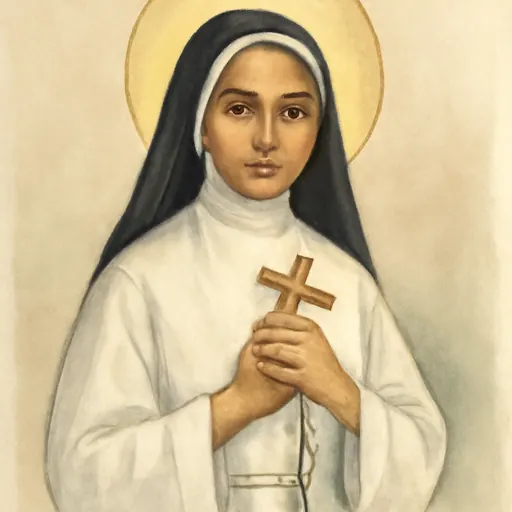
St. Alphonsa (1910–1946) was a Franciscan Clarist sister from Kerala and the first woman of India to be canonized. Born Anna Muttathupadathu, she spent most of her short religious life sick in bed and offered every pain to Christ. Pope Benedict XVI canonized her on October 12, 2008. Her feast day is July 28, and the sick and suffering ask her prayers.
Who was St. Alphonsa?
St. Alphonsa of the Immaculate Conception was a young sister of the Franciscan Clarist Congregation in Kerala, in the far south of India, who died in 1946 after years of almost constant illness. She founded nothing, wrote no books and never left her home state. Pope Benedict XVI raised her to the altars on October 12, 2008, and offered her "to the people of India as their first canonized saint." She is the first saint of the Syro-Malabar Catholic Church, the ancient Eastern Catholic church of the St. Thomas Christians.
At her canonization the Pope said her life was one of "extreme physical and spiritual suffering," and he quoted one line from her writings that sums her up: "I consider a day without suffering as a day lost." We can read that sentence wrongly, as if she loved pain for its own sake. She didn't. She loved the crucified Christ, and in her sickbed she found a way to stay close to Him.
Kerala Catholics call her Alphonsamma, "Mother Alphonsa." She should not be confused with Mother Mary Alphonsa, the American Rose Hawthorne Lathrop (1851–1926), who founded a Dominican community in New York for the incurably sick poor.
The life of St. Alphonsa
A child of Kudamaloor
She was born on August 19, 1910, at Kudamaloor, near Kottayam, into the old Muttathupadathu family. The Vatican biography says her mother gave birth to her a month early after a fright: a snake had wrapped itself around her waist while she slept. Eight days later the baby was baptized in the Syro-Malabar rite and named Annakutty, "little Anna." Her mother died three months after that.
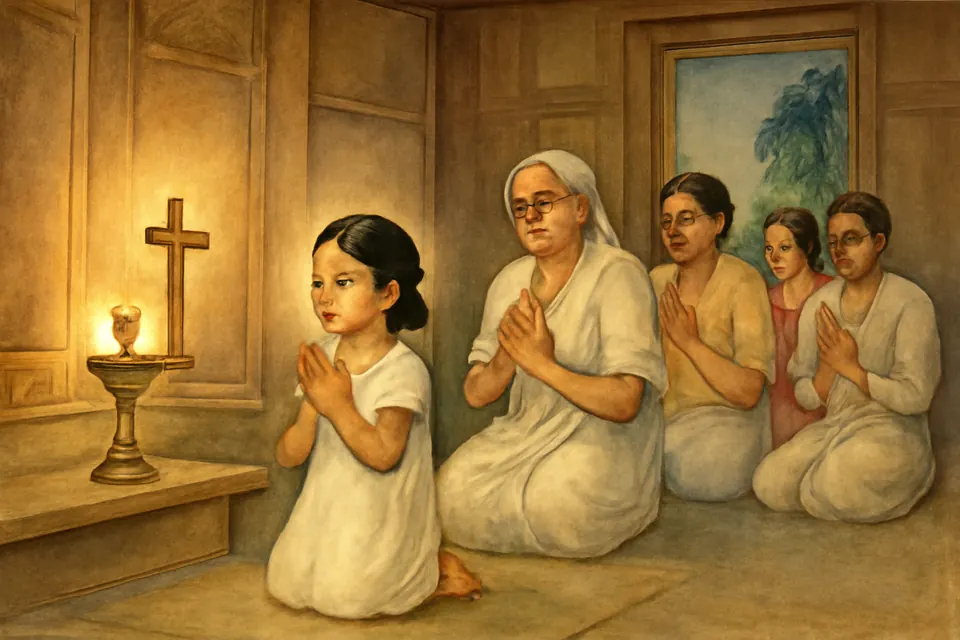
Anna spent her first years in her grandparents' home, and they were happy ones. Her grandmother taught her to pray and to give to the poor. By the age of five, the girl was leading the family's evening prayers in the household prayer room, as Syro-Malabar families do. She made her First Communion on November 11, 1917, and told her friends, "Do you know why I am so particularly happy today? It is because I have Jesus in my heart!"
The burned foot
At ten she moved to Muttuchira to live with her mother's sister, Anna Murickal, who had promised the dying mother to raise her. The aunt was strict, at times harsh, and she was set on arranging a good marriage for her pretty niece. Anna wanted only Christ.
What happened next is told two ways. Some popular accounts say she fell into a pit of burning chaff. The Vatican biography, written for her canonization, quotes Anna's own words: when a marriage was arranged for her at thirteen, she prayed all night, then put her foot into a heap of burning embers so that no one would want her. "O, how I suffered! I offered all for my great intention." The burns left her foot damaged for life. The Church doesn't hold up this act as a model. It honors the love behind it and the years of patient suffering that followed.
Sister Alphonsa
Her confessor, Fr. James Muricken, guided her toward the Franciscan Clarists, and in May 1927 she went to their school at Bharananganam as a boarding student. On August 2, 1928, she began her postulancy and took the name Alphonsa of the Immaculate Conception, after St. Alphonsus Liguori, whose feast it then was. She received the habit in 1930.
Illness came almost at once. She was able to teach in the school at Vakakkad for only the 1932 school year; after that she helped as she could, as an assistant teacher, a catechist and a writer of the convent's letters, because her handwriting was beautiful.
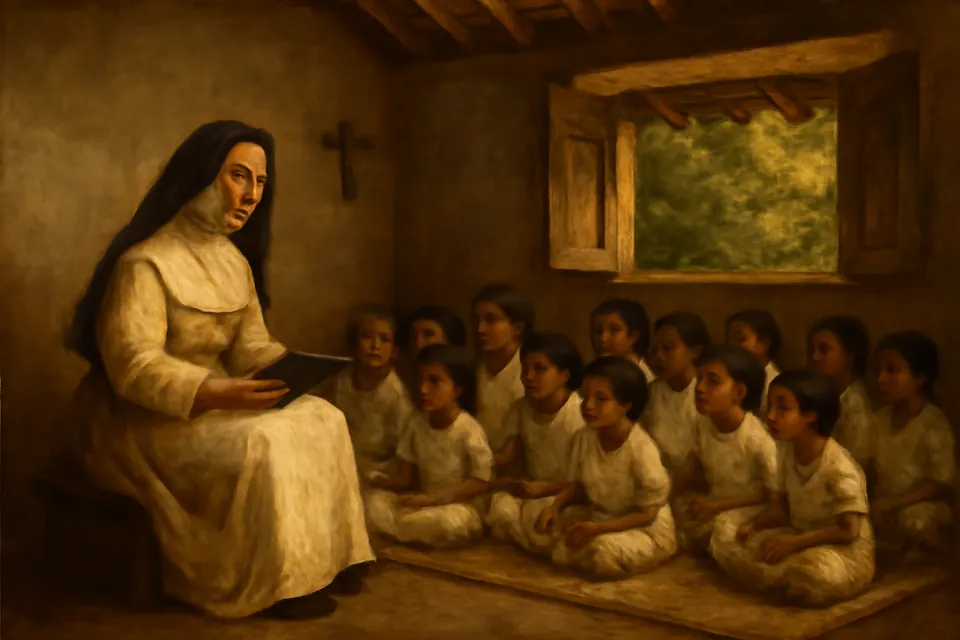
Her health kept her waiting for the novitiate until August 12, 1935. A week later she was bleeding from the nose and eyes, with open sores on her legs, and the sisters feared she would die. During a novena to Fr. Kuriakose Elias Chavara, the holy Carmelite priest of Kerala, she was suddenly cured. She made her perpetual vows on August 12, 1936, the feast of St. Clare, and wrote later, "From that time, it seems, I was entrusted with a part of the cross of Christ."
Ten years on the cross
Typhoid and double pneumonia followed. On the night of October 18, 1940, a thief broke into the convent, and the shock left her unable to read or write for about a year. In 1945 a tumor spread through her body, and her last year was an agony of convulsions and vomiting. In a letter to her spiritual director on November 20, 1944, which Pope John Paul II quoted, she wrote that because her good Lord Jesus loved her so much, she gladly wished to stay on her sick bed and bear this and anything more, even to the end of the world.
The sisters remembered her smile more than her pain. She never complained and was always gentle with others, even when she was misunderstood. She died at 12:30 in the afternoon on July 28, 1946, at the convent in Bharananganam. She was 35. Only a small group came to her funeral.
The miracles of St. Alphonsa
Soon after her death, the schoolchildren she had taught began bringing flowers and candles to her grave and telling of favors received. The diocesan process for her cause opened on December 2, 1953.
- Her own cure in 1935: reported. The Vatican biography says she was healed instantly during a novena to Fr. Kuriakose Elias Chavara, who was beatified with her in 1986 and canonized in 2014.
- The healing approved for her beatification: approved. Pope John Paul II declared her Venerable on July 9, 1985, and the Church approved a miracle through her intercession that year, which opened the way for her beatification at Kottayam on February 8, 1986.
- Ginil Joseph's clubfoot: approved, the miracle for her canonization. Ginil was born with a clubfoot. His father, Shaji Joseph, said that on May 11, 1999, the family placed the child on her tomb, and that evening during the rosary the boy "gently stood up, firmly on his feet." Dr. Aleyamma Korah of Vimala Hospital, Kottayam, testified to the Church tribunal that a clubfoot is corrected only by surgery.
- The Muslim boy of Wayanad: reported. Bishop Sebastian Valopilly of Tellicherry told of giving her holy card to a ten-year-old Muslim boy whose feet were turned under, and of the boy returning months later, healed, to thank him.
Many of the cures reported at her tomb involve feet, and Kerala Catholics have long seen a loving fitness in that, since she lived her whole adult life with a damaged foot.
Why St. Alphonsa is the patron of the sick
St. Alphonsa has no formal patronages. The faithful bring her the needs her life speaks to. The sick and the suffering come first, because she knew long illness from the inside. People with disabilities pray at her tomb, and the number of them coming to Bharananganam grew after the clubfoot cure. Schoolchildren in Kerala light candles at her grave before exams, a custom that goes back to the pupils of the convent school who first honored her. You can find other patrons on our patron saints page.

Symbols of St. Alphonsa in art
St. Alphonsa lived in the age of photography, so her image comes from photographs of her as a young sister, and nearly every holy card and painting is based on them. To recognize her:
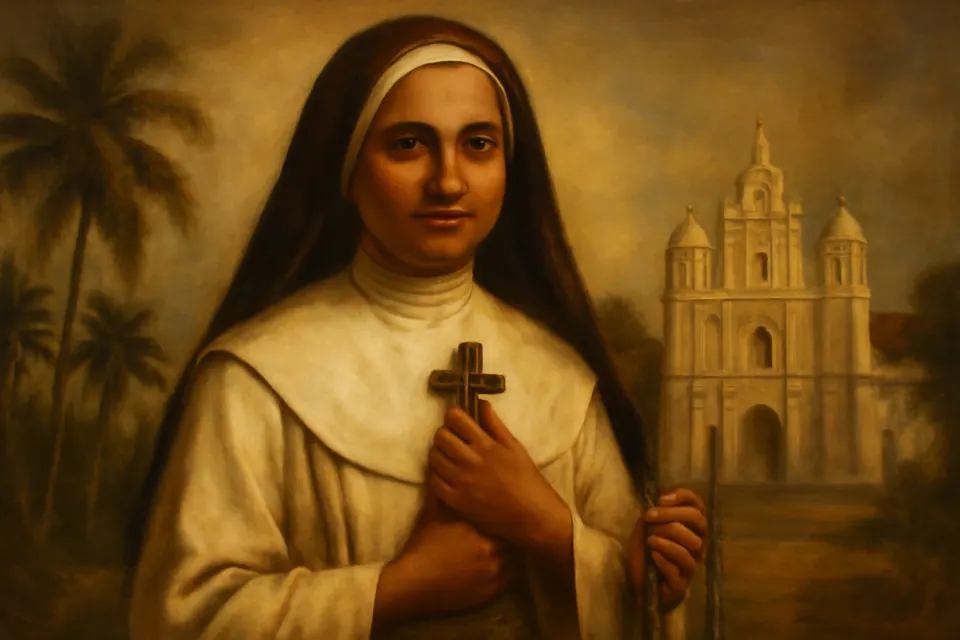
- A young face and a gentle smile: she is almost always shown in her twenties or early thirties, serene, never in visible pain. The smile is what her sisters remembered.
- A dark veil and white habit: the dress of the Franciscan Clarist Congregation, a family of the Franciscan Third Order in Kerala.
- A crucifix: for her lifelong union with Christ crucified, the heart of her spirituality.
- A rosary: for her life of prayer from her childhood prayer room to her sickbed.
Her image stands in churches and wayside shrines all over Kerala, the land evangelized, as its Christians hold, by St. Thomas the Apostle. She appears on two Indian postage stamps, from 1996 and 2008.
The feast of St. Alphonsa and her tomb at Bharananganam
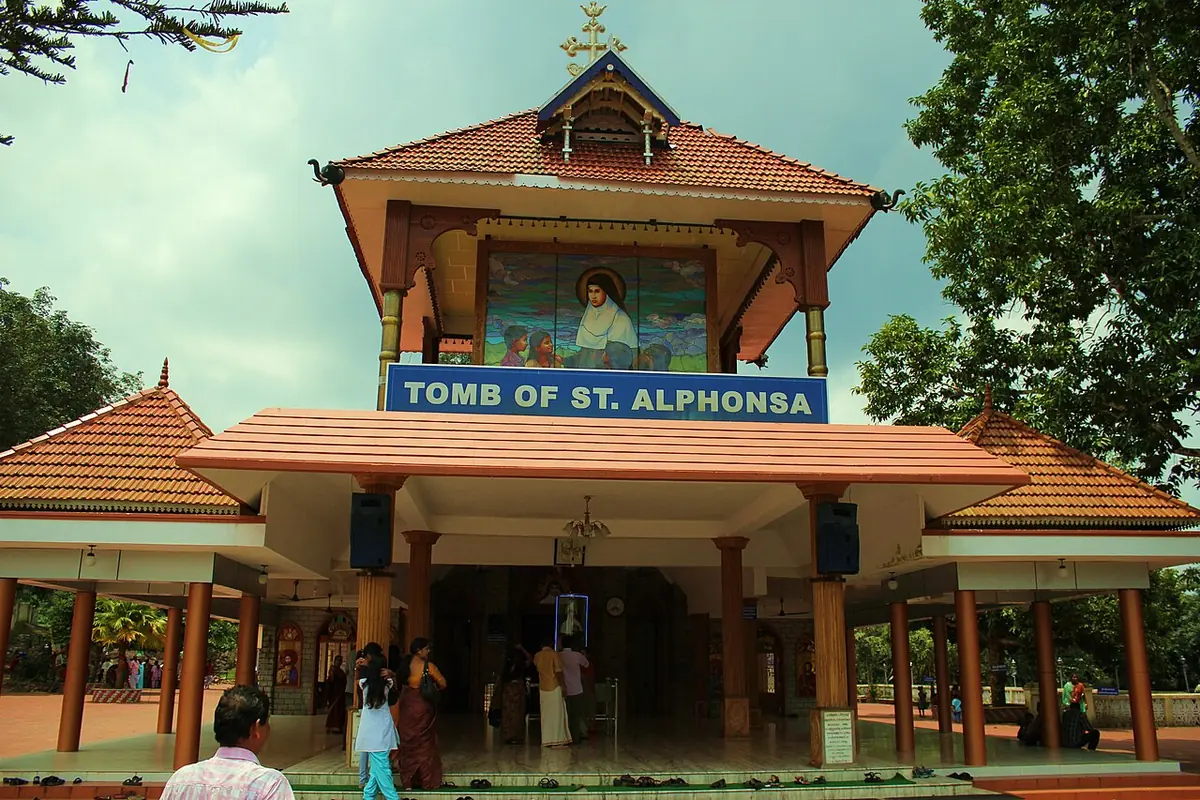
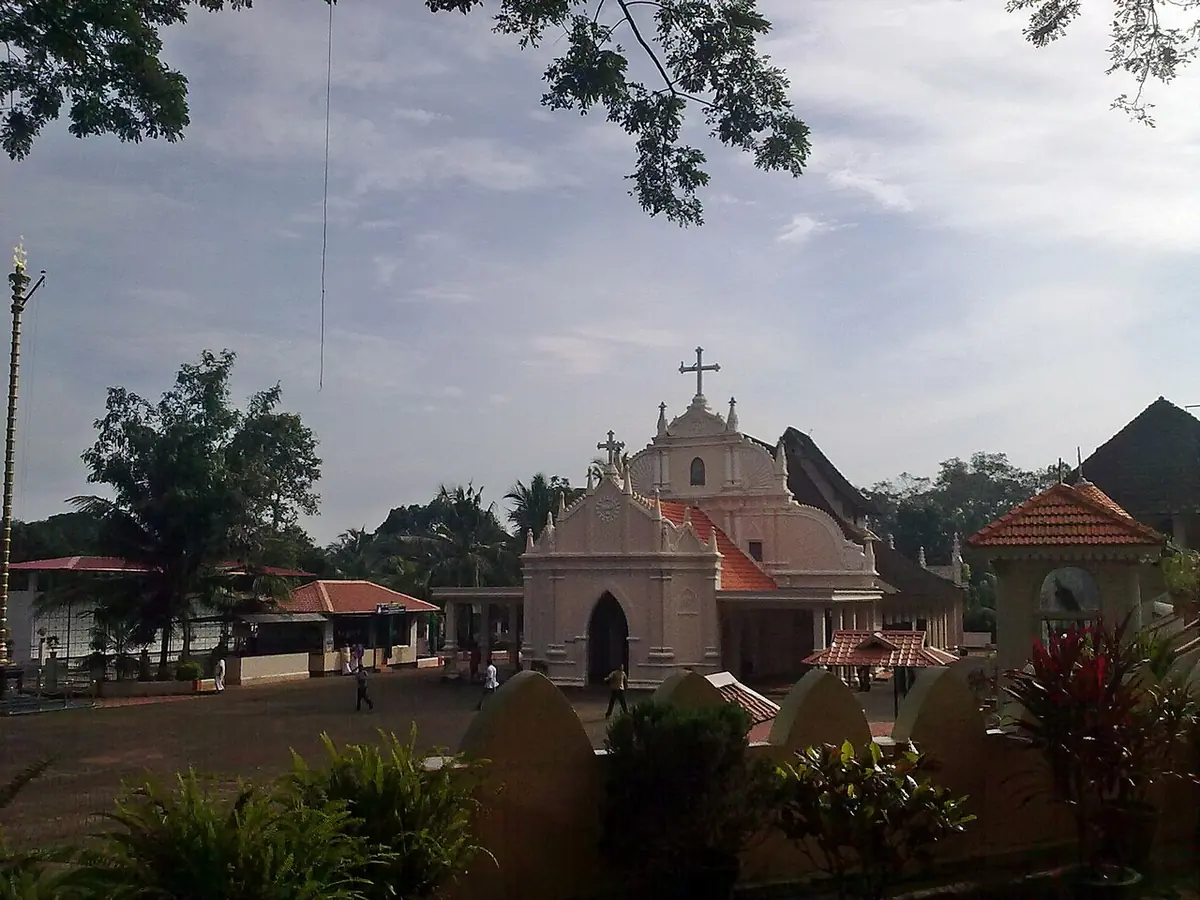
We keep St. Alphonsa's feast on July 28. At Bharananganam the celebration runs for ten days, from July 19 to 28, and draws pilgrims from all over Kerala and beyond. Her body lies in a chapel built over her grave in the cemetery of St. Mary's Forane Church, a short walk from the Clarist convent where she died, near the Meenachil River. On the day of her canonization in 2008, church bells rang across Kerala and Masses were said at the tomb from dawn.
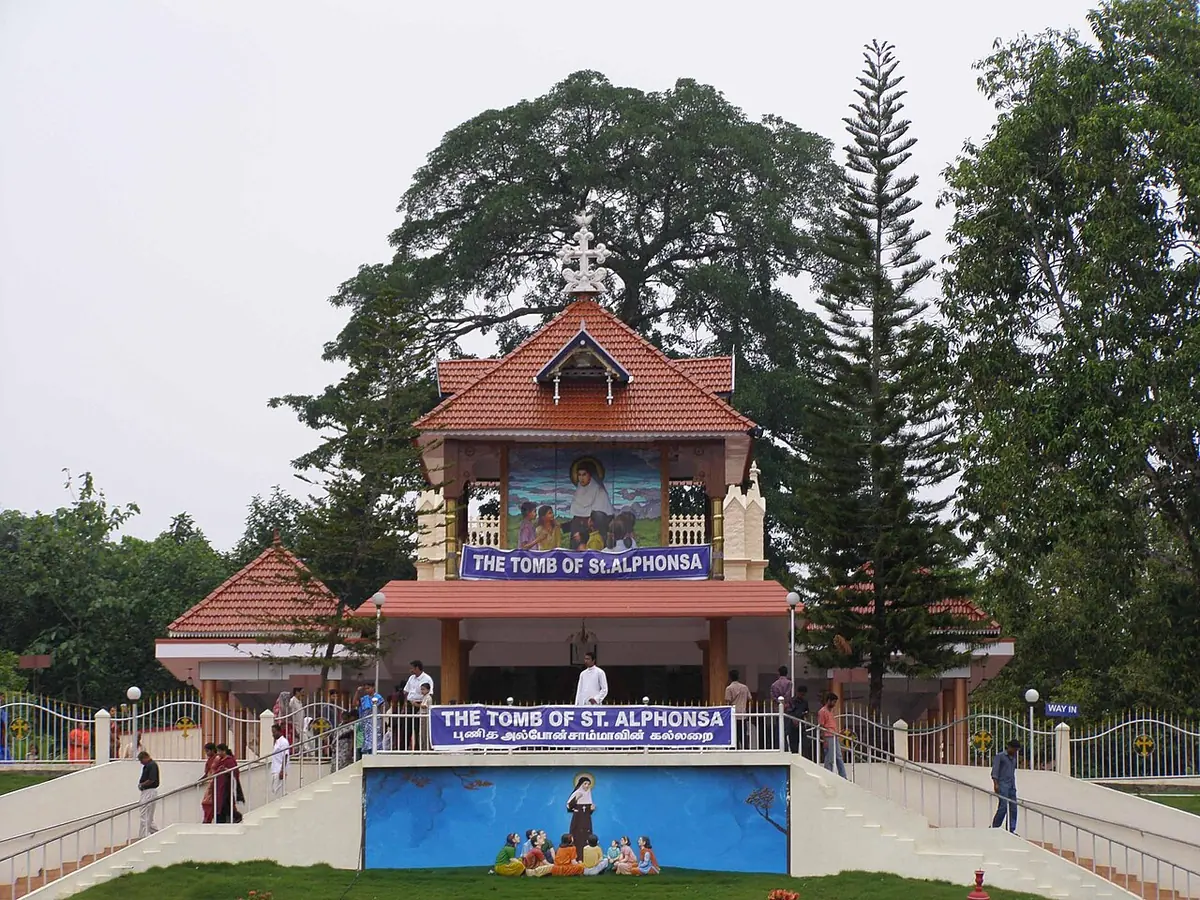
Her birthplace at Kudamaloor also welcomes pilgrims. Churches named for her now stand far from India too, among them Syro-Malabar parishes in Los Angeles and Mississauga, Canada, where Kerala families have carried her memory. See her place in the year on our feast days page.
Praying with St. Alphonsa
The Church has no single official prayer to St. Alphonsa, and Kerala parishes use novena prayers in Malayalam and English that differ from place to place. The surest way to pray with her is through her own words. Shortly before she died, she wrote in February 1946, as Pope John Paul II recalled at her beatification:
I have given myself up completely to Jesus. Let him please himself in his dealings with me. My only desire in this world is to suffer for love of God and to rejoice in doing it.
Let us ask St. Alphonsa to pray for all who are sick and in pain, for children born with disabilities and for their parents, and for every young person struggling to answer God's call. And with her, let us offer our own small crosses to Christ, so that nothing we suffer is wasted.
St. Alphonsa belongs to a family of young women saints who suffered much and loved more, among them St. Therese of Lisieux, St. Bernadette and St. Gemma Galgani. Her spiritual father was St. Francis of Assisi, and in India she is honored alongside St. Mother Teresa.
Frequently asked questions
Who was St. Alphonsa?
Alphonsa of the Immaculate Conception was a Syro-Malabar Catholic sister of the Franciscan Clarist Congregation in Kerala, India. Born Anna (Annakutty) Muttathupadathu in 1910, she joined the Clarists at Bharananganam, was ill for most of her religious life and died in 1946 at 35. The Church honors her for the patient, joyful way she united her suffering with Christ's.
When is St. Alphonsa's feast day?
July 28, the day she died in 1946. Pilgrims gather at her tomb in Bharananganam for a festival that runs from July 19 to July 28.
What miracle made St. Alphonsa a saint?
The miracle approved for her canonization was the cure of Ginil Joseph, a little boy from Kerala born with a clubfoot. His father said the boy stood firmly on his feet on May 11, 1999, the evening after the family prayed at her tomb. A doctor who examined him told the Church tribunal that a clubfoot does not correct itself without surgery. An earlier healing was approved in 1985 for her beatification.
Is St. Alphonsa the same person as Mother Mary Alphonsa?
No. St. Alphonsa is the Indian Franciscan Clarist sister who died in 1946. Mother Mary Alphonsa was Rose Hawthorne Lathrop (1851–1926), the daughter of the novelist Nathaniel Hawthorne, who founded a Dominican community in New York to care for the incurably sick poor.
Why is St. Alphonsa called the first saint of India?
She is the first woman of Indian origin canonized by the Catholic Church and the first saint of the Syro-Malabar Church. St. Gonsalo Garcia, a martyr of Nagasaki canonized in 1862, was born near Mumbai, so she is not the first Indian-born saint overall.
Keep exploring
- Patron saint pages
- HealingStudents
- Appears in
- Confirmation saints
- Feast-day calendar
- Saints remembered in JulySaint of the dayWhat saint is my birthday?
- Relics
- Where the relics are kept (map)
- More
- Saints A to ZPatron saints A to ZExplore every section
Sources
- Vatican: Alphonsa of the Immaculate Conception (1910–1946), Biography. Her birth, baptism, the burned foot in her own words, her vows, illnesses and death; the 1936 cure during a novena to Fr. Kuriakose Elias Chavara
- Pope Benedict XVI, Homily for the Canonization of Four Blesseds (October 12, 2008)
- Pope John Paul II, Homily at the Beatification of Fr. Kuriakose Elias Chavara and Sr. Alphonsa, Kottayam (February 8, 1986). Her letters of November 20, 1944, and February 1946
- Dicastery for the Causes of Saints: Alfonsa dell'Immacolata Concezione
- Vatican Radio, St. Alphonsa 2: Last Days and Veneration (2012). The opening of her cause on December 2, 1953, Venerable on July 9, 1985, the July feast at Bharananganam and Bishop Valopilly's account
- Outlook India, Alphonsa, Thy Name Is Risen (2008). The cure of Ginil Joseph on May 11, 1999, and Dr. Aleyamma Korah's testimony
- The Hindu, Catholic Church Celebrates Alphonsa's Canonisation (October 13, 2008). The tomb chapel at St. Mary's Forane Church, Bharananganam