St. John Ogilvie, Jesuit Martyr of Scotland
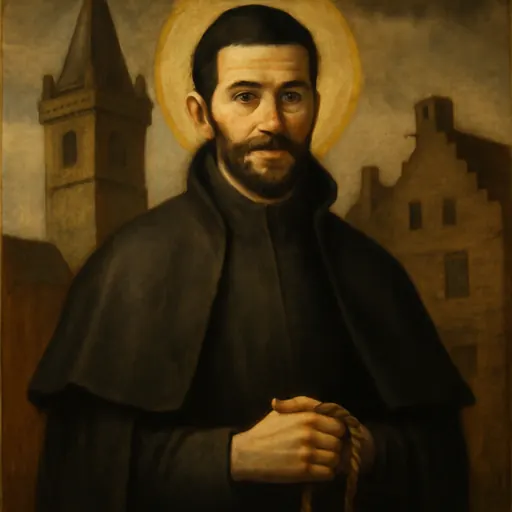
St. John Ogilvie (1579 to 1615) was a Scottish Jesuit priest who, after converting to the Catholic faith abroad, came home in disguise to serve Scotland's outlawed Catholics, and was hanged for high treason at Glasgow Cross on March 10, 1615, for refusing to accept the king's authority over the Church. Pope Paul VI canonized him in 1976. He is Scotland's only post-Reformation saint, and his feast day is March 10.
Who was St. John Ogilvie?
St. John Ogilvie was a Scottish Jesuit priest who was hanged at Glasgow Cross on March 10, 1615, for his Catholic faith. Raised a Calvinist in the northeast of Scotland, he became a Catholic as a student on the Continent, joined the Society of Jesus, and asked again and again to be sent home to a country where the Mass had been outlawed for half a century. He served Scotland's hidden Catholics for less than a year before he was betrayed. At his canonization in 1976, Pope Paul VI greeted the Scottish pilgrims with joy at a new saint "whom you, above all others, have the right to call your own." He is the only Scottish saint of the post-Reformation era.
The life of St. John Ogilvie
A laird's son becomes a Catholic
John was born in 1579 or 1580 at Drum, near Keith in Banffshire, the eldest son of Walter Ogilvie, a well-to-do laird. He was brought up a Calvinist and sent to the Continent for his education. On the Continent, amid the fierce religious arguments of the time, he was drawn to the Catholic faith, and at seventeen he was received into the Church at Louvain by the Jesuit biblical scholar Cornelius a Lapide.
He then studied with the Benedictines at Regensburg and with the Jesuits at Olomouc and Brno, in what is now the Czech Republic. He entered the Society of Jesus and was ordained a priest in Paris. The sources differ on the dates: the Catholic Encyclopedia gives 1613, and his national shrine gives 1610. Either way, he asked his superiors repeatedly to let him go to Scotland.
The mission in disguise
He landed in Scotland in November 1613, dressed as a horse trader and going by the name John Watson. Since the Reformation Parliament of 1560 it had been illegal to say Mass, and Catholics met in secret. For nine months, in Edinburgh and Glasgow, he said Mass in private houses, heard confessions and, in the words of the Catholic Encyclopedia, "reconciled many with the Church."

Arrest, torture and trial
In October 1614 he was betrayed in Glasgow and arrested on the orders of Archbishop John Spottiswoode, who had been appointed by the king. He was held in jail at Paisley. To force him to name other Catholics, his jailers kept him awake for eight days and nine nights, pricking him with needles whenever he dozed. He named no one. The Catholic Encyclopedia says his "patience, courage, and gaiety won the admiration of his very judges."
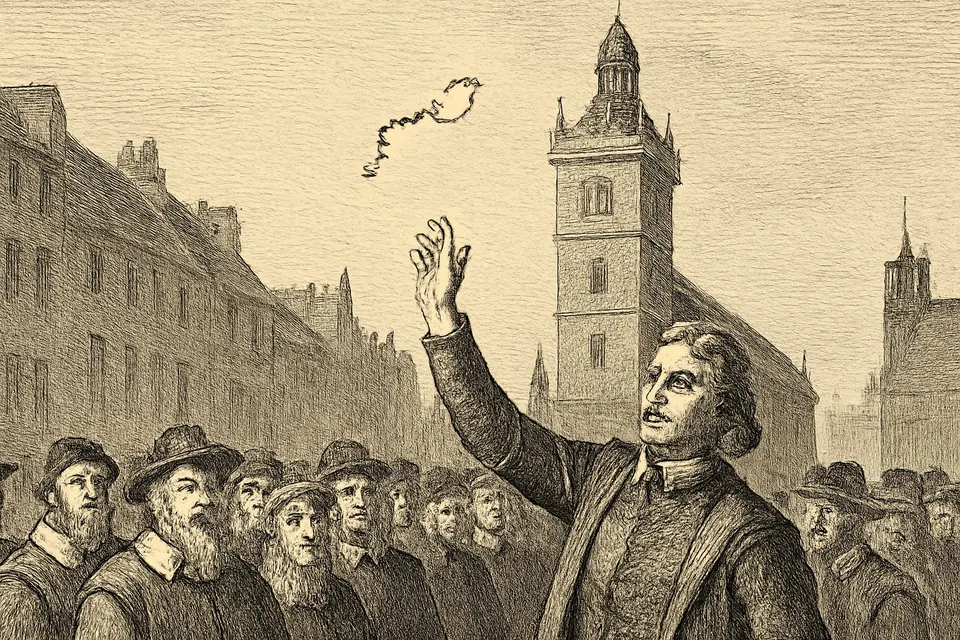
The charge was not saying Mass but treason. Ogilvie would not accept that King James VI had spiritual authority over the Church. He was condemned and hanged at Glasgow Cross on March 10, 1615, about thirty-five years old. His shrine records his last words: "If there be here any hidden Catholics, let them pray for me but the prayers of heretics I will not have." As he was pushed from the ladder he threw his rosary into the crowd. The shrine tells how "one of his enemies caught them and subsequently became a lifelong devout Catholic," a story kept by tradition.
The usual quartering of the body was not carried out, the Catholic Encyclopedia says, because of the open sympathy of the crowd. He was buried hurriedly in the churchyard of Glasgow Cathedral, and no one knows where his remains are today.
The miracle that made St. John Ogilvie a saint
Ogilvie was declared Venerable in the 17th century and beatified by Pope Pius XI on December 22, 1929. His canonization rested on one approved miracle.
John Fagan, a dock worker in Glasgow's Easterhouse district, had been diagnosed with stomach cancer in 1965. Treatment failed, and his doctors told his wife, Mary, to take him home. His parish was the only one in the world then dedicated to Blessed John Ogilvie. In January 1967 the parish priest, Father John Fitzgibbons, anointed him and gave Mary a medal of the martyr to pin to his pajamas, and the family and parish prayed through Ogilvie's intercession. By early March, Fagan had kept no food down for seven weeks and weighed about 70 pounds. On Saturday, March 4, his doctor said he would not survive the weekend. On the Monday morning Mary, keeping vigil, thought he had died. Three hours later he woke and said, "Mary, I'm hungry." The tumor was gone.
After nine years of medical inquiry, the Holy See ruled in February 1976 that the cure could not be explained naturally, and Pope Paul VI canonized John Ogilvie at St. Peter's on October 17, 1976. John and Mary Fagan were among the Scottish pilgrims in Rome.

Why St. John Ogilvie is invoked by converts and persecuted Christians
He was himself a convert, received into the Church as a young man after a Calvinist upbringing, so converts and those seeking the faith ask his prayers. He died for refusing to let the state rule the Church, which makes him a natural intercessor for Christians persecuted for their faith. In his homily Paul VI linked his sacrifice to the religious freedom taught by the Second Vatican Council in Dignitatis Humanae. For Scottish Catholics above all, he is their own martyr, the saint who kept the faith alive in their country's darkest years. See more on our patron saints page.
Symbols of St. John Ogilvie in art
- Black Jesuit cassock and cloak: his order, though in Scotland he went about in lay clothes.
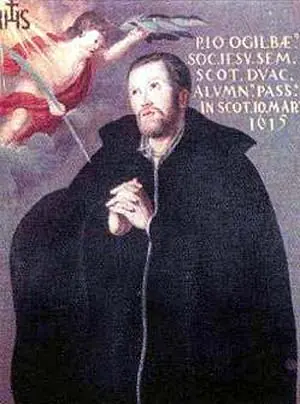
- Martyr's palm: often brought by an angel, as in the old portrait on this page.
- Rosary: the beads he threw into the crowd.
- Rope: his death by hanging, shown discreetly in modern images.
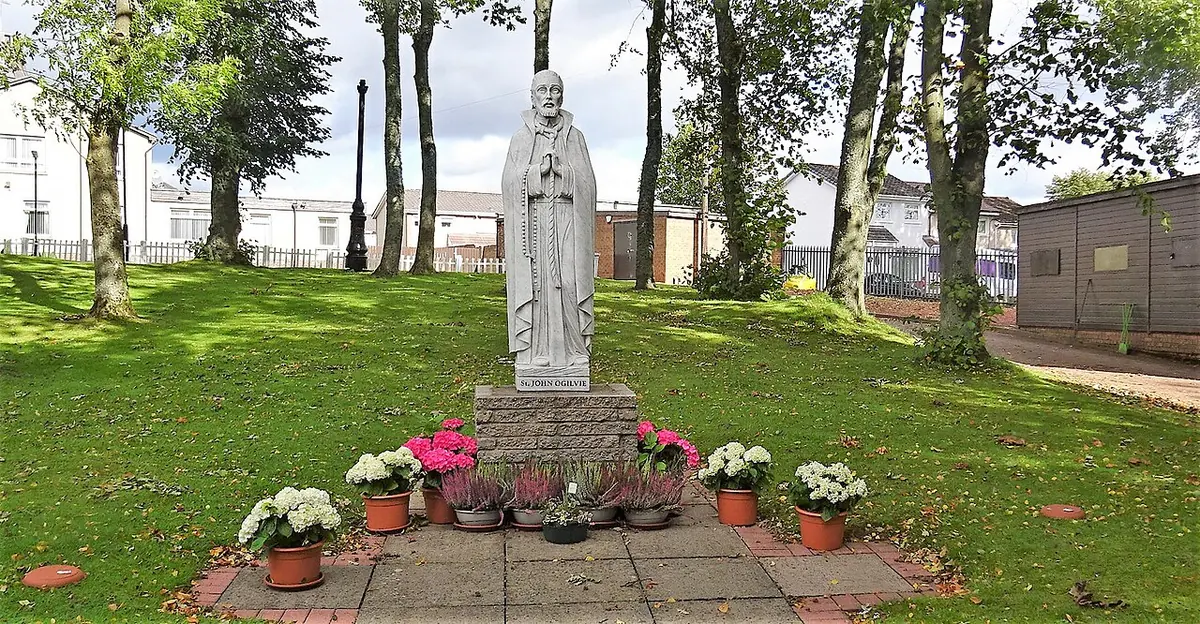
- Crucifix: held in his hands in modern statues, like the one at Carfin.
The early portrait at the top of this page carries a Latin inscription that identifies him as a Jesuit and a former student of the Scots College at Douai, martyred in Scotland on March 10, 1615.
Feast day and places to pray
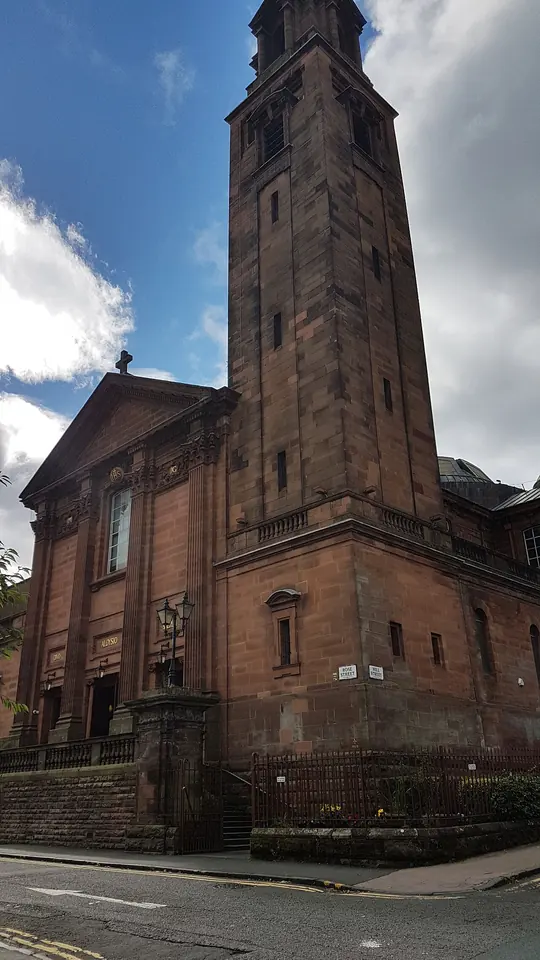
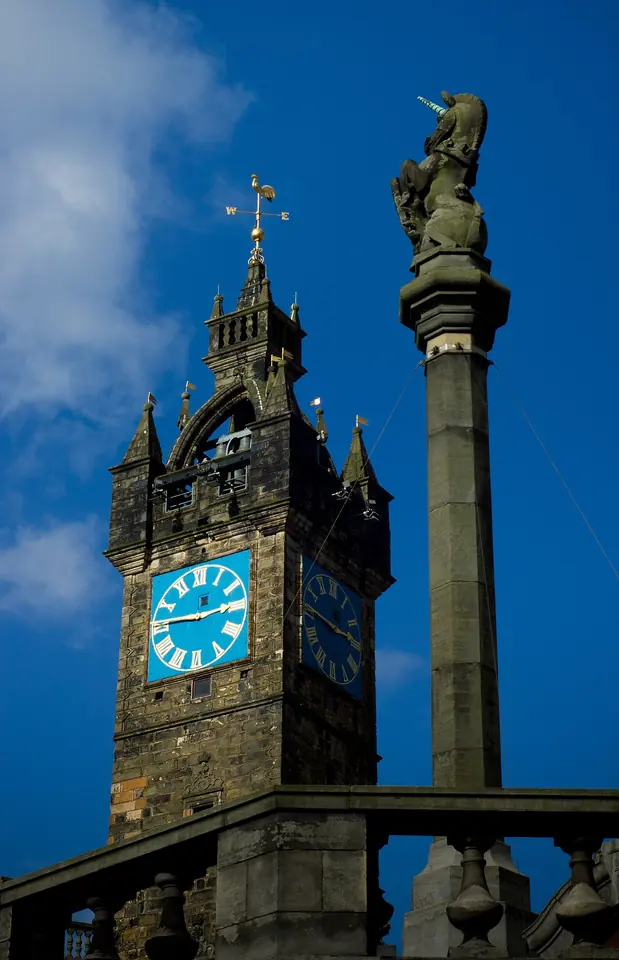
We keep his feast on March 10, the day he died. You can find the saints around him on our feast days page. His national shrine is in the Jesuit church of St. Aloysius in Glasgow. Pilgrims also stop at Glasgow Cross, where the old market cross and the Tolbooth steeple still stand near the place of his execution.
Prayer to St. John Ogilvie
The prayer the Church gave us at his canonization is the one Pope Paul VI said at the end of his homily, in Italian: "San Giovanni Ogilvie, prega per noi!" St. John Ogilvie, pray for us! We have not found an older traditional prayer to him with a source we can verify.
Let us ask him to pray for Scotland, for converts and those searching for the faith, for Christians who suffer for it, and for the sick who, like John Fagan, have been told there is nothing more to be done.
Frequently asked questions
Why was St. John Ogilvie executed?
He was convicted of high treason in Glasgow for refusing to acknowledge King James VI's spiritual jurisdiction, that is, the king's claim to authority over the Church. Saying Mass and reconciling people to the Catholic Church were illegal, but it was this refusal that made his case a capital one.
What miracle made St. John Ogilvie a saint?
The cure of John Fagan, a Glasgow dock worker with terminal stomach cancer. His parish in Easterhouse, then the only parish dedicated to Blessed John Ogilvie, prayed for him, and on the morning of Monday, March 6, 1967, after his doctor expected him to die that weekend, he woke up hungry and recovered. After years of medical study, the Holy See ruled in February 1976 that the cure could not be explained, and he was canonized that October.
When is the feast of St. John Ogilvie?
March 10, the anniversary of his martyrdom in 1615. It is kept as a feast in Scotland.
What were St. John Ogilvie's last words?
According to the account kept at his national shrine, he said, "If there be here any hidden Catholics, let them pray for me but the prayers of heretics I will not have," and then threw his rosary into the crowd.
Sources
- Pope Paul VI, Homily for the canonization of John Ogilvie (October 17, 1976). Martyred at Glasgow March 10, 1615; beatified by Pius XI on December 22, 1929; St. Columba and St. Margaret
- Michael Barrett, Ven. John Ogilvie (Catholic Encyclopedia, 1911). Received into the Church at Louvain by Cornelius a Lapide; the nine sleepless nights; Archbishop Spottiswood; burial in the cathedral churchyard
- St. Aloysius' Church, Glasgow: The National Shrine to St John Ogilvie. His education at Regensburg, Olomouc and Brno; ordination in Paris; the horse-trader disguise; prison in Paisley; last words and the rosary
- David Kerr, Father Fitzgibbons and the miracle that made a Scottish saint (Diocese of Lansing). The cure of John Fagan in March 1967 and the ruling of February 1976