St. Colette of Corbie

St. Colette of Corbie (1381–1447) was a French carpenter's daughter who lived for four years as a walled-in recluse and then reformed the Poor Clares, founding seventeen convents that returned to the strict poverty of St. Clare. She is not the French novelist Colette. We keep her feast on March 6, and she is the patron saint of expectant mothers and couples hoping for children.
Who was St. Colette?
St. Colette of Corbie was a 15th-century French nun who brought the Poor Clares back to the poverty of St. Clare. Born in 1381 in the small abbey town of Corbie in Picardy, the daughter of a carpenter, she lived for four years walled into a cell beside a parish church, then left it, at what she believed was God's command, to walk barefoot across France, Burgundy, Savoy and Flanders founding convents. Seventeen new houses of her reform were founded in her lifetime. She died at Ghent on March 6, 1447, and was canonized in 1807.
(She is not the French novelist Colette, who wrote Gigi in the 20th century.)
Today most people who search for St. Colette come to her for one reason: they are hoping for a child, or praying for one already on the way. Her own birth was an answer to prayer, and her early biographers filled their pages with mothers and newborns saved through her intercession. The Church has never stopped bringing those intentions to her.
The life of St. Colette
Nearly everything we know about Colette comes from two people who knew her. Pierre de Vaux, a Franciscan friar, was her confessor for many years and wrote her life soon after her death. Sister Perrine de Baume, one of her first nuns, wrote another from what Colette had told her. Both lives are now available in English in a translation by Renate Blumenfeld-Kosinski. Later biographers, including the Jesuit Charles Sellier in 1853 and Mrs. Parsons in English in 1879, built on them. These are devoted lives, written to show a saint, and they mix plain history with wonders. Where the line between them falls, we say so below.
A child of prayer
Colette's father, Robert Boellet, was the carpenter of the great Benedictine abbey of Corbie. Her mother, Marguerite Moyon, had been a widow and had no children. The couple prayed to St. Nicholas for a child, and, according to Parsons, Marguerite gave birth "after her sixtieth year" to a daughter on January 13, 1381. They named her Nicolette in thanksgiving, and the whole town called her Colette.
She was a small, frail child, so small that she worried she would never be strong enough to serve God. The early lives say that she prayed about it and grew, suddenly and remarkably, to a tall woman's height. Parsons admits the accounts disagree on how it happened, "but all agree in the miracle." We count it among the traditional stories.

Her parents died when she was about seventeen. She gave what they left her to the poor and went looking for a religious life strict enough for her. She tried the Beguines, communities of laywomen who lived by the work of their hands. She tried the Benedictines and then the "Urbanist" Poor Clares, whose rule had been relaxed by Pope Urban IV. Butler says she also took the habit of the Franciscan Third Order. None of them fit what she felt God asking.
The recluse of Corbie
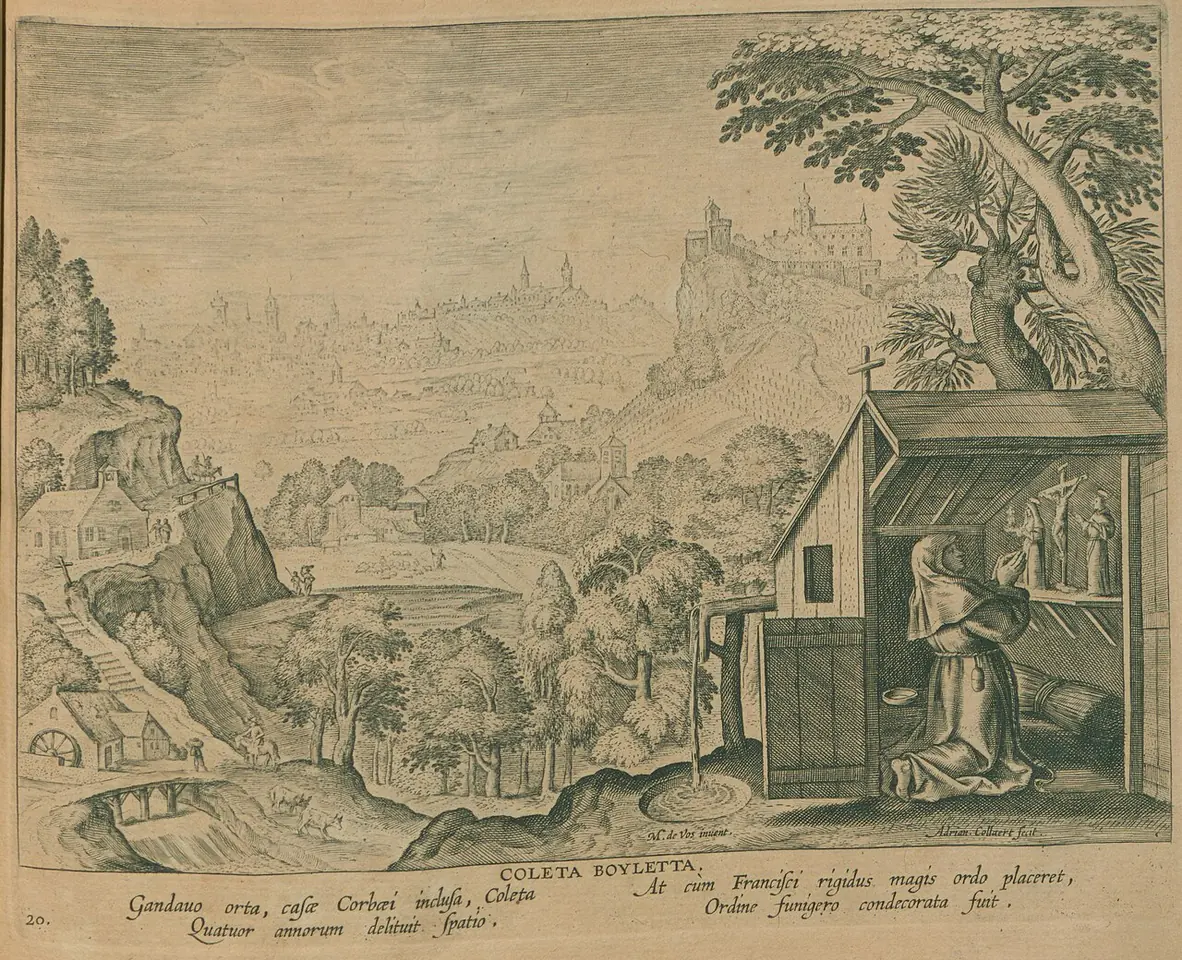
At about twenty-two, on the advice of a Franciscan friar, Father Pinet, she asked to become a recluse, a woman enclosed for life in a small cell attached to a church. The abbot of Corbie agreed. After Mass in the presence of the clergy and the town, she made her vows, which Parsons gives as: "For the love of God, and in the presence of the Queen of heaven and of the Heavenly host, I bind myself by vows to the observance of chastity, poverty, obedience, and perpetual enclosure." The abbot led her in procession to her cell beside the church and closed the door.
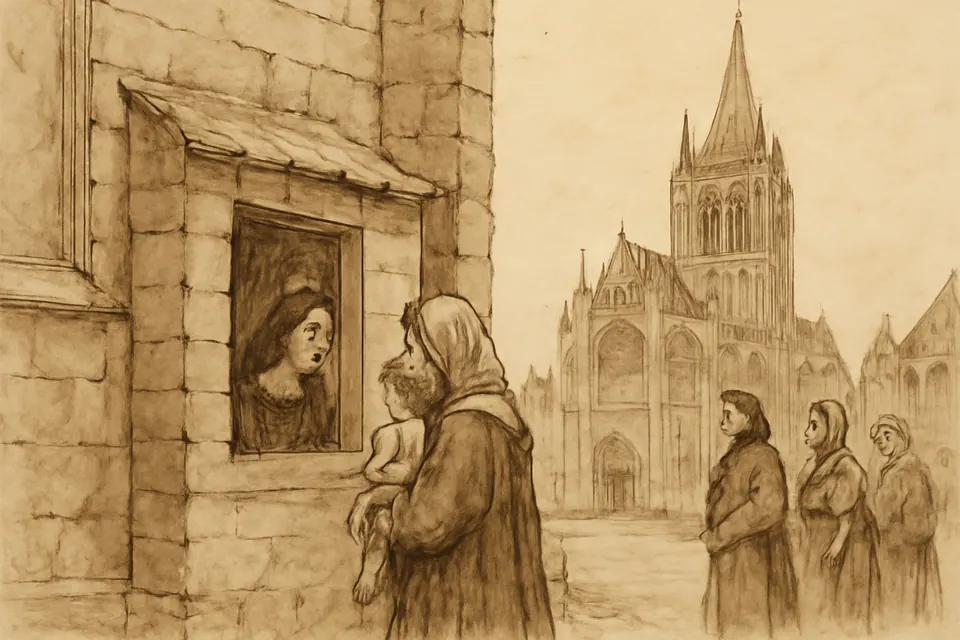
She lived there four years. One small window looked into the church, so she could see the altar; another, with a grille, opened onto the street, and through it townspeople brought her food and their troubles. A boy named Jean Guyot, seven years old when she was enclosed, came to the window to learn to read and to recite the Psalms from her. As an old man of seventy-six he testified under oath about her life.
The call to reform
In the cell, the early lives say, Colette was shown a vision. She was carried in spirit before Christ and his Mother, and she saw St. Francis kneeling and asking the Lord to give him "Colette, that she might work for the reformation of the Religious of his Order." She was horrified. She had vowed perpetual enclosure, and she told herself it must be a temptation.
What followed, as Pierre de Vaux tells it, was a hard struggle. She lost her voice for three days, then her sight for three more, until in her heart she said, "I obey." Her speech and sight returned. The friar Henri de la Baume, sent to help her, arranged for her release from her vow, and in 1406 she left the cell.
The pope at Nice
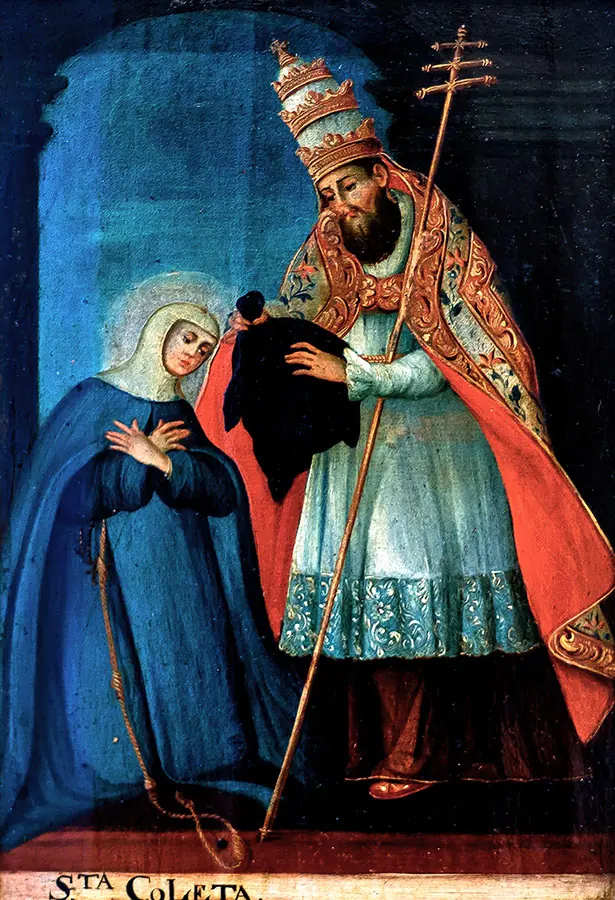
These were the years of the Great Western Schism, when rival popes claimed the Chair of Peter. France recognized Benedict XIII, Pedro de Luna, who was then at Nice. Colette went to him with Father Henri. The Catholic Encyclopedia notes that he was an antipope, but at the time France obeyed him, and Colette, like St. Vincent Ferrer, acted in good faith. Benedict received her profession as a Poor Clare, made her an abbess with authority over every house that would accept her reform, and issued bulls in 1406, 1407, 1408 and 1412 to support her. The first, Parsons records, is dated October 16, 1406.
Seventeen convents
The beginning was hard. In the convents of Picardy she met, in Butler's words, "the most violent opposition, and was treated as a fanatic." She found her first welcome in Savoy, thanks to the Countess of Geneva, and opened her first reformed house in an almost abandoned convent at Besançon around 1410. The reform spread to Auxonne, to Poligny in 1415, to Moulins, Amiens, Ghent, Heidelberg and Pont-à-Mousson. The Catholic Encyclopedia counts seventeen houses founded in her lifetime.
At Besançon she first met the Dominican preacher St. Vincent Ferrer, who was preaching there. Parsons says they "became at once united in heart and soul, and never ceased from that hour to help each other."
Her houses lived by the original rule of St. Clare: no property and no fixed income, bare feet, perpetual fasting and abstinence from meat, and complete enclosure. Butler says her own habit was "made of above a hundred patches sewed together." She wrote constitutions for her nuns, approved in 1434 by William of Casale, minister general of the Franciscans, and later by Pope Nicholas V in 1448. She also began a reform of the Franciscan friars, the "Coletani," which Pope Leo X merged into the Observants in 1517.

War and hunger
All of this happened during the Hundred Years' War. Parsons notes that St. Joan of Arc's army came close to the convent at Moulins, and that the nuns went hungry, making bread from oats and husks and sweeping up the grain between the floorboards of the granary. Later writers liked to imagine the two holy Frenchwomen meeting; the early sources Parsons used do not record a meeting.
Death at Ghent
Colette spent her last years in Flanders. In the convent of Bethlehem at Ghent, early in 1447, she fell ill for the last time. Parsons, following Pierre de Vaux, says she took leave of her confessors, lay down in her habit and said, "This is my last lying down." She placed her black veil over her own face and lay still for two days. She died at eight in the morning on Monday, March 6, 1447, with Pierre de Vaux and her sisters around her. She was sixty-six.

The miracles of St. Colette
Colette's confessor, Pierre de Vaux, wrote down many wonders, some of which he says he witnessed or heard from living witnesses. These are reported miracles: documented by people who knew her, but not each examined by the Church. Others are traditional. The miracles the Church approved for her canonization were examined in Rome before 1807; the sources consulted here do not name them case by case.
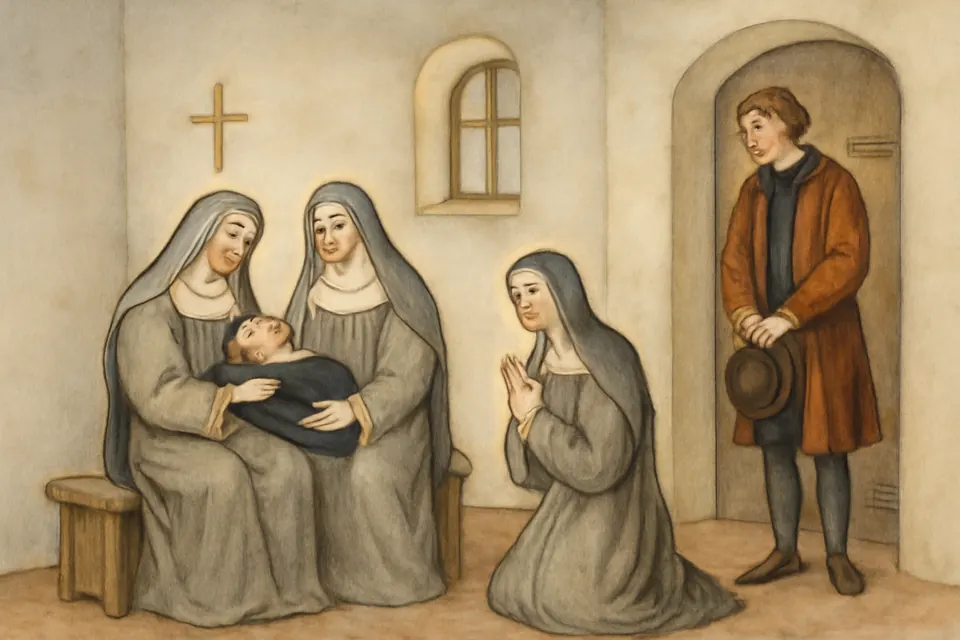
- Reported: At Besançon, a man's child was born dead before it could be baptized. The nuns wrapped the tiny body in Colette's veil and asked her to pray. The child, Parsons writes, "showed signs of life, and was immediately baptized and called Colette." She grew up to become a Poor Clare and abbess of Pont-à-Mousson, and was still alive when the saint's first biographers wrote.
- Reported: Also at Besançon, a fifteen-year-old named Jean Boisot, from one of the city's leading families, was carried dead in his shroud into the chapel while Colette heard Mass. After Mass she told him to rise, and he stood up and went home with his parents before a large crowd. Pierre de Vaux says the young man was alive when he wrote, and Parsons adds that the Boisot family still honored the Poor Clares in 1783.
- Reported: On her way to her first foundation, she stayed with Allard de Baume, brother of Father Henri, whose wife was expected to die in childbirth. Colette prayed, mother and daughter were safe, and the baby, Perrine, became one of her nuns and her biographer.
- Reported: In 1747, during the bishop of Ghent's inquiry into her miracles, an elderly nun who had been unable to speak for four years recovered her voice as Colette's relics were being examined, and intoned, "Ora pro nobis beata Mater Coleta" ("Pray for us, blessed Mother Colette").
- Traditional: Her sudden growth as a girl; a lark that drank from her cup and a lamb that followed her into the oratory; a gold cross holding a relic of the True Cross brought to her by a heavenly messenger, now kept by the Poor Clares at Poligny; and a ring given to her in a vision of St. John the Evangelist.
Why St. Colette is the patron saint of expectant mothers
Three threads run together here. Colette was herself a child of prayer, born to a mother past sixty after her parents asked St. Nicholas for a baby. Her biographers record her helping women in dangerous labor, starting with the birth of Perrine de Baume. And they tell again and again of newborns who died before baptism and were restored to life through her prayers; Parsons repeats the old claim that she "brought back life in this way to over a hundred infants."
Parsons says that in her own day the Poor Clares of Bruges kept a small piece of Colette's kerchief, sewn between silk and gauze, and lent it to women in labor, and that her convents gave blessed medals in her honor to expectant mothers.
The devotion is very much alive. In 2008 Cardinal André Vingt-Trois, archbishop of Paris, recognized the parish of Sainte-Colette des Buttes-Chaumont as a place of pilgrimage for couples struggling to conceive. The parish keeps relics of the saint, and Aleteia reports that each year couples write to say they have had a child or completed an adoption after praying there. She shares this care for mothers with St. Gerard Majella and St. Anne. See all the patron saints by cause.

Symbols of St. Colette in art
St. Colette is easy to mistake for St. Clare, since both wear the same habit. Look for these clues.
- The Poor Clare habit: a coarse gray or brown habit with a white cord, white wimple and black veil. Older paintings show it patched, recalling Butler's "hundred patches."
- Bare feet: her nuns went barefoot, and she is often shown that way.
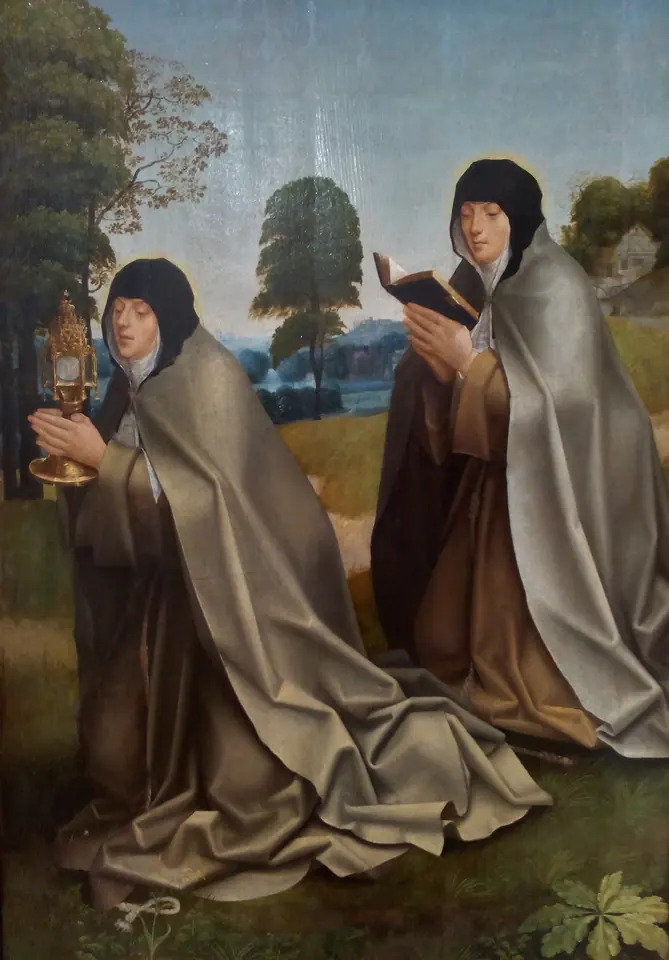
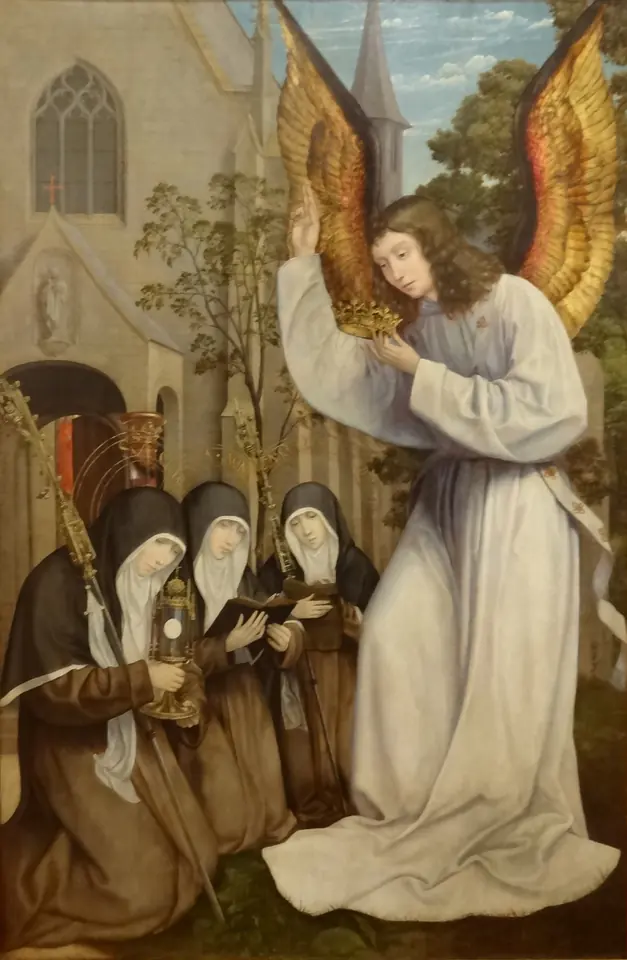
- A book: the Rule of St. Clare or her own constitutions, as in the Lourinhã painting, where she reads while Clare holds the monstrance.
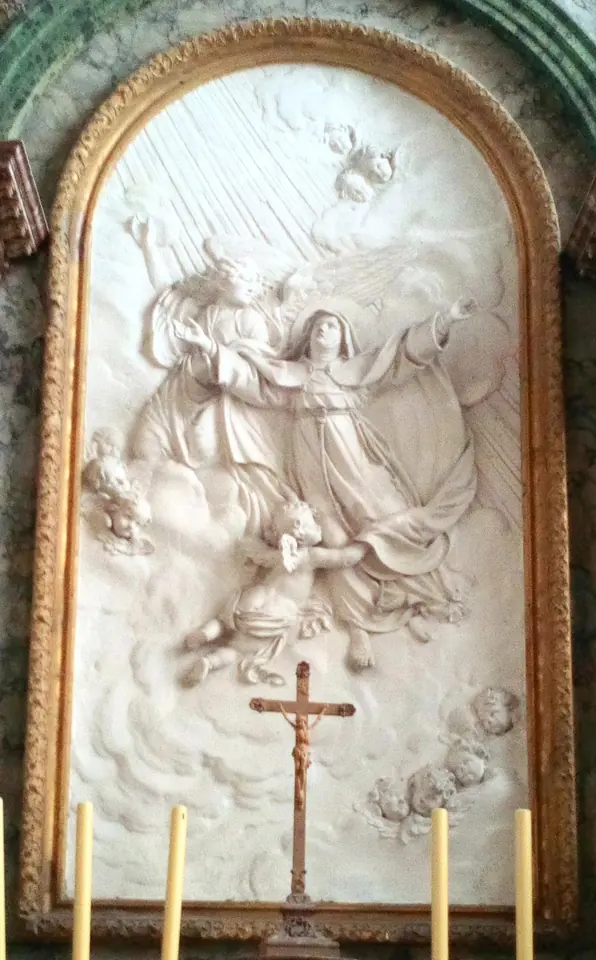
- A crucifix: her lifelong meditation on the Passion. Pierre de Vaux says she spent every Friday from six in the morning until six at night contemplating Christ's sufferings. The Ghent statue on this page shows her gazing at a crucifix.
- A lamb and a lark: from the stories of the animals that followed her. The lark, Parsons explains, was the bird she loved because it rises "straight towards the sky with its joyous song."
- An abbess's crozier: she was abbess of her reformed houses, as the Corbie statue shows.
- Kneeling before a pope: many images show her receiving the habit or her bull of reform from the pope at Nice.
- With St. Clare and St. Francis: she often appears with the founders whose way of life she restored, sometimes, as in the Metsys workshop painting, with Clare and Agnes of Assisi visited by an angel.
Feast day, relics and where St. Colette is honored
We keep St. Colette's feast on March 6. Pope Pius V intended to canonize her and fixed the date in 1572, Parsons writes, but died before he could act; Clement VIII and Paul V allowed her office in the Franciscan houses of Flanders early in the 1600s. She was beatified in 1740 and canonized on May 24, 1807. See the feast day calendar.
The long journey of her relics
Colette was buried in the nuns' cemetery at Ghent. When the Calvinist rebels known as the Gueux reached Ghent in 1577, the sisters fled to Arras and carried her bones with them, fulfilling, Parsons notes, her remark that if she did not go to Arras alive she would go there dead. They came home in 1587.
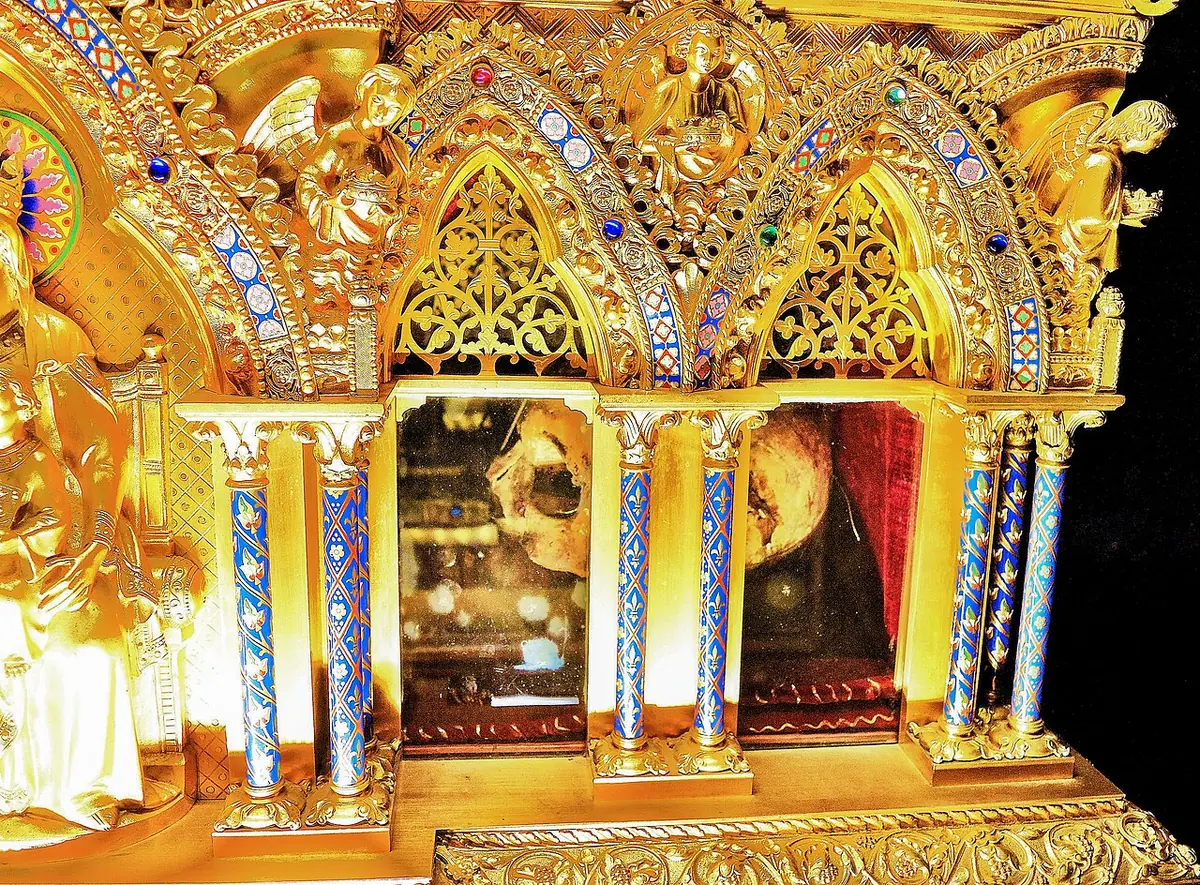
In 1783 the Emperor Joseph II closed every Poor Clare house in the Austrian Netherlands. The nuns of Ghent would not leave their mother behind. With the help of Madame Louise of France, a Carmelite nun and aunt of King Louis XVI, they obtained leave to take refuge with their sisters at Poligny, and they arrived on September 15, 1783, with Colette's relics.
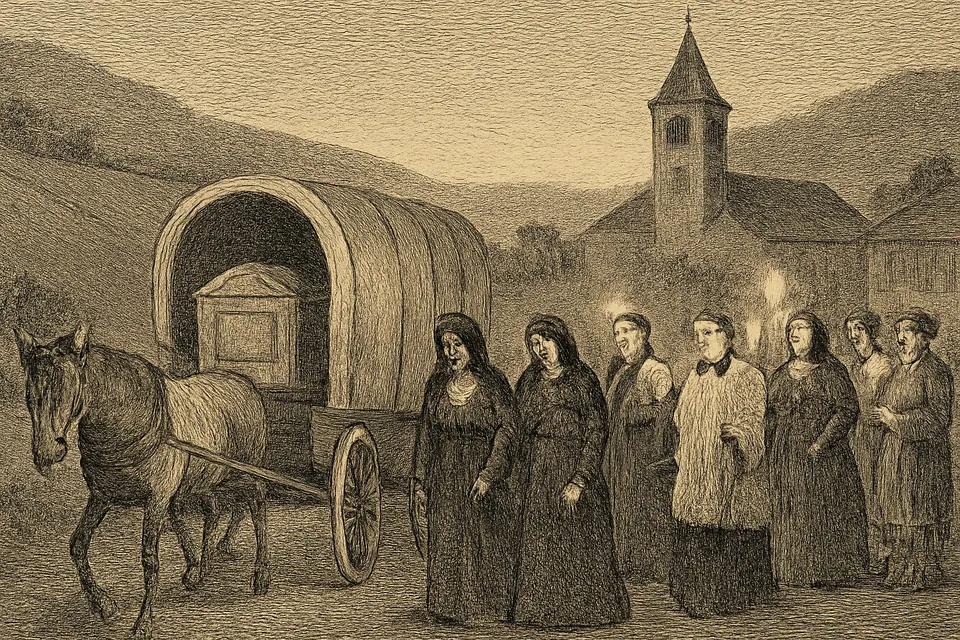
Within ten years the French Revolution drove the Poligny nuns out too. The relics were left in the parish church of Saint-Hippolyte. In 1794, Parsons records, revolutionaries planned to burn the church, and a nun living quietly with her family, Constance Parpandet, overheard the plan and persuaded leading townspeople to carry the relics to safety. The Poor Clares returned to Poligny in 1817, and her body has rested in their chapel ever since.
Places to visit
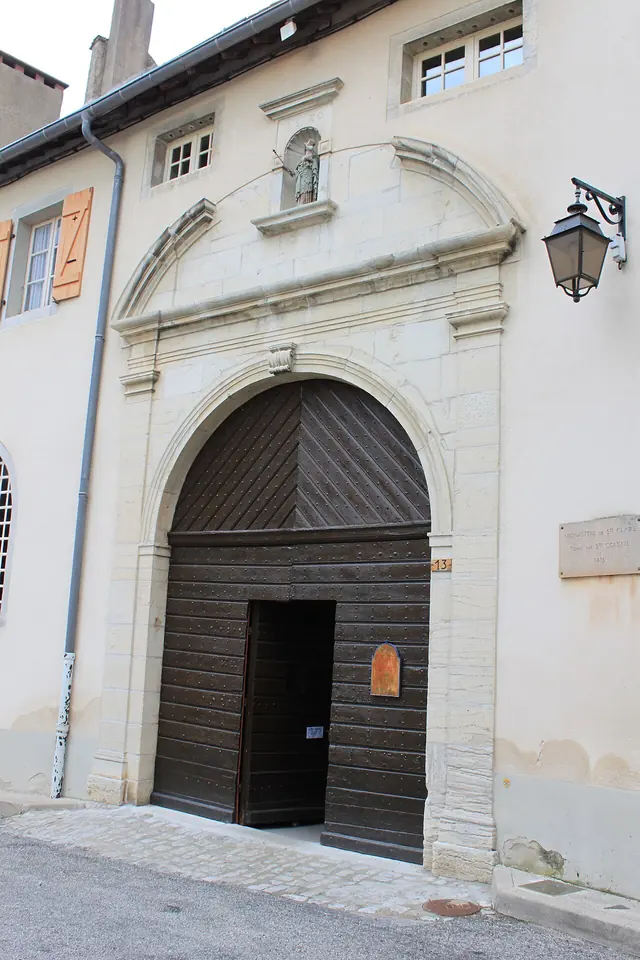
- Poligny, Jura: the Monastery of St. Clare, which she founded in 1415, keeps her body and receives a pilgrimage of couples hoping for children every July.
- Corbie, Somme: her birthplace, with the Chapelle Sainte-Colette, her statue and Duthoit's altarpiece in the abbey church. She is the town's patron.
- Ghent: the Sint-Coletakerk and the street names that remember the convent of Bethlehem where she died.
- Paris: the parish of Sainte-Colette des Buttes-Chaumont, with its relics and monthly prayer for couples.
Prayer to St. Colette
No long prayer from Colette's own hand has come down to us in a form we can quote. The Church's oldest invocation of her is short. It is the versicle from her office, which the healed nun at Ghent sang in 1747:
Ora pro nobis, beata Mater Coleta: ut digni efficiamur promissionibus Christi.
In English: "Pray for us, blessed Mother Colette, that we may be made worthy of the promises of Christ."
When we ask St. Colette for a child, for a safe pregnancy or for a sick baby, we can speak to her simply, as the people of Corbie and Besançon did at her window and her convent door. Tell her the intention, ask her to pray for you, and pray an Our Father, a Hail Mary and a Glory Be. Many couples pray this way for nine days, as a novena, or on the first Sunday of each month with the parish of Sainte-Colette in Paris.
Let us also remember the other half of her life: her love for Christ crucified and her trust in God when the answer was slow in coming. She waited years in a small cell before she knew what God wanted of her. St. Colette, pray for us.
Frequently asked questions
What is St. Colette the patron saint of?
Expectant mothers, women in childbirth, couples hoping to have a child, and sick children. The patronage comes from her own birth to a mother past sixty and from the many births and newborns her biographers say she saved by her prayers. She is also the patron of her hometown, Corbie.
When is St. Colette's feast day?
March 6, the day she died at Ghent in 1447. It is kept in the Roman Martyrology and by the Franciscan family, especially the Poor Clares, but not on the General Roman Calendar.
Is St. Colette the same as the French writer Colette?
No. St. Colette of Corbie was a 15th-century Franciscan nun and abbess. The novelist Sidonie-Gabrielle Colette, author of Gigi, lived from 1873 to 1954 and wrote under her surname.
What are the Colettine Poor Clares?
Poor Clare nuns who follow St. Clare's rule as Colette restored it, with her own constitutions, approved by the Franciscan minister general in 1434 and by Pope Nicholas V in 1448. They live in strict poverty and enclosure. Colettine monasteries still exist in France, Belgium, Ireland, England, the United States and elsewhere.
Where are St. Colette's relics?
Her body rests in the Monastery of St. Clare at Poligny in the Jura, France, where Poor Clares from Ghent brought it in 1783 when Emperor Joseph II closed their convent. The parish of Sainte-Colette des Buttes-Chaumont in Paris also keeps relics.
How do you pray to St. Colette for a baby?
Couples ask her intercession in their own words, often after Mass or before a novena. The Paris parish of Sainte-Colette prays for couples who hope for a child after Mass on the first Sunday of each month, and the Poor Clares of Poligny receive a pilgrimage of such couples every July.
Why was St. Colette named Colette?
Her parents had prayed to St. Nicholas for a child, so they named her Nicolette, and "Colette" is its short form.
Keep exploring
- Patron saint pages
- PregnancyFertility
- Appears in
- Female saintsSaint names for girls
- Feast-day calendar
- Saints remembered in MarchSaint of the day
- More
- Saints A to ZPatron saints A to ZExplore every section
Sources
- Catholic Encyclopedia (1908): St. Colette
- Mrs. Parsons, The Life of Saint Colette, the Reformer of the Three Orders of St. Francis (London: Burns and Oates, 1879), drawn from Pierre de Vaux, Sellier and Douillet
- Alban Butler, Lives of the Saints (1864 Sadlier edition): B. Colette, Virgin and Abbess (EWTN)
- Aleteia (French): Sept lieux pourvoyeurs de grâces pour les couples en espérance d'enfants (2018)
- University of Pittsburgh: Two Lives of Saint Colette, with a Selection of Letters, translated by Renate Blumenfeld-Kosinski