St. Marie-Eugénie de Jésus
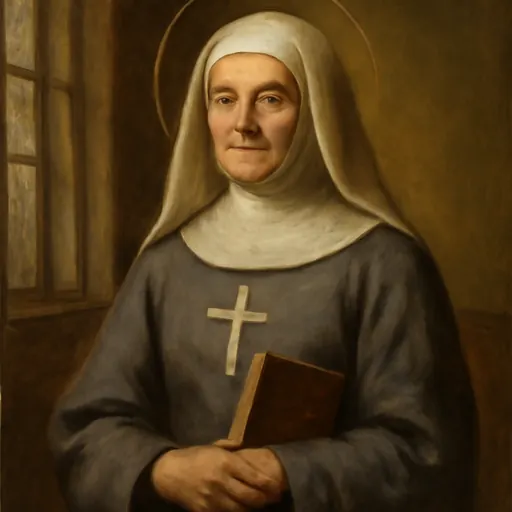
St. Marie-Eugénie de Jésus (1817–1898), born Anne-Eugénie Milleret in Metz, was converted at nineteen by Father Lacordaire's Lenten sermons at Notre-Dame and founded the Religious of the Assumption in Paris in 1839 to educate girls. Pope Benedict XVI canonized her on June 3, 2007. Her feast is March 10.
Who was St. Marie-Eugénie de Jésus?
St. Marie-Eugénie de Jésus was a French founder who gave her life to the education of girls. Born Anne-Eugénie Milleret de Brou into a rich family that had little use for religion, she was converted at nineteen by a preacher at Notre-Dame and founded the Religious of the Assumption in Paris in 1839, when she was barely twenty-two. She led her sisters for more than half a century. Pope Benedict XVI canonized her on June 3, 2007, and we keep her feast on March 10.
A childhood without faith
She was born in Metz on August 25, 1817. Her father was a liberal banker and politician who admired Voltaire; her mother gave her a sense of duty and a quick, curious mind but practiced the faith only outwardly. Anne-Eugénie went to Mass on feast days and received the sacraments without much thought.
One moment stayed with her. At her First Communion on Christmas Day 1829 she had what the Vatican's biography calls a mystical experience, whose meaning she understood only years later. "I never forgot it," she wrote. Pope Benedict XVI began his words about her at the canonization with the same point: "Marie Eugenie Milleret reminds us first of all of the importance of the Eucharist."

Then her world fell apart. Her father was ruined in 1830, her parents separated in 1831, and in 1832 her mother died of cholera within a few hours. At fifteen Anne-Eugénie was alone in Paris, living with relatives in a worldly household.
Converted at Notre-Dame
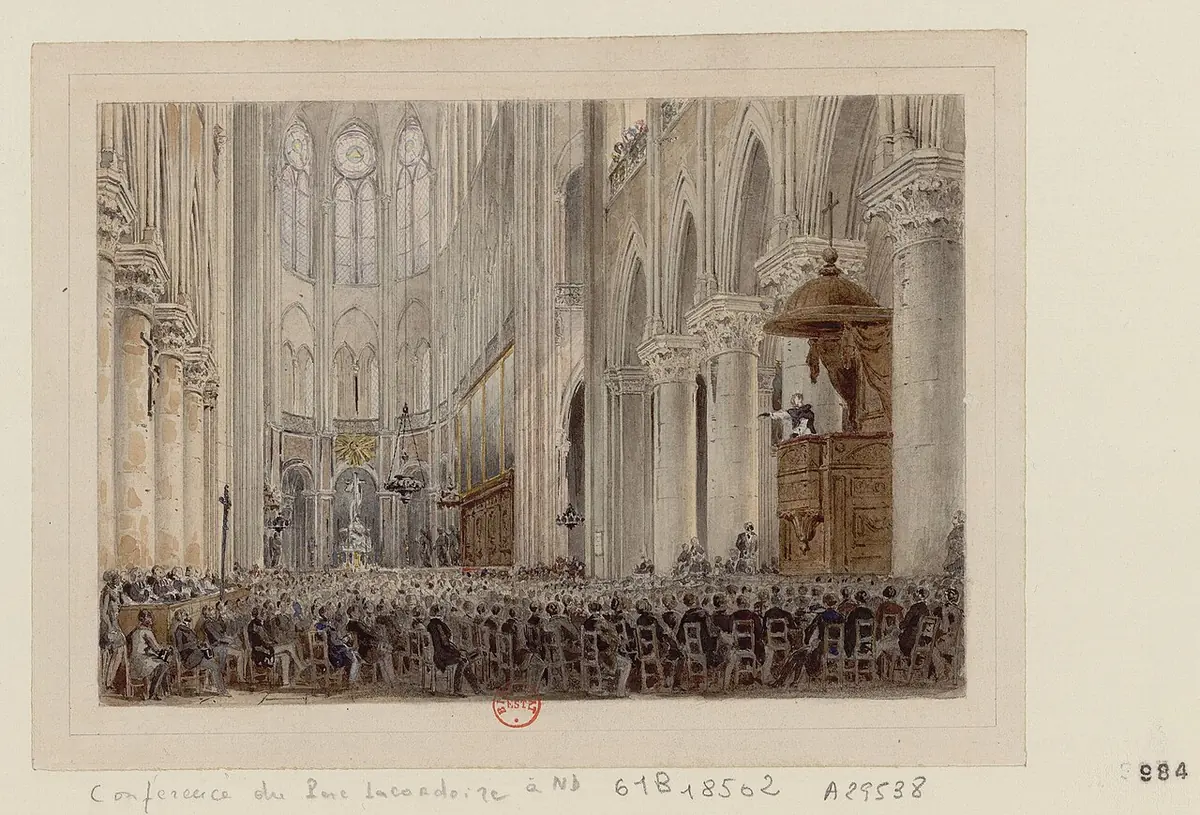
In Lent of 1836 she went to hear the young Father Henri Lacordaire preach his conferences at Notre-Dame. She came out changed. "I was truly converted," she wrote, "and I was seized by a longing to devote all my strength or rather all my weakness" to the Church. Years later she told Lacordaire, "Your words gave me a faith that nothing would ever shake again," and she liked to say, "My vocation dates from Notre-Dame."
A priest, Father Théodore Combalot, convinced her that God wanted her to found a congregation for the Christian education of girls. On April 30, 1839, she and two companions began a life of prayer and study in a small apartment on Rue Férou, near Saint-Sulpice. That November she took the name Marie-Eugénie de Jésus.

The Religious of the Assumption
The first boarding school opened in the early 1840s in the Impasse des Vignes in the Latin Quarter and moved to Chaillot in 1844, the year she made her final vows before Archbishop Affre. Within a few years she had sixteen sisters of four nationalities. Among them was an Irishwoman, Kate O'Neill, Mother Thérèse-Emmanuel, whom the congregation counts as co-founder; at the end of her life Marie-Eugénie called her "half of myself."
Her spiritual director from 1841 was Father Emmanuel d'Alzon, and in 1845 he founded the Augustinians of the Assumption, the Assumptionists. The two founders worked side by side for nearly forty years. Her sisters joined contemplation and action, with prayer, the Eucharist and serious study at the center of their day, and they taught so that girls could carry the Gospel into their homes and into society. "Education is to allow the good in every person to breakthrough the rock that imprisons it," she said.
Rome recognized the congregation in 1867, and its Constitutions were approved for good on April 11, 1888. By the time she died, the Diocese of Paris notes, the congregation already reached well beyond France.
Her last years and death
In 1894 she stepped down as superior general. Her body weakened slowly, and paralysis set in in 1897. She spoke little, and accepted it. "Now all I have to do is be good," she said near the end. She received Communion for the last time on March 9, 1898, and died the next day at the mother house in Auteuil, Paris.
Miracles and canonization
Pope Paul VI beatified her on February 9, 1975. On December 16, 2006, Pope Benedict XVI authorized the decree on a miracle obtained through her intercession, an approved miracle, and he canonized her on June 3, 2007, together with St. George Preca, St. Simon of Lipnica and St. Charles of Mount Argus.
On December 8, 2024, when the restored Notre-Dame de Paris consecrated its new altar, a relic of St. Marie-Eugénie was sealed inside it with those of St. Madeleine-Sophie Barat, St. Catherine Labouré, St. Charles de Foucauld and Blessed Vladimir Ghika. She came back to the cathedral where her faith was born.
Symbols of St. Marie-Eugénie in art
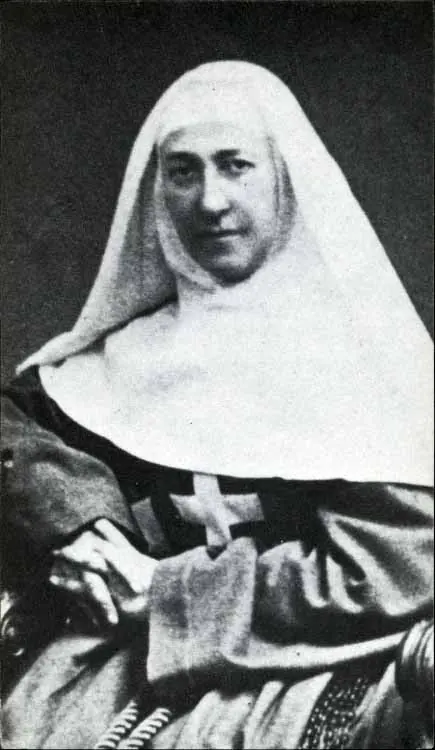
She lived in the age of photography, and most images of her come from photographs taken late in her life. Look for:
- The white veil and the cross on the breast of the Assumption habit.
- A book: her love of study and the education of girls.
- The Eucharist or a monstrance: the adoration at the heart of her congregation, and the First Communion that first touched her.
Feast day and prayer
We keep the feast of St. Marie-Eugénie de Jésus on March 10. The Religious of the Assumption now serve in some thirty-five countries, and a street in the 16th arrondissement of Paris, Avenue Milleret-de-Brou, carries her family name. See the feast day calendar for the other saints of March.
We know of no traditional prayer to her that we can cite. Let us ask her to pray for teachers and students, for young people searching for faith, and for everyone who hears the Gospel for the first time as an adult: St. Marie-Eugénie de Jésus, pray for us.
Frequently asked questions
Who was St. Marie-Eugénie de Jésus?
Born Anne-Eugénie Milleret de Brou in Metz in 1817, she grew up in a wealthy family with little faith, lost her mother at fifteen, and was converted by Lacordaire's preaching at Notre-Dame. In 1839 she founded the Religious of the Assumption, a congregation of sisters devoted to prayer and the education of girls, and she led it for over fifty years.
When is the feast of St. Marie-Eugénie de Jésus?
March 10, the day she died in Paris in 1898.
Who canonized St. Marie-Eugénie?
Pope Benedict XVI canonized her in St. Peter's Square on June 3, 2007, together with George Preca, Simon of Lipnica and Charles of Mount Argus. Pope Paul VI had beatified her on February 9, 1975.
What did St. Marie-Eugénie say about education?
Her sisters remember her saying, "Education is to allow the good in every person to breakthrough the rock that imprisons it." She wanted girls formed in faith, mind and character so they could carry the Gospel into society.
Keep exploring
Sources
- Vatican: Blessed Marie Eugenie of Jesus (1817–1898), Biography. Her family, conversion, the founding, Mother Thérèse-Emmanuel, Father d'Alzon and her last days
- Pope Benedict XVI, Homily for the Canonization of June 3, 2007. The saints canonized with her and the Pope's words about the Eucharist in her life
- Église catholique en France: Sainte Marie-Eugénie Milleret. Her family's ruin, her own words about Notre-Dame, the miracle decree of December 16, 2006, and the approval of the Constitutions
- Diocese of Paris: Sainte Marie-Eugénie Milleret. The first boarding school, the move to Chaillot and her death at Auteuil
- Diocese of Paris: Messe de consécration de l'autel de Notre-Dame de Paris. The five relics sealed in the altar of Notre-Dame on December 8, 2024
- Religious of the Assumption Asia Pacific: Marie Eugenie de Jesus. The first community on Rue Férou and her saying on education