St. Frances of Rome (Santa Francesca Romana)
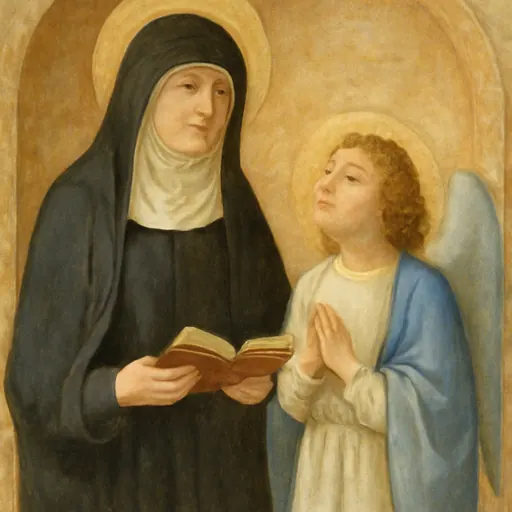
St. Frances of Rome (Santa Francesca Romana, 1384–1440) was a Roman noblewoman who lived forty years as a devoted wife and mother, served the poor and the sick through war, famine and plague, and founded the Oblates of Tor de' Specchi. She is famous for seeing her guardian angel at her side. Her feast day is March 9, and she is the patroness of drivers and motorists, widows and Benedictine oblates.
Who was St. Frances of Rome?
St. Frances of Rome, Santa Francesca Romana, was a Roman noblewoman of the early 15th century who became a saint in the middle of ordinary family life. She was married at twelve, raised children, ran a large household, nursed the sick through famine and plague, buried two of her children and saw her home plundered in war. In 1425 she gathered a group of Roman women into a community of prayer and charity, the Oblates of Tor de' Specchi, and after her husband's death she lived among them as their mother. She died on March 9, 1440, and Rome called her a saint on the day of her death.
What makes her unusual among the saints is the story she told her confessor: for most of her adult life, she said, her guardian angel was visible at her side. That angel is why she appears in paintings with a child-sized angel next to her, and it is the reason, by a long road, that she became the patroness of drivers.
Pope Benedict XVI, visiting her community on her feast in 2009, called her "the most Roman of women Saints" and praised the balance she found between "contemplation and action, prayer and charitable service." We keep her feast on March 9.
Almost everything we know about her inner life comes from Giovanni Mattiotti, a priest of Santa Maria in Trastevere who was her confessor for the last ten years of her life. He had her tell him her visions in detail, kept a daily record of them for a time, and wrote her life. Three canonical inquiries followed her death, in 1440, 1443 and 1451. Lady Georgiana Fullerton's English life of 1855, drawn from these early sources, is the source for many of the stories below. The visions are private revelations. The Church does not require anyone to believe them, but it read them closely before declaring her a saint.
The life of St. Frances of Rome
A girl who wanted the cloister
Frances was born in Rome in 1384 to Paolo Bussa and Iacobella dei Roffredeschi, both of noble families. Alban Butler, following the early lives, says she loved solitude and prayer as a small child and at eleven asked to enter a monastery. Her father had other plans. In 1396, at the age of twelve, she was married to Lorenzo de' Ponziani, a young nobleman of a wealthy family in Trastevere.
The marriage began badly for her. She fell gravely ill soon after the wedding, and her biographers saw in her recovery both a miracle and a sign that God wanted her where she was. She came to love Lorenzo deeply. Butler writes that in the forty years they lived together "there never happened the least disagreement."
Vannozza
In the Ponziani palace she found a friend and partner for life in her sister-in-law Vannozza, the wife of Lorenzo's brother Paluzzo. The two young wives prayed together, visited the hospitals together and, when the family's charity ran short, went out together to beg for the poor at church doors. Vannozza is the witness to several of the miracles told about Frances.
Wife, mother and mistress of the house
Frances had at least three children: Battista, the eldest, who carried on the family name; Evangelista, a gifted and devout boy; and a daughter, Agnese. While still young, Frances was put in charge of her father-in-law's whole household. She treated the servants, Butler says, "not as servants, but as brothers and sisters, and future co-heirs in heaven."
She kept her prayer life, but not at the cost of her family. A sentence from her early lives has become the best-known thing she ever said:
A married woman must, when called upon, quit her devotions to God at the altar, to find him in her household affairs.
One day, her biographers say, while she was reciting the Little Office of the Blessed Virgin, Lorenzo called for her four times, each time for some small task. Each time she got up without complaint. When she came back the fifth time, she found the antiphon she had started and left four times written in letters of gold. Vannozza saw it, and the gold letters stayed in the book until Frances died.

Famine, war and plague
Rome in those years was a broken city. The papacy was split by the Great Western Schism, and the troops of King Ladislaus of Naples occupied Rome more than once. Famine and plague followed.
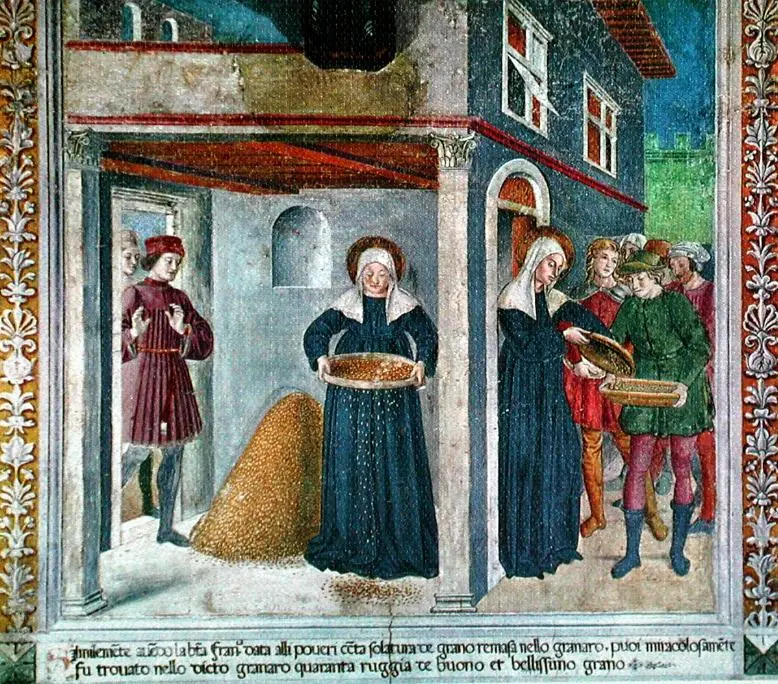
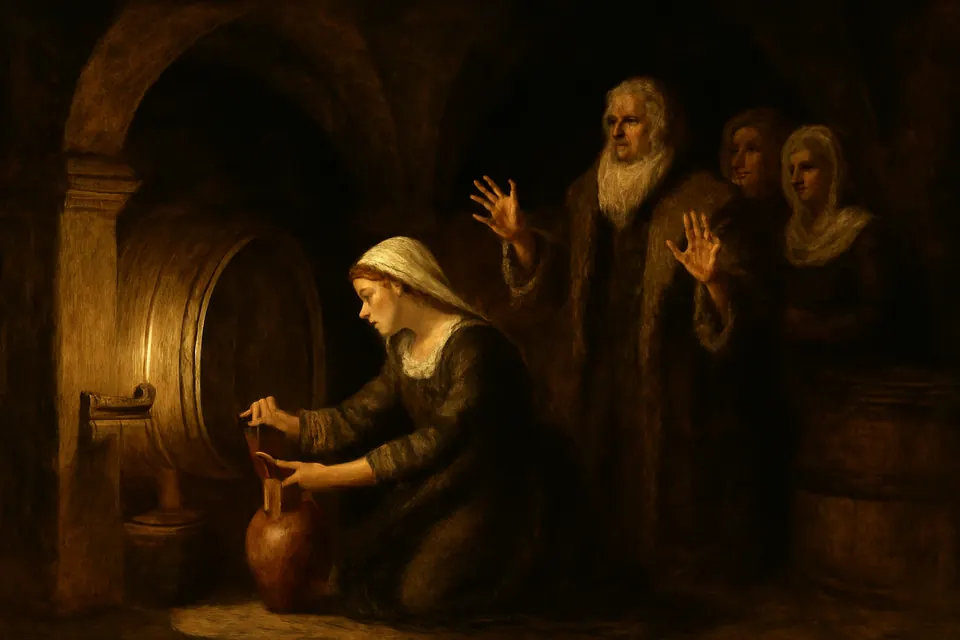
Frances gave away grain, wine, oil and clothing from the family stores. Her father-in-law, Andreozzo, alarmed, took away the key to the granary and sold off everything but the family's own supply. Fullerton's life, following the earliest biographer, tells what happened next. Frances, Vannozza and a servant knelt in the empty granary for hours sifting the straw for a few handfuls of grain for the poor. Lorenzo came in and saw, where the straw had been, forty measures of bright golden wheat. Later the sick came begging for wine, and Frances drew from the one cask left until it was empty. Andreozzo stormed at her. She led the family down to the cellar, turned the tap, and the cask poured wine better than any he had tasted. The old man told her, with tears, to give away whatever he owned.
The war came into her house. Lorenzo, loyal to the pope, was badly wounded in the fighting. The Neapolitan commander demanded their eldest son, Battista, then eight or nine, as a hostage. Frances first fled with the boy. Then, on her confessor's advice, she brought him to the Capitol herself, handed him over and went into the church of Santa Maria in Aracoeli to pray before the image of Our Lady. Her biographers say the soldiers could not make a horse move with the child on its back, though they tried four horses, and the boy was returned to her before the altar. Butler adds that Lorenzo was later banished, his estates confiscated and his house pulled down, and that Frances answered with the words of Job.
When plague followed the famine, Frances and Vannozza nursed the sick. The epidemic reached the Ponziani palace, and in 1411 it took Evangelista. Two years later Agnese died too.

Evangelista and the angel
About a year after Evangelista died, her biographers say, Frances was praying in her oratory when the room filled with light. Her son stood before her, with a companion of the same height but more beautiful still. Evangelista told her that he was among the angels in heaven, that God asked for his sister Agnese, and that the angel beside him had been given to Frances as her guardian for the rest of her life. Then he was gone, and the angel stayed.
Frances described the angel to her confessor in these words, as Fullerton translates them:
His stature is that of a child of about nine years old; his aspect full of sweetness and majesty; his eyes generally turned towards heaven... He wears a long shining robe, and over it a tunic, either as white as the lilies of the field, or of the colour of a red rose, or of the hue of the sky when it is most deeply blue.
The light around him was so bright, she said, that she could read and write by it in the dark. When she committed a fault the angel seemed to vanish, and he returned only after she had confessed it. A later tradition, retold by the liturgist Pius Parsch, says that three angels of different rank accompanied her in the three periods of her life. Read more about guardian angels.

The Oblates of Tor de' Specchi
Peace slowly returned to Rome after the Council of Constance ended the schism in 1417, and Lorenzo came home. He gave Frances freedom to live as she felt God was calling her, and the two lived together in continence.
Frances had long been gathering other Roman women to pray and serve the poor with her, under the direction of the Olivetan Benedictine monks of Santa Maria Nova in the Forum. On the feast of the Assumption, August 15, 1425, she and nine companions, Vannozza among them, made their offering to the Blessed Virgin in that church. They used the Olivetan formula but said "me offero," I offer myself, instead of the words of solemn profession. That is why they were called Oblates: they took no solemn vows, did not wear a strict enclosure and could keep their property, but lived for prayer and charity.
On March 25, 1433, the feast of the Annunciation, the ten Oblates moved into a house at Tor de' Specchi, at the foot of the Capitoline Hill. Pope Eugene IV approved the community that July, the Catholic Encyclopedia says. Butler writes that Frances gave the Oblates the Rule of St. Benedict with constitutions of her own.

Widow and mother of the community
Lorenzo died in 1436. Frances settled her family's affairs, and then, Butler writes, she walked barefoot with a cord around her neck to Tor de' Specchi and knelt before the sisters to ask to be admitted. She took the habit on the feast of St. Benedict, March 21, 1437. The sisters soon made her their superior, though she looked for the lowest work in the house.
Her death
On March 3, 1440, her son Battista, who was ill with fever, sent for her. She went at once, found him recovering, and fell ill herself at the family palace. She foretold the day of her death. On March 9, the seventh day of her illness, she was still murmuring the Vespers of the Blessed Virgin. Her last words, as Fullerton gives them, were: "The heavens open! The angels descend! The archangel has finished his task. He stands before me. He beckons to me to follow him."
The miracles of St. Frances of Rome
Frances lived long before the modern rules for investigating miracles. Here is how the stories stand.
- The grain in the granary (traditional). Forty measures of wheat in place of straw, seen by her husband. The 1468 fresco at Tor de' Specchi illustrates it with an inscription.
- The cask of wine (traditional). An empty cask poured wine before her father-in-law, during the same famine.
- The golden antiphon (traditional). The unfinished antiphon written in gold, which Vannozza is said to have seen.
- Battista and the horses (traditional). The hostage returned when no horse would carry him away.
- Her visible guardian angel (reported). Her own account, recorded by her confessor and repeated by witnesses in the canonization processes of the 1440s and 1450s.
- Healings and conversions (reported). The Catholic Encyclopedia says she had "the gift of miracles and ecstasy," could read the secrets of consciences and foretold the end of the Western Schism. Many cures were reported at her funeral and tomb.
- Miracles for her canonization (approved). Paul V canonized her in 1608 after long processes. The sources consulted here do not describe the miracles examined.
Canonization
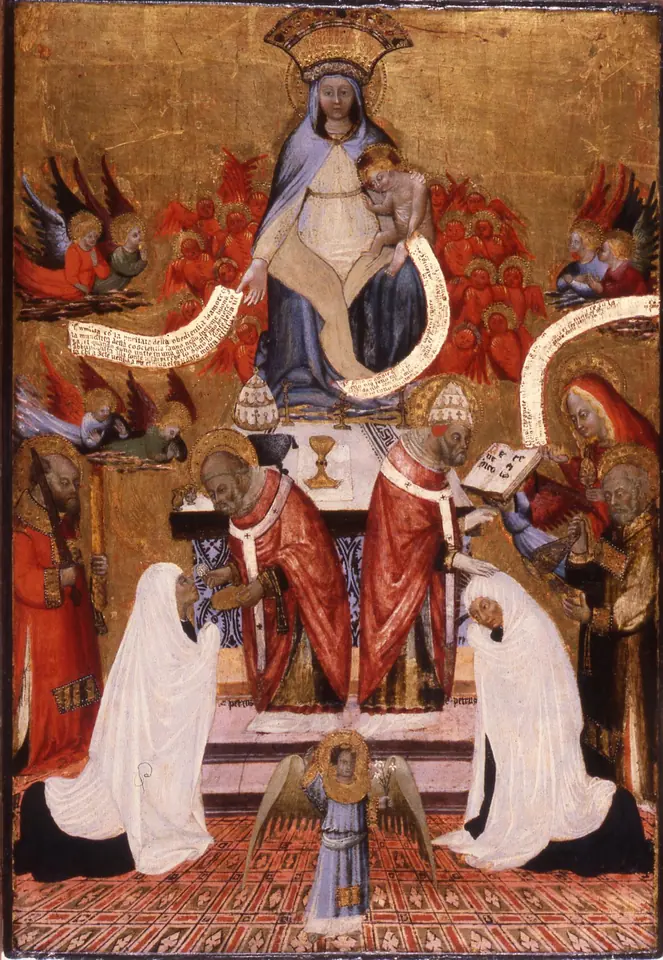
Popes from Eugene IV to Julius II took up her cause, but it was finished only under Paul V. The canonization was proclaimed in St. Peter's on May 29, 1608, and Paul V assigned March 9 as her feast. A few months after her death, her body had been moved into a monument in Santa Maria Nova. The church has been called Santa Francesca Romana ever since.
Why St. Frances of Rome is the patron saint of drivers and widows
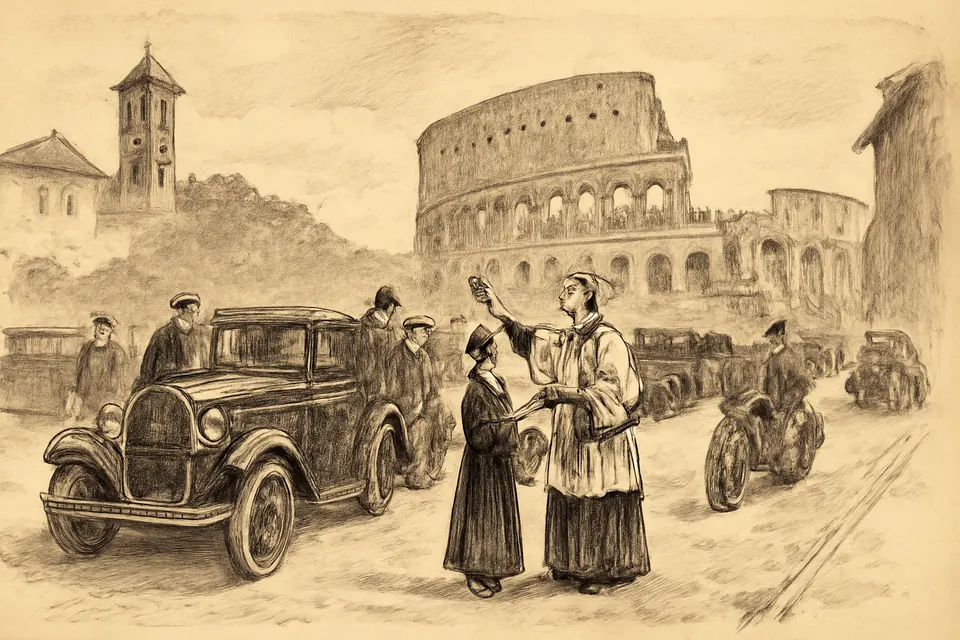
Drivers and motorists. It is one of the more surprising patronages in the calendar, but it comes straight from her angel. Her biographers say the angel's light let her see in the dark; later tradition, which Catholic Culture repeats, says he lit the road ahead of her with a lantern when she went out at night. When the automobile arrived, Italians looked for a patron for the new road, and in 1925 Pope Pius XI named Frances the patroness of motorists. Catholic Culture also gives a date of 1951 under Pius XII, so the exact year is uncertain. From 1928, Romans brought their cars on her feast to be blessed near her church by the Colosseum. Hundreds lined up every year until traffic restrictions on the Via dei Fori Imperiali stopped it; Wanted in Rome reports that a token blessing of a few cars now takes place on the first Sunday after the feast. See all the patron saints of drivers, including St. Christopher.
Widows and married women. She was a wife for forty years and a widow for four, and she is held up, in the words of the Mass, as "a singular model of both married and monastic life."
Benedictine oblates. Her community was the first great congregation of oblates attached to a Benedictine monastery, and lay oblates of Benedictine houses around the world still take her as a model. See all the patron saints.

Symbols of St. Frances of Rome in art
Frances is one of the easiest saints to recognize, because she almost never appears without her angel.
- The guardian angel: a child-sized angel standing beside her or kneeling before her, often in a white tunic or a deacon's dalmatic. It is the angel she described to her confessor. Antoniazzo Romano gives him a red tunic; the marble group over her tomb shows him kneeling.
- The black habit and white veil: the dress of a Roman widow and of her Oblates. Painters from the 15th century to the 17th dress her this way.
- A book: the Office of the Blessed Virgin that she prayed every day, and the story of the golden antiphon.
- A basket of bread or a sieve of grain: her charity to the poor and the miracle of the granary.
- The Christ Child in her arms: a vision in which the Virgin gave her the infant Jesus, painted by Gentileschi and by Carlo Maratta.
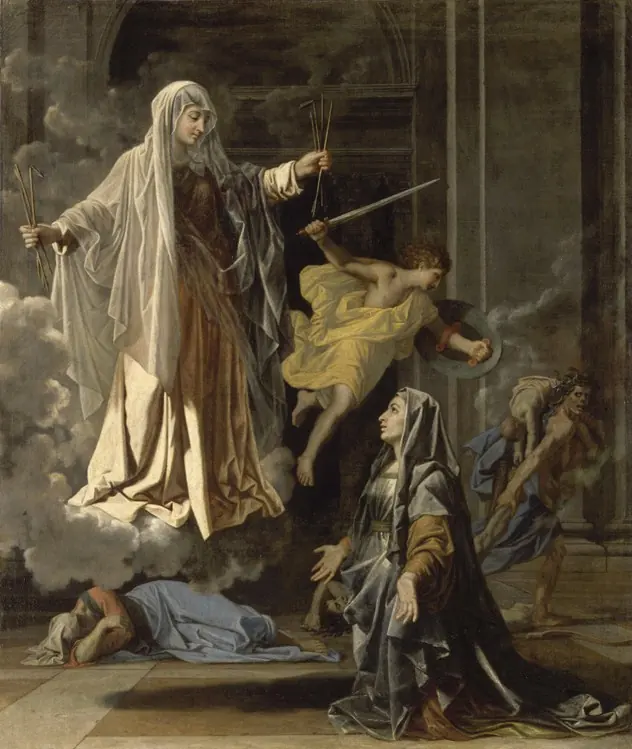
- Broken arrows: in Poussin's painting she holds the arrows of the plague, broken, as she appears in the sky to tell Rome the epidemic is over.
The earliest images were made by people who knew her. The Walters panel in Baltimore and its companion pieces in New York and Prague probably framed a portrait of her placed at her tomb around 1445. The frescoes at Tor de' Specchi, from 1468, are a picture book of her life painted for her own spiritual daughters. She belongs to the Latin Church, and there is no Eastern icon tradition for her.
Feast day and where St. Frances of Rome is honored
The Church celebrates her on March 9, an optional memorial in the General Roman Calendar. It nearly always falls in Lent, so in most years it is kept as a commemoration. See the feast day calendar.
Santa Francesca Romana, the Roman Forum
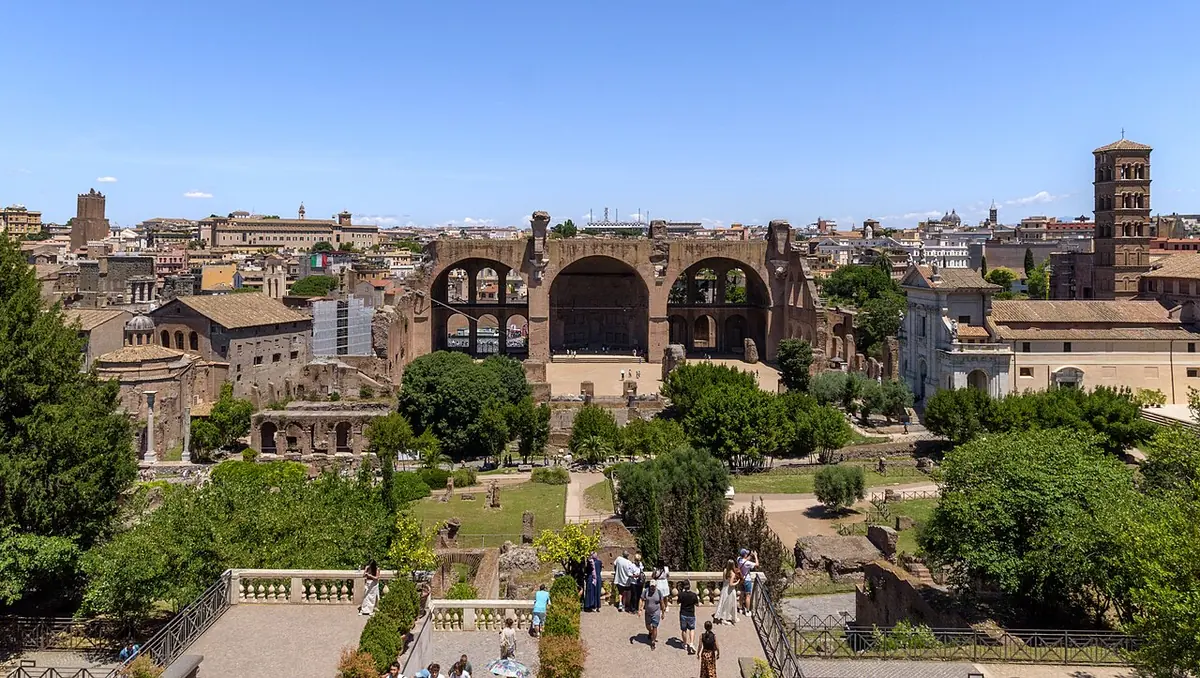
Her tomb is in the old church of Santa Maria Nova, which stands on the edge of the Roman Forum beside the ruins of the Temple of Venus and Rome, a short walk from the Colosseum. The church, now called Santa Francesca Romana, is served by the Olivetan Benedictines who guided her. Her remains rest in the confessio below the high altar, under a marble group of Frances with her angel. Its Romanesque bell tower is one of the landmarks of the Forum.

Tor de' Specchi
The Oblates still live in the monastery she founded on Via del Teatro di Marcello. Fullerton wrote in 1855 that the house was opened to visitors during the octave of her feast, and that Roman mothers brought their children to see the rooms where they had once been taught. When Benedict XVI came on March 9, 2009, he called the community a spiritual "lung" for the city and noted that its walls are "decorated with scenes from her life."
The Ponziani house in Trastevere
The palace where she lived as a wife and mother, and where she died, stands in Trastevere. Fullerton knew it as the Casa degli Esercizi Pii, a house for retreats, and it is still remembered as her home.
Prayer to St. Frances of Rome
We ask St. Frances to pray for wives and mothers, for widows, for parents who have buried a child, for all who drive, and for anyone trying to pray in the middle of a busy household.
The collect of her Mass
The Roman Missal gives this prayer for her memorial on March 9:
O God, who have given us in Saint Frances of Rome a singular model of both married and monastic life, grant us perseverance in your service, that in every circumstance of life we may see and follow you. Through our Lord Jesus Christ, your Son, who lives and reigns with you in the unity of the Holy Spirit, God, for ever and ever.
For the road
No traditional drivers' prayer comes from Frances herself. Catholic Culture suggests a simple practice for her feast: invoke her protection as you get into your car. "St. Frances of Rome, pray for us," with a prayer to your own guardian angel, is a good way to begin any trip. For blessings and prayers for the road, see the prayer for safe travel.
Let us ask St. Frances of Rome to help us find God where she found him: at the altar, and just as surely in the kitchen, the sickroom and the street.
Frequently asked questions
When is the feast day of St. Frances of Rome?
March 9, the day she died in 1440. Pope Paul V set the date when he canonized her in 1608. It is an optional memorial in the Roman calendar and usually falls in Lent, when it is kept as a commemoration.
Why is St. Frances of Rome the patron saint of drivers?
Because of her guardian angel. Her biographers say the angel was always visible to her and gave off a light by which she could read and write at night, and later tradition told of the angel lighting the road ahead of her. In 1925 Pius XI named her patroness of motorists (some sources give 1951 under Pius XII), and Romans began bringing their cars to be blessed near her church in 1928.
Did St. Frances of Rome really see her guardian angel?
That is what she told her confessor, Giovanni Mattiotti, who wrote down her life and visions, and witnesses repeated it in the processes for her canonization. According to her biographers, the angel looked like a child of about nine in a shining white robe. The Church never requires belief in a saint's private visions, but it canonized her with this account well known.
What is St. Frances of Rome the patron saint of?
Drivers and motorists, widows, Benedictine oblates and married women. Catholic Culture's list adds people ridiculed for their piety and protection against plague, and Benedict XVI called her "the most Roman of women Saints."
Was St. Frances of Rome married?
Yes. Her father married her at twelve, in 1396, to the young nobleman Lorenzo de' Ponziani, though she wanted to become a nun. They were married for about forty years and had at least three children, Battista, Evangelista and Agnese. Only after Lorenzo died in 1436 did she enter the community she had founded.
Who are the Oblates of St. Frances of Rome?
The community of women she gathered in 1425 at the Olivetan Benedictine church of Santa Maria Nova. They took a simple oblation instead of solemn vows and served God in prayer and works of charity. In 1433 they moved into the house at Tor de' Specchi, at the foot of the Capitoline Hill, where the Oblates still live.
Where is St. Frances of Rome buried?
In the church of Santa Maria Nova on the edge of the Roman Forum, now called Santa Francesca Romana after her. Her remains rest in the confessio below the high altar, beneath a marble group of the saint with her angel.
What is the prayer to St. Frances of Rome?
The Church's prayer for her feast is the collect of the Mass, which calls her "a singular model of both married and monastic life" and asks for perseverance in God's service. Drivers often add a simple invocation before setting out, "St. Frances of Rome, pray for us."
Keep exploring
- Patron saint pages
- Drivers
- Feast-day calendar
- Saints remembered in MarchSaint of the day
- More
- Saints A to ZPatron saints A to ZExplore every section
Sources
- Catholic Encyclopedia (1909): St. Frances of Rome
- Lady Georgiana Fullerton, The Life of St. Frances of Rome (1855), from the life by her confessor Giovanni Mattiotti, Project Gutenberg. the grain and wine, the hostage, Evangelista's appearance, the angel's description, the golden antiphon, her last words
- Alban Butler, Lives of the Saints (1866), March 9: St. Frances, Widow
- Benedict XVI, Visit to the Monastery of Saint Frances of Rome at Tor de' Specchi, March 9, 2009
- Catholic Culture: Optional Memorial of St. Frances of Rome, March 9 (collect, patronages, Pius Parsch excerpt). gives both Pius XI, 1925 and Pius XII, 1951 for the motorists' patronage
- Wanted in Rome: Rome patron saint of drivers, Santa Francesca Romana