St. Joseph Marello

St. Joseph Marello (1844–1895) was a priest of Asti in northern Italy who founded the Oblates of St. Joseph in 1878 and served as bishop of Acqui from 1889 until his death. He taught his brothers to imitate the hidden life of St. Joseph and to "be extraordinary in ordinary things." Pope John Paul II canonized him in 2001. His feast day is May 30.
Who was St. Joseph Marello?
St. Joseph Marello was a priest of Asti, in the wine hills of Piedmont, who founded the Oblates of St. Joseph in 1878 and spent the last six years of his life as bishop of Acqui. He lived only fifty years. Pope John Paul II, who canonized him in 2001, placed him in what he called "the golden period of holiness in the Piedmont area," alongside St. Joseph Benedict Cottolengo, St. Joseph Cafasso, St. John Bosco, St. Leonard Murialdo and Blessed Joseph Allamano.
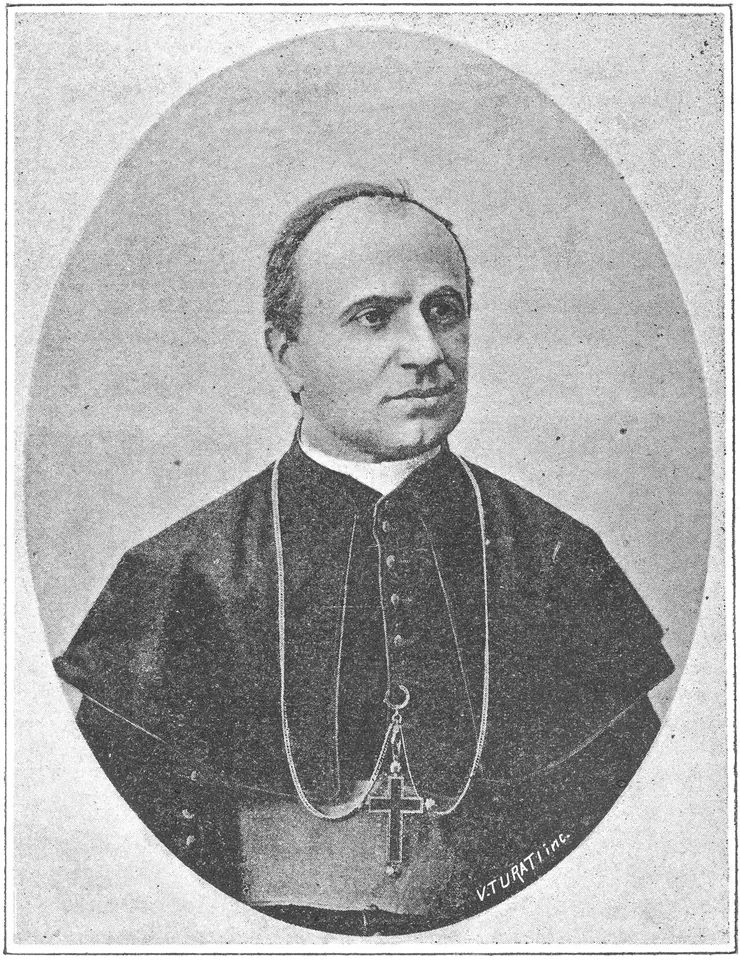
His motto, as the Pope recalled, was "to take care of the interests of Jesus." He found the model for that in St. Joseph, who guarded Jesus and Mary in silence and never drew attention to himself. Marello asked the same of his brothers. "Be extraordinary in ordinary things," he told them, and "be Carthusians inside your house and apostles outside."
The life of St. Joseph Marello
Childhood in Turin and San Martino Alfieri
Joseph was born in Turin on December 26, 1844, and baptized the same day in the parish of Corpus Domini. His father, Vincent, was a merchant from the village of San Martino Alfieri near Asti. His mother, Anna Maria Viale, died while the boys were small, and Vincent took Joseph and his younger brother, Victor, back to the village to be raised near their grandparents.
There Joseph served Mass for the parish priest every day. The Oblates' founding biography, written in 1919 by Fr. John Baptist Cortona, who knew him well, says that on a trip with his father to Savona the boy prayed at the Shrine of Our Lady of Mercy and loved it for the rest of his life. In October 1856, not yet twelve, he entered the seminary of Asti.

A detour, a fever and a promise
Italy was at war in 1859, and the seminary of Asti became a barracks. In 1862 his father, who wanted his clever eldest son in business, persuaded him to leave and enroll in a commercial school in Turin. Joseph obeyed, sadly.
In December 1863 he fell gravely ill with typhoid fever. Fr. Cortona tells how, in his fever, Joseph sensed Our Lady of Consolation, the patroness of Turin, assuring him that God wanted him back in the seminary. He asked his father whether he wanted him to recover, and told him he was sure he would get well if he were allowed to follow his vocation. "Then I give my consent, if only you recover," his father answered. Joseph improved at once and was back in the seminary in January 1864. This recovery is a reported grace from the saint's own life, told by his first biographer; the Church has never examined it.

Priest of Asti
He was ordained a priest on September 19, 1868. Bishop Carlo Savio of Asti made him his secretary, and in December 1869 the young priest went with him to Rome for the First Vatican Council and stayed until it was suspended in 1870. There Cardinal Gioacchino Pecci, the future Pope Leo XIII, came to know him.
Back in Asti he became chancellor of the diocese and a canon of the cathedral. He heard confessions for hours, gave spiritual direction, ran evening catechism classes for young workers, and took over a home for the chronically ill and elderly poor that had run out of money. Twice he asked to leave it all for the silence of a Trappist monastery. Twice Bishop Savio told him that God wanted something else from him.
The Oblates of St. Joseph
That something else began on March 14, 1878. In a few rooms of the Michelerio charitable institute in Asti, Canon Marello gathered a handful of young laymen to live in common, pray and serve, and called them the Company of St. Joseph. They were desperately poor. Their first work was caring for the old and the sick and teaching orphan boys. In time the group became the Oblates of St. Joseph, priests and brothers devoted to the education of the young and to helping parish priests. The Holy See gave the congregation its full approval in 1909, fourteen years after his death.

What he wanted most from them was St. Joseph's hiddenness. The Oblates' own account says that for years many people in Asti who knew the Company of St. Joseph had no idea Canon Marello had founded it.
Bishop of Acqui
In 1889 Leo XIII named him bishop of Acqui, a large rural diocese south of Asti. The Dicastery for the Causes of Saints records that the Pope wanted to give that diocese "a pearl of a bishop." He was consecrated in Rome on February 17, 1889, and took possession of his diocese that June.
In six years he visited every parish of the diocese, many of them high in the hills and hard to reach. He wrote pastoral letters on peace, penance, the catechism and the Christian education of children in the family, preached parish missions, and worked to bring his clergy and people together. He kept his Oblates in Asti close to his heart through all of it, at a time when their future was uncertain.

His death in Savona
In May 1895, though already unwell, he kept a promise to preach in Savona at the third centenary of the death of St. Philip Neri. On May 27 he spent a morning in prayer at the Shrine of Our Lady of Mercy outside the city, the place he had loved since boyhood. He collapsed that day and died in Savona on Thursday, May 30, 1895, at about six in the evening. Fr. Cortona writes that the bishop of Asti, Giuseppe Ronco, called him "a martyr of charity."

He was buried in the cemetery of Acqui. On June 30, 1923, his body was brought to the mother house of the Oblates in Asti.
The miracles of St. Joseph Marello
Two miracles have been approved by the Church through his intercession.
- The cure of Aldo Falconetti (approved, 1993). In 1944 a young Oblate seminarian lay dying of tubercular meningitis and had been given the last rites. His brothers prayed to their founder and gave Aldo a holy card and a relic of Marello. By the Oblates' account he woke the next morning feeling well and was found completely cured. The decree recognizing the miracle came on April 2, 1993, and John Paul II beatified Marello in Asti on September 26, 1993.
- The cure of Alfredo and Isila Chávez León (approved, 2000). Two chronically malnourished children in Ranquish, a village in the Ancash region of Peru where the Oblates work, were cured at the same moment of bronchopneumonia with high fever, breathlessness and cyanosis. The Holy See declared the cure "sudden, complete and enduring" by decree on December 18, 2000. John Paul II canonized him on November 25, 2001, the Solemnity of Christ the King.
The favors that people report through his prayers today, and the cure of his own typhoid fever in 1863, are reported, not formally examined.
St. Joseph Marello and the Oblates of St. Joseph
Marello is not named patron of a cause or a trade. The Oblates of St. Joseph honor him as their founder and father, and in their prayers call him "apostle of youth" and "father of the poor." The congregation sent its first missionaries to the Philippines in 1915 and now works in Italy, the United States, Mexico, Peru, Bolivia, Brazil, Poland, India and Africa, running parishes, schools and youth ministries. For other saints who watch over the young, see our patron saints page and the life of his fellow Piedmontese St. Dominic Savio.
Symbols of St. Joseph Marello in art
St. Joseph Marello lived in the age of photography, and his images follow the photographs taken of him as bishop. You will know him by:
- Purple choir dress and a pectoral cross: a bishop's skullcap, mozzetta and cassock, with a gold cross on a cord or chain, as in the 1889 portrait near the top of this page. Holy cards often color it in deep red or purple with a soft halo.
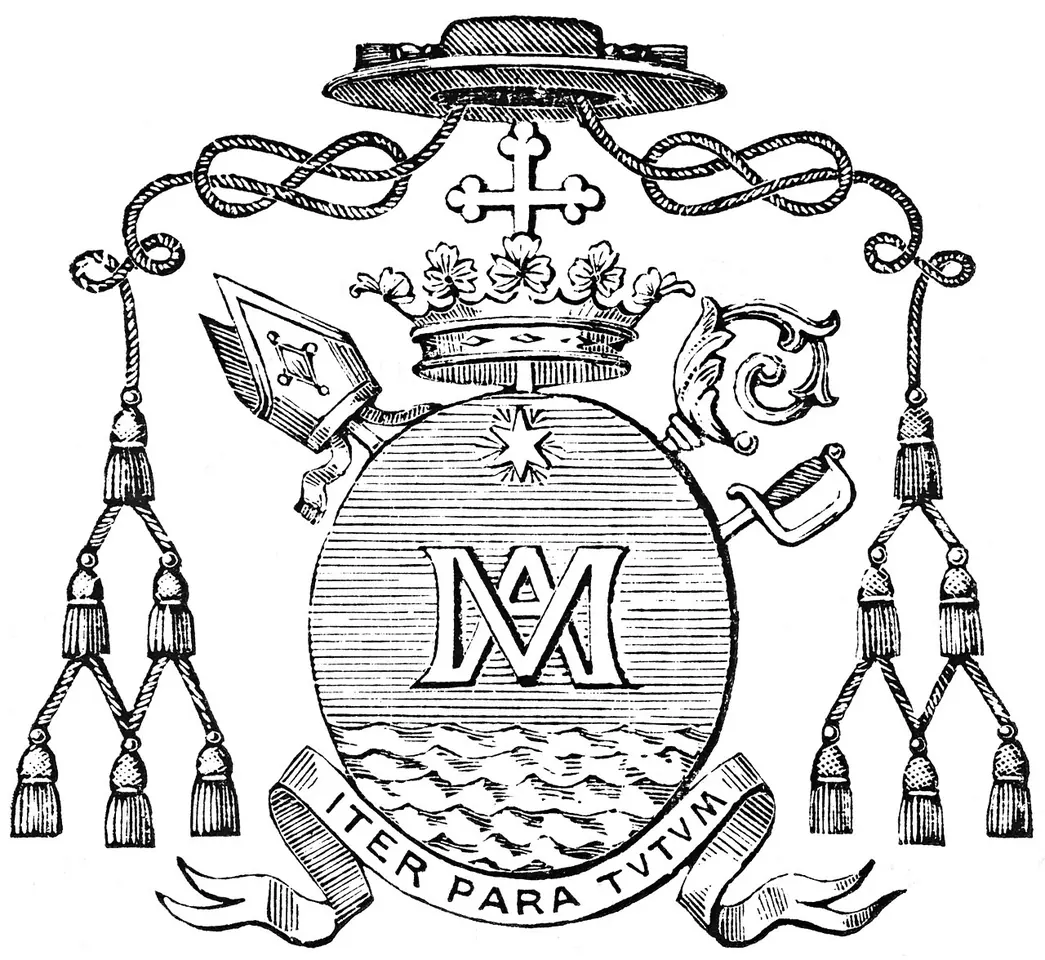
- His coat of arms: the shield he chose in 1889 shows an interlaced M and A, for Mary, above the waves under a star, with the words Iter para tutum, "make safe our way," from the Marian hymn Ave Maris Stella. The same hymn greets Mary as the Star of the Sea.
- St. Joseph with the Child Jesus: churches of the Oblates often place him near an image of St. Joseph, whose hidden life he took as the rule of his own.
- Boys and young men around him: paintings for Oblate schools and parishes show him teaching or blessing the young.
Feast day and the Shrine of St. Joseph in Asti
His feast day is May 30, the day he died in Savona. He is not on the General Roman Calendar, so his memorial is kept mainly by the Oblates of St. Joseph, the people of Asti and Acqui, and Oblate parishes around the world. You can see his neighbors on the calendar on our feast days page.
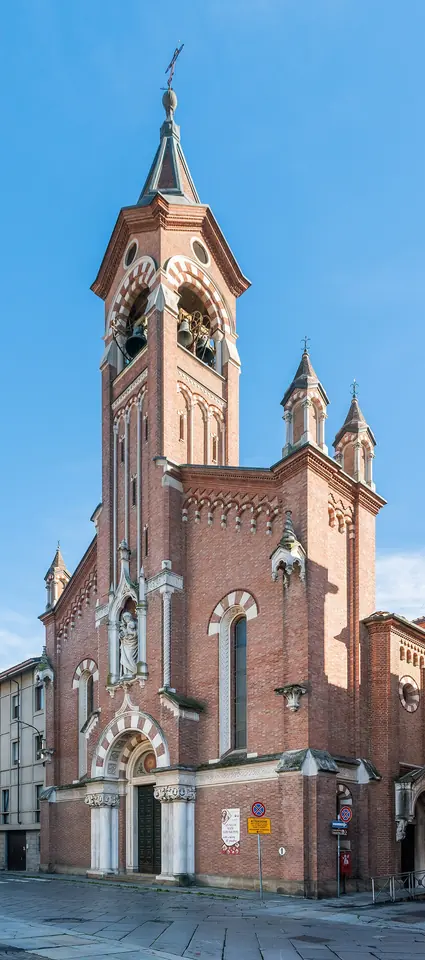
His tomb is in Asti, at the Shrine of St. Joseph (Santuario di San Giuseppe) beside the Oblates' mother house on Corso Alfieri. Pilgrims come there to pray at his tomb and to honor St. Joseph, the patron he gave his sons.

Prayer to St. Joseph Marello
The Oblates of St. Joseph publish several prayers to their founder. This short one, from the Oblates' website, asks his intercession for a special intention:
We thank you, O Lord, for giving your Church Saint Joseph Marello, apostle of youth, father of the poor, a meek and zealous priest and bishop. Grant us the grace we seek with faith through the intercession of your faithful servant, a great devotee of Joseph, Husband of Mary; let his example help us to seek You above all else and the good of our neighbor. Amen.
The Oblates also pray a three-part prayer "through Jesus, Mary and Joseph," recalling his devotion to the Sacred Heart, to Our Lady of Sorrows and to St. Joseph, each part followed by an Our Father, a Hail Mary and a Glory Be. Let us ask St. Joseph Marello to pray for us, that like him we may serve the interests of Jesus in the ordinary work of each day.
Frequently asked questions
Who was St. Joseph Marello?
An Italian priest and bishop, born in Turin in 1844, who founded the Oblates of St. Joseph in Asti in 1878 to serve young people and the poor in imitation of St. Joseph. Pope Leo XIII made him bishop of Acqui in 1889. He died at Savona on May 30, 1895, at fifty, and was canonized on November 25, 2001.
When is the feast day of St. Joseph Marello?
May 30, the anniversary of his death in 1895. It is his memorial as listed by the Dicastery for the Causes of Saints. He is not on the General Roman Calendar, so his feast is kept mainly by the Oblates of St. Joseph, their parishes and schools, and the Church in Piedmont.
What miracles were approved for St. Joseph Marello?
Two, both approved. For his beatification, the 1944 cure of an Oblate seminarian, Aldo Falconetti, from tubercular meningitis (decree of April 2, 1993). For his canonization, the simultaneous cure of two malnourished Peruvian children, Alfredo and Isila Chávez León, from bronchopneumonia with high fever (decree of December 18, 2000).
Who are the Oblates of St. Joseph?
The congregation of priests and brothers he founded in Asti on March 14, 1878, first called the Company of St. Joseph. The Holy See approved it in 1909. The Oblates spread devotion to St. Joseph, educate the young and help in parishes, and today work in Italy, the Philippines, the United States, Latin America, Poland, India and Africa.
Where is St. Joseph Marello buried?
In Asti, at the Shrine of St. Joseph beside the mother house of his Oblates. He was first buried in the cemetery of Acqui in 1895; his body was moved to Asti on June 30, 1923.
Keep exploring
Sources
- Holy See: Giuseppe Marello (1844–1895), canonization biography. The canonization miracle, the decrees of 1978 and 2000, and the canonization date
- John Paul II, Homily for the canonization of four blesseds (November 25, 2001). His sayings "Be extraordinary in ordinary things" and "Be Carthusians inside your house and apostles outside"
- Dicastery for the Causes of Saints: Giuseppe Marello. Beatification and canonization dates, memorial on May 30, Leo XIII's "pearl of a bishop," and the 1993 beatification homily in Asti
- Oblates of St. Joseph: St. Joseph Marello, founder (biography and timeline). The beatification miracle of Aldo Falconetti and the transfer of his body to Asti in 1923
- John Baptist Cortona, O.S.J., Brief Memories of the Life of Joseph Marello (1919), chapter 1. His typhoid fever in 1863 and his return to the seminary
- John Baptist Cortona, O.S.J., Brief Memories of the Life of Joseph Marello (1919), chapter 12. His last days in Savona and his death
- Oblates of St. Joseph: Prayer to St. Joseph Marello for a special intention