St. Ephigenia of Ethiopia (St. Iphigenia)

St. Ephigenia of Ethiopia, also called St. Iphigenia, was, according to the Roman Martyrology, a virgin baptized and consecrated to God by the apostle St. Matthew. The Golden Legend tells how a king's fire meant for her house turned on his own palace, and Spain, Portugal and Brazil came to invoke her against fire. Her feast is September 21.
Who was St. Ephigenia of Ethiopia?
St. Ephigenia of Ethiopia, more often written Iphigenia, is the king's daughter in the story of the apostle St. Matthew. Tradition says Matthew baptized her, and she gave her life to God as a virgin and led a community of women consecrated to Christ. The Roman Martyrology keeps her memory on September 21, St. Matthew's own day, in a single sentence:
In Ethiopia, St. Iphigenia, virgin, who being baptized and consecrated to God by the blessed apostle Matthew, ended her holy life in peace.
That is everything the Church's martyrology says, and nothing older or more historical survives. Her story is a legend in the old sense, a holy tale handed down with the life of an apostle. Yet she became a beloved saint in Spain, Portugal and especially Brazil, where Black Catholics took the African princess as their own and asked her protection against fire.
Which Ethiopia?
The ancient writers who say Matthew preached in "Ethiopia" did not all mean the country in Africa. The Catholic Encyclopedia notes that the Ethiopia of the Matthew tradition was a land south of the Caspian Sea. Later devotion, though, took Iphigenia to be an African princess, and the images made for her in Portugal, Spain and the Americas show her as a Black woman. This is the saint people love and pray to.
The legend of Iphigenia
The fullest form of her story is in the Golden Legend, the thirteenth-century book of saints' lives by Jacobus de Voragine, inside its life of St. Matthew. In Caxton's English translation of 1483, Matthew comes to Ethiopia, confounds two sorcerers and raises the king's son from the dead. The king, called Egippus, and his people are baptized, and the apostle "hallowed to God Ephigenia the king's daughter" and made her "mistress and governess of more than two hundred virgins."
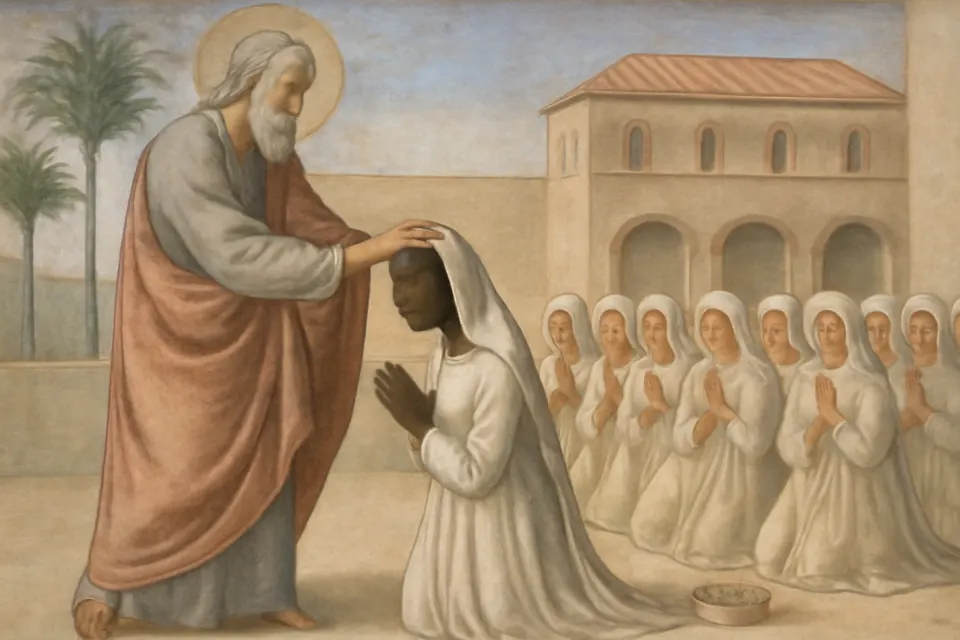
After Egippus died, his successor Hirtacus wanted Ephigenia for his wife and promised Matthew half his kingdom if he would persuade her. Instead, Matthew preached before the king and declared that a woman already promised to the heavenly King could not be taken by an earthly one. He blessed Ephigenia and the virgins kneeling before him. Soon after, the king's man killed Matthew at the altar.
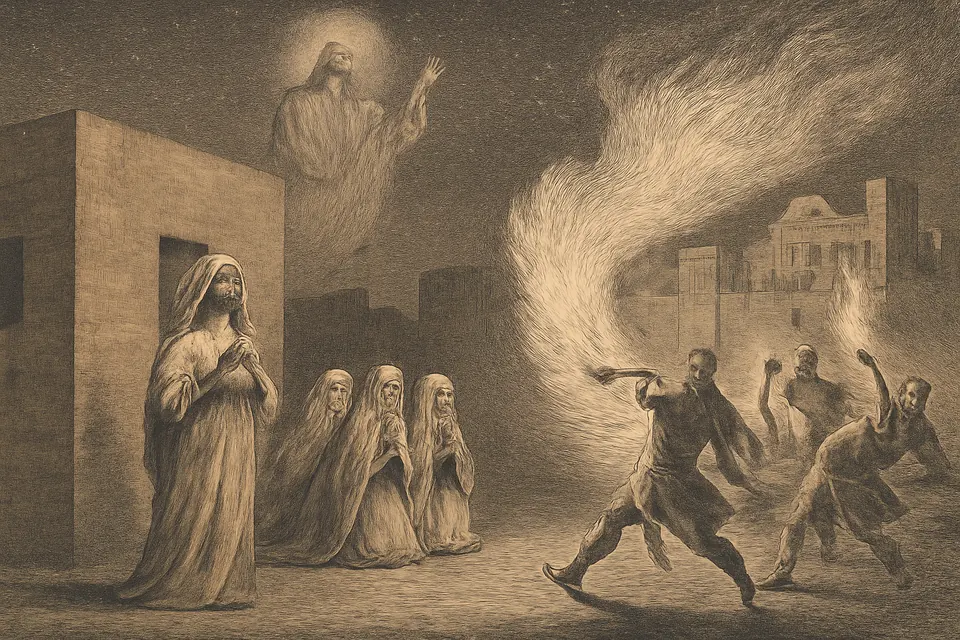
Hirtacus then sent matrons and enchantresses to change her mind, and when they failed, he surrounded her house "with a right great fire, for to burn her and all the other virgins." The legend says the apostle appeared and put out the fire around the house, and the flames leaped instead to the king's palace and burned all that was in it. Afterward Ephigenia's brother, whom Matthew had baptized, reigned seventy years.
From the martyrology to Brazil
Petrus de Natalibus, in a catalog of saints printed in 1493, gave Iphigenia her own entry, and Cardinal Baronius placed her in the Roman Martyrology on September 21 in the edition of 1583, according to the historians Rafael Castañeda García and Bernard Vincent.
Her great popularity came later. In 1735 and 1738 the Portuguese Carmelite José Pereira de Santana published Os dous Atlantes da Ethiopia, on Iphigenia and St. Elesbaan, the Ethiopian king also known as Kaleb. He presented both as Carmelite saints, a claim Castañeda García and Vincent note rested on weak, apocryphal sources, and he called Iphigenia the advocate against fires in buildings. Carmelites in Spain took up the same devotion.
Brotherhoods of Black Catholics made her one of their own. Castañeda García and Vincent found the most images of her in Brazil, above all in Minas Gerais, and others in Andalusia, Portugal, Mexico, Peru, Cuba and Central America. In Rio de Janeiro the brotherhood of Santo Elesbão and Santa Efigênia had statutes by 1740, the Brazilian historian Anderson de Oliveira records.

Miracles and legends
- Traditional: her baptism and consecration by St. Matthew, from the Roman Martyrology and the Golden Legend.
- Traditional: the fire that spared her house and burned the king's palace, from the Golden Legend.
Why St. Ephigenia is invoked against fire
The reason is the fire in her legend. Because God protected her and her sisters from the flames, Christians in Portugal, Spain and Brazil have asked her to protect their homes, churches and workplaces from fire. Santana's title gave her the name "advocate against the fires of buildings."
Symbols of St. Ephigenia in art
Santana's book set the pattern for her images in the Portuguese world. Castañeda García and Vincent describe it:
- A church in flames in her left hand: the fire of the legend, and her protection against fire.
- A cross in her right hand: her faith and her consecration.
- A royal crown at her feet: the princess who gave up a throne and a royal marriage for Christ.
- A Carmelite habit: brown with a white mantle, from the Carmelite tradition.
- A Black face: she is the African princess of the legend.
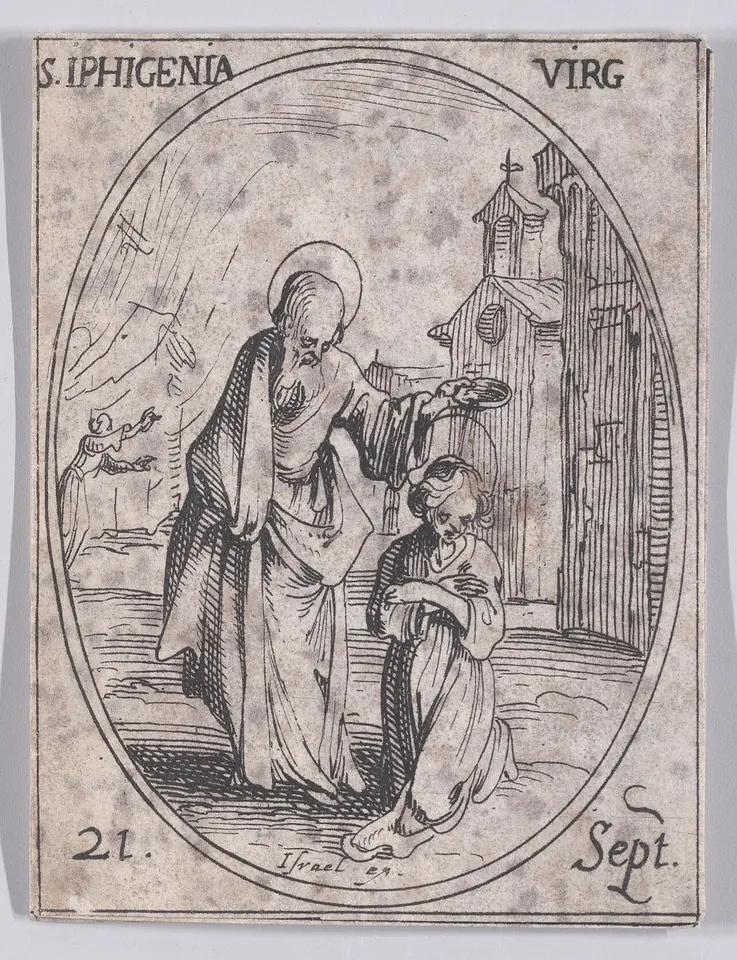
Other images give her a martyr's palm, a book, a lily, a ring or a rosary. In older European prints such as Callot's, she simply kneels before St. Matthew.
Feast day and prayer
We keep her memory on September 21, together with St. Matthew; see our feast day calendar. We have found no traditional English prayer to her. Let us ask in our own words: St. Ephigenia, who gave yourself wholly to Christ and were kept safe from the flames, pray for us, protect our homes from fire, and pray for all who are forced to choose between Christ and the powers of this world.
Frequently asked questions
Who was St. Ephigenia of Ethiopia?
A first-century virgin known from the legend of St. Matthew. The Roman Martyrology says she was "baptized and consecrated to God by the blessed apostle Matthew" and "ended her holy life in peace." No historical record of her life survives beyond that tradition.
When is the feast of St. Ephigenia (Iphigenia)?
September 21, the same day as St. Matthew.
What is St. Ephigenia the patron saint of?
In Spain, Portugal and Brazil she is invoked against fire, especially fires in houses and buildings, because of the legend that the fire set to burn her convent turned instead on the king's palace.
Why is St. Ephigenia shown holding a burning church?
The burning church recalls the fire in her legend that could not harm her and her sisters. In the Portuguese and Brazilian images she usually holds it in one hand and a cross in the other, with a crown at her feet.
Keep exploring
- Patron saint pages
- Firefighters
- Feast-day calendar
- Saints remembered in SeptemberSaint of the dayWhat saint is my birthday?
- More
- Saints A to ZPatron saints A to ZExplore every section
Sources
- The Roman Martyrology (English edition, 1916), Internet Archive. September 21, the entry quoted in full
- The Golden Legend, Caxton's translation: Life of St. Matthew (Christian Iconography). Her consecration, the two hundred virgins, Hirtacus and the fire
- Catholic Encyclopedia (1911): St. Matthew. The "Ethiopia" of the Matthew tradition placed south of the Caspian Sea
- Rafael Castañeda García and Bernard Vincent, Las representaciones de santa Ifigenia en las monarquías ibéricas, siglos XVII-XVIII, Atlante 15 (2021). Her place in Baronius's martyrology, the Carmelite claims of José Pereira de Santana, her iconography and her cult in Spain, Portugal and the Americas
- Anderson José Machado de Oliveira, Devoção e identidades: significados do culto de Santo Elesbão e Santa Efigênia no Rio de Janeiro e nas Minas Gerais no Setecentos, Topoi 7 (2006). The Black brotherhoods of Santo Elesbão and Santa Efigênia in Rio de Janeiro and Minas Gerais