St. Felix of Valois, Hermit and Co-Founder of the Trinitarians

St. Felix of Valois (1127–1212) was a French hermit who lived in the forest of Cerfroid, near Meaux, and with St. John of Matha founded the Order of the Most Holy Trinity (the Trinitarians) to ransom Christians held captive. Pope Innocent III approved the order in 1198. The Roman Martyrology remembers him on November 4, and he is a patron of captives.
Who was St. Felix of Valois?
St. Felix of Valois was a French hermit of the twelfth century who, already an old man, became one of the two founders of the Trinitarians, the religious order that crossed the Mediterranean to buy back Christians held as captives. He prayed for years in the forest of Cerfroid, in the Diocese of Meaux. There a younger priest, St. John of Matha, came to him with a plan, and together they carried it to the pope. Felix died at Cerfroid on November 4, 1212, at about eighty-five, and the Roman Martyrology still names him on that day.

We should be honest about how little is certain. When the Church reformed its calendar in 1969, it moved his feast to particular calendars because, in the words of the official commentary, the documents about his life present many historical difficulties. His role as co-founder is the constant tradition of his order, and his cult is very old: Butler cites an act showing his feast was already kept throughout the Diocese of Meaux in 1219.
The life of St. Felix of Valois
The hermit of Cerfroid
Tradition gives his birth year as 1127. The name "of Valois" may point to the province where he was born. Some writers made him a grandson of Count Hugh of Vermandois, of the royal line, and said he changed his baptismal name Hugh to Felix out of humility; Butler reports the claim and notes that others objected to it. What all the accounts agree on is that he gave up his property and went into the woods of Cerfroid to live alone in prayer and penance.
John of Matha and the plan to ransom captives
John of Matha, a young doctor of theology from Provence, had heard of the hermit's holiness and came to live under his direction. John told him of a plan he had received at his first Mass: an order dedicated to the Holy Trinity that would ransom Christians held captive. Butler says Felix was about seventy and offered himself at once. After three days of fasting and prayer, the two walked to Rome in the depth of winter and arrived in January 1198, early in the reign of Pope Innocent III.
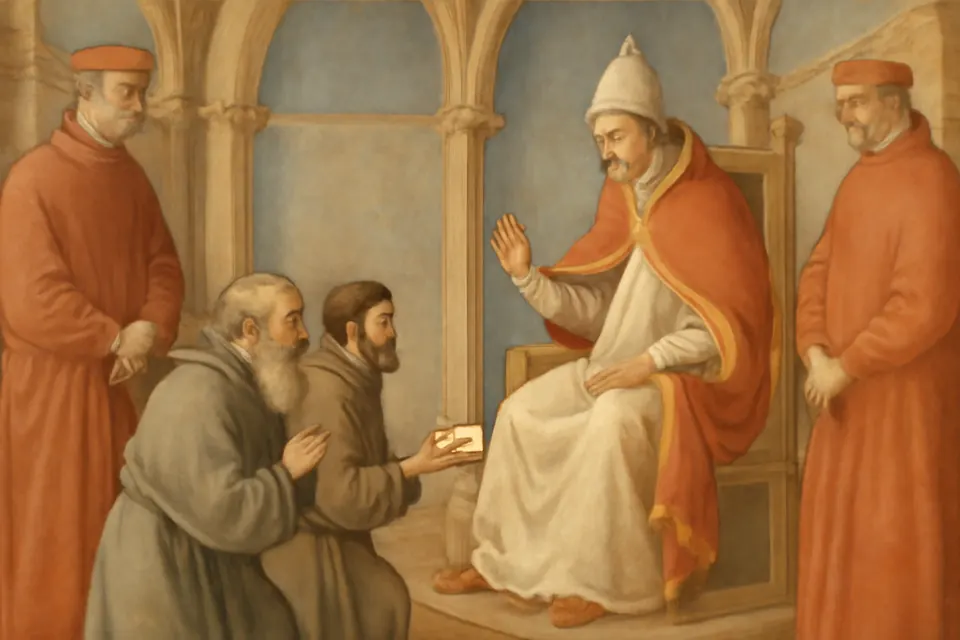
The pope received them with great kindness and lodged them in his palace. After consulting his cardinals, he approved the new institute as the Order of the Holy Trinity for the Redemption of Captives, and he confirmed its rule on December 17, 1198. A third of the order's income was set aside to pay ransoms.
Founder of houses in France
John went to Rome to found a house there, and Felix stayed in France. King Philip Augustus authorized the order, and Margaret of Blois gave land in the forest where the hermitage stood. There Felix built Cerfroid, the mother house of the order. Butler and the Catholic Encyclopedia's life of Felix credit him with a house in Paris at the church of St. Mathurin, which is why the French long called Trinitarians "Mathurins," though the same encyclopedia's article on the order dates that house to 1228, after his death. Each house divided its income into three parts: one for the brothers, one for the poor and one for ransoming captives.

The miracles and legends of St. Felix of Valois
No miracle of Felix has been formally investigated by the Church. Two stories, both traditional, shaped how he is remembered:
- The stag of Cerfroid. A Trinitarian legend tells that a white stag with a red and blue cross between its antlers came to the spring where Felix and John prayed. The cross matched the one the order wears.
- Our Lady at matins. Butler relates that shortly before his death Felix came to the choir before the other brothers and found the Blessed Virgin there with angels, singing the office. He adds that painters often showed this vision.

Why St. Felix of Valois is the patron of captives
Felix gave his last years to an order whose whole reason for being was to free prisoners. Its friars carried ransom money to the Barbary coast of North Africa, and when the money fell short, some were held there as hostages themselves. So we ask his prayers for prisoners and hostages, for people trapped in slavery or trafficking, and for all who live in any kind of bondage. His work runs in the same channel as that of St. Peter Nolasco and St. Raymond Nonnatus of the Mercedarians.
Symbols of St. Felix of Valois in art
Felix is easy to recognize once we know the signs:
- An old man with a long white beard, since he was about seventy when the order began.
- The white habit with a red and blue cross, the Trinitarian cross. Butler notes that the English called the Trinitarians "Red Friars" for it, though their habit is white.
- A stag with a cross between its antlers, from the legend of Cerfroid.
- Chains, shackles or kneeling captives, for the order's work of ransom.
- A book and a rosary, for his life of prayer.
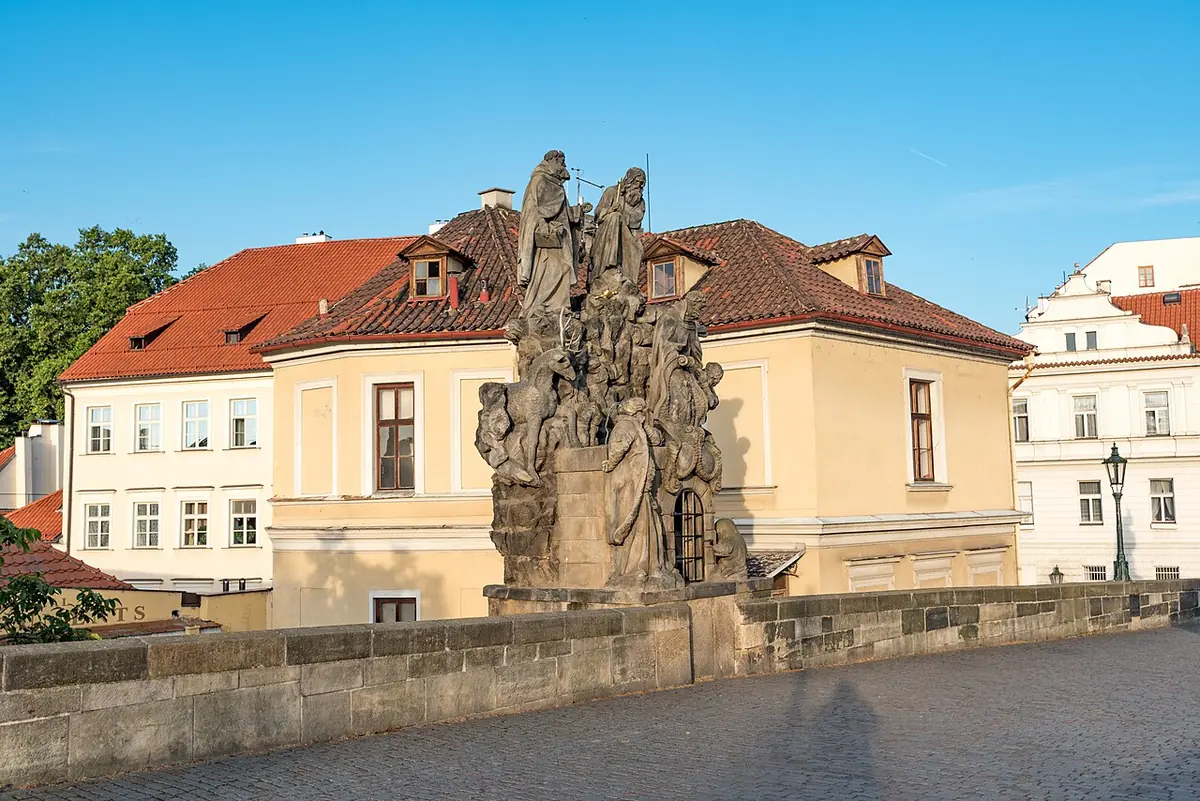
He often appears with John of Matha. On the Charles Bridge in Prague, Ferdinand Maximilian Brokoff's baroque group of 1714 shows them with St. Ivan above a cave where a Turkish guard watches over chained Christian prisoners.
Feast day and where he is honored
The Roman Martyrology names him on November 4. Pope Innocent XI moved his feast to November 20 in 1679, and it stayed there in the universal calendar until 1969. Trinitarian houses around the world still keep his memory, and Cerfroid, where he lived and died, remains the cradle of the order. See our feast days calendar and the patron saints list.

Prayer to St. Felix of Valois
The traditional Roman Missal had a collect for his feast. It thanks God for calling Felix out of the desert to the work of ransoming captives and asks that, through his intercession, we may be freed from the captivity of our sins and brought to our heavenly homeland. The Latin and an English rendering are published on the Divinum Officium site.
Let us pray it for every captive, and for ourselves. St. Felix of Valois, pray for us.
Frequently asked questions
When is the feast of St. Felix of Valois?
November 4 in the Roman Martyrology, the day he died in 1212. From 1679 to 1969 his feast was kept on November 20 in the General Roman Calendar; since 1969 it belongs to particular calendars, above all that of the Trinitarian Order.
What order did St. Felix of Valois found?
The Order of the Most Holy Trinity and of the Captives, the Trinitarians, which he founded with St. John of Matha. Pope Innocent III approved it, and he confirmed its rule on December 17, 1198. Its first work was to ransom Christians held captive.
Why is St. Felix of Valois shown with a stag?
A Trinitarian legend says a white stag with a red and blue cross between its antlers appeared to Felix and John of Matha at a spring in the forest of Cerfroid. The colors are those of the Trinitarian cross, and the stag became his usual emblem in art. The story is traditional, not documented history.
Was St. Felix of Valois a member of the French royal family?
Some old writers said he descended from a royal branch of the house of Valois and was baptized Hugh, but Alban Butler noted that others disputed this pedigree. The more modest view is that he was simply called 'of Valois' from the region where he was born.
Keep exploring
Sources
- Catholic Encyclopedia (1909): St. Felix of Valois. Cerfroid, Innocent III, the rule of December 17, 1198, Urban IV, Alexander VII in 1666, and Innocent XI in 1679
- Alban Butler, Lives of the Saints, vol. XI (1866): St. Felix of Valois, Confessor. The royal-descent claim and its critics, the vision at matins, the feast kept at Meaux, and the Paris house of St. Mathurin
- Catholic Encyclopedia (1912): Order of Trinitarians. The threefold division of income, the Paris house of St. Mathurin dated 1228, and friars held as hostages
- Calendarium Romanum (1969), commentary on November 20. Why his memorial was left to particular calendars
- The Roman Martyrology (1916 English edition), November 4
- Divinum Officium: Roman Missal propers for St. Felix of Valois (November 20). The collect of his feast in the traditional Missal, in Latin and English