Blessed Columba of Rieti, Dominican Peacemaker of Perugia
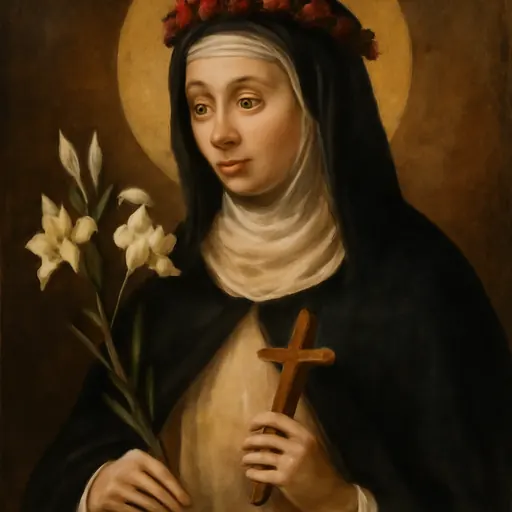
Blessed Columba of Rieti (1467–1501) was an Italian mystic of the Dominican Third Order who modeled her life on St. Catherine of Siena. Leaving Rieti in 1488, she founded the convent of St. Catherine in Perugia, known as the convent of the "Colombe," worked to make peace between the city's warring families, and offered her life for Perugia in the plague of 1494. She is honored as a protector of Perugia and Rieti, and her feast is May 20.
Who was Blessed Columba of Rieti?
Blessed Columba of Rieti was a young Dominican tertiary of the Italian Renaissance who tried, in everything, to be another Catherine of Siena. She fasted, prayed for hours in ecstasy, and lived on the Eucharist. Then, at twenty-one, she walked out of her hometown by night and went to Perugia, a city at war with itself, where the people received her as a living saint. She founded a community of sisters there, urged the feuding families toward peace, and offered her life for the city when plague came in 1494. She died in Perugia on May 20, 1501, at thirty-four.

The life of Blessed Columba of Rieti
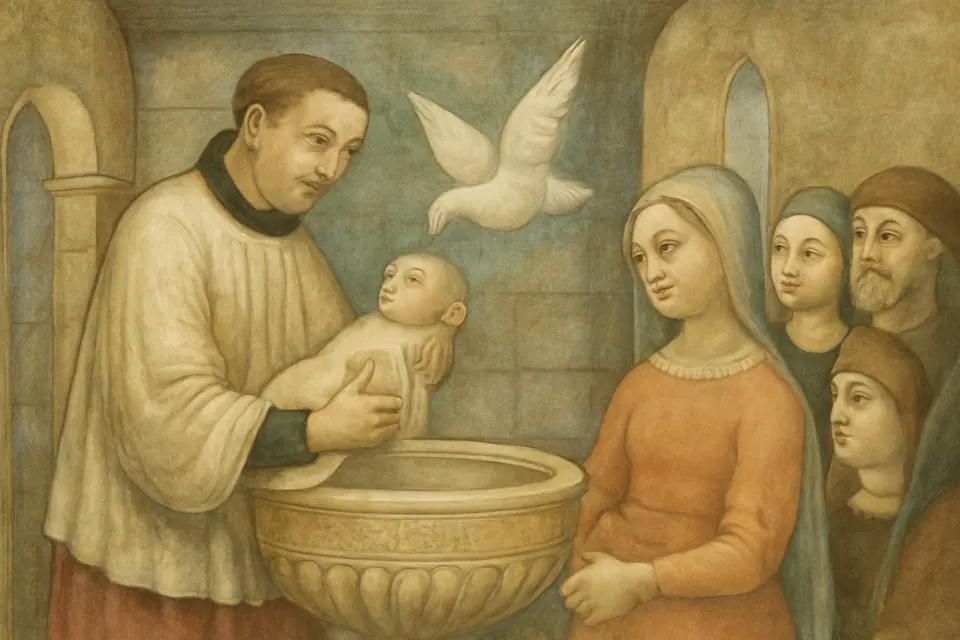
The dove at the font
She was born in Rieti on February 2, 1467, and baptized Angelella. Her confessor and first biographer, the Dominican Sebastiano Bontempi, wrote her life in Latin soon after her death, and it remains the main source for her story. He tells that a white dove flew down over the baby at the font, and from that day everyone called her Colomba, "dove." Historians have recently questioned even her surname: the Dizionario Biografico degli Italiani notes that her father may have been Angelo Antonio Petrozzi, her mother's second husband, rather than a Guadagnoli.
Catherine of Siena as her model
As a little girl she spent time with the Dominican tertiaries who lived near the friars' church in Rieti, and learned to read from a newly printed life of St. Catherine of Siena. That book shaped her whole life. When her parents arranged a noble marriage for her at about twelve, she did what Catherine had done: she cut off her hair and appeared that way before the young man. On Palm Sunday 1486 she received the habit of the Dominican Third Order, still living at home.
Flight to Perugia
In 1488 she slipped away from Rieti at night. Bontempi tells that she first shared a last supper with twelve close friends and washed their feet. The journey was hard. At Foligno the magistrates grew suspicious of the young woman who wandered and did not eat, and her father and the prior of Rieti caught up with her. They expected her to go on to Siena. She chose Perugia.
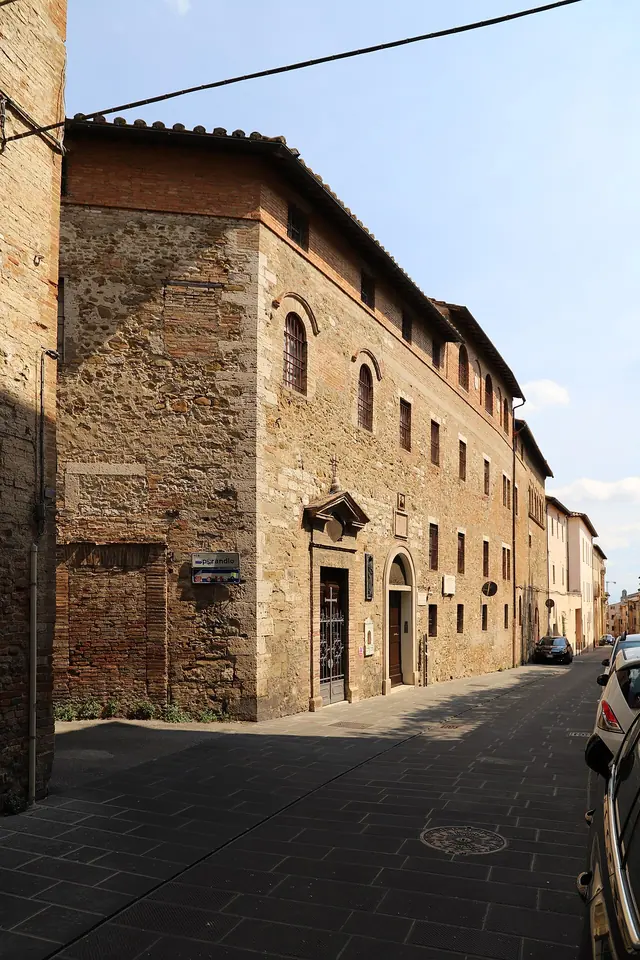
Perugia was then torn by the fighting between the Baglioni and the Oddi families. A crowd welcomed her at the gate in September 1488, and the city soon refused every attempt by Rieti to get her back. Noble young women joined her, and she made her profession on January 1, 1490, in the church of San Domenico. Her community, the convent of St. Catherine, was something new: sisters who lived a common life of prayer under the Dominican Third Order's rule, without enclosure, so they could go out into the city. By 1497 there were forty of them. Perugians called the house the convent of the "Colombe," the doves.
Plague, a pope and hard years
When plague struck Perugia in the spring of 1494, the magistrates asked her advice. She proposed a painted banner showing the city sheltered under the mantles of St. Dominic and St. Catherine, and it was carried in procession for three days from May 4. She nursed the sick, offered herself to God for the city, caught the disease and recovered.

In 1495 Pope Alexander VI, passing through Perugia, met her and questioned her at length. He was irritated at first when she fell into ecstasy during the audience, but he came away convinced of her holiness and granted an indulgence for her convent. The Catholic Encyclopedia passes on the tradition that she also told him boldly of his own sins.
Her last years were not easy. Rumors spread that her holiness was a pretense or worse, commissions from her order and from Rome examined her, and for a time she was treated as an impostor and removed as prioress. She was never found guilty. She died at vespers on Ascension Day, May 20, 1501, and the city paid for her funeral.
The miracles of Blessed Columba of Rieti
- The dove at her baptism is traditional, told by Bontempi.
- Ecstasies and visions: Bontempi records long raptures, including one in which she visited the holy places of Jerusalem in spirit and described them in detail. These are reported by her confessor.
- The plague of 1494: her offering for the city and her own recovery are reported in the earliest sources.
- Healings and exorcisms during her life and at her tomb are reported; no formal investigation of a miracle was needed, since her cult was confirmed as already ancient.
Why Blessed Columba of Rieti is honored
Perugia and Rieti both claim her as protector: the city she chose and the city she left. She is a model of the peacemaker who works from prayer, a young woman who spoke to the powerful about justice and mercy. See more on our patron saints page.
Symbols of Blessed Columba of Rieti in art
- Dominican tertiary's habit: a white tunic with a black mantle and veil.
- A dove: her name and the sign at her baptism.
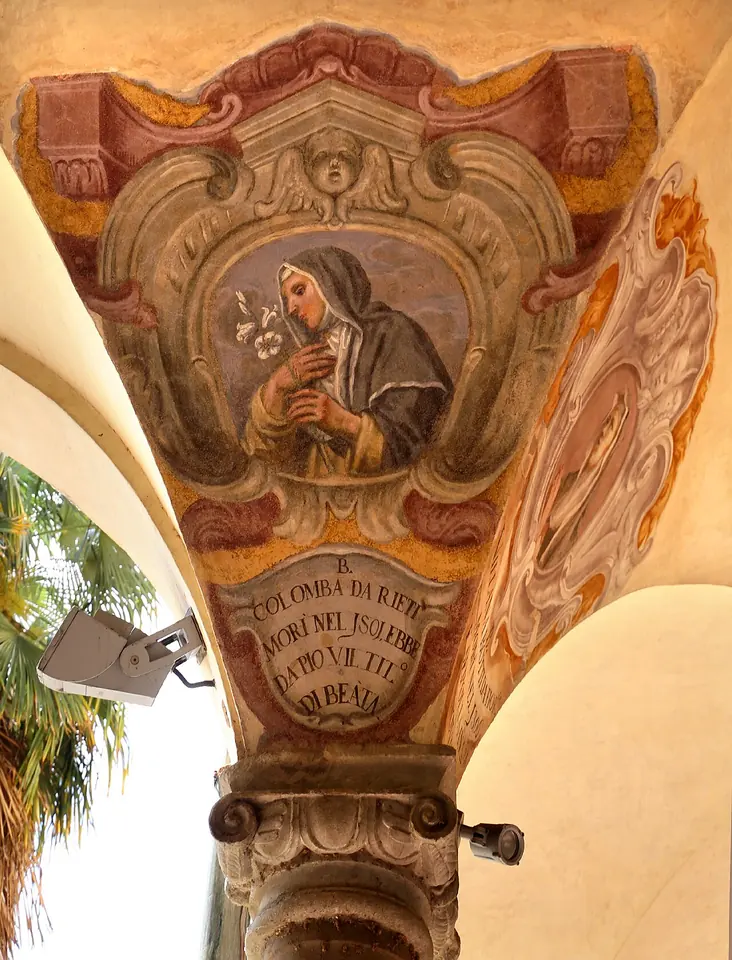
- A lily: her consecrated virginity.
- A crucifix, a book or a wreath of roses on her veil, as in many images of Dominican women.
- The Eucharist: some pictures show a hand from heaven giving her Communion, for her devotion to the Blessed Sacrament.
The engraving and the Ulivelli fresco on this page show the usual type.
Feast day and prayer
We keep her feast on May 20, the anniversary of her death. The Dominican Order celebrates her that day, and Pius V allowed her convent to keep her memorial as early as 1566. Find others of May on our feast days page.
We have not found a traditional English prayer to Blessed Columba to reprint here. Let us ask her to pray for cities divided by violence, for those who nurse the sick in times of epidemic, and for young people who want to give their whole lives to God.
Frequently asked questions
Who was Blessed Columba of Rieti?
Angelella Guadagnoli, a girl of Rieti who took the name Columba (dove), became a Dominican tertiary at about nineteen, and founded a community of sisters in Perugia. She was known for her fasting, her ecstasies and her love of the Eucharist, and for urging peace in a city torn by feuds.
Why was she called Columba?
Her earliest biographer, her confessor Sebastiano Bontempi, says a white dove came down over her at her baptism. From then on no one called her Angelella; everyone called her Colomba, the dove.
When is Blessed Columba of Rieti's feast day?
May 20, the day she died in Perugia in 1501, which was Ascension Day that year.
Where are her relics?
In Perugia, at the convent of Dominican nuns still known as the Monastero della Beata Colomba.
Keep exploring
Sources
- Guadagnoli, Angelella (Colomba da Rieti), Dizionario Biografico degli Italiani (Treccani, Italian). Critical biography: Bontempi's life as the main source, the 1494 plague banner, Alexander VI's examination, the inquiries into her, and the history of her cult
- Bl. Colomba of Rieti, Catholic Encyclopedia (1908), via Wikisource. Her offering for Perugia in 1494, the calumnies against her and her deposition as prioress
- Beata Colomba (Angela) da Rieti, Santi e Beati (Italian). Roman Martyrology entry, her family, the Monastery of the Colombe and her relics