St. Yared the Melodist
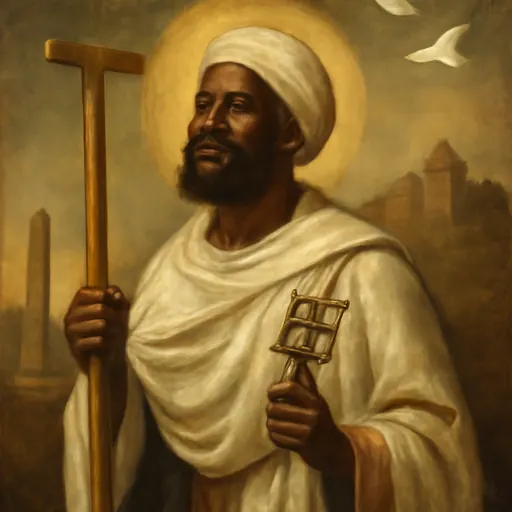
St. Yared was a sixth-century deacon of Aksum, revered by the Ethiopian Orthodox Tewahedo Church as the father of its sacred music. Tradition says he learned his hymns from three birds sent from heaven, and he gave the Ethiopian liturgy its three modes of chant, still sung today. His feast day is 11 Genbot (May 19).
Who was St. Yared?
St. Yared is the saint who taught the Ethiopian Church to sing. He was a deacon of Aksum, the ancient capital of the Ethiopian kingdom, in the sixth century, and the Ethiopian Orthodox Tewahedo Church honors him as the composer of its sacred chant. The Ethiopian Synaxarium calls him "the poet and hymn writer, who was like unto the Seraphim." The hymns he arranged for every season of the year are still sung in Ethiopian and Eritrean churches some fourteen centuries later.
Most of what we know comes from the Synaxarium, the book of saints read in Ethiopian churches, and from his gädl, or Life. Historians cannot check much of it; the Dictionary of Ethiopian Biography notes a "strong Syriac influence" in the hymns attributed to him. The tradition, though, is lovely, and it is the Church's own memory of him.
The boy who could not learn the Psalms
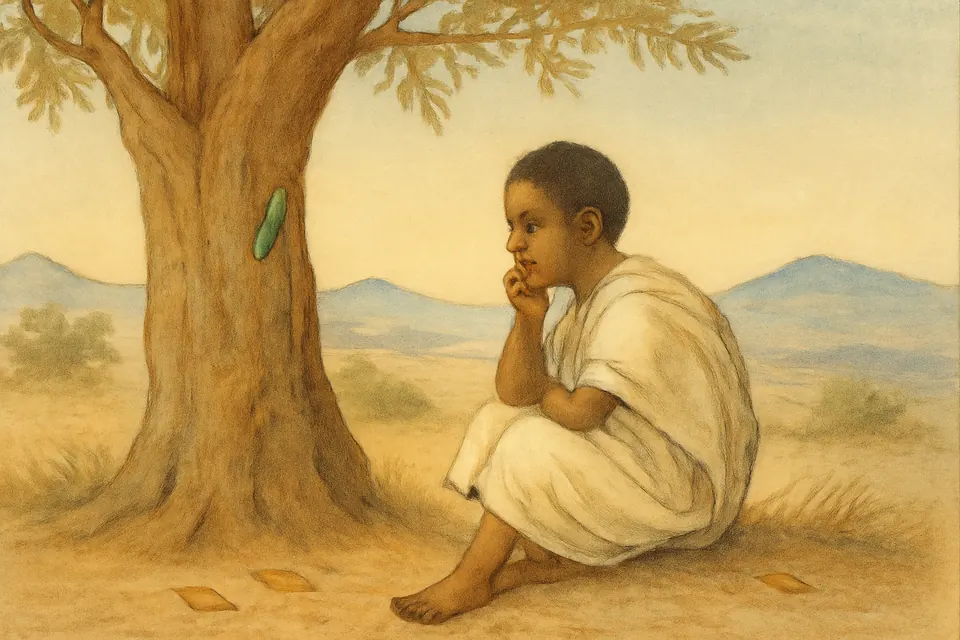
Yared was born near Aksum and was taught by a kinsman, Abba Gideon, a priest of Aksum, the city that held, in the Synaxarium's words, "the first church that was built in the country of Ethiopia," dedicated to the Virgin Mary. The boy struggled. He could not learn the Psalter, and when his teacher beat him, he ran away into the wilderness and sat under a tree.
There he watched a caterpillar climbing the trunk. Halfway up it fell to the ground, then started again, and fell, and started again, until at last it reached the top. Yared was ashamed. He went back to his teacher and said, in Budge's translation, "Forgive me, O father, and dispose of me as thou wishest." His teacher prayed for him with tears, the Synaxarium says, and God opened Yared's mind so that he learned the Scriptures in one day. He was then made a deacon.
The three birds from Eden
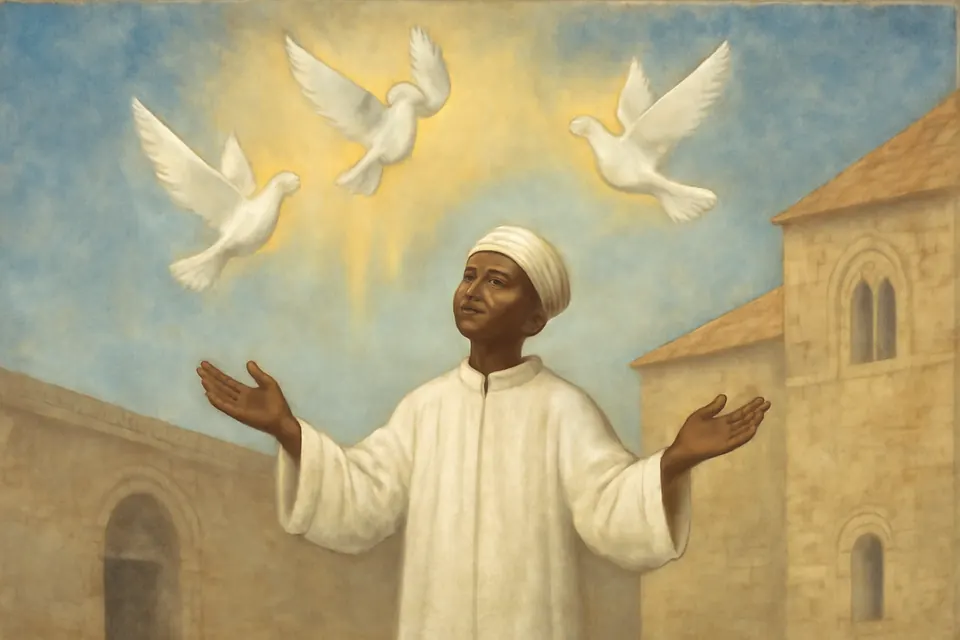
In those days, the Synaxarium says, "there was no singing of hymns and spiritual songs in a loud voice to well-defined tunes, but men murmured them in a low voice." Then God "sent unto him three birds from the Garden of Eden," which spoke with Yared in human speech and carried him up to the heavenly Jerusalem. There he learned the songs of the twenty-four elders who worship before the throne.
When he came back to himself, he went into the church at Aksum at the third hour of the day and cried out, "Hallelujah to the Father, Hallelujah to the Son, Hallelujah to the Holy Spirit." The king, the queen, the bishop and the priests ran to the church and spent the whole day listening to him.
The three modes of Ethiopian chant
Yared arranged hymns for summer, winter, spring and autumn, for feasts and Sabbaths, for the days of the angels, prophets, martyrs and the righteous. His great hymnbook is the Deggwa. He set everything in three modes, which the Dictionary of Ethiopian Biography names ge'ez, ezel and araray: one for ordinary days, one for fasts and days of mourning, one for the great festivals. They are still used in the Ethiopian Church, sung by the trained church singers called debtera with drums, sistrums and prayer staffs.

The king's spear
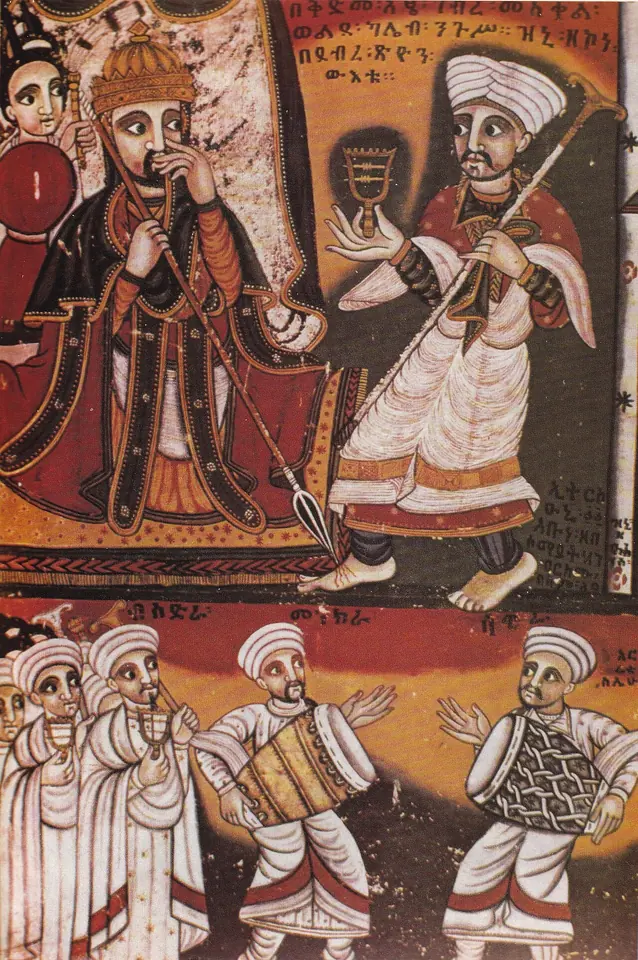
The best-known story of Yared is traditional, from the Synaxarium. One day he was singing at the feet of King Gebre Meskel, and the king was so absorbed that he drove the point of his spear into Yared's foot. Blood poured out, but Yared did not notice until he finished his song. The horrified king swore to give him any reward he asked. Yared asked to be let go to become a monk.
The king grieved but kept his oath. Before he left, Yared stood before the Tabernacle of Zion and prayed, and the Synaxarium says he "was raised above the ground the space of a cubit." Then he went into the wilderness to live in fasting and prayer.

His death
He died on 11 Genbot, May 19. The Synaxarium places his last years in "the desert of the south" and says "the place of his grave in the south is not known to this day." Another tradition, recorded in the Dictionary of Ethiopian Biography, says he retired with disciples to the Semien Mountains and was buried there.
Miracles and legends of St. Yared
Every wonder told of Yared is traditional: his sudden gift of learning, the three birds and his journey to heaven, his not feeling the king's spear, and his rising from the ground in prayer. The Synaxarium adds that God gave him a promise for anyone who calls on his name or keeps his commemoration.
Why St. Yared is the patron of church music
For Ethiopian Christians, Yared simply is church music. Every chant school traces its teaching back to him, and the Dictionary of Ethiopian Biography notes that his book also set down principles of teaching, urging teachers to be patient with the slow growth of a young mind. Church singers and musicians ask his prayers, and so do students who struggle, remembering the boy and the caterpillar.
Symbols of St. Yared in art
Ethiopian painters show Yared in the white robe and turban of a church singer. He holds a prayer staff (mequamiya), the T-shaped stick singers lean on and use to keep time, and often a sistrum (tsenatsel), the rattling instrument of Ethiopian worship. Often three birds fly above him. The favorite scene shows him singing before King Gebre Meskel, sometimes with the spear in his foot, and with his disciples drumming and playing below. Look for these scenes on church walls and in paintings on parchment and leather.

Prayer and the Synaxarium's salutation
The Ethiopian Synaxarium ends its account of him with a simple greeting, as it does for each saint: "Salutation to Yared." No other set prayer to him is in common use outside the Ethiopian liturgy, so we greet him with the Synaxarium and ask, in our own words, that he pray for all who sing God's praise.
St. Yared, who learned the songs of heaven, pray for every choir and every singer, and teach us to praise the Father, the Son and the Holy Spirit with all our hearts.
Frequently asked questions
When is the feast of St. Yared?
11 Genbot in the Ethiopian calendar, which falls on May 19. It is the day of his death in the Ethiopian Synaxarium.
What did St. Yared do?
He composed the hymns of the Ethiopian Church for the whole year, collected in the hymnbook called the Deggwa, and set them in three modes, ge'ez, ezel and araray. Before him, the Synaxarium says, hymns were only murmured in a low voice.
What is the story of St. Yared and the three birds?
The Ethiopian Synaxarium says God sent him three birds from the Garden of Eden, which spoke with him and carried him up to the heavenly Jerusalem, where he learned the songs of the twenty-four elders. It is a traditional account, cherished in the Ethiopian Church.
Is St. Yared a Catholic saint?
He is a saint of the Ethiopian and Eritrean Orthodox Tewahedo churches and is not on the Roman calendar. His chant is the heritage of all Christians of the Ethiopian tradition.