St. Andrew of Constantinople, the Fool for Christ

St. Andrew of Constantinople, called Andrew the Fool for Christ, was a slave from Scythia who lived as a holy fool, hiding a life of prayer behind madness. At Blachernae he saw the Mother of God spread her veil over the people, the vision behind the feast of the Protection (Pokrov). The Greeks remember him on May 28.
Who was St. Andrew of Constantinople?
St. Andrew of Constantinople, Andrew the Fool for Christ, is the holy man who saw the Mother of God spread her veil over the faithful. He belongs to a strange and beloved company in the Eastern Church, the saloi or holy fools, who took St. Paul at his word: "We are fools for Christ's sake" (1 Corinthians 4:10). They hid their holiness behind apparent madness, bore mockery without complaint, and spoke hard truths that no respectable person dared to say. In the Byzantine calendar his day is May 28; the Russian Church honors him on October 2.
He is not St. Andrew the Apostle, whose relics Constantinople also treasured.
The slave who became a fool
His story comes from a long Greek Life of Andrew the Fool, which names its author as Nicephorus, a priest of Hagia Sophia who knew him. More than 110 Greek manuscripts survive, the oldest a fragment from the second half of the tenth century.
According to the Life, Andrew came from Scythia and was sold as a boy in Constantinople to a wealthy official named Theognostus. The boy became his master's favorite, learned to read and write, and served as his secretary. He loved the Scriptures and the lives of the saints and longed to imitate them.
One night he dreamed that he fought a huge demon before the hosts of heaven and hell and won, and that Christ promised him heavenly treasure if he would take up the struggle of foolishness for His sake. The Orthodox life gives the angel's words: "Be a fool for My sake and you will receive much in the day of My Kingdom." The next night Andrew sat by a well, cut his clothes into rags and babbled nonsense. Theognostus, grieved, had him taken to the church of St. Anastasia in hope of a cure. When nothing changed, he let him go.
In the streets of the city
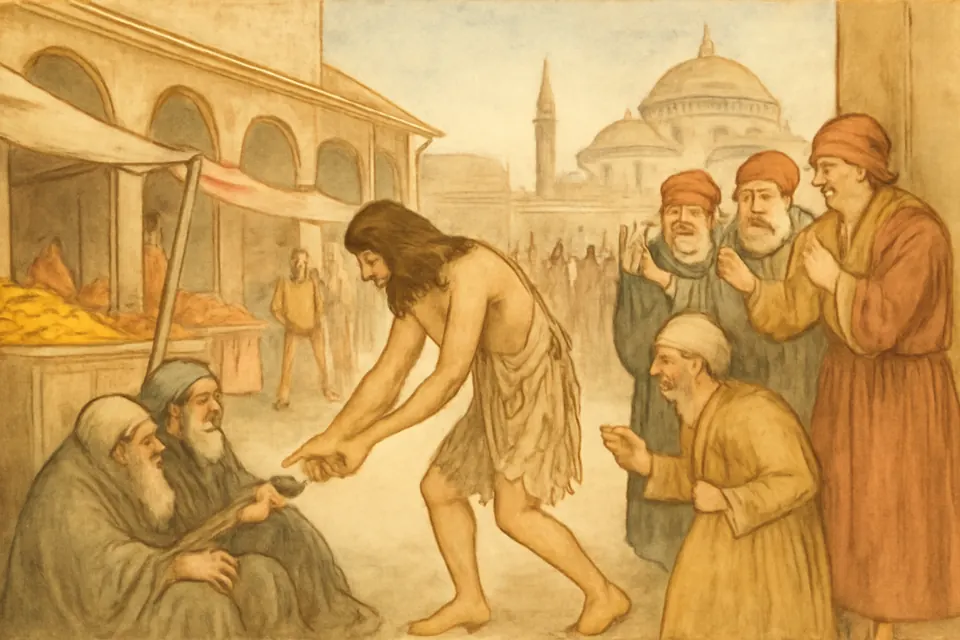
From then on Andrew lived on the streets of Constantinople in rags, drinking from puddles, sleeping among stray dogs, mocked and beaten. He begged and gave what he got to other beggars. By day he played the madman; by night he prayed in the churches. Only a few knew who he was, above all a young man of good family named Epiphanius, whom Andrew turned away from sin and guided with counsel.
The vision at Blachernae
The Blachernae church, near the land walls of Constantinople, kept the robe and veil of the Mother of God. During an all-night vigil there, the Orthodox Church in America tells us, Andrew "lifted up his eyes towards the heavens and beheld our most Holy Lady Theotokos coming through the air, resplendent with heavenly light," with St. John the Baptist and St. John the Theologian at her side. She knelt and prayed for Christians with tears, and then took her veil and spread it over the people in the church. Andrew turned to Epiphanius:
"Do you see, brother, the Holy Theotokos, praying for all the world?" Epiphanius answered, "I do see, holy Father, and I am in awe."
- Traditional: the vision of the Mother of God at Blachernae. It comes from his Life, not from an independent record, and the Orthodox Church in America itself notes that the dates in the story do not fit easily together.
This vision became the feast of the Protection of the Mother of God, in Russian Pokrov, kept on October 1. Curiously, the Greeks never made much of it, as the Orthodox Church in America observes, but the Slavs took it to heart. A twelfth-century Russian Prologue explains why the feast was established: "it transpired that Your holy Protection should not remain without festal celebration, O Ever-Blessed One!" Churches of the Protection began to rise in Russia in that same century, and Pokrov became one of the best-loved days of the Russian year.

His death
The Life says Andrew spent his last days in Epiphanius's house, foretold that Epiphanius would become patriarch of Constantinople, and then went off alone to pray through the night for the whole world. He died there.
- Traditional: that his body vanished after death, leaving only a fragrance, as the Orthodox Encyclopedia summarizes the Life. No relics are known.
When did he live?
The Life sets Andrew in the reign of Emperor Leo I (457–474), in the days of St. Daniel the Stylite. Its first modern editor, the Bollandist Konrad Janning, noticed anachronisms and similarities to the lives of other holy fools such as St. Simeon of Emesa, and moved him to the reign of Leo VI (886–912). The Orthodox Church in America gives his death as 936. The Swedish scholar Lennart Rydén, who edited the Greek text, argued that the Life was written in the 950s. Whatever the dates, his name does not appear in Greek synaxaria until the twelfth century, and modern Greek calendars have largely dropped him, while the Slavic churches never forgot him.
Symbols of St. Andrew of Constantinople in art
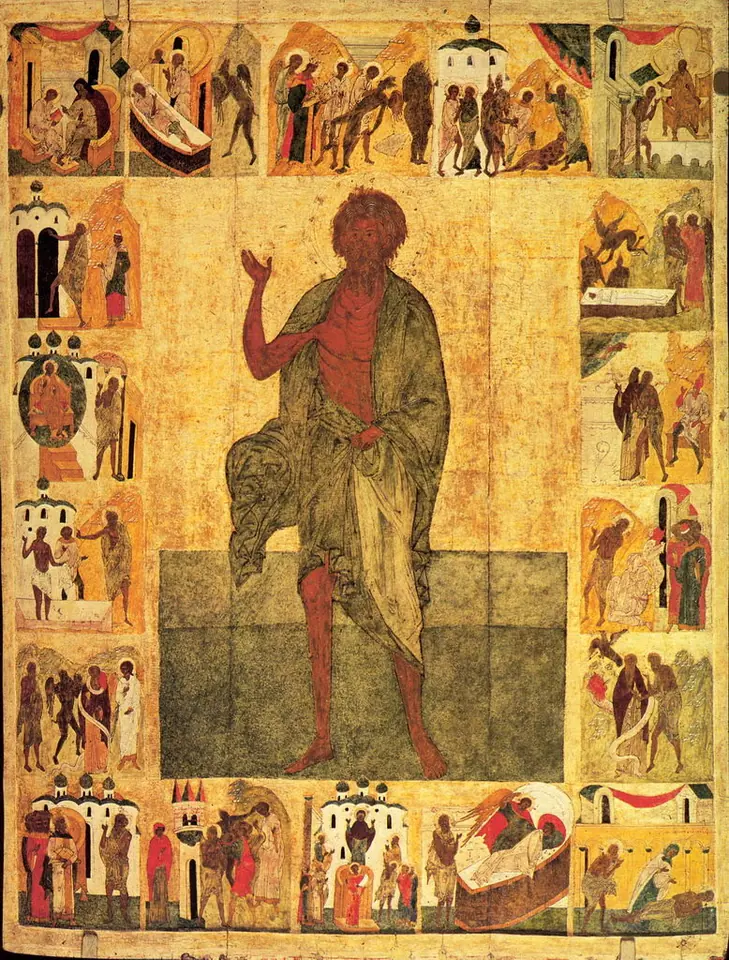
- A nearly naked, barefoot figure in a ragged cloth: the holy fool who gave up everything.
- An arm raised toward heaven: in Pokrov icons, he points his disciple to the Mother of God.
- The Blachernae church and the Virgin with her veil: his vision.
Russian icons of the Protection almost always include him at the lower right, ragged among the bishops and princes. Vita icons show him standing in the center, surrounded by small scenes from his Life.
Prayer to St. Andrew of Constantinople
The Orthodox Church sings a troparion and kontakion for his feast. In the Western Church there is no traditional prayer to him. Let us ask St. Andrew, who saw the Mother of God praying for all the world, to pray for the poor who sleep in our streets, for all who are mocked for their faith, and for us, that we may not be too proud to be thought fools for Christ. See also St. Simeon the Holy Fool, St. Xenia of St. Petersburg and the feast day calendar.
Frequently asked questions
Who was St. Andrew of Constantinople?
A holy fool, or "fool for Christ," of Constantinople. According to his Life, he was a Scythian slave of a nobleman named Theognostus who, after a vision, pretended to be mad and lived in rags on the streets, praying at night and giving away the alms he received.
What did St. Andrew the Fool see at Blachernae?
During an all-night vigil in the Blachernae church, he saw the Mother of God with St. John the Baptist and St. John the Theologian pray for the world and spread her veil over the people. His disciple Epiphanius saw it too. This is the origin of the feast of the Protection of the Mother of God (Pokrov), October 1.
When is the feast of St. Andrew of Constantinople?
May 28 in the Byzantine synaxaria, the day of his death. The Russian Church keeps him on October 2, right after the Protection feast.
When did St. Andrew the Fool live?
His Life places him in the time of Emperor Leo I in the fifth century, but anachronisms led scholars to date him to the ninth or tenth century. The editor Lennart Rydén dated the writing of the Life to the 950s.
Keep exploring
Sources
- Pravoslavnaya Entsiklopediya (Orthodox Encyclopedia), vol. 2: Andrei Yurodivy (in Russian). The Life and its manuscripts, the dating debate (Janning, Mango, Rydén), the May 28 Byzantine and October 2 Russian feasts, his disappearance at death
- Orthodox Church in America: Blessed Andrew the Fool-for-Christ at Constantinople. The Orthodox life and the year 936
- Orthodox Church in America: The Protection of our Most Holy Lady the Mother of God and Ever-Virgin Mary. The vision at Blachernae, quoted from this account, and the historical problems of its date