St. Sarah, Black Sarah of Saintes-Maries-de-la-Mer
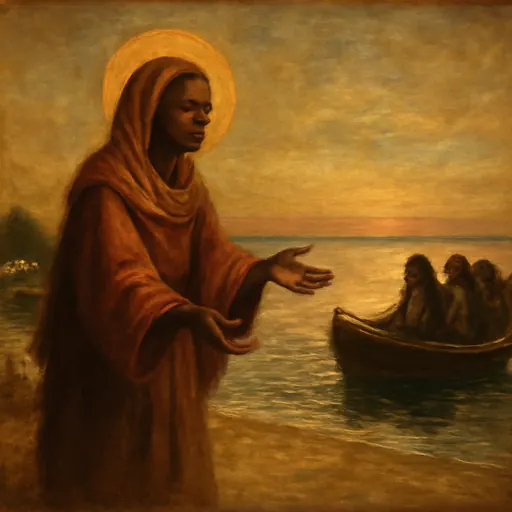
St. Sarah, called Sara-la-Kâli or Black Sarah, is honored at Saintes-Maries-de-la-Mer in Provence, France, as the patron of the Romani people. Tradition makes her the servant who came by boat with the holy women of the Gospels, or a woman of Provence who welcomed them. She has never been formally canonized; her feast is May 24.
Who is St. Sarah?
When people search for St. Sarah, they almost always mean Sara-la-Kâli, Black Sarah of Saintes-Maries-de-la-Mer, a small town on the sea in the Camargue, the marshy delta of the Rhône in Provence. Her dark-skinned statue, heaped with capes of bright silk and crowned with a tiara, stands in the crypt of the town's fortified church. Every year on May 24 thousands of Romani pilgrims, together with priests, local horsemen and townspeople, carry her down to the sea. She is the patron of the Romani people, and one of the most beloved figures of popular Catholic devotion in France.
She is also a saint we know almost nothing about. She has never been canonized, she is not in the Roman Martyrology, and the stories about her were written down long after the events they describe. Her devotion is real, though, and the Church has welcomed it. This page tells what tradition says about her, what history can and cannot confirm, and how she is honored today. At the end you will also find the other St. Sarah, the wife of Abraham, whom the Church honors as a holy woman of the Old Testament.
The legend of the holy women of Provence
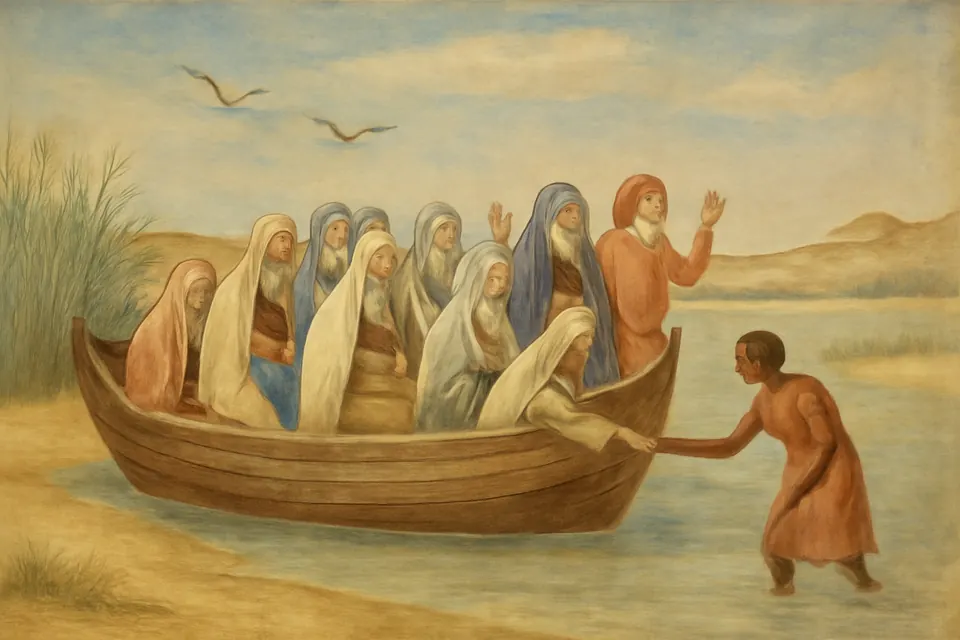
Sarah's story is part of a larger one. Provençal tradition, recorded by the 13th century, says that after the Resurrection a group of Christ's followers were put out to sea from Palestine in a boat without sails or oars. Among them were two women the Gospels place at the cross and the empty tomb: Mary Jacobe, the mother of St. James the Less, whom the Gospel of John calls Mary the wife of Clopas, and Mary Salome, the mother of the apostles James and John. Later tellings add St. Mary Magdalene, St. Martha, St. Lazarus and others. The boat came ashore in the Camargue. Magdalene, Martha and Lazarus went on to preach in Provence, but the two older Marys stayed where they had landed, and they were buried there.
A church grew up over their tomb, and the town took their name: Saintes-Maries-de-la-Mer, "the holy Marys of the sea." The bishop of Arles approved a confraternity in their honor in 1315. In 1448 King René of Anjou had the church excavated, bones were found beneath it, and Pope Nicholas V declared them the relics of the two Marys. Their reliquary still hangs in a chapel high above the altar.
Where Sarah comes in
Sarah appears in the story as their companion. According to the Catholics & Cultures study by Thomas Landy of the College of the Holy Cross, a reference from 1357 already calls her the Marys' servant. The first full account comes from Vincent Philippon, the parish's perpetual vicar, in a text of 1521, which even claims that her bones were found beside the Marys' in 1448; the original accounts of the discovery do not mention her. From there the tradition divides:
- The Egyptian servant. In the Camargue legend, Sarah was a dark-skinned servant, often called Egyptian, who sailed with the Marys from Palestine and cared for them. One old variant even makes her an Egyptian woman converted by the Passion.
- The woman who welcomed them. In the Romani tradition, Sarah was a woman of the region, a leader of a dark-skinned people living in the Camargue, who went out to meet the holy women and asked to be baptized. The Marquis Folco de Baroncelli, a devout Catholic layman and horseman of the Camargue, popularized this version in the early 20th century.
The Romani call her Sara-la-Kâli. In their language kali means "black," and it is also a word for a Romani woman. Some 20th-century writers tried to connect her with the Hindu goddess Kali, since the Romani people came from India centuries ago, but there is no historical evidence for it.
All of this is traditional. The holy women of the Gospels are real; their voyage to Provence is an old and cherished legend that historians cannot confirm. Sarah herself stands at the very edge of what can be known. The Archbishop of Aix, approving her procession in 1967, put it with honest simplicity: "Like many other saints, it is not possible to give precise historical details about the character of Saint Sara."
How Sarah became the patron of the Romani people
Romani families came to the pilgrimage of the two Marys long before they had a procession of their own. By 1862 they were helping to carry the Marys' statues to the sea. Photographs from the early 20th century show their wagons and tents camped around the church every May.
They took Sarah as their own. Around 1900 the brown-skinned statue appeared in the crypt below the church, beneath the altar of the Marys, and, as an old account quoted by Landy puts it, "little by little, the crypt became the domain reserved to the Bohemians." Romani pilgrims lit candles there and dressed the statue in capes as offerings.
The great change came in 1935. Baroncelli asked the Archbishop of Aix to let the Romani carry Sarah to the sea, as the town carried the Marys. From May 24, 1935, they did. For years the clergy did not take part. After the Second World War, in which many French Romani had been held in internment camps, the Church built a dedicated chaplaincy for them. In 1948 the papal nuncio in Paris, Archbishop Angelo Roncalli, the future Pope St. John XXIII, presided at the pilgrimage. In 1967 the Archbishop of Aix formally approved Sarah's procession.
The miracles of St. Sarah
No miracle has ever been investigated or approved through Sarah's intercession. Sorted by the labels this encyclopedia uses:
- The voyage of the holy women and Sarah's welcome: traditional.
- Healings, safe journeys and protection that pilgrims attribute to her prayers: reported. The crypt is full of ex-votos, photographs and thank-you notes left by families who believe she helped them. None has been examined by the Church.
Symbols of St. Sarah in art
Sarah has no ancient image. She is known almost entirely through her statue at Saintes-Maries, and newer statues and holy cards copy it. To recognize her, look for:
- A dark-skinned woman standing upright, usually alone.
- Many layered capes and mantles of silk, satin and lace. Each one is a pilgrim's gift, and so many are given that they can hide her face. Families take their capes home after the pilgrimage, as a blessing.
- A crown or tiara, given by the Romani in 1958 as a sign of honor.
- Candles, flowers and ex-votos around her, as in her crypt.
- The sea and a small boat, when she is shown with the two Marys.
Her look links her, in many pilgrims' minds, with the Black Madonnas of France, though she is not Mary. Pilgrims dress the statue in many layered capes, and the faithful add new ones over the years.
The pilgrimage of May 24 and 25
The pilgrimage takes place every year at the church of Notre-Dame-de-la-Mer, a Romanesque church built like a fortress against raiders from the sea. Catholics & Cultures reports that it draws 25,000 to 40,000 people over a week, many arriving in caravans and staying in camps around the town, each with its own chaplain.
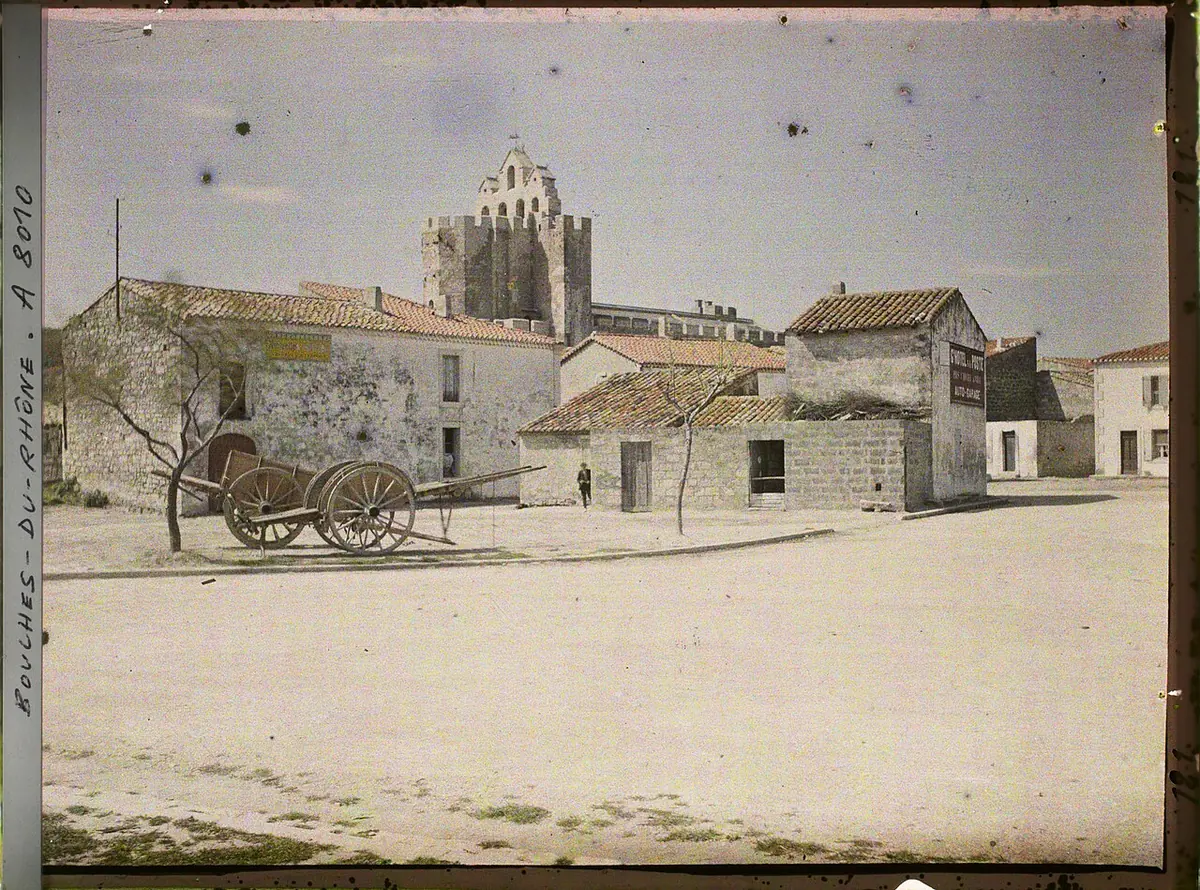
- May 24, St. Sarah's day. The archbishop of Aix and Arles celebrates Mass. In the afternoon the reliquary of the two Marys is let down from its high chapel to the altar on ropes hung with flowers. Then Sarah's statue is brought up from the crypt and carried through the streets to the beach, escorted by the gardians, the cowboys of the Camargue, on their white horses. The bearers wade into the sea with her, and the crowd follows.
- May 25, St. Mary Jacobe's day. After Mass, the statues of the two Marys in their little boat are carried to the sea, where the archbishop, standing in a boat at the water's edge, blesses the sea and the pilgrims.
The week is also full of the sacraments: Masses in the camps, baptisms and weddings in the church, vigils for the sick and the dead, catechism for children. St. Mary Salome has a second, smaller pilgrimage in October.

Prayer to St. Sarah
There is no traditional prayer to St. Sarah with a printed source we could verify, so we do not give one here. Pilgrims pray to her in their own words in the crypt, light a candle, touch her statue and leave a cape or a note of thanks.
We can join them simply. Let us ask St. Sarah to pray for the Romani people and for all who live on the road, for families who travel to find work, and for everyone who has ever felt like a stranger. Then let us turn with her to the holy women she served, who stood by the cross and were the first to hear that Christ is risen.
The other St. Sarah: Sarah, wife of Abraham
The Church also honors a far older Sarah: the wife of Abraham and the mother of Isaac, whose story is told in Genesis 11 to 23. Her name was first Sarai; God changed it to Sarah, "princess," when He promised that nations and kings would come from her (Genesis 17:15–16). She laughed when the three visitors at Mamre told her she would bear a son in her old age, and when Isaac was born she laughed again, for joy. She died at 127 and was buried in the cave of Machpelah at Hebron.
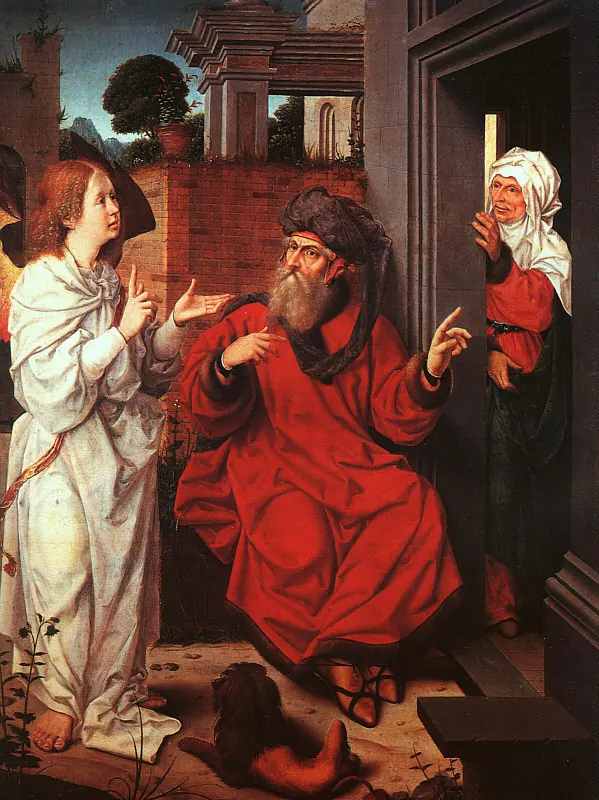
The New Testament praises her faith and her obedience. The Letter to the Hebrews says, in the Douay-Rheims translation, "By faith also Sara herself, being barren, received strength to conceive seed, even past the time of age; because she believed that he was faithful who had promised" (Hebrews 11:11), and St. Peter holds her up as a model for Christian wives (1 Peter 3:6). The Church's old nuptial blessing asked that every bride be longaeva et fidelis ut Sara, long-lived and faithful like Sarah. Women who long for a child have always prayed with her story; see our page on patron saints of fertility.
The Orthodox Church commemorates Righteous Sarah with the holy forefathers of Christ on the Sunday between December 11 and 17. The Latin Church has no separate feast for her, but she belongs to the great company of the holy men and women of the Old Testament whom the Church honors as our ancestors in faith, with Abraham, "our father in faith," named in the Roman Canon of the Mass.

So there are two St. Sarahs: the mother of Isaac, whose holiness Scripture itself proclaims, and the beloved Black Sarah of the Camargue, whose story is legend but whose devotion is alive in tens of thousands of hearts. Let us ask them both to pray for us.
Frequently asked questions
Who was St. Sarah?
The St. Sarah most people search for is Sara-la-Kâli, Black Sarah, whose statue stands in the crypt of the church at Saintes-Maries-de-la-Mer in southern France. A legend first written down in the Middle Ages makes her the servant of Mary Jacobe and Mary Salome, who came by boat to Provence after the Resurrection. Another tradition makes her a woman of the region who welcomed them. Nothing is known of her for certain.
Is St. Sarah a real saint?
She has never been canonized and is not in the Roman Martyrology. Her devotion is real and old, though, and the Church accepts it. In 1967 the Archbishop of Aix approved her procession on the basis of "immemorial" tradition, saying that "like many other saints, it is not possible to give precise historical details" about her. Clergy now take part in her May pilgrimage.
When is the feast of St. Sarah?
May 24. On that day Romani pilgrims carry her statue from the church of Saintes-Maries-de-la-Mer to the sea. The next day, May 25, the town honors St. Mary Jacobe with a procession of the boat of the two Marys.
Why is St. Sarah the patron saint of the Romani people?
Romani pilgrims have come to Saintes-Maries for at least two centuries, and over time they took Sarah, the dark-skinned servant of the legend, as their own. Romani tradition makes her one of their people. The crypt where her statue stands became, in the words of one old account, the domain reserved to them.
Is Sarah the wife of Abraham a saint?
Yes, in the sense that she is honored as holy. The Orthodox Church commemorates "Righteous Sarah" with the holy forefathers of Christ on the Sunday before Christmas, and the New Testament praises her faith (Hebrews 11:11). She is a different person from Sara-la-Kâli, and has no feast of her own on the Roman calendar.
Keep exploring
- Patron saint pages
- Travelers
- Feast-day calendar
- Saints remembered in MaySaint of the dayWhat saint is my birthday?
- Relics
- Where the relics are kept (map)
- More
- Saints A to ZPatron saints A to ZExplore every section
Sources
- Thomas M. Landy, Gypsy and Camarguaise Catholics in France honor women saints linking region to Jesus (Catholics & Cultures, College of the Holy Cross). Earliest references to Sara (1357, 1521), the 1448 discovery, the 1935 procession, Roncalli in 1948, the archbishop's approval of 1967
- Thomas M. Landy, Feast brings Saintes Marie and Sainte Sara to the sea in France (Catholics & Cultures). The pilgrimage as kept today, the capes, the chaplaincy in the camps
- Provence-Alpes-Côte d'Azur tourism: La Vierge noire, Sara la Noire (French). Vincent Philippon's text of 1521, the two traditions, the meaning of "Kâli"
- Orthodox Church in America: Righteous Sarah
- Hebrews 11:11, Douay-Rheims 1899 American Edition (Bible Gateway)
- Catholic Culture: The Nuptial Blessing (Rev. Edgar Schmiedeler)