St. Melangell of Pennant Melangell
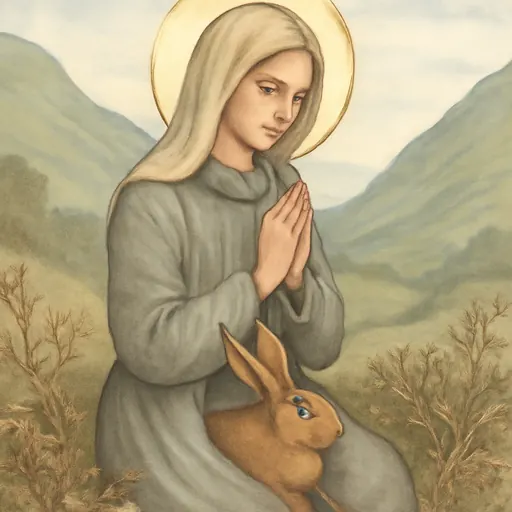
St. Melangell was a Welsh hermit and abbess of the 7th century who, her legend says, sheltered a hunted hare under her robe so that the hounds of the prince of Powys would not touch it. Moved by her holiness, he gave her the valley of Pennant as a sanctuary, and she is the patron saint of hares. Her shrine church at Pennant Melangell in the Berwyn Mountains still draws pilgrims, and her feast day is May 27.
Who was St. Melangell?
St. Melangell was a holy woman of 7th-century Wales who lived as a hermit, then as abbess, in a remote valley of the Berwyn Mountains in Powys. Everything we know of her life comes through one story: a hunted hare ran to her for safety, the prince's hounds would not touch it, and the prince gave her the valley as a sanctuary forever. That valley still bears her name, Pennant Melangell, and her shrine stands in its little church.
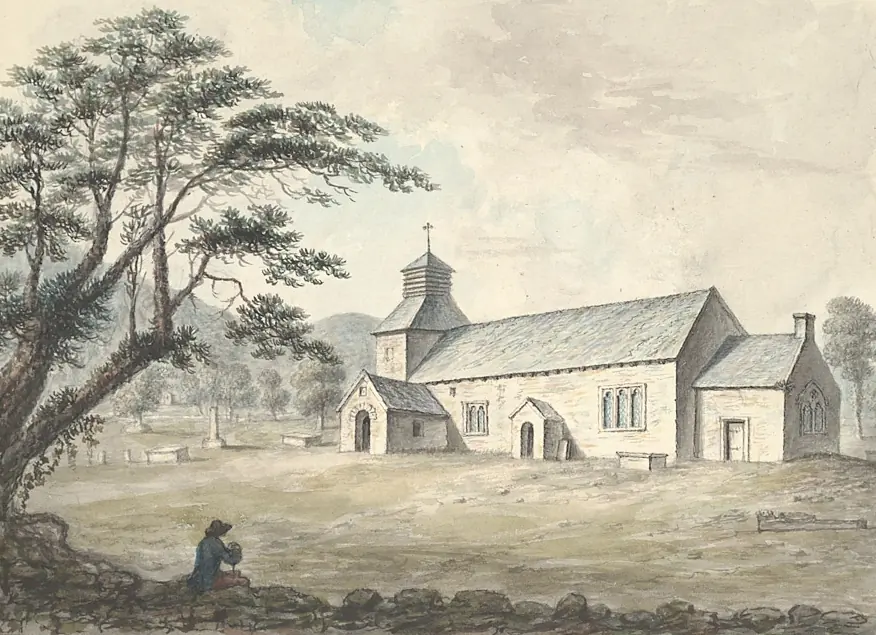
The Welsh call her Melangell. Her Latin legend calls her Monacella, a form that puzzled even the great Welsh hagiographers Sabine Baring-Gould and John Fisher, who wrote in 1911 that they could not explain how the two names were connected. She is a different person from the Roman widow St. Marcella, with whom some old calendars seem to have confused her.
Her legend and what history can say
Two kinds of evidence speak about Melangell, and they should be kept apart.
The Welsh pedigrees, the genealogies of saints copied by medieval scribes, make her a granddaughter (in some copies a daughter) of Tudwal Tudclud, a prince of the North British kingdom of Strathclyde. They name her mother as Ethni Wyddeles, "Ethni the Irishwoman." If they are right, Melangell was a niece of Rhydderch Hael, the king who won the battle of Arderydd in 573. That fits a life in the late 6th and 7th centuries.
The legend, the Historia Divae Monacellae, is much later. Its text survives only in copies: one made in 1640 from a manuscript of the 16th century or earlier, kept in the Wynnstay Library until fire destroyed it in 1858, and another from a Llanfyllin manuscript. Baring-Gould and Fisher call it late. Everything below from the legend is traditional.
Flight from Ireland
The Historia says Melangell was the daughter of "king Jowchel of Ireland," who meant to marry her to a great Irish nobleman. She had vowed herself to God. She fled her father's lands and, "God guiding me," came to the hills of Pennant in Powys. There, she later told the prince, she lived fifteen years "without seeing the face of man," serving "God and the spotless Virgin with my heart and a chaste body."
The hare and the hounds
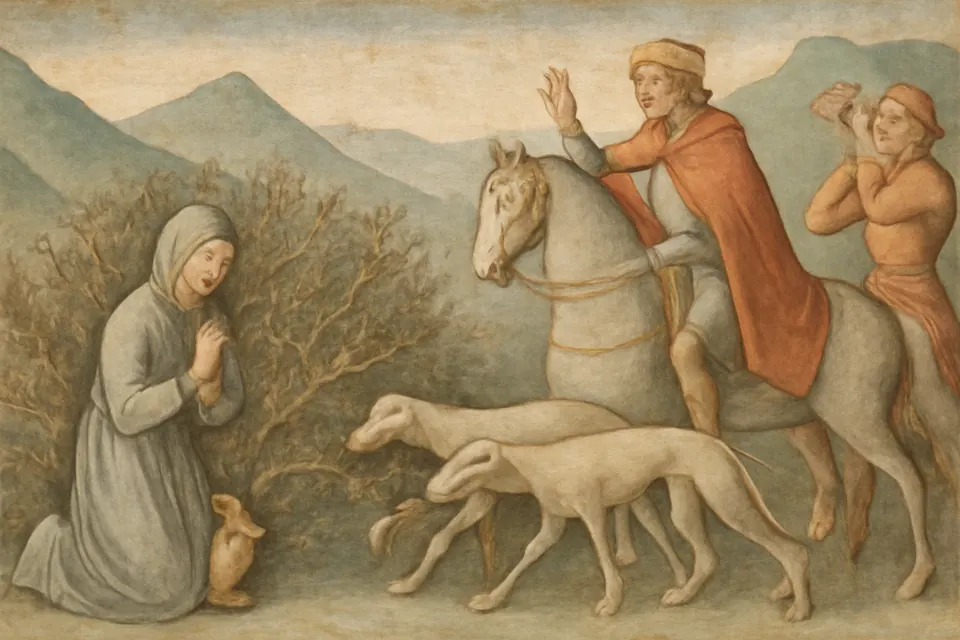
In the year 604, the legend says, Brochwel Ysgythrog, prince of Powys, went hunting at Pennant. His hounds started a hare and chased it into a great thorny thicket. There the prince found a young woman deep in prayer, with the hare lying under the fold of her robe, "with its face turned towards the dogs," as the 1848 translation puts it, "boldly and intrepidly."
Brochwel shouted, "Catch her, little dogs! catch her!" The louder he urged them, the further the hounds drew back, until they fled howling from the little animal. The Welsh traveler Thomas Pennant, retelling the story in his Tours in Wales in the 18th century, adds that when the huntsman raised his horn to blow, it stuck to his lips.
The gift of the valley
The prince asked who she was, and she told him her story. Brochwel answered with a grant that the legend gives in full:
because it has pleased the supreme and almighty God, for thy merits, to give safety to this little wild hare, with safe conduct and protection from the attack and pursuit of the ravenous and biting dogs, I give and present to thee, with a most willing mind, these my lands for the service of God, and that they may be a perpetual asylum, refuge, and defence, in honour of thy name, O excellent virgin
No king or prince, he added, should dare drag out anyone, man or woman, who fled to her lands for protection. His successors as princes of Powys confirmed the sanctuary.
Abbess of Pennant
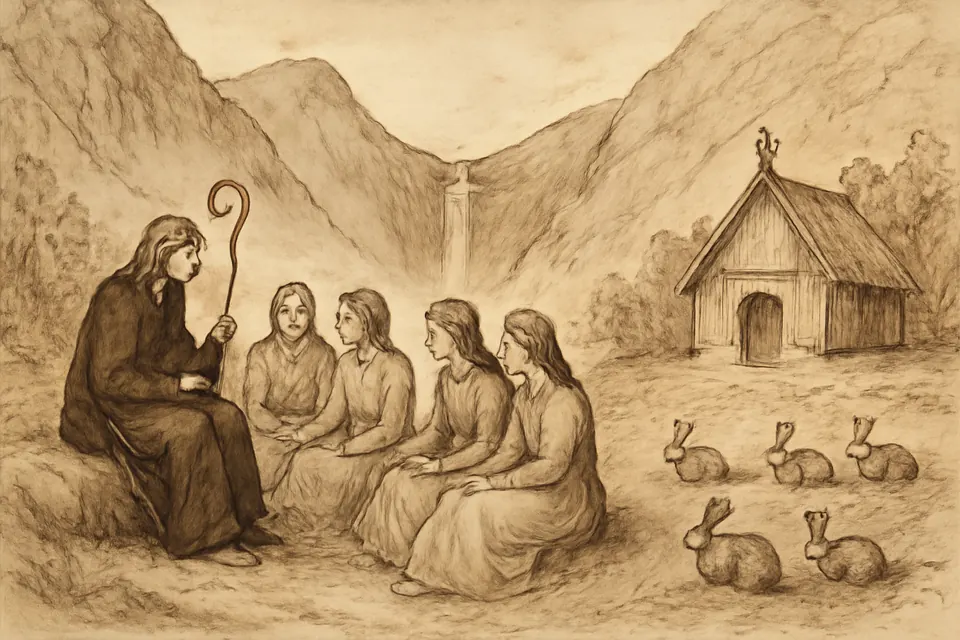
The Historia says Melangell spent 37 years in that place. The hares, the Historia says, "were in a state of familiarity about her every day throughout her whole life," and miracles and favors were granted to those who called on her. She gathered young women around her and taught them to live in chastity and prayer, giving their days and nights to the service of God. So a hermit became an abbess, and the sanctuary became a small community. Pennant tells us she "died abbess, in a good old age" and was buried in the church.
The miracles of St. Melangell
All of Melangell's miracles belong to her legend and are traditional:
- The hounds that would not attack: traditional, the heart of her story.
- The horn stuck to the huntsman's lips: traditional, known from Thomas Pennant's retelling.
- Tame hares around her all her life: traditional.
- Favors granted at her shrine: the Historia mentions miracles for those who called on her; the offerings at her relics recorded in 1535 show that pilgrims kept coming. These are traditional, never examined.
Why St. Melangell is the patron saint of hares
The patronage comes straight from the story. The people of the valley called the hares Ŵyn Melangell, "Melangell's lambs." Baring-Gould and Fisher report that no one would kill a hare in the parish, and that if anyone cried "Duw a Melangell a'th gadwo!", "God and Melangell preserve thee!", after a hunted hare, people firmly believed it would escape. The parishioners of Pennant were nicknamed ysgyfarnogod, "the hares."
We ask her prayers for the protection of animals and of all who are hunted or hounded, and for places of refuge. You can find other patrons of animals on our patron saints page, among them St. Francis of Assisi and St. Giles, another hermit who sheltered a hunted creature from a royal hunt.
Symbols of St. Melangell in art
Melangell's images are few and almost all in her own church, so they are worth knowing:
- A hare under her robe or at her side: her one essential attribute. Wherever you see a holy woman with a hare, it is almost always Melangell.
- Hounds turning away: the dogs that would not attack.
- A crozier: the staff of an abbess, for the community she led.
- A prince on horseback and a huntsman with a horn: Brochwel and his man, the two other figures in her story.
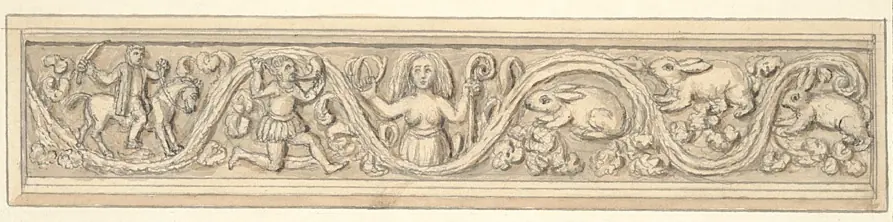
The oldest telling of the legend in art is a 15th-century carved oak frieze on the screen of her church. Baring-Gould and Fisher describe its six panels: Brochwel on horseback brandishing a sword, the huntsman kneeling with his horn at his lips, Melangell seated as an abbess holding a crozier, the hare scuttling toward her, a greyhound in pursuit, and a dog. John Ingleby drew it in 1795.
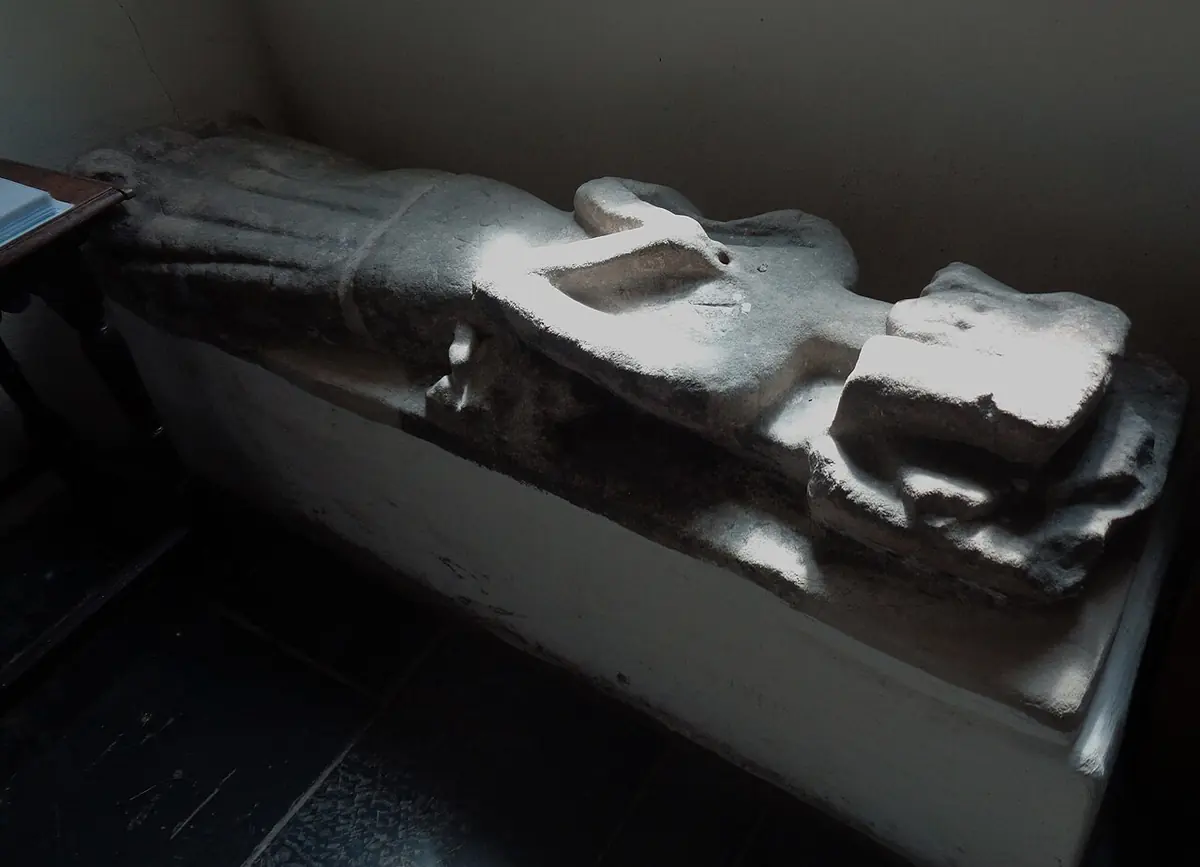
In the chancel lies a 14th-century stone effigy of a woman, which the church identifies as Melangell, with two hares at her sides. It spent many years out in the churchyard and was brought back inside in 1876 and 1877, so it is badly worn. The sculptor Meical Watts has carved Melangell and the hare in stone for the church.
Her shrine at Pennant Melangell
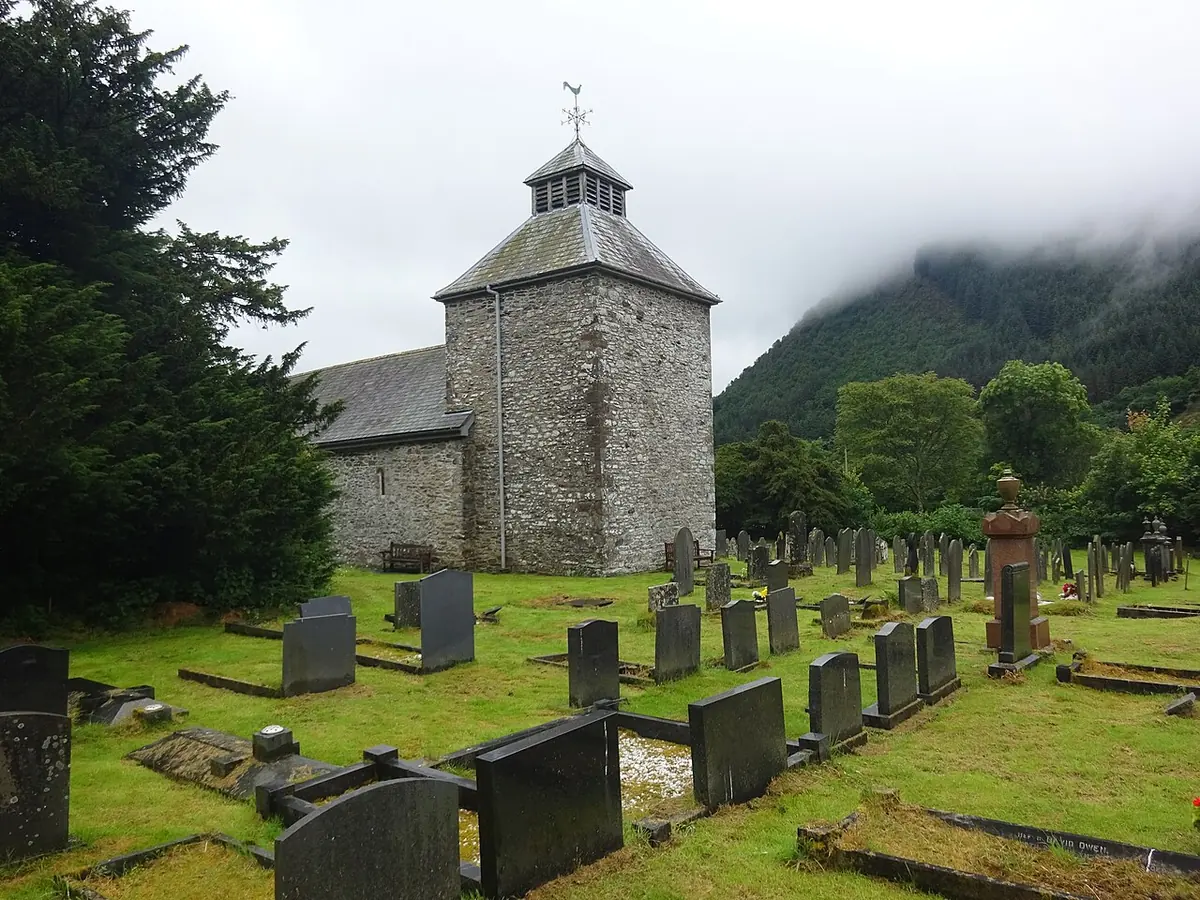
The shrine church stands at the head of the Tanat valley in a round churchyard ringed by four great yew trees. The Conservation Foundation estimated the yews at about 2,000 years old, and Bronze Age burials have been found in the churchyard. Parts of the stone church go back to the 12th century, and it probably replaced an earlier wooden one.
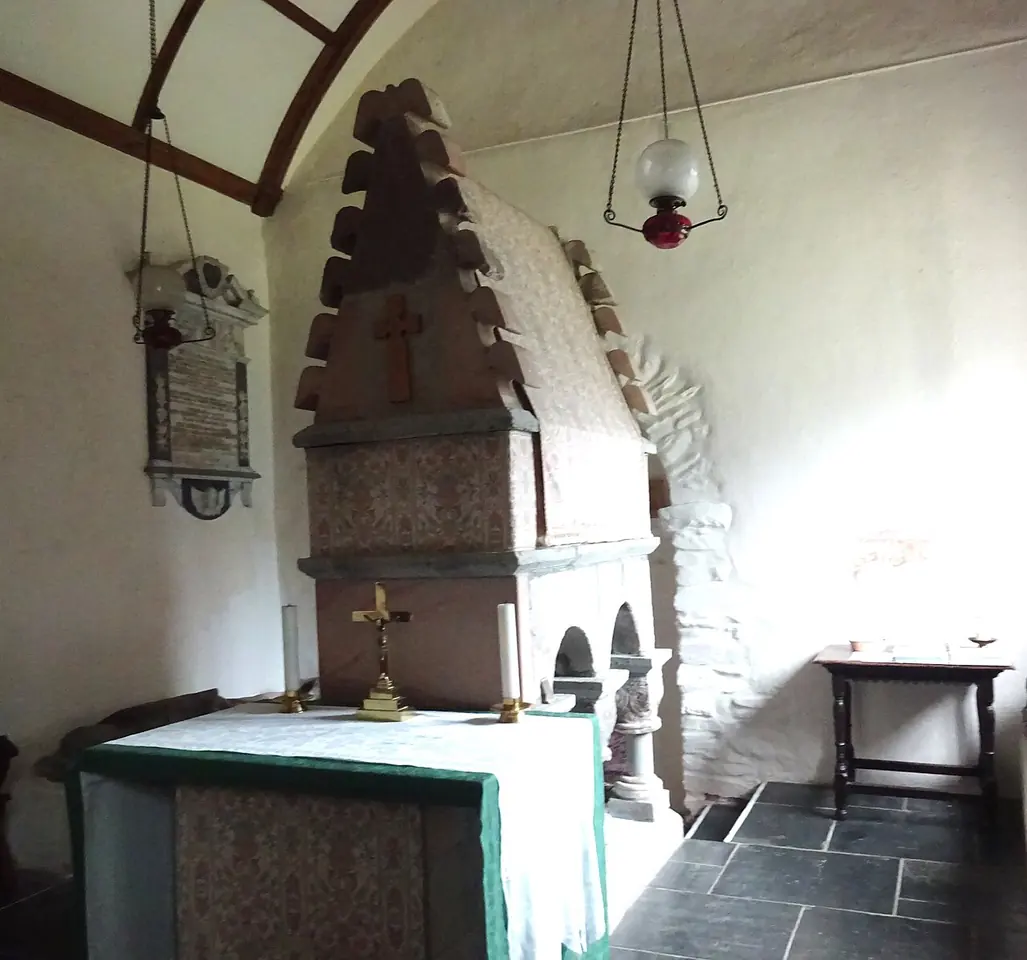
Melangell's stone shrine was built around 1160 to 1170 to hold her relics. In 1561 it was ordered demolished, and its carved stones were built into the lych-gate and the walls of the church. In 1989 the surviving stones were gathered and the shrine was rebuilt in the chancel, with the missing pieces made in plain concrete so that no one would mistake new for old.
Behind the chancel stood a small room called Cell y Bedd, "the cell of the grave," where tradition placed her burial. When it was excavated in 1958, and again in 1989, bones were found beneath its floor. A surgeon who examined them identified them as a woman about five feet tall. They now rest in the reconstructed shrine. Whether they are Melangell's no one can prove; we call them her claimed relics. The rebuilt apse stands on the original curved foundations found in 1989.
Across the valley, about a quarter of a mile south of the church, a cleft in the rock called Gwely Melangell, "Melangell's bed," is shown as the place where she slept.
Feast day and pilgrimage
Her feast is May 27. That was the day it was kept at Pennant Melangell, and it appears on that date in most medieval Welsh calendars and in the printed Welsh primers of 1546, 1618 and 1633. You can see other saints of late May on our feast days page.
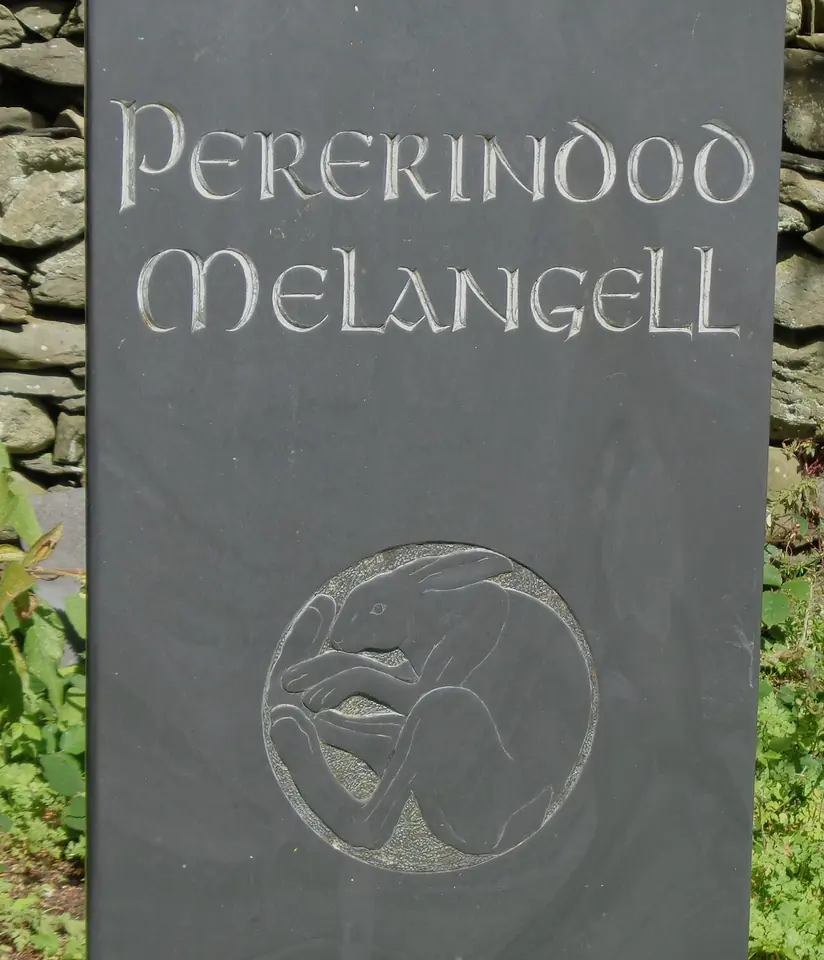
The church has always been a pilgrims' church. It is open every day for prayer, and its regular services include the Eucharist with prayers for healing. Slate markers carved with a hare mark the Pererindod Melangell, the Melangell pilgrimage.
Prayer to St. Melangell
No ancient prayer to St. Melangell has come down to us. What survives is the cry of the valley people over a hunted hare, recorded by Baring-Gould and Fisher: "Duw a Melangell a'th gadwo!", "God and Melangell preserve thee!"
When we ask her intercession, we pray simply, in our own words: that she who sheltered the hare will pray for the frightened and the hunted, for animals in danger, and for every place that gives refuge to people in need.
Frequently asked questions
Why is St. Melangell the patron saint of hares?
Her legend tells that Brochwel Ysgythrog, prince of Powys, was hunting a hare in the year 604 when it hid under her robe. His hounds would not touch it and backed away howling. The hares of the valley were afterward called Melangell's lambs, and for centuries no one in the parish would kill one. The story is traditional.
Where is St. Melangell's shrine?
In the Shrine Church of St. Melangell at Pennant Melangell, at the head of the Tanat valley near Llangynog in Powys, Wales. Her stone shrine, built around 1160 to 1170, was taken apart at the Reformation and rebuilt in 1989 from the surviving carved stones.
When is St. Melangell's feast day?
May 27, the day it was kept at Pennant Melangell and in most medieval Welsh calendars. Some Welsh manuscripts list her on January 31 or May 4.
Is Melangell the same as St. Monacella?
Yes. Monacella is the Latin form of her name used in her legend, the Historia Divae Monacellae. The Welsh call her Melangell, and the valley and village are named for her.
Sources
- Baring-Gould and Fisher, The Lives of the British Saints, vol. 3 (1911): S. Melangell, Virgin, Abbess
- Archaeologia Cambrensis, vol. 3 (1848): Pennant Melangell, Montgomeryshire, with the Latin text and translation of the Historia Monacellae
- The Shrine Church of Saint Melangell: Saint Melangell, patron saint of hares
- The Shrine Church of Saint Melangell: The Shrine Church