St. Mariana de Jesús de Paredes

St. Mariana de Jesús de Paredes (1618–1645), the Lily of Quito, was a young laywoman of Quito who lived a hidden life of prayer and penance in her family's home and, during the earthquakes and epidemic of 1645, offered her life to God for her city. She died at 26, was canonized by Pope Pius XII in 1950 as Ecuador's first saint, and is honored as a national heroine. We keep her feast on May 26.
Who was St. Mariana de Jesús de Paredes?
St. Mariana de Jesús de Paredes was a young laywoman of Quito, in present-day Ecuador, who never entered a convent and never left her city, yet gave her whole life to God in prayer, penance and love for the poor. In 1645, when earthquakes and an epidemic struck Quito, she offered her life for her people. She died a few weeks later at 26. The city called her the Lily of Quito, and in 1950 Pope Pius XII made her Ecuador's first canonized saint.
We keep her feast on May 26, the day of her death.

Her life
An orphan of Quito
Mariana was born in Quito on October 31, 1618, the youngest of eight children. Her father, Jerónimo Flores Zenel de Paredes, was a nobleman of Toledo and a militia captain; her mother, Mariana de Granobles y Jaramillo, came from a leading family of the city. Her father died when she was four, and her mother soon after. Her older sister Jerónima and Jerónima's husband, Cosme de Caso, took her in and raised her with their own daughters.
She was a cheerful child who loved music, played the vihuela well and was quick at her lessons. Prayer drew her from the beginning. At the age of ten, with her confessor's permission, she made private vows of poverty, chastity and obedience. Pius XII noted in his canonization homily that she was "scarcely ten" when she consecrated herself to her heavenly Spouse.
A hermit in her sister's house
Mariana longed first to carry the faith to distant peoples and then to enter a monastery. Both doors closed. The Catholic Encyclopedia says that "when God made it plain to her that He wished neither the one nor the other," she accepted his will and made a solitude for herself in her own home. She kept a strict rule of prayer, slept little, and fasted so severely that, by the sworn testimony of many witnesses, the Eucharist she received each morning was almost her only food.
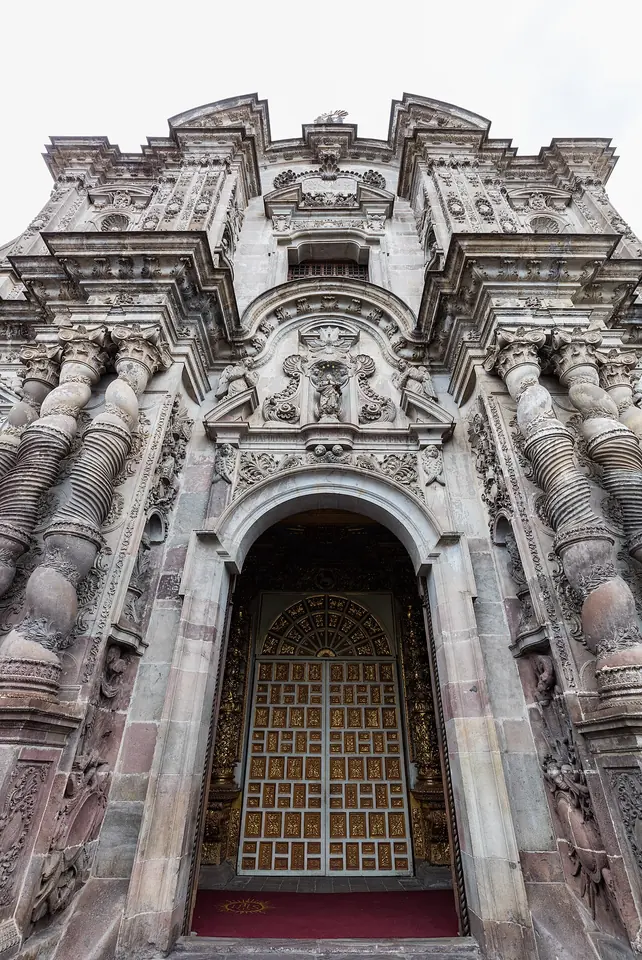
Her spiritual life centered on the Jesuit church of La Compañía, a short walk from her home, where her confessors were Jesuits. On their advice she also became a member of the Third Order of St. Francis, which gave her penitential life a recognized place in the Church. She took the name Mariana de Jesús.
Bread for the poor
Her life was hidden, not closed. The poor gathered at the door of her family's house at midday, and she gave them alms paid for by her own embroidery, which the ladies of Quito bought eagerly. Quito's El Comercio, drawing on her biographers, records her saying that God was pleased when "my poor eat from my work and effort." She washed and cared for the most neglected with her own hands.
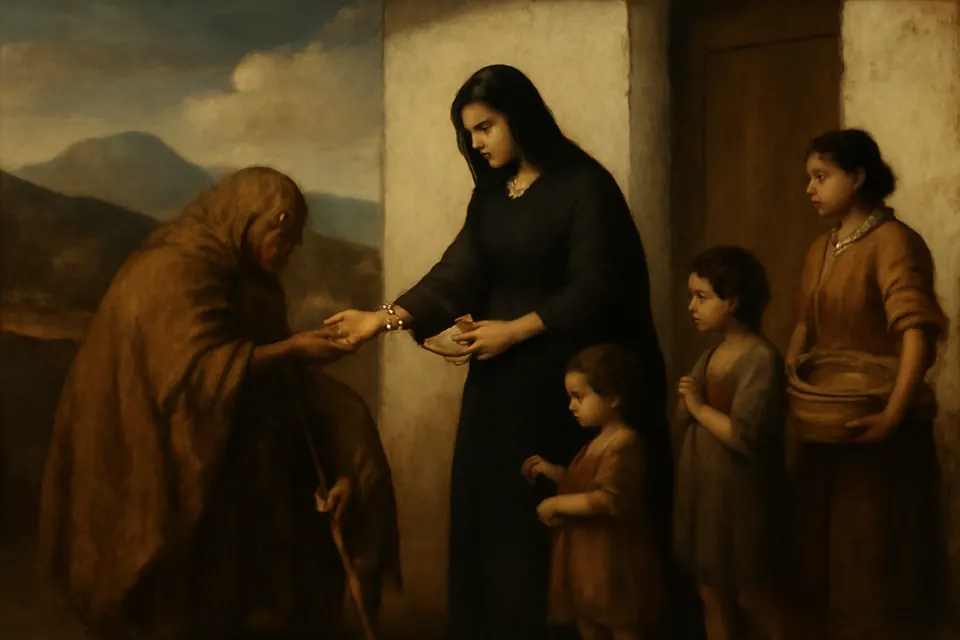
Her offering for Quito
In 1645 a series of earthquakes shook Quito, and an epidemic followed. According to the account kept in Quito, the Jesuit preacher Alonso de Rojas, preaching in La Compañía, offered his own life to God for the city. Mariana, kneeling in the church, offered hers instead. Pius XII named this at her canonization: through her penances "she offered herself to God as a victim" to obtain the salvation of others.
The earthquakes ceased and the sickness passed, and Mariana fell ill. She died on May 26, 1645. She was buried in La Compañía, the church where she had prayed every day.

The miracles of St. Mariana de Jesús
- Traditional: the Lily of Quito. The Catholic Encyclopedia records that immediately after her death a pure white lily sprang up from her blood and blossomed.
- Reported: in her lifetime, witnesses testified that she foresaw future events, read hearts, healed the sick with the sign of the cross or holy water, and at least once raised a dead person to life.
- Approved: two miracles worked through her intercession were examined and approved by the Congregation of Rites before her beatification in 1853.
Symbols of St. Mariana de Jesús in art
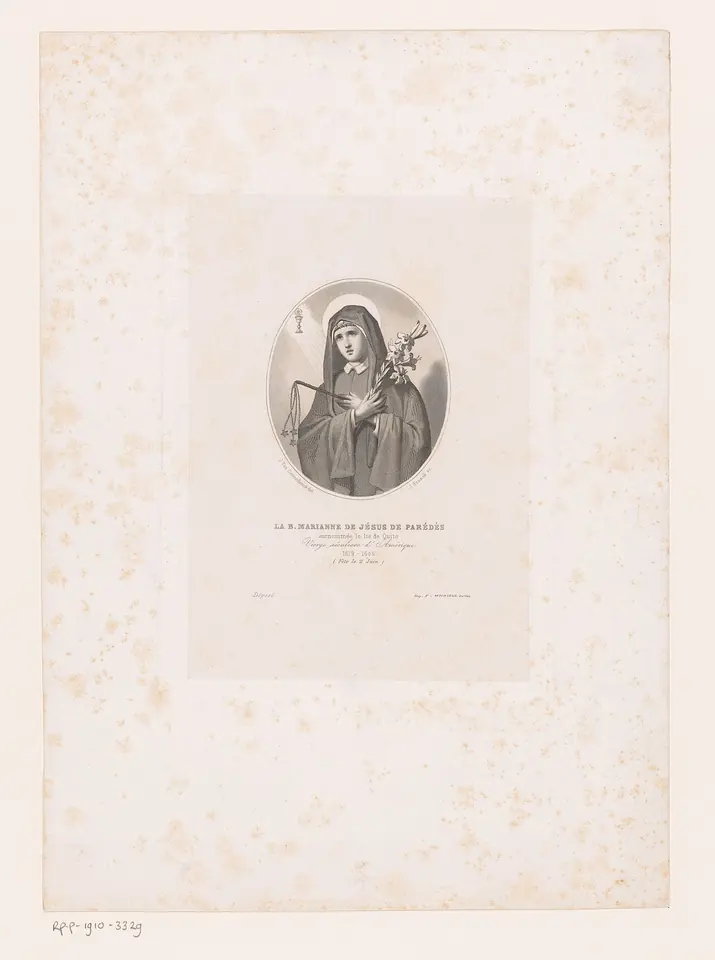
- White lily: her title, the Lily of Quito, and the flower that sprang from her blood.
- Skull: her constant meditation on death and eternity.
- Crucifix and scourge: her penance in union with Christ's Passion.
- Black mantle and veil: the dress of a devout laywoman of colonial Quito, not a nun's habit.
- IHS monogram: the name of Jesus, and her bond with the Jesuits.
The colonial engravings and paintings of Quito show her almost always the same way: a young woman in black, with a lily, a skull and a crucifix. Don't confuse her with Blessed Mariana de Jesús of Madrid, a Mercedarian nun of the same era; Vicente Carducho's painting of "Beata Mariana de Jesús" in the Prado is of her, not of the Lily of Quito.
Feast day and where she is honored
We keep her feast on May 26. Her remains rest under the main altar of La Compañía in Quito, in a chest given by President Gabriel García Moreno, and her personal belongings are kept in a reliquary at the altar of Our Lady of Loreto in the same church. Her family's house became, at her wish, the Carmelite monastery of El Carmen Alto, honoring St. Teresa of Ávila, whom she loved. Ecuador honors her as a national heroine. See the feast day calendar for other saints of May.
Prayer to St. Mariana de Jesús
There is no single traditional English prayer to St. Mariana de Jesús in the common prayer books; in Ecuador many prayers and novenas are said in her honor. Let us ask St. Mariana, Lily of Quito, to pray for Ecuador and for every city struck by earthquake or disease, for young people seeking God's will for their lives, and for all who give from their own work to feed the poor.
Frequently asked questions
Who was St. Mariana de Jesús de Paredes?
A laywoman of Quito, orphaned as a small child, who made private vows at ten, lived as a recluse in her sister's house under Jesuit direction, joined the Third Order of St. Francis, cared for the poor and sick, and offered herself as a victim for Quito in 1645. She died that year at 26.
Why is she called the Lily of Quito?
According to the Catholic Encyclopedia, right after her death a pure white lily sprang up and blossomed from her blood. The name also fits her purity of life.
When was St. Mariana de Jesús canonized?
Pope Pius IX beatified her on November 10, 1853, and Pope Pius XII canonized her on July 9, 1950. She was the first saint from what is now Ecuador.
Where is St. Mariana de Jesús buried?
Her remains rest under the main altar of the Jesuit church of La Compañía in Quito, where she prayed every day of her adult life.
Keep exploring
Sources
- Pius XII, Homily for the canonization of St. Mariana de Jesús de Paredes, July 9, 1950 (vatican.va, Latin). The canonization formula, the date of her feast and her offering of herself as a victim
- Catholic Encyclopedia (1910): Bl. Mary Anne de Paredes. Her fasting, gifts, the lily, and the steps of her cause to the 1853 beatification
- El Comercio (Quito): Mariana de Jesús, la Santa Alegre. Her family, her almsgiving, Fr. Alonso de Rojas's sermon and the place of her relics
- Our Sunday Visitor: Ecuador's first saint offered her life for the people of Quito. Her house becoming the Carmelite monastery of El Carmen Alto, and her title of national heroine