St. Simon Stock

St. Simon Stock was an English Carmelite friar who was elected prior general of the order at Aylesford in Kent in 1247 and led it through its hard first years in Europe. He died at Bordeaux on May 16, 1265. Carmelite tradition says Our Lady gave him the brown scapular. His feast day is May 16.
Who was St. Simon Stock?
St. Simon Stock was an English Carmelite friar of the 13th century, the prior general who led the young order of Our Lady of Mount Carmel through its hardest years in Europe. He was elected at Aylesford, in Kent, in 1247, and died at the Carmelite friary in Bordeaux on May 16, 1265. Most Catholics know his name from one story: that the Virgin Mary appeared to him holding the brown scapular of the order and promised her protection to everyone who wore it.
That story is traditional, written down long after his death, and we will look at it honestly below. But Simon himself was a real man, and the little that is certain about him is worth knowing. The Catholic Encyclopedia (1912) calls him "the most celebrated" of the order's generals.
He is also called Simon Anglus, "Simon the Englishman." The origin of the surname Stock is unknown.
What history can say about St. Simon Stock
A hermit order comes to Europe
The Carmelites began as Latin hermits living on Mount Carmel in the Holy Land at the end of the 12th century, beside a spring and a small chapel of Our Lady. As the crusader kingdom weakened in the 13th century, they began moving to Europe, and England was one of their first homes. The Kent Historic Environment Record dates the Carmelite house at Aylesford, on the River Medway in Kent, from 1242.
In Europe the hermits found themselves in trouble. They had no place in the Church's plans, the bishops and parish clergy were suspicious of them, and the established orders saw them as rivals. To survive they had to become something else: friars, living in towns, preaching and studying, like the Franciscans and Dominicans.
Prior general from 1247
The Catholic Encyclopedia puts it plainly: "All that is historically certain is that in 1247 he was elected the sixth general of the Carmelites, as successor to Alan, at the first chapter held at Aylesford, England." It adds that he was already very old and showed "remarkable energy" all the same.

Under his leadership the order spread quickly through southern and western Europe, especially in England. Simon saw that the future lay in the universities, and he founded houses in the great university towns: Cambridge in 1248, Oxford in 1253, and Paris and Bologna in 1260. That decision trained the order's young friars and gave the Carmelites a place in the intellectual life of the Church for centuries.
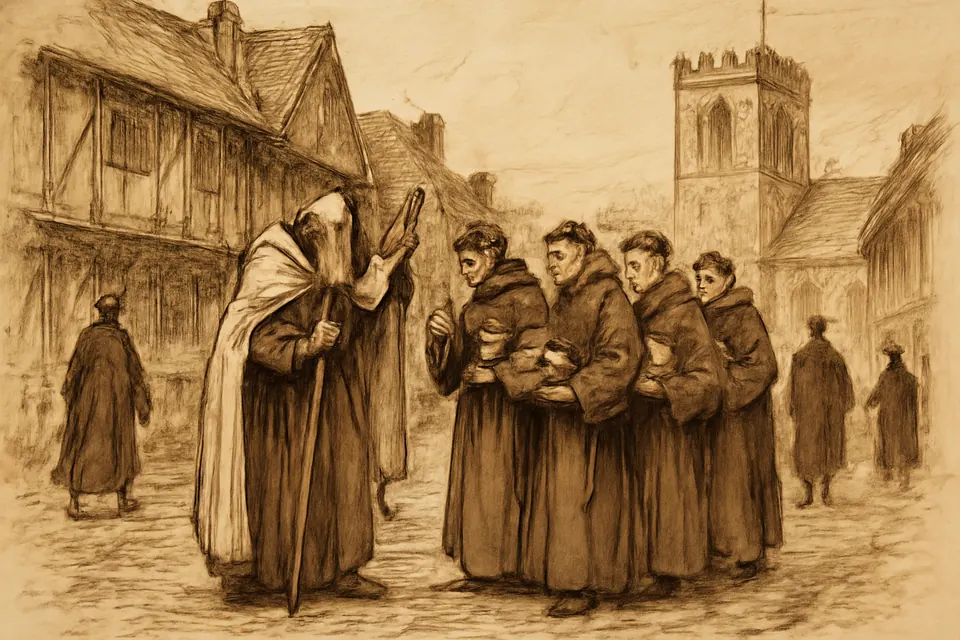
He also obtained from Pope Innocent IV at least a temporary approval of the order's rule, newly adapted to life in Europe. Opposition went on. A Carmelite chronicler, William of Sanvico, writing shortly after 1291, tells how the friars turned to their patroness in prayer: "And the Virgin Mary revealed to their prior that they were to apply fearlessly to Pope Innocent, for they would receive from him an effective remedy for these difficulties." The prior did so. On January 13, 1252, at Perugia, Innocent IV issued a letter protecting the Carmelites from harassment. That letter is a documented fact.
Death at Bordeaux
Simon died on May 16, 1265, while visiting the friary at Bordeaux, in the Carmelite province of Gascony. The Order of Carmelites' own summary of his life says miracles were recorded by those who visited his tomb, that a local cult grew up at Bordeaux in the 14th century, and that his feast spread to the whole order in the 16th. According to the Catholic Encyclopedia, his feast entered the choir books at Bordeaux in 1435, reached Ireland before 1458 and probably England at the same time, and was ordered for every Carmelite house by the general chapter of 1564.
Legends of St. Simon Stock
The first lives of Simon date from around 1430, more than 160 years after his death, and the Catholic Encyclopedia says they "are not entirely reliable." These details come from that later tradition and are traditional:
- Born in Kent about 1165. The Catholic Encyclopedia gives this date and place. If it were true, Simon would have been over eighty when he was elected and about a hundred when he died. The Carmelites today treat the Kent birth as a later addition.
- The boy hermit in the oak. "It is said that when twelve years old he began to live as a hermit in the hollow trunk of an oak," the Catholic Encyclopedia reports, "and later to have become an itinerant preacher." Since "stock" is an old English word for a tree trunk, the story and the surname have often been tied together. The Order of Carmelites lists the tree trunk among the "invented" details.
- A pilgrimage to Rome and years on Mount Carmel before he joined the order in England.
The brown scapular and St. Simon Stock
The vision
The account that made Simon famous first appears in writing around 1430, in the Viridarium of the Carmelite John Grossi. The Catholic Encyclopedia gives Grossi's Latin and an English version of Mary's words as she held out the scapular of the order: "Hoc erit tibi et cunctis Carmelitis privilegium, in hoc habitu moriens salvabitur" (This shall be the privilege for you and for all the Carmelites, that anyone dying in this habit shall be saved).
Grossi adds that because of this privilege, King Edward II of England, Henry, Duke of Lancaster, and other nobles secretly wore the Carmelite scapular under their clothes and died in it. The longer and best-known form of the promise, set at Cambridge on July 16, 1251 ("whoever dies in this garment, will not suffer everlasting fire"), first appears in 1642.

What the scapular meant in Grossi's day
The Catholic Encyclopedia makes an important point: in Grossi's story, "the scapular of the order must be taken to mean the habit of the Carmelites and not as the small Carmelite scapular." Medieval orders gave their habit, or at least its scapular, to benefactors and friends so that they could share in the order's prayers. The two little squares of brown wool on cords came later, probably not before the 16th century, as a sign of the scapular confraternity.
What historians say
Here the honest answer matters. The 1912 Catholic Encyclopedia already admitted that Grossi's narrative and the tradition "have not the full value of historical proof," while holding them "worthy of belief." Modern scholarship has gone further. The Carmelite historian Richard Copsey, writing in the Journal of Ecclesiastical History in 1999, studied how little is firmly known about Simon Stock and how the stories grew. The Order of Carmelites now explains that around 1400 a separate story circulated in the Low Countries of a "holy Simon" to whom Our Lady gave the scapular with the words, "This is a privilege for you and your brethren: whoever dies wearing it, will be saved." Within a few years the two Simons were merged, and the prior general was credited with the vision. The order's own page says the vision's historicity is rejected.
None of this takes the scapular away from us. The Church approves the brown scapular as a sacramental, not because of the vision but because of what it is: a small habit, a sign of belonging to Mary and of the promise to live as her child and as a follower of her Son. The Carmelites still say the scapular stands for Mary's motherly protection and a personal commitment to follow Jesus as she did. For the full story, the promise rightly understood and how to be enrolled, see our guide to the brown scapular and our page on Our Lady of Mount Carmel.
The miracles of St. Simon Stock
Sorted by this encyclopedia's labels:
- The scapular vision: traditional. First written down around 1430; its historicity is rejected by the Carmelite Order itself, though the devotion it inspired is approved.
- Mary's counsel to appeal to the pope: traditional, but early. William of Sanvico recorded it within about thirty years of Simon's death, and the papal letter that followed is real.
- Miracles at his tomb in Bordeaux: reported. The Carmelites' account says visitors recorded miracles there; none was formally examined, since his cult began before modern canonization procedures.
No miracle of St. Simon Stock has been approved in the formal sense.
Why St. Simon Stock is the patron of the Carmelites and of scapular wearers
Simon is not the founder of the Carmelites. The order has no single founder: it grew from the hermits on Mount Carmel, who received their rule from St. Albert, patriarch of Jerusalem. But Simon is the general who carried the hermits through their transformation into a European order of friars, and for six centuries Carmelites have honored him as the father of that second birth. Because the scapular tradition is tied to his name, everyone enrolled in the brown scapular, members of the scapular confraternity and the lay Carmelites, looks to him as a patron as well.
Symbols of St. Simon Stock in art
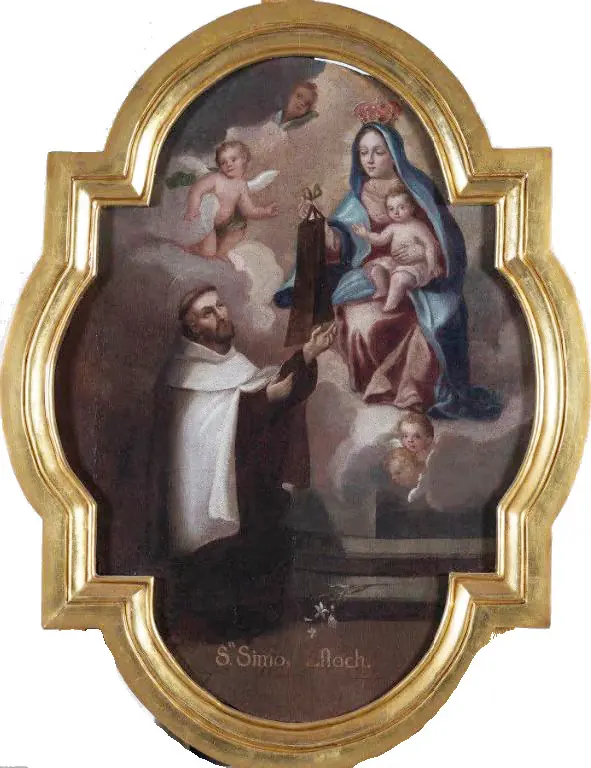
Simon is almost always painted in one scene, receiving the scapular. To recognize him:
- An old friar with a long white beard, often bald, kneeling. Artists followed the tradition that he was very old as prior general.
- The Carmelite habit: brown tunic and scapular with a white or cream cloak over them. Spanish and Latin American paintings sometimes show the habit as dark brown or black.
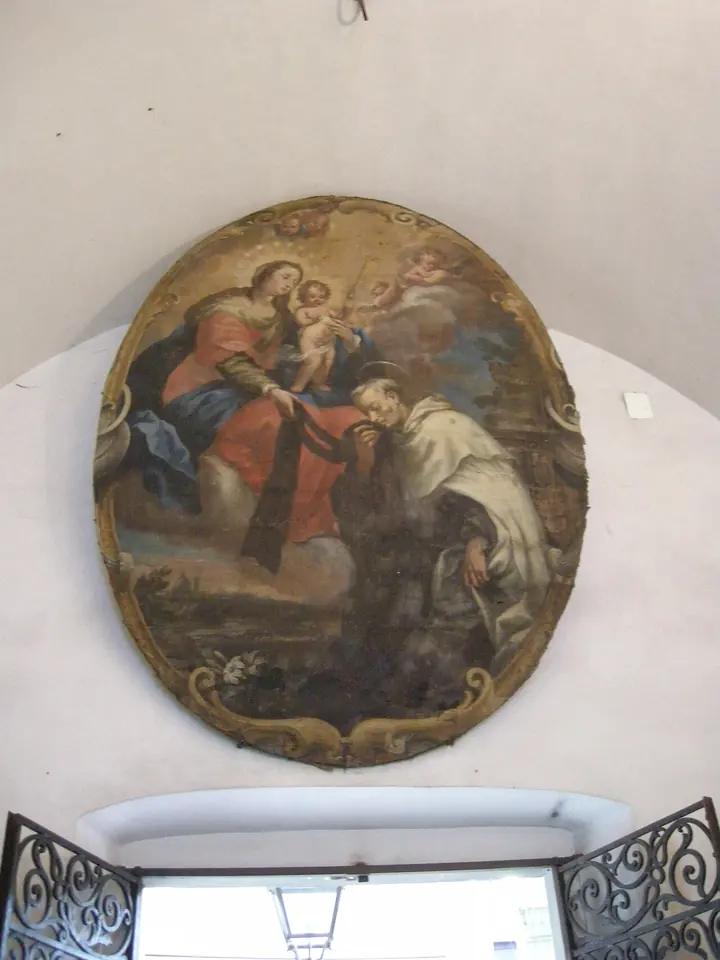
- The Virgin, usually with the Child, holding out a brown scapular from the clouds. In some paintings the Child Jesus holds it, and in some, like Berdusán's, Mary lays it on Simon's shoulders herself.
- Souls in purgatory at the bottom of the picture, reaching up toward the scapular. This detail belongs to the later Sabbatine tradition, not to Simon's own story.
- A lily or flowering branch, recalling the Flos Carmeli, the "Flower of Carmel" hymn attributed to him.
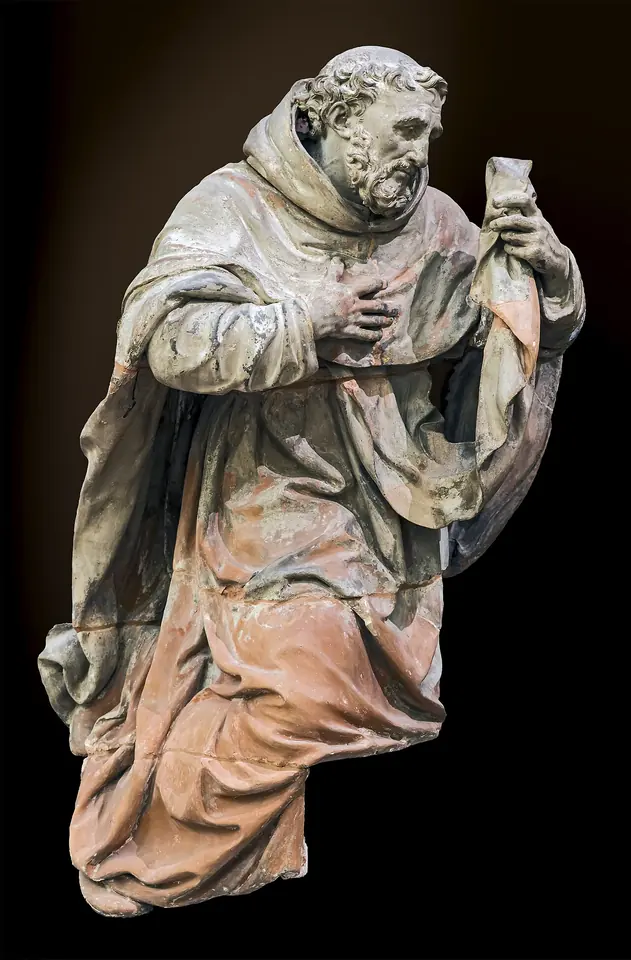
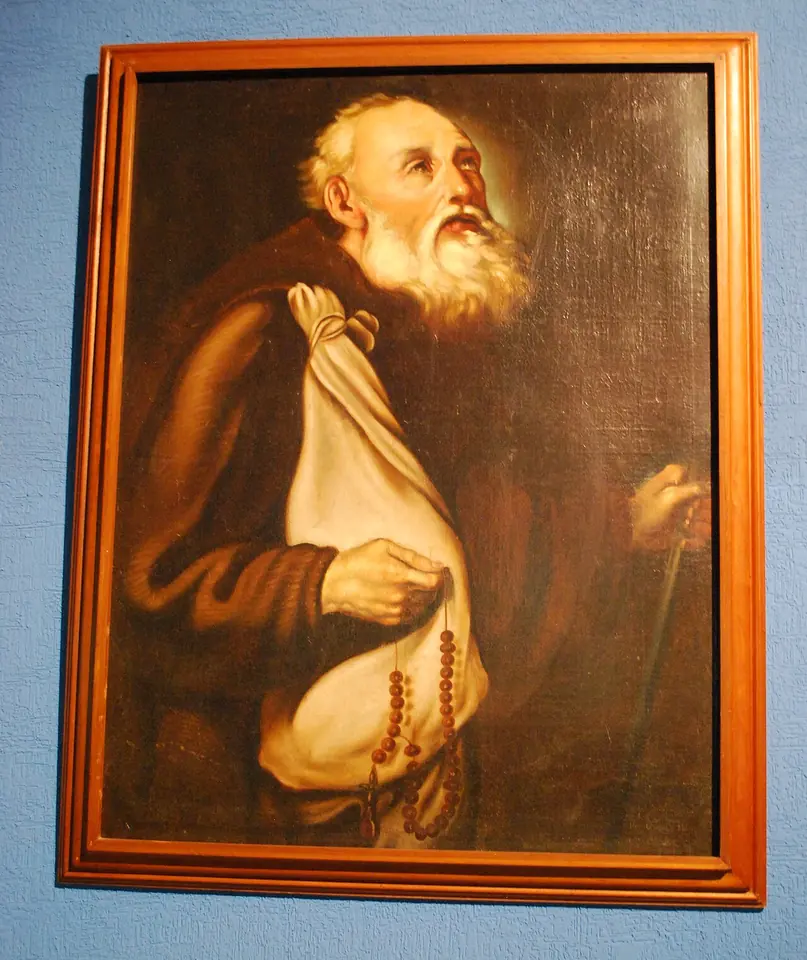
Marc Arcis's terracotta statue in Toulouse shows him alone, without the Virgin: an old man holding the scapular up as if he had just received it, his face turned toward heaven. A painting in the regional museum at Tuxtla Gutiérrez, in Chiapas, Mexico, does the same, with a rosary hanging beside the scapular.
For other Carmelite saints in art, see St. Teresa of Ávila, St. John of the Cross, St. Thérèse of Lisieux, St. Edith Stein and St. Titus Brandsma.
What St. Simon Stock's scapular asks of us
In 2001 the Carmelites kept a Marian year for what John Paul II called, choosing his words carefully, "the 750th anniversary of the bestowal of the Scapular," dated "according to a venerable tradition of the Order itself." His message to the order for that year is the best short guide we have to living the devotion Simon's name is joined to.
"The Scapular is essentially a 'habit,'" the Pope wrote. Those who receive it are joined in some measure to the Carmelite family and give themselves to Our Lady's service. He drew two truths from the sign. The first is "the constant protection of the Blessed Virgin, not only on life's journey, but also at the moment of passing into the fullness of eternal glory." The second is that devotion to her "cannot be limited to prayers and tributes in her honour on certain occasions, but must become a 'habit', that is, a permanent orientation of one's own Christian conduct, woven of prayer and interior life, through frequent reception of the sacraments and the concrete practice of the spiritual and corporal works of mercy."
That is a fair description of Simon's own life as history knows it: an old man who kept praying, kept working and kept trusting Mary while his order fought to survive. Then John Paul II added a line of his own: "I too have worn the Scapular of Carmel over my heart for a long time!"
So when we put on the scapular, or renew our enrollment, we are not buying a charm. We are putting on the habit of a family that has prayed to the Flower of Carmel for eight hundred years, and asking its old prior general to pray that we wear it well.
Feast day, relics and Aylesford
May 16
His feast is May 16, the day of his death. It is an optional memorial in the Carmelite calendar and an obligatory memorial for the Carmelites of Great Britain. The feast was dropped in the calendar reform after Vatican II and later restored. You can find other saints of mid-May on our feast days calendar, including St. Paschal Baylon the next day.
From Bordeaux to Aylesford
His body stayed at Bordeaux. When the Carmelite prior general Henry Silvio visited Gascony in the 16th century, his secretary recorded that the body of St. Simon Stock was "contained intact in a painted casket, set in an elevated position in a special chapel." Wars had destroyed the friary's records, and the old friars, aged 85 and 90, could testify only that the relics had always been venerated as Simon's.
Aylesford passed out of Carmelite hands at the Reformation. In 1949 the Carmelites bought it back. They kept the seventh centenary of the scapular tradition from July 16, 1950, to July 16, 1951, and Pope Pius XII wrote the letter Neminem profecto latet for it on February 11, 1950. The year ended at Aylesford on July 14–16, 1951, with what the order calls "the solemn return of the relics": Simon's skull, given by the Archbishop of Bordeaux, came home to England. Cardinal Adeodato Piazza presided, and the Carmelites record 25,000 pilgrims, among them Éamon de Valera, then leading the government of Ireland.

The shrine and the Relic Chapel
The friars then built a great open-air shrine designed by Adrian Gilbert Scott between 1958 and 1965, with ceramics and furnishings by the Polish artist Adam Kossowski. The Relic Chapel was finished in 1963, and in 1964 the skull was moved into Kossowski's reliquary: an exedra of white and gold ceramic tiles about eleven feet high, showing Mount Carmel, with kneeling angels guarding a central grille that holds the relic. An oak statue of St. Simon Stock by Philip Lindsey Clark stands behind it. In the nearby Chapel of Carmelite Saints is a medieval carving of the scapular vision, acquired in 1951.
Where the relics of St. Simon Stock are kept: see them on the relics map →
Prayer to St. Simon Stock
The Church's prayer on his feast is the collect of the Carmelite proper, given by the Irish Carmelites:
Father, you called St. Simon Stock to serve you in the brotherhood of Our Lady of Mount Carmel. Through his prayers help us like him to live in your presence and to work for the salvation of the human family. We ask this through Christ our Lord.
The Flos Carmeli
The hymn long attributed to Simon is the Flos Carmeli, "Flower of Carmel," which Carmelite communities sing every day. Whether or not Simon wrote it, it is the prayer of his order to the Mother he served. These are its first two stanzas, in Latin and in the English version given by Fr. Nicholas Blackwell, O.Carm.:
Flos Carmeli, vitis florigera, splendor caeli, Virgo puerpera singularis. Mater mitis, sed viri nescia, Carmelitis, esto propitia, Stella maris.
Flower of Carmel, tall vine blossoming laden; Splendor of heaven, child-bearing yet maiden. None equals thee. Mother so tender, who no man didst know, on Carmel's children thy favors bestow. Star of the Sea.
Let us ask St. Simon Stock to pray for us, that we may wear Mary's habit, whether in cloth or in our hearts, as he did: humbly, faithfully, and to the end.
St. Simon Stock, pray for us.
Frequently asked questions
Who was St. Simon Stock?
An English Carmelite who became the order's sixth prior general at a chapter held at Aylesford, Kent, in 1247. He founded Carmelite houses in the university cities of Cambridge, Oxford, Paris and Bologna and won papal protection for the struggling order. He died at Bordeaux, France, on May 16, 1265.
What did Our Lady promise St. Simon Stock?
The oldest written form of the tradition, by the Carmelite John Grossi around 1430, has Mary say: "This shall be the privilege for you and for all the Carmelites, that anyone dying in this habit shall be saved." A longer version, dated to July 16, 1251, says "whoever dies in this garment, will not suffer everlasting fire." The account is traditional: it was first written down long after Simon's death. The Church approves the scapular itself as a sacramental.
When is the feast of St. Simon Stock?
May 16, the day he died. It is kept in the Carmelite calendar as an optional memorial, and as an obligatory memorial by the Carmelites in Britain. It is not on the General Roman Calendar.
Was St. Simon Stock canonized?
Not through a formal canonization process, which did not yet exist in its modern form when his cult began. He was honored as a saint at Bordeaux, where his feast was in the choir books by 1435, and the Carmelite general chapter of 1564 ordered it kept by the whole order.
Where are St. Simon Stock's relics?
His skull is at The Friars, Aylesford Priory, in Kent, England, where it was brought from Bordeaux in July 1951. Since 1964 it has rested in a ceramic reliquary made by the Polish artist Adam Kossowski in the shrine's Relic Chapel.
Did St. Simon Stock write the Flos Carmeli?
Tradition says so, and the Catholic Encyclopedia (1912) accepted it, but the Order of Carmelites now notes that the hymn appears in the 14th century and can't be shown to be his. Carmelites sing it every day.
Why is he called Simon Stock?
No early source explains the name. A late legend says he lived as a boy hermit in the hollow trunk of an oak, and "stock" is an old English word for a tree trunk, so the two are often linked. The Carmelites themselves treat the hollow-tree story as a later addition.
Is there a prayer to St. Simon Stock?
Yes, the collect of his feast in the Carmelite proper: "Father, you called St. Simon Stock to serve you in the brotherhood of Our Lady of Mount Carmel." The full text is in the prayer section below.
Keep exploring
Sources
- Catholic Encyclopedia (1912): St. Simon Stock
- Order of Carmelites (O.Carm.): St. Simon Stock, Religious
- Order of Carmelites (O.Carm.): The Relics of St. Simon Stock from Bordeaux to Aylesford
- Richard Copsey, O.Carm., Simon Stock and the Scapular Vision, Journal of Ecclesiastical History 50, no. 4 (1999): 652–683
- Kent Historic Environment Record: Shrine of Our Lady of Mount Carmel and St Simon Stock, Aylesford (TQ 75 NW 415)
- Pope John Paul II, Message to the Carmelite Order (March 26, 2001)
- Irish Carmelites: Saint Simon Stock (with the collect of his feast)
- Nicholas Blackwell, O.Carm., Flos Carmeli: The Tapestry of Our Lady of Mount Carmel