St. William of Gellone
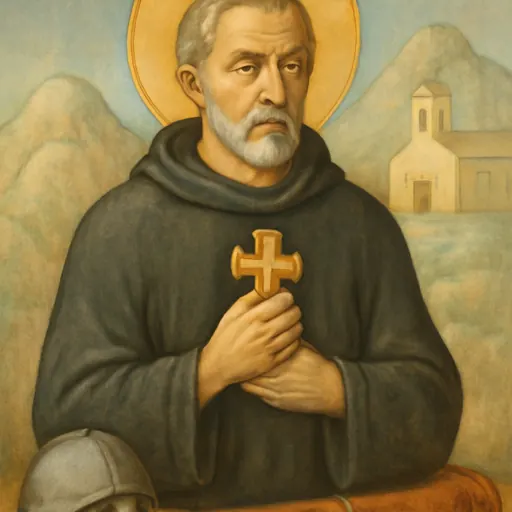
St. William of Gellone (Guilhem, about 755–812) was a cousin of Charlemagne, Count of Toulouse and a leading Frankish commander against the Muslim armies of Spain. In 804 he founded the abbey of Gellone in southern France, and in 806 he became a monk there himself, doing the humblest work of the house until his death. His feast day is May 28.
Who was St. William of Gellone?
St. William of Gellone, called Guilhem in the south of France, was one of Charlemagne's great captains who ended his life as a monk washing pots and baking bread. Born around 755 to Count Theoderic and his wife Aldana, he was a kinsman of Charlemagne and grew up at the Frankish court. In 790 Charlemagne made him Count of Toulouse, and for the next fifteen years he guarded the southern frontier of the Frankish realm against the Umayyad emirs of Córdoba.
In 804 he founded a monastery in the rocky valley of Gellone, near Lodève in Languedoc, and in 806 he left the world and entered it. He died there on May 28, around 812. The village that grew up around his abbey is called Saint-Guilhem-le-Désert to this day.

The Catholic Encyclopedia notes that his life is told in two forms: in the epic poems of the 12th century, and "in a more reliable form" in a Latin life written by an anonymous monk of Gellone, which Mabillon and the Bollandists printed. The English-born Benedictine historian Orderic Vitalis copied an abridgment of that life into his Ecclesiastical History in the 12th century, when a monk of Winchester brought a copy to his abbey in Normandy. Orderic's version is the source for most of what follows.
The life of St. William
Charlemagne's count
Orderic's source says William "was taught letters from his childhood," then took up arms in Charlemagne's service and rose to command. In 790 he replaced the disgraced Count Chorso at Toulouse and became the chief defender of the young kingdom of Aquitaine, which Charlemagne had given to his son Louis, then still a boy.
In 793 a large army from Córdoba crossed the Pyrenees, reached Narbonne and pushed on toward Carcassonne. William met it on the Orbieu River and was beaten, but his men fought so hard that the invaders turned back to Spain. In 801 he was one of the commanders, with King Louis, of the Frankish army that took Barcelona after a long siege. Orderic's 19th-century translator called the capture of Barcelona his "most remarkable exploit."
William was married twice and had several children. One of his sons, Bernard of Septimania, became one of the most powerful men of the next generation.
The founding of Gellone
William had a friend from his youth named Witiza, a Visigothic nobleman who had left the army to become a monk and taken the name Benedict. This was St. Benedict of Aniane, the great reformer of Benedictine life under Charlemagne and Louis. Benedict's monastery at Aniane stood on the Hérault River, and in 804, on his advice, William founded a new monastery a few miles away, in the narrow gorge of Gellone. He dedicated it to the Holy Savior and the twelve apostles and placed it under the abbot of Aniane. Orderic's source adds that his two sisters, Albana and Bertha, became nuns there.
Leaving the world
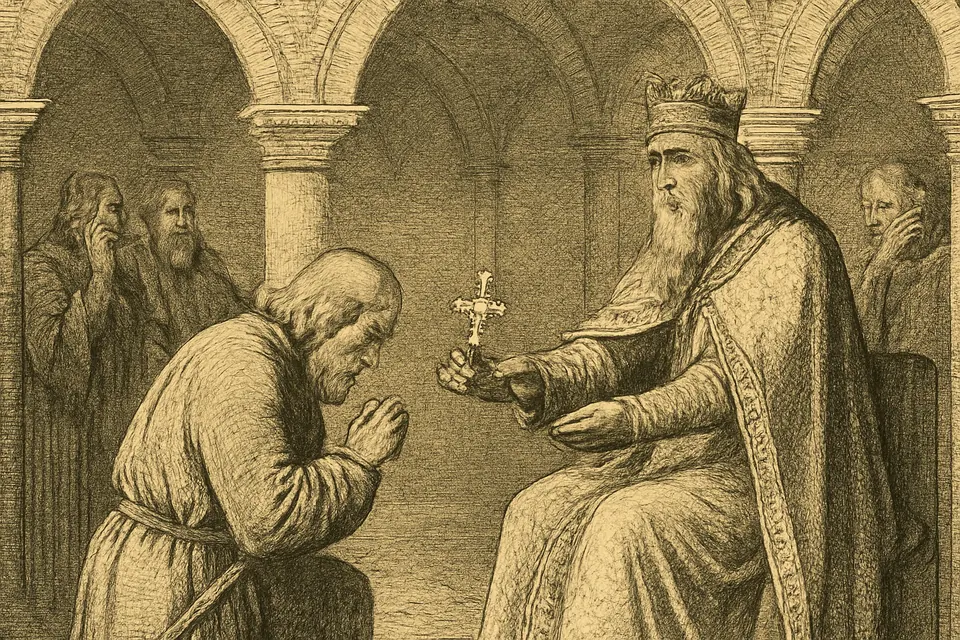
In 806 William went to Charlemagne's court and asked leave to become a monk. Orderic's source says the emperor "could not refrain from tears in granting his permission" and told him to take whatever he wanted from the treasury for his church. William refused gold and asked for one thing: a reliquary containing a piece of the wood of the Holy Cross, which Zachariah, Patriarch of Jerusalem, had sent to Charlemagne.
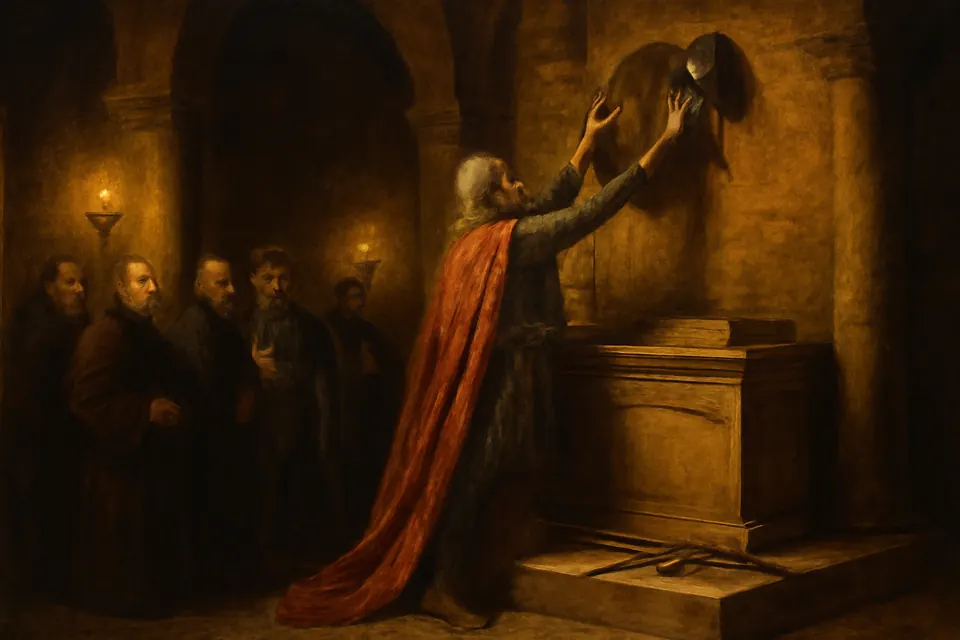
On his way south he stopped at a church of the martyr St. Julian and laid his armor on the altar, hanging his helmet and shield over the martyr's tomb and leaving his quiver, bow, lance and sword as an offering to God. Then, the life says, he walked on to Gellone "with naked feet and with hair-cloth about his body." The monks came out to meet him in procession, against his wishes. He took the habit on the feast of Sts. Peter and Paul, June 29, 806.
The duke who became a cook
What the old life loves most is William's humility as a monk. He "suffered blows and injuries unresistingly," Orderic's version says, and asked for the lowest jobs in the house. "See the Lord William from a count become a cook, from a duke become a menial, loading his shoulders with faggots, carrying vessels of water, lighting and extinguishing fires." He washed the bowls, gathered the vegetables, made the soup, baked the bread and rode out on a donkey loaded with water jars. He also finished the monastery buildings, cut a road through the rocks to reach it, and planted vines, olives and fruit trees on the slopes around it.

Eventually his abbot forbade him any more servile work and gave him a cell for prayer. "Having performed the service and busy occupations of Martha," the life says, "he joined with Mary in the delights of heavenly contemplation."
His death
The life says William foresaw the day of his death, told the abbot and brethren, and sent word to Charlemagne. He died on May 28, and his monks buried him in the abbey church near the cell where he had lived.
The miracles of St. William
The miracles in William's life come from the monastic life of the saint, written down long after his death. Sorted by the labels this encyclopedia uses:
- The oven: traditional. One day, short of firewood and scolded because dinner was late, William threw twigs and straw into the oven, made the sign of the cross, stepped inside and raked out the burning ashes with his bare hands, gathering them in his cowl, and came out with neither body nor habit scorched.
- The bells: traditional. At his death, the life says, the bells of the churches in the surrounding country rang for a long time though "no human hands pulled the ropes."
- Healings at his tomb: reported. Orderic's source says crowds of sick people received health there "by the merits of St. William." Pilgrims kept coming for centuries, but no cure has been formally examined by the Church.
St. William of Gellone and William of Orange
Within a few centuries, the real Count William had become a legend. Orderic already knew "a story in verse concerning St. William which is commonly sung by glee-men," though he preferred the monks' sober life. That verse story grew into the cycle of Guillaume d'Orange: some two dozen chansons de geste, the oldest probably from the 11th or early 12th century, which the Saint-Guilhem town hall counts at more than 130,000 lines in all.
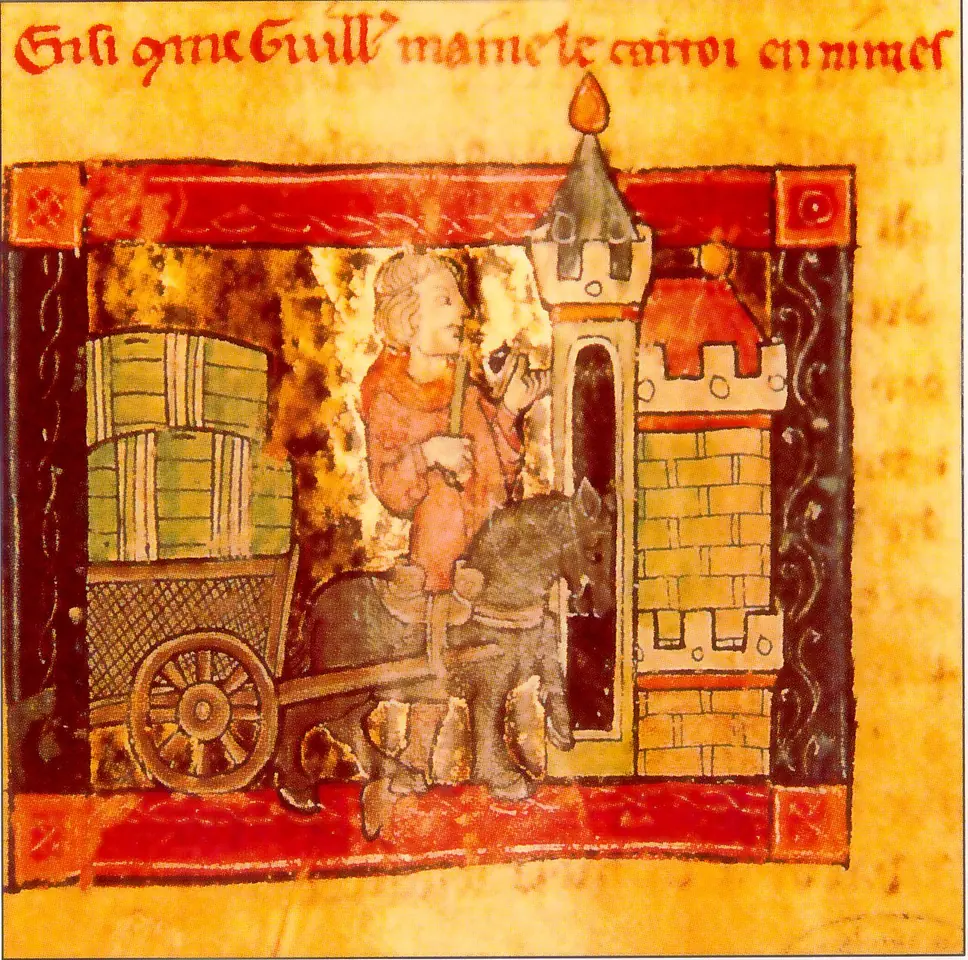
In the poems William is Guillaume Fierebrace (Strong-Arm) and Guillaume au court nez, "Short-Nose," after a giant clipped his nose in battle. He takes the city of Nîmes by smuggling his knights inside wine barrels (Le Charroi de Nîmes), captures Orange and marries its Saracen queen, who is baptized Guibourc (La Prise d'Orange), and in Le Moniage Guillaume retires to a monastery where he proves far too much for his fellow monks. None of this is history. The real William never took Orange, and the Muslim raids of his day don't seem to have reached the Rhône at all.
Symbols of St. William of Gellone in art
William appears in art in two quite different ways: as the warrior-saint of the epics and as the humble monk of Gellone. Look for:
- Armor, helmet and weapons laid aside: the most telling sign, from the offering of his arms before he entered the cloister. In the 1455 Book of Hours at the top of this page, his helmet and crossed weapons lie at his feet while he preaches in a Benedictine habit.
- The black Benedictine habit: for the monk he became.
- A banner: the cataloguers of the Koninklijke Bibliotheek list armor, banner and helmet as his usual attributes.
- The reliquary of the True Cross: in images connected with Gellone, for Charlemagne's parting gift.
One warning when you look for him in museums. Pictures labeled "St. William of Aquitaine," especially Baroque paintings of a weeping knight in armor beside a skull and crucifix, often show a different penitent: Duke William X of Aquitaine, whose conversion was credited to St. Bernard of Clairvaux, blended in legend with St. William of Maleval. Check the date and the story before you give such a picture to William of Gellone.
Saint-Guilhem-le-Désert and his relics
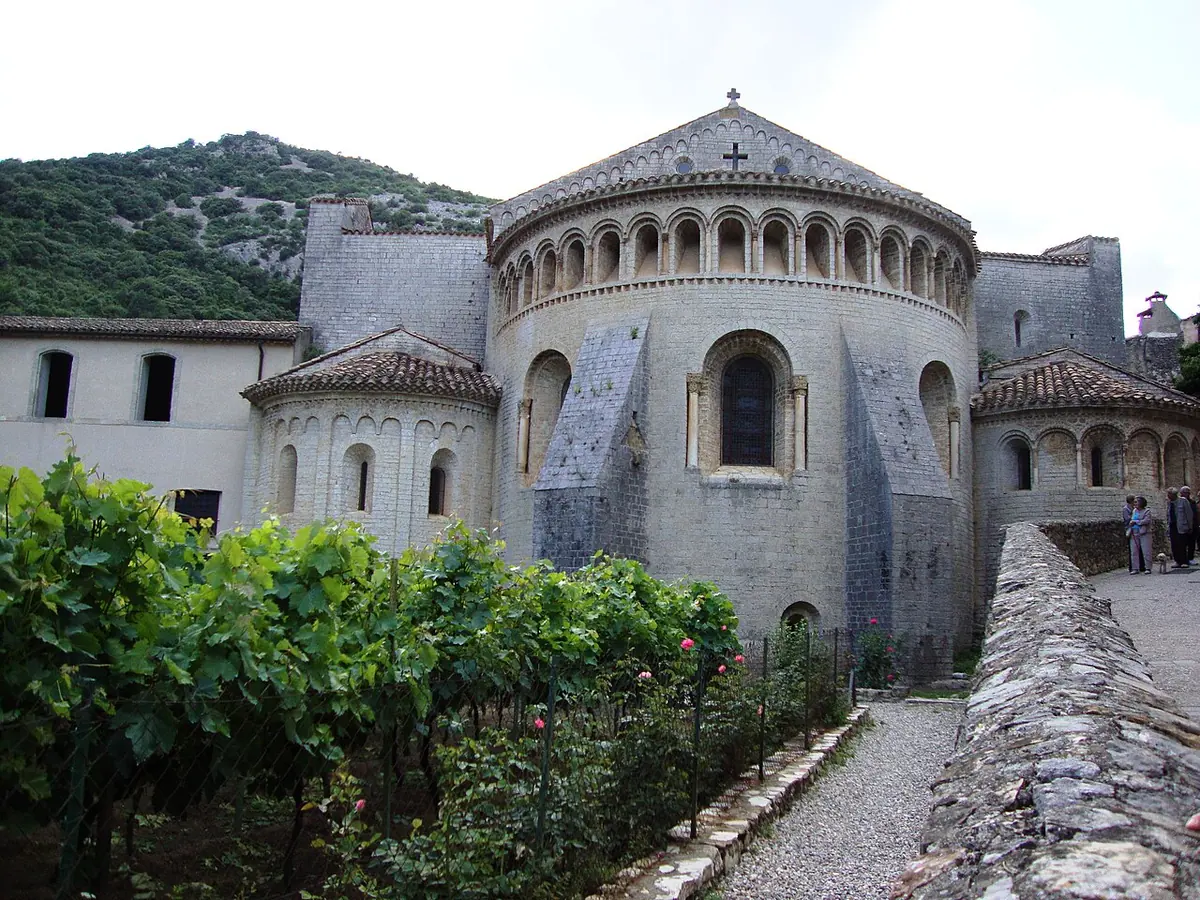
The monks of Gellone began to honor William as a saint by the 10th century, according to the village's own history, and around the year 1000 they moved his tomb under the main choir of the abbey church to make room for pilgrims. In 1138 his body was raised again and placed in a new shrine in the choir. Later tradition credits Pope Alexander II with formally canonizing him in 1066. By the 12th century the valley itself had taken his name: Saint-Guilhem-le-Désert, "the desert" meaning the solitude William went there to find.
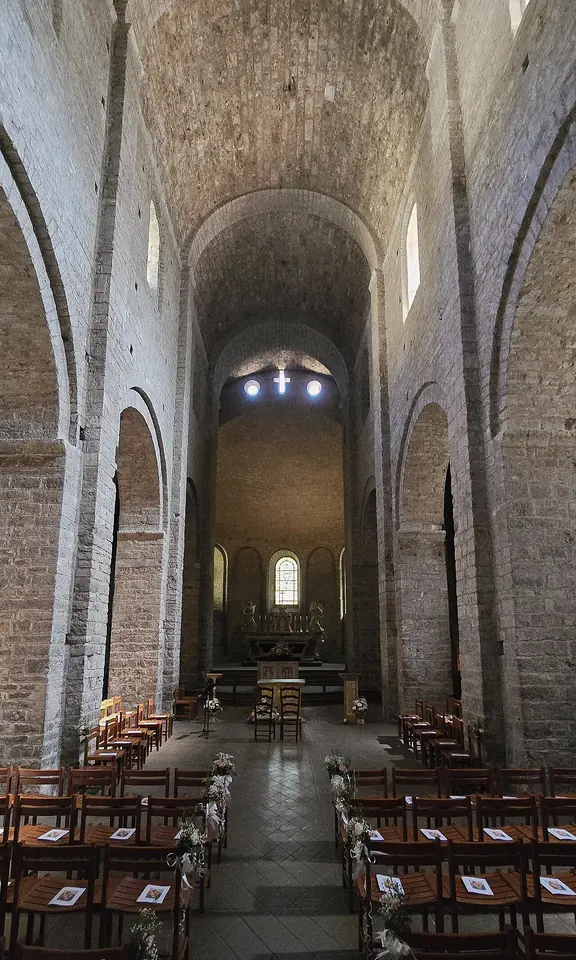
Gellone became a major stop on the road to Santiago de Compostela, and pilgrims bound for Spain turned aside to pray before William's tomb and the True Cross relic. The abbey church is part of the Routes of Santiago de Compostela in France on the UNESCO World Heritage list. Today, according to the town, William's relics rest in a 19th-century goldsmith's reliquary in a niche of the eastern pillar on the left side of the nave. The True Cross relic is kept opposite, on the right, in a silver reliquary made in Lyon in 1862.
Each year, on a Sunday in early May, the village keeps the feast of the Cross. The relic is honored at the main altar during a solemn Mass and venerated until evening, and small cross-shaped breads are blessed and given out in memory of the bread the monks once shared with pilgrims. Many families keep one at home all year.
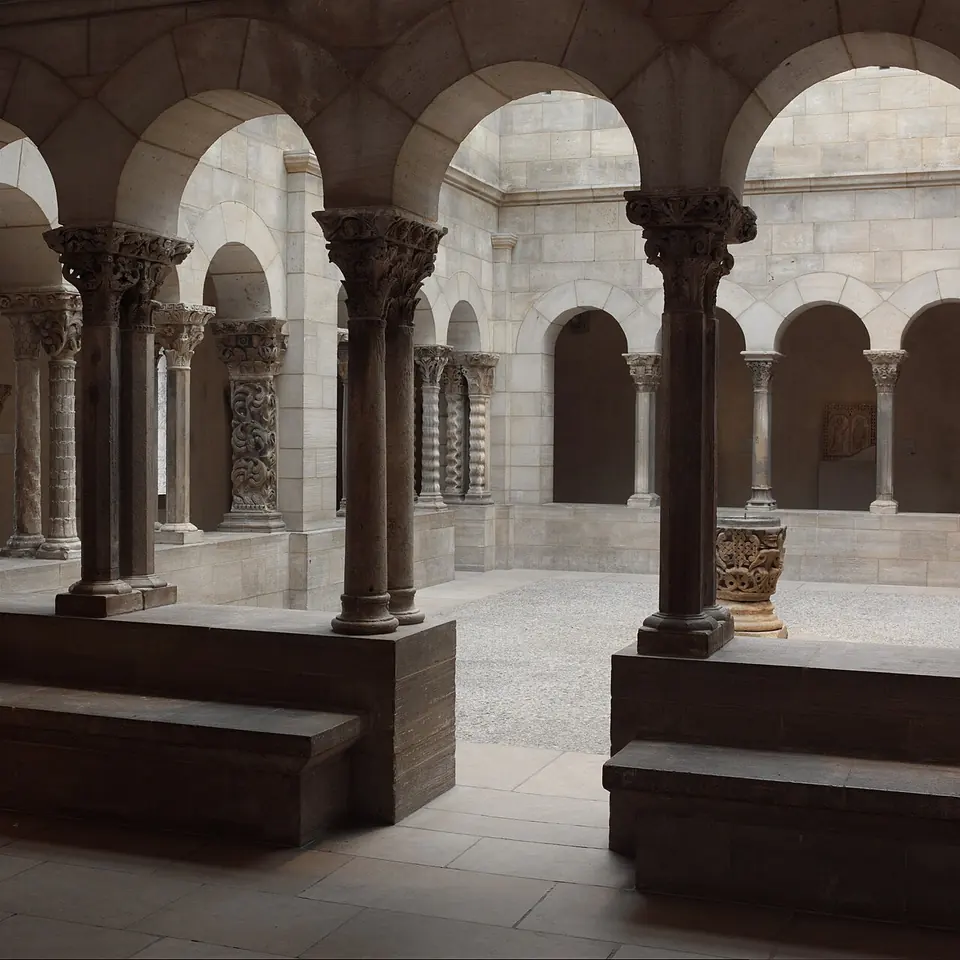
Much of the abbey's 12th-century cloister was taken apart during and after the French Revolution. Its carved columns and capitals were later bought by the American sculptor George G. Barnard and are now rebuilt as the Saint-Guilhem Cloister at The Met Cloisters in New York, where visitors can walk under arches William's monks once walked.
Where the relics of St. William of Gellone are kept: see them on the relics map →
Prayer to St. William of Gellone
No traditional English prayer to St. William of Gellone has come down to us in the standard prayer books. We keep his feast on May 28, and we may ask his prayers in our own words: for soldiers and for all who have exercised power, that they may lay it down humbly; for those who feel called late in life to give everything to God; and for the grace to do small, hidden work gladly.
Let us ask St. William of Gellone, who traded a count's sword for a monk's broom, to pray for us, that we may love the lowest place in the house of the Lord.
Frequently asked questions
Who was St. William of Gellone?
A Frankish nobleman related to Charlemagne, made Count of Toulouse in 790, who defended southern France against raids from Muslim Spain and helped take Barcelona in 801. In 804 he founded a Benedictine monastery at Gellone, near Lodève in Languedoc, and in 806 he entered it as a monk. He died there on May 28, about 812.
When is the feast day of St. William of Gellone?
May 28, the day he died, as the Catholic Encyclopedia gives it. The village of Saint-Guilhem-le-Désert, which grew up around his abbey, still bears his name.
Is St. William of Gellone the same as William of Orange?
Yes and no. The real Count William is the man behind Guillaume d'Orange, the hero of some two dozen medieval French epics (chansons de geste). The poems give him a short or hooked nose, a converted Saracen wife and battles with giants, almost all of it legend. He is not the Dutch William of Orange of the 16th century.
Is he the same as St. William of Aquitaine?
Sometimes, but be careful. William of Gellone held the title Duke of Aquitaine in some sources, so he is often called William of Aquitaine. Later artists and writers mixed his story with that of Duke William X of Aquitaine (died 1137) and of St. William of Maleval (died 1157). A Baroque painting of an armored penitent "William of Aquitaine" usually belongs to that later legend.
What relics are at Saint-Guilhem-le-Désert?
The abbey church keeps William's own relics in a 19th-century reliquary and a fragment of the True Cross that, by tradition, Charlemagne gave him for the monastery. The village still holds a feast of the Cross in May, when the relic is honored and small cross-shaped breads are blessed and shared.
Keep exploring
Sources
- Catholic Encyclopedia (1912): St. William of Gellone
- Ordericus Vitalis, The Ecclesiastical History of England and Normandy, trans. Thomas Forester, vol. 2 (1853), book VI, ch. 3: the story of St. William (archive.org). Orderic's 12th-century abridgment of the old Latin life of William
- Mairie de Saint-Guilhem-le-Désert: Les reliques de Guilhem et de la Vraie Croix
- Mairie de Saint-Guilhem-le-Désert: Les petits pains de croix
- Mairie de Saint-Guilhem-le-Désert: Guilhem de Gellone, une épopée carolingienne
- Vita sancti Willelmi, in Acta Sanctorum, May, vol. 6, pp. 154–172