St. William of Perth
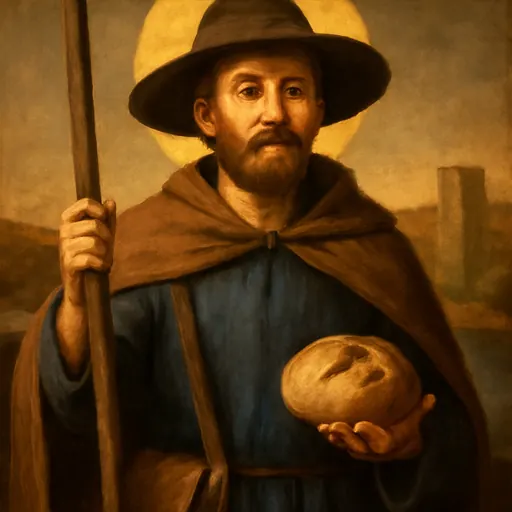
St. William of Perth was a baker from Perth in Scotland who gave every tenth loaf he baked to the poor and raised a foundling as his own son. On a pilgrimage in 1201 he was murdered on the road just past Rochester in Kent, and his tomb in Rochester Cathedral became one of the busiest pilgrim shrines in medieval England. We keep his feast on May 23.
Who was St. William of Perth?
St. William of Perth was a Scottish baker of the late twelfth century who lived his faith in the plainest way: with bread. He gave every tenth loaf he baked to the poor, took in an abandoned baby and raised him as a son, and went to Mass every day. In 1201 he set out on a pilgrimage and was murdered on the road just beyond Rochester in Kent. The monks of Rochester buried him in their cathedral, and his tomb became one of the great pilgrim shrines of medieval England.
Because his cult grew at Rochester, he is often called St. William of Rochester. We keep his feast on May 23.
Almost everything we know about him comes from one short Latin life, preserved in the Nova Legenda Anglie, the collection of English saints' lives printed in 1516 and edited by Carl Horstman in 1901. Horstman noted that no other life of William is known. It is a devotional text, written to honor a martyr, so we read it with gratitude and with care.
The baker of Perth
The life says William was born in Perth, "commonly called St. John's town," and that as a young man he lived carelessly, until he was suddenly "changed into another man." He disciplined himself, supported his small household by the baker's trade he had learned as a boy, and gave every tenth loaf to the poor, so that, as the writer puts it, he might one day be fed with the bread of angels. He was gentle with everyone, "a father to orphans, a defender of widows," and he went to church every day.

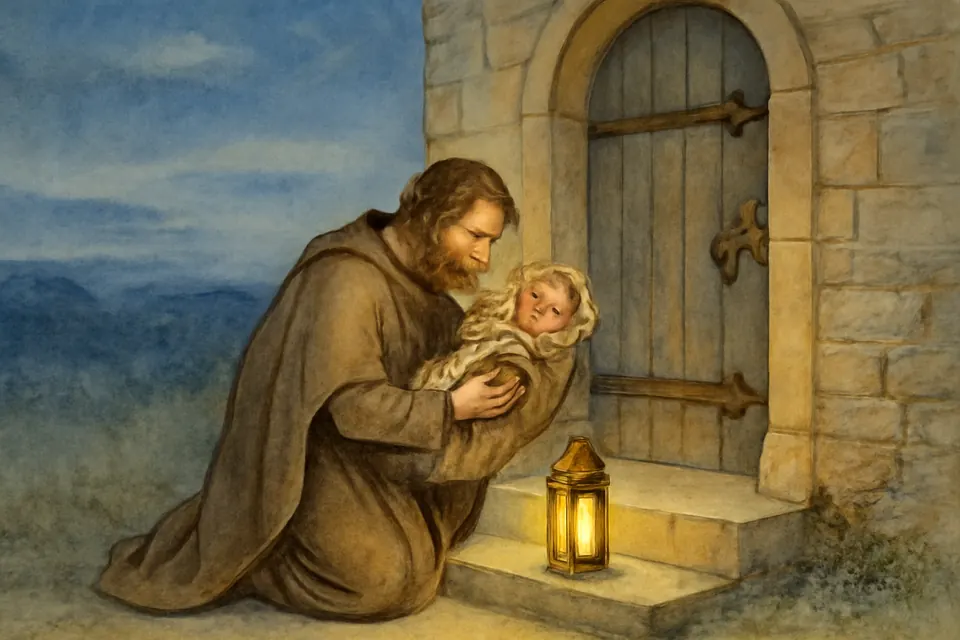
One morning, coming to the church door before it was light, he found a newborn baby crying on the step, wrapped in coarse rags. He picked the child up, gave him to a woman to nurse, and when the boy was older taught him the baker's trade. The life gives the boy's name in Gaelic as Cokermay Doueni, which it explains as "foundling David." William loved him as a father.
The pilgrimage and his death
William made a vow to visit the place of the Lord's Passion. He heard Mass, had his pilgrim's staff and scrip blessed, put his affairs in order and said goodbye to his neighbors. He took only one companion: the young man he had raised.
They traveled south through England by the king's highway and stayed three days at Rochester. When they left for Canterbury, the life says, the young man led William off the straight road at a fork, struck him on the back of the head with an axe, cut his throat and fled with his money. The writer compares William to a grain of wheat that falls into the ground and dies and bears much fruit.
That is the medieval account. Suzanne Hagedorn, who studies the saint at William & Mary, thinks a murder is likely but says no one really knows who did it. Later Protestant writers even accused the Rochester monks of arranging the killing; she finds that hard to believe.
The miracles of St. William of Perth
The life records one miracle, and it is a traditional account, not one examined by the Church.
A woman of the district, tormented by madness and, the life says, by a demon, came upon the body lying among the thorns. Talking nonsense to the dead man, she wove a crown of honeysuckle and set it on his head. The next day she came back, took the crown, now stained with his blood, and put it on her own head. At once her mind was restored. Ashamed, she hid in the bushes until evening, then said she knew God had sent his angel to free her through this martyr.
A later account claims that more miracles followed at his tomb, without describing them; these are reported favors. What is certain is that people came: worn steps, cathedral account books and the candles and alms of pilgrims show heavy traffic at the shrine.
A great medieval shrine
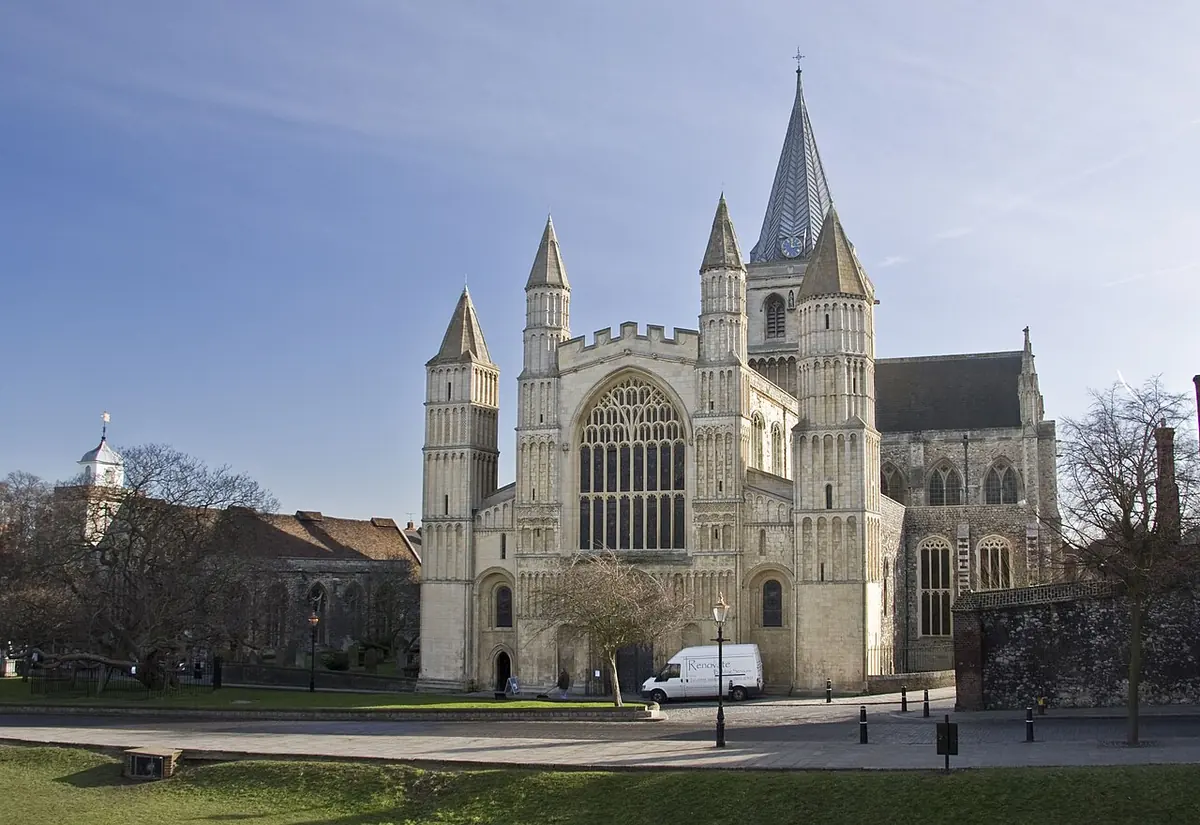
The monks carried William's body into Rochester Cathedral and buried him there. According to Hagedorn, the Bishop of Rochester obtained papal permission to honor him, and Pope Alexander IV is said to have canonized him in 1256, though how that came about is unclear. In the Middle Ages his shrine was one of the busiest in England, behind only St. Thomas Becket's at Canterbury and Our Lady's at Walsingham.
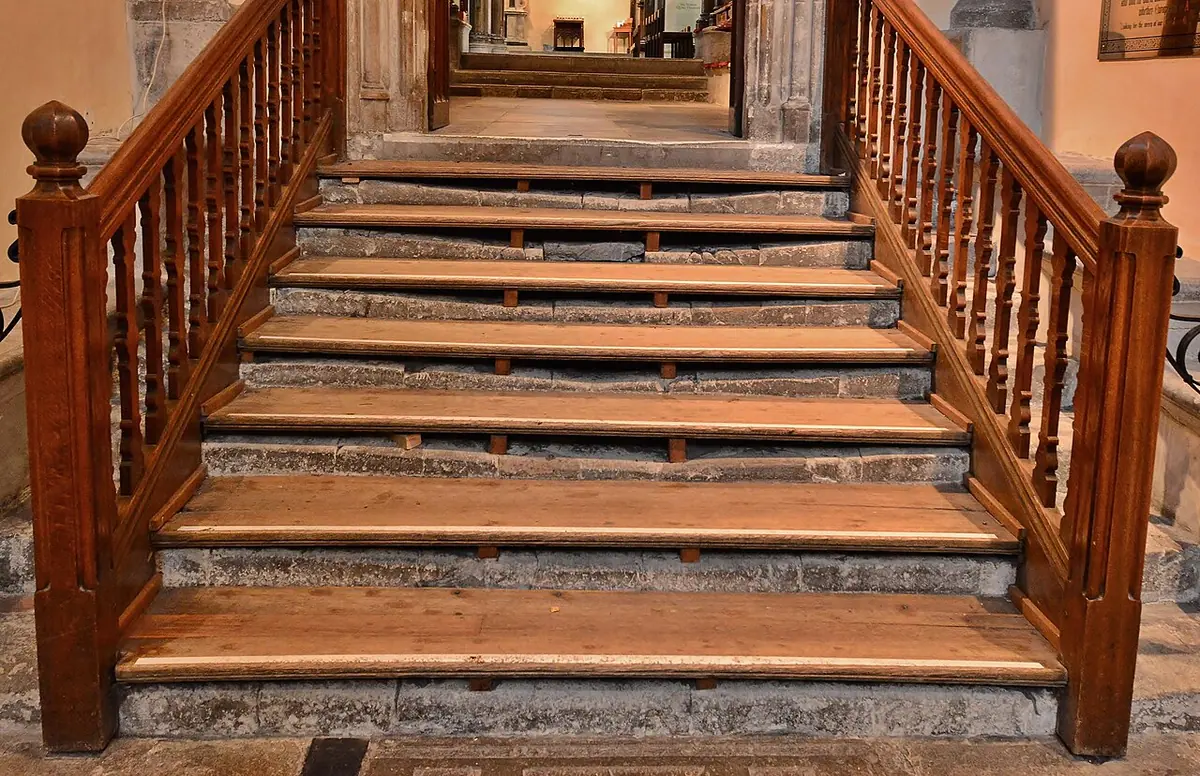
The shrine was destroyed at the Reformation. Nothing of it survives, though its site is marked. The stone steps that pilgrims climbed inside the cathedral, still called the Pilgrim Steps, are worn hollow by centuries of feet.
Symbols of St. William of Perth in art
Few images of him survived the Reformation, and most of what we see today is Victorian. The attributes are simple:
- Pilgrim's staff and scrip (satchel): he died a pilgrim. The scallop shell on his satchel in the Rochester window is the common badge of pilgrims.
- Pilgrim's hat: the broad-brimmed hat worn on the road.
- Loaves of bread: his trade and his tithe to the poor.
- Axe and martyr's palm: for the way he died and the honor of a martyr given to him at Rochester.
In the cathedral window at the top of this page he is a young man in blue with a halo and a yellow hat, staff in one hand and satchel in the other, with his name in Latin above him.
Feast day and where he is honored
We keep his feast on May 23, the day under which his life was printed in the Acta Sanctorum. It was always a local feast, centered on Rochester, and he is not on the General Roman Calendar. Rochester still remembers him: a road and a school in the city carry his name. See our feast days calendar for other saints.
Prayer to St. William of Perth
We have not found a traditional prayer to St. William that has come down from the Middle Ages. We can ask his intercession in our own words. Let us ask him to pray for bakers and all who feed others by their work, for adoptive parents and the children they raise, for pilgrims on the road, and for families wounded by betrayal. St. William of Perth, pray for us.
Frequently asked questions
Who was St. William of Perth?
A baker of Perth, Scotland, known for his charity to widows, orphans and the poor. He set out on pilgrimage with his adopted son and was killed near Rochester, Kent, in 1201. He was buried in Rochester Cathedral and honored there as a martyr.
Why is he called William of Rochester?
Because he died and was buried at Rochester, and his cult grew there rather than in Scotland. Medieval sources often call him by the place of his shrine.
Who killed St. William of Perth?
The only medieval life says his adopted son, a foundling he had raised, struck him with an axe for his money and fled. Modern historians such as Suzanne Hagedorn of William & Mary agree he was probably murdered but say we cannot know for certain who did it.
When is the feast of St. William of Perth?
May 23. The Bollandists printed his life under that day in the Acta Sanctorum. His feast was a local one at Rochester and is not on the General Roman Calendar.
Keep exploring
Sources
- Nova Legenda Anglie, ed. Carl Horstman, vol. 2 (Oxford, 1901), "De sancto Willelmo martire" (archive.org). The medieval Latin life: his birth at Perth, the tenth loaf, the foundling "Cokermay Doueni" (foundling David), the murder at a crossroads past Rochester and the honeysuckle crown; Horstman notes that no other life is known
- William & Mary News: "Forgotten saint sparks W&M professor's curiosity" (2019). Suzanne Hagedorn on the 1256 canonization, the popularity of the shrine and its destruction