St. Antoninus of Florence, Dominican Archbishop
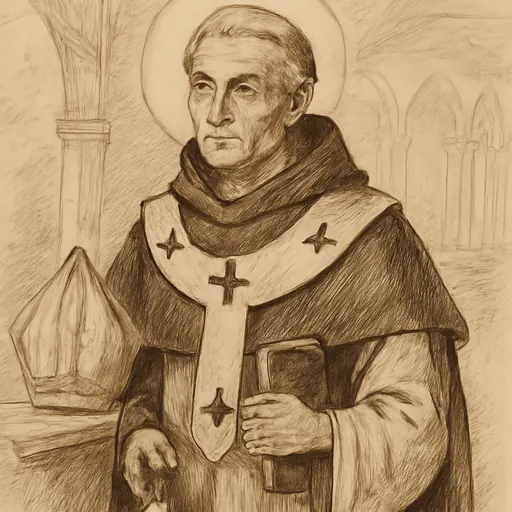
St. Antoninus of Florence (Antonino Pierozzi, 1389–1459) was a Dominican friar who founded the convent of San Marco and was made archbishop of Florence by Pope Eugene IV against his will. He gave away nearly everything he had, founded the Buonomini to help the hidden poor, and wrote a great Summa of moral theology. His feast is May 10.
Who was St. Antoninus of Florence?
St. Antoninus of Florence was a Dominican friar and archbishop of the fifteenth century, one of the holiest men of Renaissance Florence. Born Antonio Pierozzi on March 1, 1389, the son of a notary, he founded the convent of San Marco, served Popes Eugene IV, Nicholas V and Pius II, and governed the Church of Florence from 1446 until his death on May 2, 1459. We keep his feast on May 10.
He was a small, slight man, and the Florentines called him not Antonio but Antonino, "little Anthony." The Catholic Encyclopedia notes that his own manuscripts and even the bull of his canonization use the full name, but the people's affectionate form won out.

A friar with Fra Angelico
At fifteen he asked the reforming friar Blessed John Dominici to admit him to the Dominican Order. Dominici made him wait a year, then gave him the habit as the first novice of the new convent at Fiesole, above Florence. He made his novitiate at Cortona together with the young painter who became Blessed Fra Angelico.
His gift turned out to be governing. He was prior of Dominican houses in Cortona, Rome, Naples, Gaeta, Siena and Fiesole, and from 1433 to 1446 he led the reformed Tuscan Congregation of the order. In 1436 he founded the convent of San Marco in Florence, and with money from Cosimo de' Medici he rebuilt its church, which Pope Eugene IV attended at its consecration on the Epiphany of 1441. Fra Angelico painted the friars' cells. In 1439 Antoninus served as a theologian at the Council of Florence.
Archbishop against his will
Eugene IV knew him well and decided to make him archbishop of Florence. According to the Buonomini of San Martino, when the little friar heard the news he ran off to the Maremma, the wild coast of southern Tuscany, to hide; but he had to come back and take up the burden. He was consecrated at Fiesole on March 13, 1446.
As archbishop he kept the Dominican rule and lived poorly. He visited his parishes and religious houses, corrected abuses, preached, wrote for clergy and lay people and looked after the poor. Florence sent him as ambassador to the pope in 1455 and 1458. He attended Eugene IV on his deathbed, Nicholas V often asked his advice, and Pius II put him on a commission of cardinals to reform the Roman Curia.
The Buonomini and the shamefaced poor
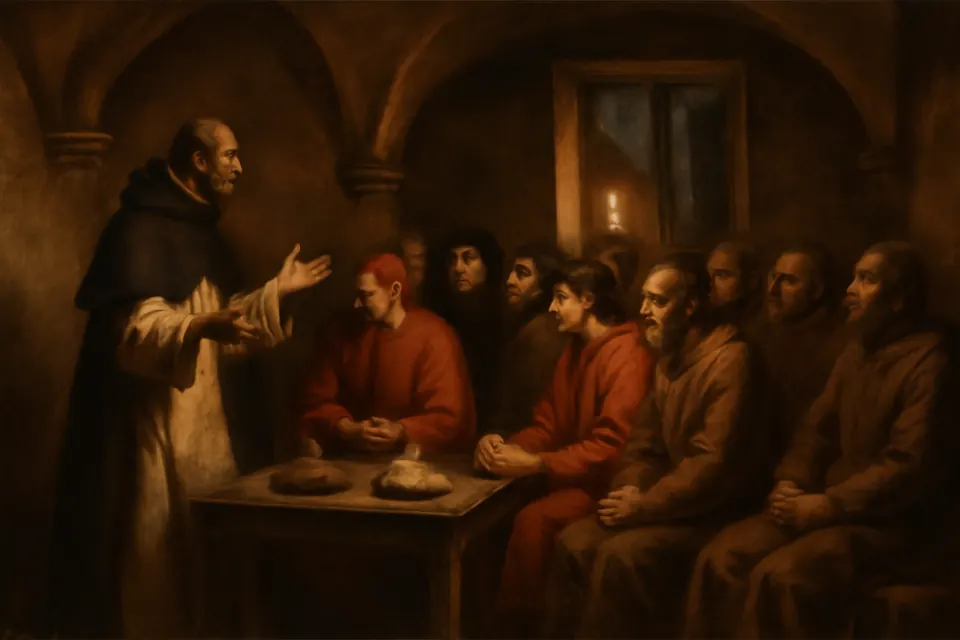
In his day many respectable Florentine families, merchants and craftsmen, had been ruined and were too proud to beg. They were called the poveri vergognosi, the "shamefaced poor." In 1441 Antoninus gathered twelve citizens, two from each district of the city, chosen from different social ranks, and made them Procurators of the Shamefaced Poor. Their rule was simple: collect from those who can give, and give everything away in complete secrecy.
The Buonomini ("good men") of San Martino still meet every week in Florence. When their funds run out, they light a candle in the window of their meeting place, and the city hears that the Buonomini are "down to the last candle" and gives again.
The miracles of St. Antoninus
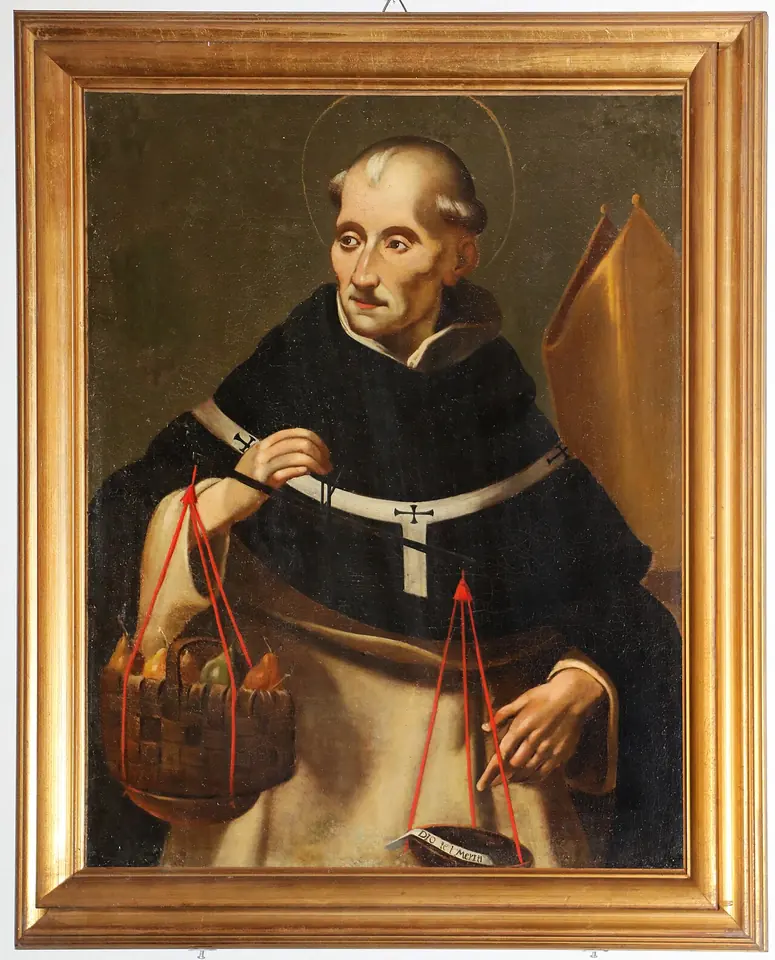
- Traditional: the miracle of the scales. A painting at Sant'Angelo a Lecore near Florence shows him weighing a basket of fruit given to him as a gift against a slip of paper with the words Dio te 'l meriti, "May God reward you." The pan with the blessing hangs lower than the fruit.
- Traditional: Bernardino Poccetti's fresco in the cloister of San Marco shows the canon Boninsegna Machiavelli saved from drowning in the river Sieve through Antoninus's prayer.
These stories come from the Florentine tradition about him and from the paintings that keep it. We have not found the record of the miracles examined for his canonization, so we do not label any as approved.
His writings
The Catholic Encyclopedia calls his Summa Theologica Moralis a "new and very considerable development in moral theology." First printed at Venice in 1477, it went through fifteen editions in fifty years. His shorter guides for confessors were printed again and again, and he also wrote a world chronicle letters, and treatises on the Christian life for women of the Medici family.

Symbols of St. Antoninus in art
- Dominican habit with the pallium: a friar in white and black wearing the archbishop's woolen pallium.
- Miter set aside: painters often place his miter beside him rather than on his head, a sign of the honor he tried to refuse.
- Alms and the poor: as in Lotto's altarpiece, where his clerics hand out money and bread.
- Scales: the weighing of the gift of fruit.
- A book: his Summa and his teaching.
A slight, beardless Dominican with a pallium and a miter near him is almost certainly Antoninus. Look for him especially in Florence and in Dominican churches.

His death and his tomb
Antoninus died on May 2, 1459. Pope Pius II gave instructions for his funeral and presided at it. He was buried at San Marco, the convent he had founded, and was canonized by Pope Adrian VI on May 31, 1523. His body now rests in a glass shrine under the altar of the chapel of St. Antoninus in the church of San Marco. See the feast day calendar.

Prayer to St. Antoninus
We have not found a traditional prayer to St. Antoninus with a source we can cite, so we offer none in his name. Let us ask his intercession in our own words: St. Antoninus, friend of the hidden poor, pray for bishops and confessors, and for every family too proud to ask for help.
Frequently asked questions
Who was St. Antoninus of Florence?
A Florentine Dominican, born in 1389, who entered the order at sixteen, reformed its convents, founded San Marco in Florence and became archbishop of the city in 1446. He was known for his poverty, his care for the poor and his writings on moral theology. He died in 1459 and was canonized in 1523.
When is the feast of St. Antoninus?
May 10, the date kept on the General Roman Calendar from 1683 to 1969 and still widely used. The current Roman Martyrology remembers him on May 2, the day he died.
Why is he called Antoninus?
His name was Antonio (Anthony). The Florentines, who loved him, called him by the diminutive Antonino, "little Anthony," and that is the name that stuck. He was a small, slight man.
Where is St. Antoninus buried?
In the church of San Marco in Florence, the convent he founded, in the chapel built in his honor. His body lies in a glass shrine under the altar.
Keep exploring
Sources
- Catholic Encyclopedia (1907): St. Antoninus. His dates, the origin of his name, his training with Fra Angelico, San Marco, his consecration in 1446, his embassies, his writings and his canonization by Adrian VI
- Buonomini di San Martino: Storia (in Italian). The founding of the Buonomini for the "shamefaced poor," their rule of secrecy, the candle in the window, and his flight when the pope wanted to make him bishop
- Roman Martyrology, May 10 (1916 English edition). His old commemoration on May 10