St. Dunstan of Canterbury

St. Dunstan (died 988) was abbot of Glastonbury and Archbishop of Canterbury, the monk who led the revival of Benedictine life in England and advised a line of English kings. He was also a skilled metalworker, scribe and harpist, which is why legend has him seize the devil by the nose with a smith's tongs. His feast day is May 19, and he is the patron saint of goldsmiths, jewelers and metalworkers.
Who was St. Dunstan?
St. Dunstan was the most important churchman of 10th-century England. He was abbot of Glastonbury, bishop of Worcester and of London, and from 959 until his death in 988 Archbishop of Canterbury. With his fellow monks St. Æthelwold and St. Oswald he brought the Rule of St. Benedict back to an England where monastic life had nearly died out under the Viking raids. He advised one king after another, crowned King Edgar at Bath in 973, and spent his last years teaching boys in the cathedral school at Canterbury.
He was also a craftsman. His biographers say he worked in metal, made bells and organs, copied and corrected books, drew, and played the harp. The Catholic Encyclopedia calls him "one of the greatest saints of the Anglo-Saxon Church," and until St. Thomas Becket eclipsed him, he was the favorite saint of the English people.
The oldest life of Dunstan was written around the year 1000 by a cleric who knew him and signed himself only "B." Later lives by Osbern and Eadmer of Canterbury, about a century on, added many of the legends. The historian William Stubbs gathered them all in his Memorials of Saint Dunstan (1874).
The life of St. Dunstan
A boy of Glastonbury
Dunstan was born near Glastonbury in Somerset, on the estate of his father Heorstan, a West Saxon noble. The year is disputed: Osbern says 924 or 925, but the Catholic Encyclopedia argues for the first years of the 10th century, and about 909 is often given. Tradition says his mother Cynethryth was in church on Candlemas when every candle suddenly went out, and then hers alone relit, and everyone lit theirs from it. That story is traditional.
Irish scholars taught him at Glastonbury. He became a favorite at the court of King Æthelstan, which made enemies. Courtiers accused him of studying pagan poetry and magic, beat him, and threw him into a filthy pit. He crawled out and went to his kinsman Ælfheah, Bishop of Winchester, who urged him to become a monk. Dunstan hesitated until a severe illness, perhaps blood poisoning from the beating, changed his mind.
The hermit-craftsman's cell
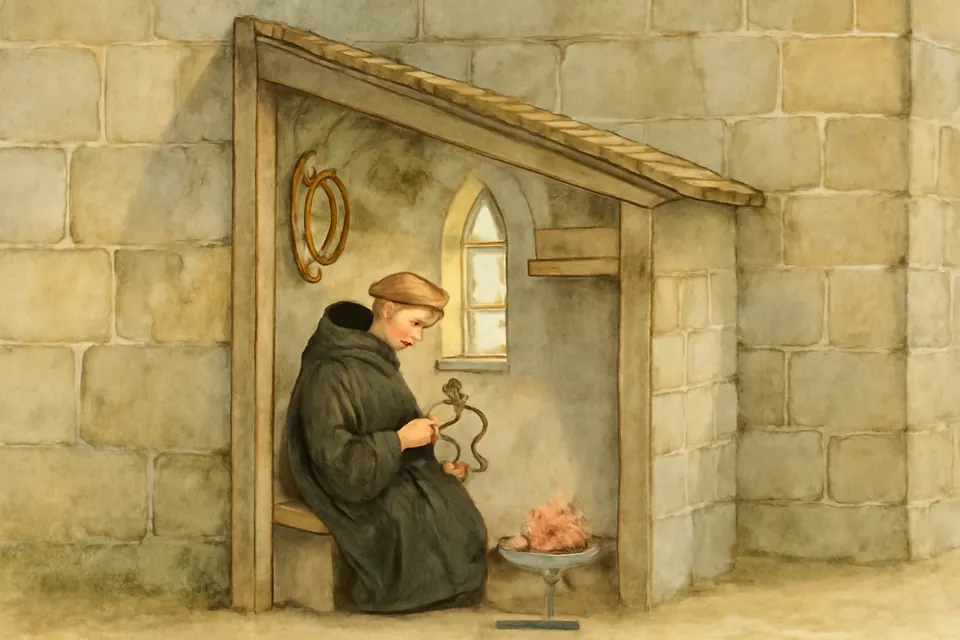
Back at Glastonbury he built himself a cell against the old church of St. Mary, only five feet long and two and a half feet deep. There he prayed, studied, worked at his crafts and played his harp.
Abbot of Glastonbury
King Edmund, who took the throne in 940, called Dunstan to his council and then, listening to jealous courtiers, sent him away. A few days later the king went hunting near Cheddar. The stag he was chasing ran over the edge of the gorge and the hounds followed it. Unable to stop his horse, Edmund remembered how he had treated Dunstan and promised to make amends if his life was spared. The horse stopped at the very edge. The king rode straight to Glastonbury, gave Dunstan the kiss of peace, and seated him on the abbot's throne.

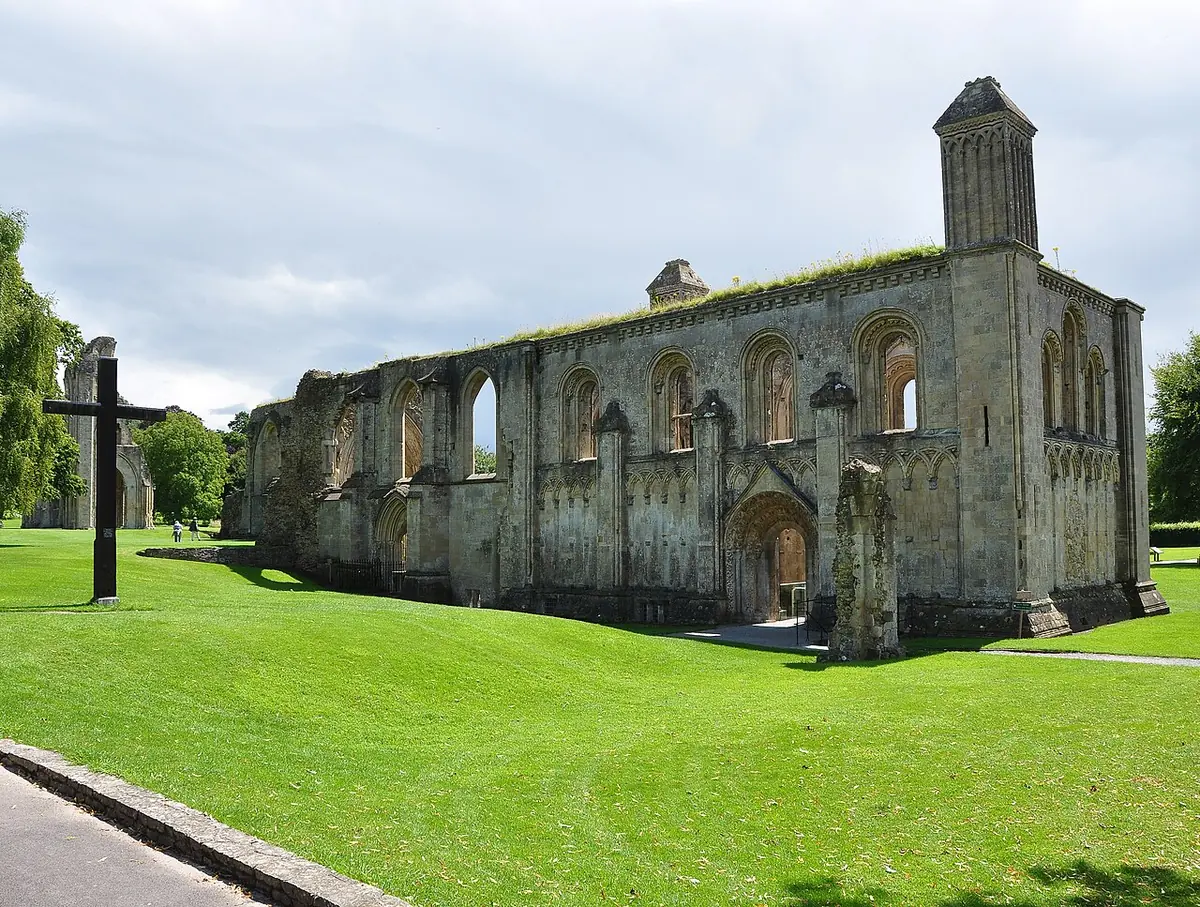
Dunstan rebuilt the abbey, restored the enclosure and the life of the Rule, and opened a school that became the most famous in England. Under King Eadred he kept the royal treasure and twice refused a bishopric.
Exile and return
In 956 the young King Eadwig walked out of his own coronation feast to spend the evening with two women. Dunstan went and brought him back, setting the crown on his head again. Dunstan's property was seized, and he fled to Flanders, where Count Arnulf lodged him at the abbey of Mont Blandin near Ghent. There, for the first time, he saw the strict Benedictine life that had been reborn on the continent.
His exile was short. In 957 the Mercians and Northumbrians chose Eadwig's brother Edgar as king, and Edgar recalled Dunstan and made him bishop of Worcester, then of London. When Edgar became king of all England in 959, he named Dunstan Archbishop of Canterbury. He received the pallium from Pope John XII in Rome in 960.
Archbishop and reformer
For sixteen years, with King Edgar's support and with Oswald at Worcester and Æthelwold at Winchester, Dunstan reformed the English Church. Monasteries were refounded. Parish priests were held to celibacy and to teaching their people the faith and useful trades. The Regularis Concordia, the common rule for English monks and nuns agreed at Winchester in these years, came out of this reform.
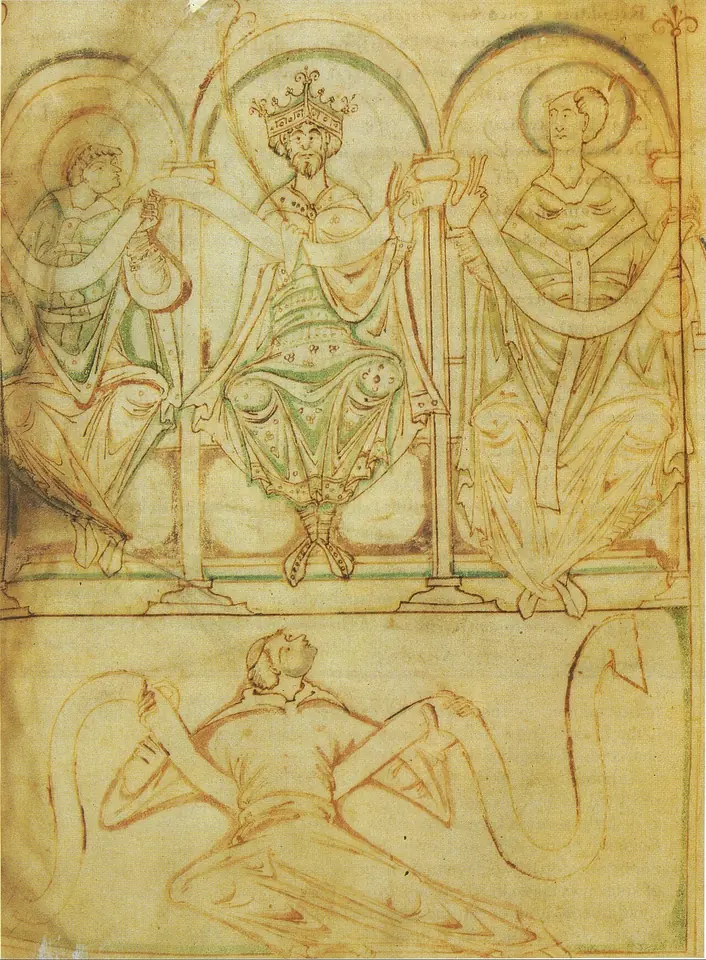
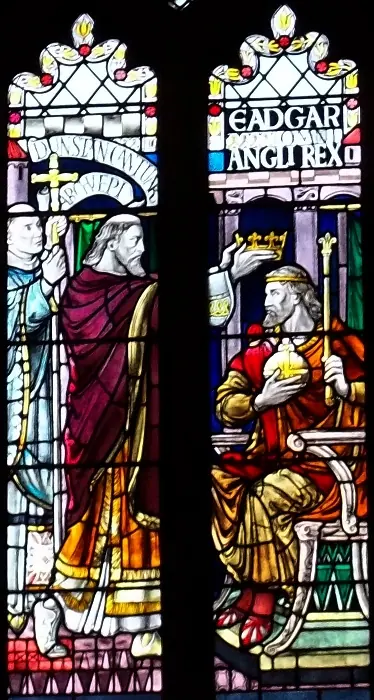
In 973 Dunstan crowned Edgar with great solemnity at Bath. In 978, after Edgar's son Edward was murdered at Corfe, he crowned the boy Æthelred with a stern warning about the crime that had made him king.
His last years at Canterbury
Dunstan then withdrew to Canterbury. He prayed for long hours and often visited the shrines of St. Augustine and St. Æthelbert. He built churches, made bells and organs, corrected the cathedral's books and defended widows and orphans. His first biographer shows the old man sitting among the boys of the cathedral school, telling them stories of his youth.
On Ascension Day 988 he preached three times at Mass and told the people he would soon die. He chose the place of his grave and went to bed. On Saturday, May 19, he received the last sacraments and died with words from Psalm 111 on his lips:
He hath made a remembrance of his wonderful works, being a merciful and gracious Lord: He hath given food to them that fear Him.
The miracles and legends of St. Dunstan
The stories about Dunstan grew over the century after his death. We sort them by our labels:
- The candle relit at Candlemas (traditional), from the early lives.
- The harp that played by itself (reported). His first biographer, B., tells how Dunstan's harp, hanging on the wall while he designed a stole for a noblewoman, began to play the antiphon "Gaudent in caelis" ("the souls of the saints rejoice in heaven") with no one touching it.
- King Edmund saved at Cheddar (reported) in the early lives as an answer to the king's prayer.
- The collapse at Calne (reported). In 978 the upper floor where the king's council met gave way, and everyone fell except Dunstan, who held on to a beam. This is history; the miraculous reading of it is the biographers'.
- The devil and the tongs and the horseshoe (traditional), described below.
The devil and the tongs
Osbern of Canterbury, writing in the late 11th century, tells how the devil came to Dunstan's cell at Glastonbury and tried to tempt him with idle and impure talk. Dunstan said nothing, quietly heated his iron tongs in the fire until they glowed, then seized the tempter by the face. The devil tore free and fled into the night howling, Osbern says, "O quid fecit calvus iste!" ("Oh, what has this bald man done!"). In the morning Dunstan told the neighbors who had heard the noise that it was the devil.
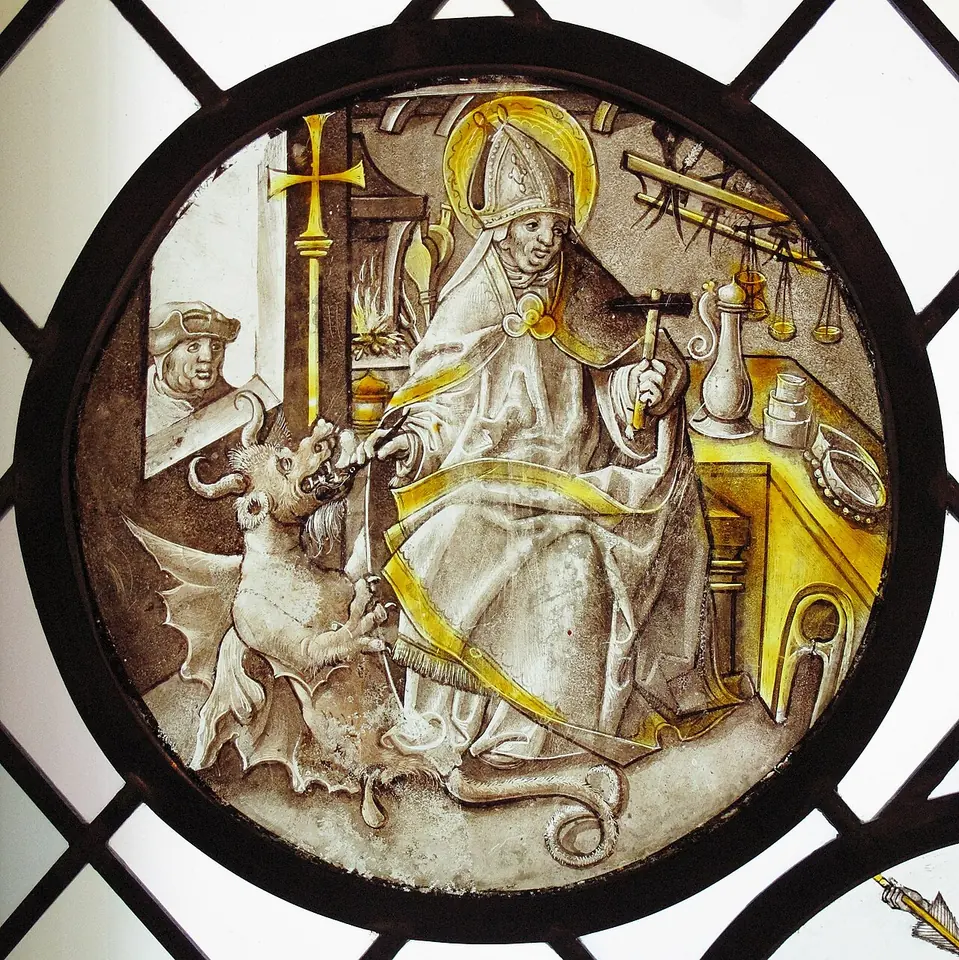
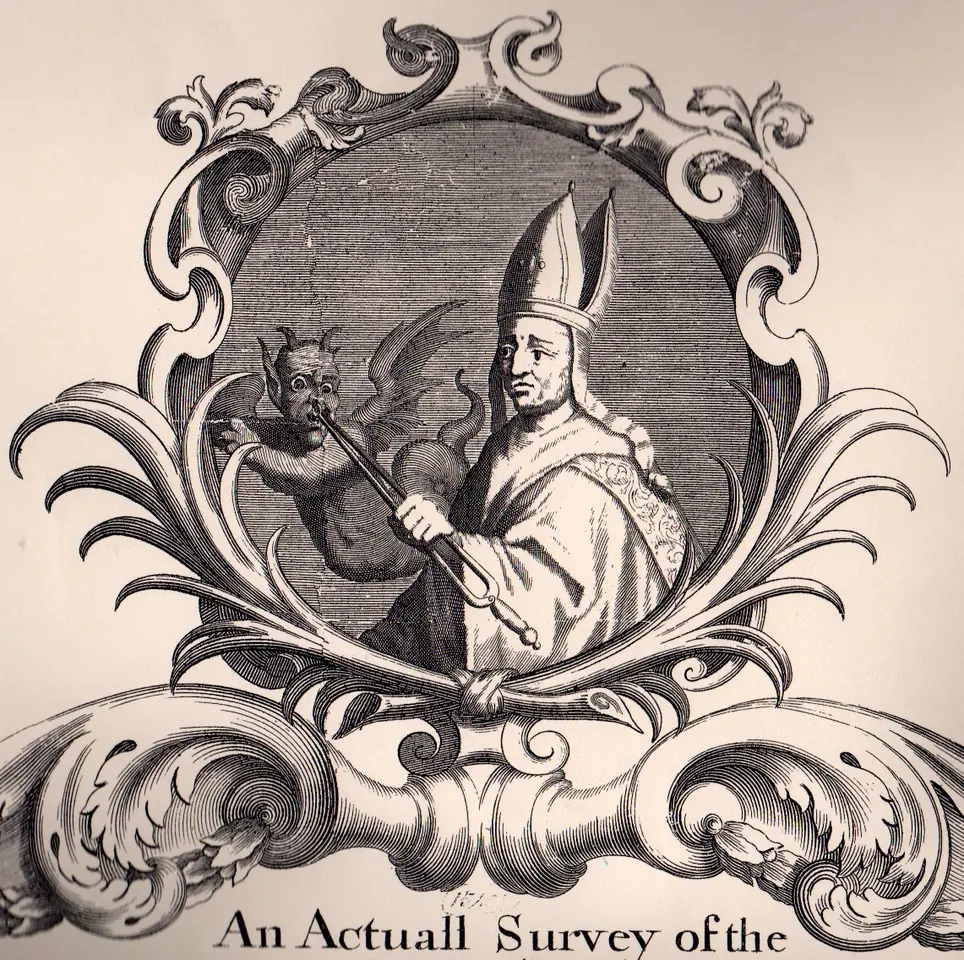
In later tellings the devil comes disguised as a beautiful woman, and the tongs catch him by the nose. Local tradition at Mayfield in Sussex, where the archbishops later had a palace and the parish church is dedicated to Dunstan, claims the story for itself. We read it as a picture of what St. James asks of us: resist the devil, and he will flee from you.
The horseshoe
A later English folk tale has the devil come to Dunstan the blacksmith asking to have his hoof shod. Dunstan nails the shoe on so painfully that the devil begs for mercy and swears never to enter a house with a horseshoe over its door. Victorian readers knew it from Edward G. Flight's comic poem The Horse Shoe: The True Legend of St. Dunstan and the Devil, illustrated by George Cruikshank and in its third edition by 1871. It is a folk tale, traditional in the loosest sense, and we know of no medieval source for it.
Why St. Dunstan is the patron saint of goldsmiths
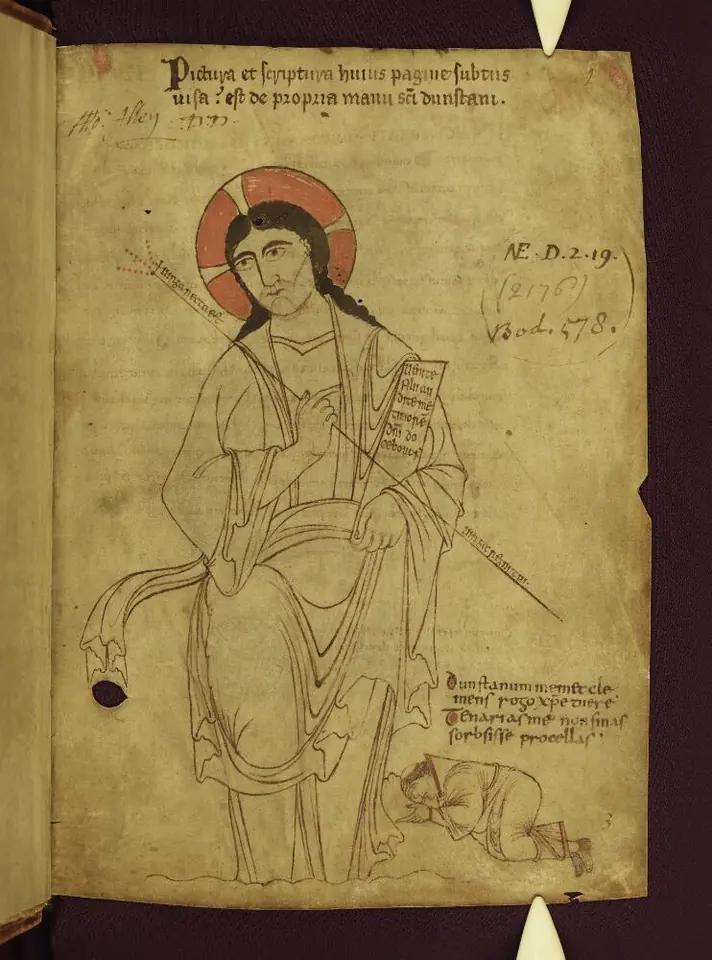
Dunstan was a real craftsman, and the Classbook drawing may be his own. Through the Middle Ages the goldsmiths' guild took him as its patron. William Hone's Every-Day Book describes how the Goldsmiths' Company of London paid for a Lord Mayor's Day pageant in 1687 in which Dunstan sat on a golden chair as their patron, holding a pair of goldsmith's tongs, and caught the devil by the nose. Jewelers, locksmiths, blacksmiths and other metalworkers have claimed him too. See more on our patron saints page, and his fellow craftsman-bishop St. Eligius.
Symbols of St. Dunstan in art
Dunstan is shown as an archbishop with miter, crozier and the white pallium. To tell him from other bishops, look for:
- Smith's tongs: his main attribute, for his metalwork and the devil legend. Often the devil is caught in them by the nose or lip.
- The devil: a horned, winged demon twisting at his side, as in the Met's glass roundel and Gascoyne's map.
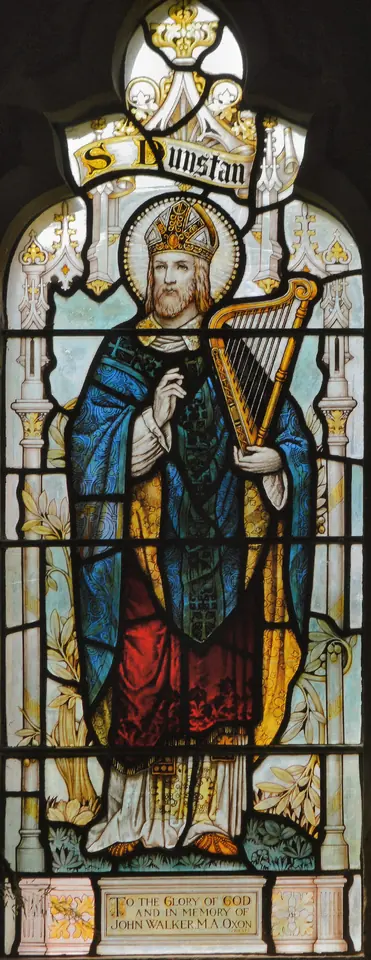
- A harp: for his music and the harp that played by itself, as in the window at Berwick in Sussex.
- A dove or a choir of angels: for his visions, according to the Catholic Encyclopedia.
Feast day and where St. Dunstan is honored
We keep St. Dunstan's feast on May 19, the day he died. The Synod of Winchester ordered it kept throughout England in 1029, and the Catholic Church in England has it on her national calendar. Find his neighbors on our feast days page, including St. Celestine V, who shares the day.
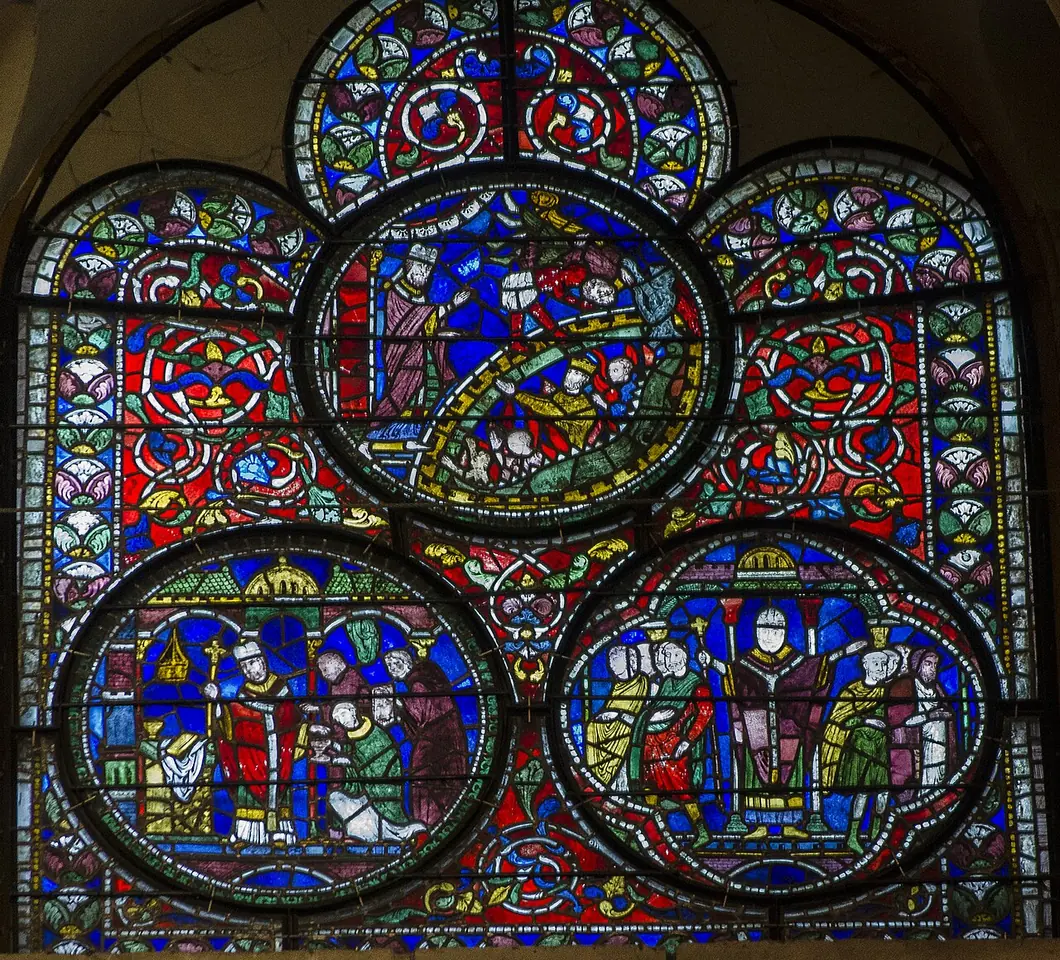
He was buried in Canterbury Cathedral. After the old cathedral burned, Archbishop Lanfranc translated his relics to a new tomb on the south side of the high altar. The monks of Glastonbury later claimed that his body had been carried to them for safety when the Danes sacked Canterbury in 1012. Archbishop Warham settled the question in 1508 by opening the tomb at Canterbury and finding the relics there. The shrine was destroyed at the Reformation, but Canterbury's medieval glass still tells his story.
Prayer to St. Dunstan
The prayer most closely tied to Dunstan is the one written above the kneeling monk in his Classbook, which the British Library judges to be in his own hand. In its translation:
Merciful Christ, I ask you to defend me, Dunstan, That you may not permit the storms of Taenarus to swallow me.
Taenarus was the legendary gate of the underworld; the prayer asks Christ to keep him from hell. We can make it our own, asking St. Dunstan to pray that we too resist every temptation and come safely home. Let us ask his help for craftsmen and artists, for teachers and their students, and for all who serve the Church in hard times. St. Dunstan, pray for us.
Frequently asked questions
What is the legend of St. Dunstan and the devil?
The story says that while Dunstan was working at his forge in his cell at Glastonbury, the devil came to tempt him. Dunstan heated his tongs in the fire and grabbed the devil by the face, and the devil fled howling into the night. It first appears in Osbern of Canterbury's life of Dunstan, written about a century after his death, and is traditional, not history.
What does St. Dunstan have to do with horseshoes?
An English folk tale says the devil asked Dunstan, a blacksmith, to shoe his hoof, and Dunstan nailed the shoe on so painfully that the devil promised never to enter a house with a horseshoe over the door. It is a traditional folk tale, best known from Victorian retellings such as Edward G. Flight's comic poem The Horse Shoe (third edition 1871). We know of no medieval source for it.
Why is St. Dunstan the patron saint of goldsmiths?
His biographers describe him as a skilled craftsman in metal who made bells, organs and church vessels. Throughout the Middle Ages he was the patron of the goldsmiths' guild, and the Goldsmiths' Company of London honored him as its patron. Jewelers, locksmiths and other metalworkers claim him too.
When is St. Dunstan's feast day?
May 19, the day he died in 988. The Synod of Winchester in 1029 ordered his feast kept solemnly throughout England, and the Catholic Church in England still keeps it on that day.
Where is St. Dunstan buried?
In Canterbury Cathedral. After a fire destroyed the old cathedral, Archbishop Lanfranc moved his relics to a tomb beside the high altar, and Archbishop Warham opened the tomb and found them in 1508. His shrine was destroyed at the Reformation. The monks of Glastonbury once claimed to have his body, but the claim was rejected.
Sources
- Catholic Encyclopedia (1909): St. Dunstan
- William Stubbs, ed., Memorials of Saint Dunstan, Archbishop of Canterbury (Rolls Series, 1874), with the early lives by B. and Osbern
- British Library, Medieval Manuscripts Blog: An Anglo-Saxon 'Renaissance Man': St Dunstan (2016)
- William Hone, The Every-Day Book (1826–27), May 19: St. Dunstan
- Edward G. Flight, The Horse Shoe: The True Legend of St. Dunstan and the Devil (3rd ed., 1871; Project Gutenberg)