St. Theodotus of Ancyra, Innkeeper and Martyr

St. Theodotus of Ancyra was a married Christian innkeeper of Ancyra in Galatia (today Ankara, Turkey) who, during Diocletian's persecution about 303, turned his inn into a refuge, bought pure food for Christians, and buried the bodies of martyrs. He recovered the bodies of seven elderly virgins drowned in a lake and was beheaded for it. We keep his feast on May 18, and he is the patron of innkeepers.
Who was St. Theodotus of Ancyra?
St. Theodotus of Ancyra was a married Christian innkeeper who lived in Ancyra, the capital of the Roman province of Galatia, today Ankara in Turkey. When the Great Persecution under Diocletian reached his city about 303, he turned his business into a lifeline. His inn fed Christians who would not eat food offered to idols, sheltered the sick, and became a church when the churches were shut. He buried the martyrs when burial was forbidden. In the end he was beheaded for rescuing the bodies of seven old women who had died for Christ.
The Catholic Encyclopedia names him the patron of innkeepers. We honor him on May 18 together with those seven virgin martyrs.

The story of St. Theodotus
His Acts claim to be written by a man named Nilus who said he saw much of what he describes. Butler retells them at length, and we follow him here.
The Christian innkeeper
Theodotus had been raised in the faith by a consecrated virgin named Thecusa, who was, the Orthodox life says, his aunt. He married, kept an inn and sold wine. Butler, who did not think highly of the trade, says that Theodotus was "just, abstemious, and zealous," and that he converted drunkards to temperance. His Acts credit him with healing the sick by prayer and the laying on of hands, which is traditional.
A refuge in the persecution
The governor Theotecnus, eager to please the emperor, came to Ancyra to wipe out the Christians. Many fled to the mountains. He ordered that every food sold in the market first be offered to the idols, so that Christians would starve or be defiled.
Theodotus had laid in a large store of grain and wine and sold it to Christians at cost. "Thus," Butler writes, "the altars were furnished with pure oblations." His inn became, in Butler's words, "the place of divine worship, an hospital for the sick and strangers, and the only refuge of the Christians in that town." The Orthodox life says the Divine Liturgy was celebrated there when the churches were destroyed.
The priest, the ring and the relics
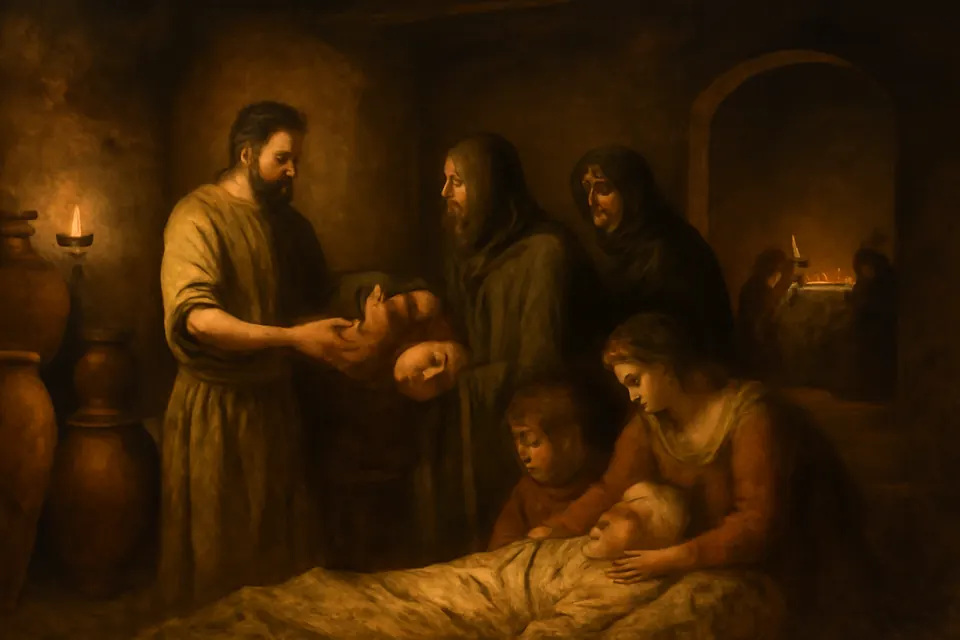
Out on an errand of mercy, Theodotus recovered the remains of a martyr named Valens near the village of Malos, a few miles from Ancyra. He ate there with the village priest, Fronto, and told him the place would make a fine shrine for relics. When Fronto said they would need relics first, Theodotus gave him his ring as a pledge and promised that relics would come.
The seven virgins
Back in Ancyra seven elderly women, consecrated virgins, had been arrested: Thecusa, Alexandra, Claudia, Euphrasia, Matrona, Julitta and Phaina. The governor handed them over to young men to be abused. Thecusa, who was over seventy, threw herself at one young man's feet, pulled back her veil to show her gray hair, and asked him to think of his own mother. The young men left them alone in tears.
The governor then ordered the women to serve as priestesses of Diana and Minerva. They refused, and he had them drowned in a pond with stones tied to them, and set guards so that no one could take their bodies.
The night by the water
Thecusa appeared to Theodotus in a dream and begged him not to leave their bodies to the fish. She warned him to beware of a traitor. On a dark, stormy night he and his friends set out. A light in the shape of a cross guided them, and the Acts say the martyr Sosander appeared in armor and frightened the guards away. The wind drove back the water, and they carried the seven bodies to a church and buried them. These wonders are traditional.

Betrayal and death
One of his companions, Polychronius, was caught and under torture told everything. Theodotus would not let others suffer in his place. He gave himself up, refused the governor's offer of a priesthood of Apollo, and was tortured on the rack, with iron hooks and with fire. Through it, Butler writes, he told the people that it was "but reasonable" to offer such sacrifices to Christ "who was pleased to set us the example, and submit to be sacrificed for us." He was beheaded.
The governor ordered the body burned, but, the Acts say, a light surrounded it and no one dared go near. That evening Fronto arrived from Malos with a donkey loaded with wine. He shared his wine with the guards, and when they had fallen into a deep sleep he put the ring back on the martyr's finger, and laid the body on the donkey, which carried it home to Malos. A chapel rose over the grave.
History and legend
Butler called these Acts authentic. In 1901 Pio Franchi de' Cavalieri published a critical edition and at first judged them trustworthy, then changed his mind. The Bollandist Hippolyte Delehaye went further. The Catholic Encyclopedia quotes his verdict: "The kernel of the legend is a tale narrated by Herodotus, while the existence of the hero of the narrative is not vouched for by any historic document." The episode of the guards, the wine and the donkey recalls a tale in Herodotus, the treasure of King Rhampsinitus, in which a thief gets the guards drunk on wine from his donkeys to steal back his brother's body.
The Church keeps his memory on the Roman Martyrology and in every Byzantine calendar. We can honor the innkeeper who fed the hungry and buried the dead while reading the details of his story as the legend it is.
Why St. Theodotus is the patron saint of innkeepers
He kept an inn and used it as a work of mercy: food for the hungry, shelter for strangers, care for the sick, and a home for the Mass. The Catholic Encyclopedia lists him as the patron of innkeepers. See more on our patron saints page.
Symbols of St. Theodotus in art
- Torches: the Catholic Encyclopedia gives torches as his emblem, from the burning of his flesh and the night by the water.
- Sword: the instrument of his beheading.
- Wine jar or cup: his trade, in some Western images.
- Cross: in Orthodox icons he is shown as a martyr in tunic and cloak, holding a cross.
His feast day
We keep his feast on May 18, with the seven virgins, as the Roman Martyrology and the Orthodox Church both do. The Byzantine calendars add a second feast on June 7; the OCA lists that day under the title "Hieromartyr Theodotus, Bishop of Ancyra," though its own text tells the innkeeper's story. A real bishop named Theodotus of Ancyra lived in the fifth century and wrote against Nestorius; he is a different man. See more on our feast days page.
Prayer to St. Theodotus
The Orthodox Church in America gives this kontakion (tone 2) for May 18:
You struggled well, O Theodotus, / together with your fellow athletes and the passion-bearing virgins. / You have all received crowns of honor. / Therefore, unceasingly pray to Christ God for us all.
Let us ask St. Theodotus to pray for innkeepers, cooks and all who feed and shelter others, and for Christians who risk their safety to care for the persecuted.
Frequently asked questions
Who was St. Theodotus of Ancyra?
A married innkeeper and wine seller of Ancyra, the capital of Roman Galatia, who sheltered and fed Christians during the Great Persecution and gave the martyrs Christian burial. He was arrested, tortured and beheaded about 303.
Why is St. Theodotus the patron saint of innkeepers?
Because he was one. The Catholic Encyclopedia names him the patron of innkeepers, since he used his inn to feed the persecuted, shelter the sick and host the Eucharist when the churches were closed.
When is the feast of St. Theodotus of Ancyra?
May 18, with the seven virgin martyrs of Ancyra, in the Roman Martyrology and the Orthodox calendar. Byzantine calendars give him a second feast on June 7.
Is the story of St. Theodotus historical?
His Acts claim to be written by an eyewitness named Nilus, and Ruinart counted them among the genuine Acts of the martyrs. The Bollandist Hippolyte Delehaye later argued that the core of the tale is borrowed from Herodotus. The Church keeps his memory, but the details of the story are best read as legend.
Keep exploring
Sources
- St. Theodotus of Ancyra, Catholic Encyclopedia (1912). His patronage of innkeepers, his emblems, the second feast on June 7, the Acts by Nilus, Ruinart, Franchi and Delehaye's judgment
- Alban Butler, The Lives of the Fathers, Martyrs, and Other Principal Saints, vol. 5 (May), 1842 edition. May 18: the full story from the Acts, including Victor, the martyr Valens, the priest Fronto and the ring, Thecusa's words and the night at the pond
- Martyr Theodotus of Ancyra and the Seven Virgin Martyrs, Orthodox Church in America. The Orthodox life: the inn used for the Liturgy, the seven virgins' names, the dream of Thecusa and the betrayal by Polychronius
- Martyr Theodotus of Ancyra and the Seven Virgin Martyrs, Troparion and Kontakion, Orthodox Church in America. Text of the kontakion quoted on this page